中国制造业龙头全球化

Search documents
国庆节后A股行情如何演绎?券商热议日历效应
Nan Fang Du Shi Bao· 2025-09-30 08:49
Core Viewpoint - The A-share market is currently experiencing a sideways adjustment around the 3850-point level, with increased volatility due to the tug-of-war between bulls and bears. There is a divergence in opinions among brokerage firms regarding whether the market has reached a temporary bottom and the direction of the market post-National Day holiday [2] Group 1: Calendar Effect - The "calendar effect" refers to abnormal return differences associated with specific dates in financial markets, with seasonal and holiday effects being significant manifestations. For the National Day holiday, it is noted that low-valued and early-cycle sectors tend to perform better in the fourth quarter, provided that macroeconomic expectations remain stable [2] - Historical data from 2010 onwards indicates that the A-share market typically experiences a downturn in the ten days leading up to the National Day holiday, followed by a significant rebound in the five days after the holiday, with an average increase and higher win rates for small-cap stocks compared to large-cap stocks [3] - Analysis from Tianfeng Securities shows that the median return for the market in the five trading days before the holiday is -0.81%, while the first five days after the holiday see a median return of 2.27% with an 80% win rate [4] Group 2: Macro Perspective - Brokerages are analyzing the A-share market's performance post-National Day from a macro perspective, focusing on global policy interactions, domestic economic data, and medium to long-term strategic layouts. Key concerns include overseas variables and domestic policy windows [5] - Huatai Securities highlights that overseas policy and economic variables, such as new tariffs announced by the Trump administration and upcoming U.S. economic data releases, may influence investor sentiment and risk appetite [5] - The market is expected to see a marginal recovery in trading willingness post-holiday, with potential policy and performance layout opportunities arising from significant upcoming political meetings and corporate earnings reports [5] Group 3: Investment Direction - Resource stocks are shifting from a cyclical to a dividend-oriented valuation approach due to supply constraints and global geopolitical uncertainties, while leading Chinese manufacturing firms are expected to leverage their market share for pricing power and profit margin improvements [6] - The A-share and Hong Kong markets may benefit from long-term policy layouts and a relatively loose liquidity environment in October, with opportunities concentrated in the technology growth sector for A-shares and unique market structures for Hong Kong stocks [6] - The market is anticipated to enter a consolidation phase, waiting for the next policy trigger, as the A-share market has already accumulated significant gains since the June 23 rally [7]


中信证券:重视中国制造业龙头全球化带来的投资机会
Zhong Guo Jin Rong Xin Xi Wang· 2025-09-22 02:53
Core Viewpoint - The overall industry selection framework remains focused on resources, new productivity, and globalization, with a shift in resource stocks from cyclical to dividend attributes due to supply constraints and global geopolitical uncertainties [1] Group 1: Investment Opportunities in Chinese Manufacturing - In 2023, there are 290 stocks globally with a market capitalization exceeding $50 billion and $100 billion (after deduplication), of which 9 are A-shares (3.1%), primarily in technology manufacturing and innovative pharmaceuticals [2] - The market capitalization structure of leading A-share companies is becoming more diversified, moving away from a focus on banks, operators, and oil and petrochemicals [2] Group 2: Trends in Overseas Revenue - Over the past 15 years, the average overseas revenue share of the top 30 cyclical manufacturing companies has increased from approximately 5% in 2010 to about 32% by 2025 [3] - Companies with over 20% overseas revenue contribution accounted for 22% of non-financial A-share profits in 2015, rising to over 40% by mid-2025 [3] - The market capitalization share of these companies in non-financial A-shares increased from 28% in 2015 to 37% as of September 19, 2025, indicating a shift towards multinational companies becoming the mainstay of large-cap stocks [3]

A股分析师前瞻:聚焦高低切,四季度风格,居民存款入市节奏等焦点问题
Xuan Gu Bao· 2025-09-21 14:00
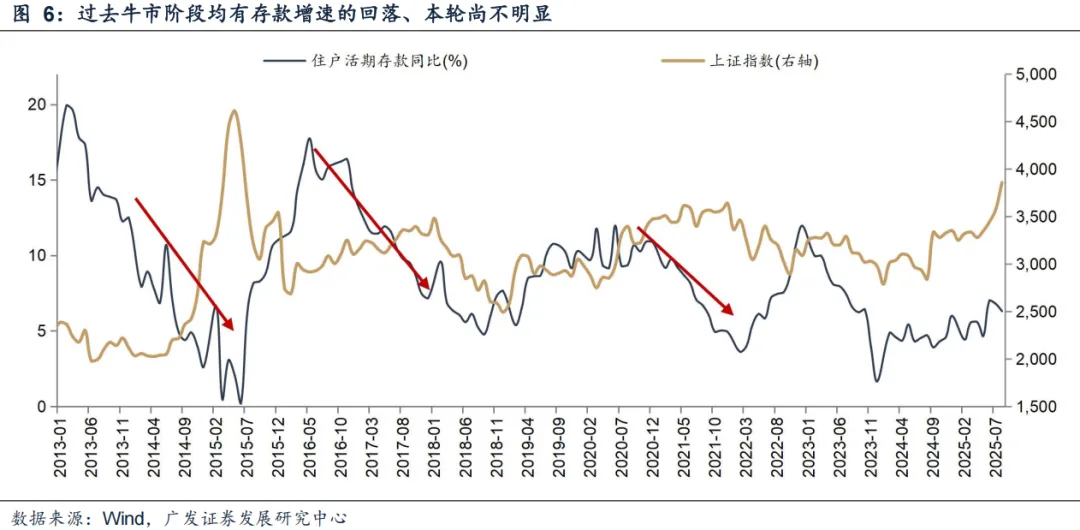
Group 1 - The brokerage strategies remain positive, addressing market concerns such as high-low switching, market style in Q4, and the pace of retail investor entry [1] - The strategy team from Xingzheng emphasizes that the current market rotation is driven by incremental funds and economic advantages, focusing on identifying opportunities based on economic logic and industry trends rather than simple position switching [1][7] - The Citic strategy team highlights the importance of the globalization of leading Chinese manufacturing firms, which is expected to enhance pricing power and profit margins, leading to market capitalization growth beyond domestic economic fundamentals [1][7] Group 2 - The strategy team from招商策略 notes that the Federal Reserve's interest rate cut in September historically correlates with a higher probability of A/H shares rising in the future [4] - Historical data indicates that the market tends to be relatively flat before the National Day holiday, but risk appetite improves significantly afterward, with over 60% probability of gains in major indices during the week following the holiday [4][8] - The strategy team from广发分析 suggests that the current rise in retail investor sentiment is still in its early stages, with various indicators showing that the market is not yet experiencing significant capital outflow from savings [1][9] Group 3 - The strategy from信达 suggests that the market is likely to continue its upward trend, with the current environment favoring strong industry trends while maintaining flexibility in high-low switching strategies [8] - The analysis indicates that the market is currently in a bull phase, with expectations of increased retail investment in the coming year, supported by a favorable policy environment [8] - The strategy team from国全策略 believes that the true bull market has not yet begun, but signs of recovery in corporate earnings and the potential for a new market cycle are emerging [9]