
英德红茶

Search documents
粤字号“土特产”如何成链成群?2026年广东各地农业农村高质量发展这样谋划
Nan Fang Nong Cun Bao· 2026-02-27 01:30
Core Viewpoint - The article discusses the strategic planning for high-quality agricultural and rural development in Guangdong province for 2026, emphasizing the integration of agriculture with manufacturing and service industries to enhance value and drive economic growth [2][76]. Group 1: Agricultural Development Strategies - Various cities in Guangdong are focusing on high-quality agricultural development, presenting unique plans and tasks tailored to their local resources [5][76]. - Guangzhou aims to strengthen its characteristic industries such as flowers, fruits, vegetables, and fisheries, leveraging its dual advantages as a "thousand-year commercial capital" and a "manufacturing hub" [9][10]. - Shenzhen is adopting a "flyover" model through the construction of the Deep-Shan Special Cooperation Zone, which integrates advanced manufacturing with local agricultural development [15][16]. Group 2: Integration of Industries - Zhuhai reported a significant increase in rural collective economic income, with an annual growth rate of over 14% in the last three years, showcasing the successful integration of manufacturing and service industries [18][21]. - Foshan is focusing on developing industries that enrich rural communities, emphasizing the need for industrialized thinking to transform traditional agriculture and enhance product value [23][24]. - Meizhou is promoting the development of the "sixth industry" and enhancing local brands to stimulate rural economic growth through cultural and tourism integration [32][35]. Group 3: Regional Highlights - Yangjiang is setting ambitious goals for its marine economy and health food industry, aiming to create a "blue granary" while integrating various sectors such as tourism and agriculture [60][62]. - Clear water and tea tourism in Qingyuan has attracted 220,000 visitors, demonstrating the successful fusion of tea culture and tourism, which is a model for extending agricultural value into the service sector [51][56]. - Zhanjiang is committed to advancing rural revitalization and modernizing its marine fisheries, focusing on the integration of agriculture with cultural and tourism industries [73][75]. Group 4: Overall Trends - The overarching trend across Guangdong's 2026 plans is the emphasis on a full industrial chain approach to strengthen local specialties, expand agricultural value, and activate county-level development through reforms [76][78]. - The integration of agriculture with manufacturing, service, and digital industries is seen as a key strategy to drive economic growth and modernize the agricultural sector in Guangdong [79][80].


广东省加快建设农业强省 农民收入增速连续16年跑赢城镇居民
Zhong Guo Fa Zhan Wang· 2026-02-24 09:39
Group 1: Agricultural Development in Guangdong - Guangdong has implemented the "Hundred Counties, Thousand Towns, and Ten Thousand Villages High-Quality Development Project" to achieve significant agricultural growth, with the primary industry value ranking second nationally and rural incomes outpacing urban residents for 16 consecutive years [1] - The agricultural output value of five major industries in Qingyuan has increased by 15.1%, with Qingyuan chicken, bamboo shoots, and Yingde black tea each exceeding 10 billion yuan in output value [1] - The province has created 12 national advantageous characteristic industrial clusters and 24 national modern agricultural parks, focusing on cultivating agricultural industry clusters worth hundreds of billions and tens of billions [6] Group 2: Food Security and Grain Production - Guangdong has achieved record-high grain yields, with rice production exceeding 500 kg per mu for four consecutive years, contributing to local food security [2][3] - The province's comprehensive grain production capacity has increased from 12.38 million tons in 2021 to 12.98 million tons by 2025, marking a continuous increase in grain output [3] - Guangdong is enhancing its food supply system by developing marine ranches and modernizing fishing ports, leading the nation in total aquatic product output and marine fish farming [3] Group 3: Rural Infrastructure and Living Conditions - Guangdong has made significant improvements in rural living conditions, with 90% of natural villages achieving wastewater treatment and 97% of rural households having sanitary toilets [8][9] - The province has constructed or renovated approximately 46,000 green houses and planted over 42 million trees in villages, enhancing the rural environment [9] - Rural infrastructure has been upgraded, with 99.3% of rural areas having access to tap water and 83.5% of administrative villages connected to dual-lane roads [9] Group 4: Rural Industry and Employment - The development of the Baijiao sea bass industry in Zhuhai has created an agricultural value chain worth over 18 billion yuan, benefiting over 2,000 farming households [5] - The cultivation of lychee in Guangdong has reached the highest area, output, and value in the country, contributing to the growth of the Lingnan fruit industry cluster [7] - The "Meizhou pomelo" brand has achieved a public brand value of 22.75 billion yuan, showcasing the successful establishment of a complete industrial chain for local agricultural products [6][7]
中国工程院院士何镜堂:将英德红旗茶厂打造为世界级红茶文化展示平台
Nan Fang Nong Cun Bao· 2026-02-24 07:35
Core Viewpoint - The goal is to transform the Hongqi Tea Factory into a world-class platform for showcasing red tea culture, integrating historical, cultural, production, and research resources to promote economic and cultural development in Yingde and Qingyuan regions [2][15][16]. Group 1: Project Overview - The Hongqi Tea Factory, established in 1958, is the birthplace of Yingde red tea and is recognized as one of the earliest and largest large-leaf tea manufacturing plants in China [10][11]. - The factory has been selected as a national industrial heritage site and a provincial industrial heritage site in Guangdong [11]. Group 2: Cultural and Historical Significance - Yingde red tea is noted for its quality, ecological environment, historical significance, and cultural heritage, which includes memories from the early industrialization period and the cultural contributions of overseas Chinese [8][9]. Group 3: Development Strategy - The planning for the Hongqi Tea Factory aims to maintain its original appearance while revitalizing it as a base for continued production, an interactive platform, and a center for research and innovation [15][20]. - The project emphasizes the integration of ecology, production, and daily life, aiming to create a space that serves both as a cultural exchange venue and a museum-like experience for visitors [22][24].
挥“农”墨于岭南大地,执“工”笔绘“两业融合”新篇
Nan Fang Nong Cun Bao· 2026-02-24 03:06
Core Viewpoint - Guangdong is focusing on high-quality development through the integration of manufacturing and service industries, aiming to transition from scale to quality leadership in its economy [11][12][13]. Group 1: Economic Strategy - Guangdong has been the "first engine" of the national economy for 37 consecutive years and is strategizing to maintain its leadership in the "14th Five-Year Plan" period [7][9]. - The 2026 Guangdong High-Quality Development Conference will emphasize the collaborative development of manufacturing and service industries [11]. Group 2: Industry Integration - The province is implementing measures to promote the deep integration of manufacturing and productive services, with a focus on transforming from "manufacturing" to "intelligent manufacturing" [25][30]. - Guangdong's agricultural sector is evolving by integrating agricultural equipment manufacturing with socialized agricultural services, enhancing production relationships and value chains [33][34]. Group 3: Talent Development - Guangdong is prioritizing "investment in people," emphasizing the integration of human resources with manufacturing to drive long-term economic development [73][75]. - The province is cultivating "new farmers" and rural leaders through various training programs, such as the "Rural CEO" training initiative [83][86]. Group 4: Cultural and Consumer Experience - The integration of manufacturing and service industries is redefining "Guangdong goods," transforming products into cultural experiences and consumption scenes [116][118]. - Industrial design is becoming a key driver for high-quality development, with initiatives like the "Mayor's Cup" Industrial Design Competition promoting innovation [120][123]. Group 5: Agricultural Innovation - The establishment of smart farms in Guangdong is showcasing the collaboration between manufacturing and technology services, with examples of fully automated agricultural processes [46][49]. - The province is leveraging modern logistics and digital marketing to enhance the agricultural value chain, as seen in the case of lychee production in Maoming [128][130].
新年第一杯广东奶茶,口口皆新意|马年新春·来粤叹茶⑦
Nan Fang Nong Cun Bao· 2026-02-22 00:33
Core Viewpoint - The article highlights the cultural significance and growing popularity of milk tea in Guangdong, emphasizing its roots in traditional tea-drinking customs and its evolution into a modern beverage trend that resonates with both local and global consumers [4][25]. Industry Overview - Guangdong has over 1.76 million acres of tea gardens and produces more than 200,000 tons of dry tea, fostering a rich variety of renowned tea products such as Phoenix Dan Cong and Yingde Black Tea, which are now being explored by new tea brands [13][14]. - The region's tea-drinking tradition provides a fertile ground for the modern milk tea industry, allowing for innovative flavors and seasonal consumption trends that keep the market vibrant [10][18]. Market Dynamics - The milk tea industry in Guangdong is characterized by its innovative integration of local flavors, such as dried tangerine peel and lychee, which align with the local culinary philosophy of "eating in season" [16][18]. - Guangdong's developed supply chain and logistics network have enabled local tea brands to expand their presence nationally and internationally, with notable success in cities like London and New York [22][23]. Cultural Impact - The article illustrates how Guangdong's deep-rooted tea culture, combined with the innovative spirit of the reform era, has allowed its tea beverages to gain recognition and popularity beyond local borders, serving as a cultural bridge for international audiences [25][29].
茶香年味浓!英德茶旅游春节三天迎客7万人次|新春走基层
Nan Fang Nong Cun Bao· 2026-02-20 04:05
Core Viewpoint - The tea tourism sector in Yingde has become a significant highlight during the Spring Festival, attracting a large number of visitors and showcasing local tea culture through various themed activities [2][4][11]. Group 1: Visitor Statistics - From February 15 to February 18, Yingde received a total of 202,200 visitors, with tea tourism accounting for approximately 50% of this figure [3][4]. - By the third day of the Lunar New Year, tea tourism had already welcomed 70,000 visitors, indicating its central role in the local tourism market during the holiday [4]. Group 2: Themed Activities - Local tea enterprises organized a series of "tea+" themed activities to provide immersive experiences for visitors, enhancing the festive atmosphere [6][11]. - Activities included interactive experiences such as pet interactions in oilseed flower fields, traditional tea-making classes, and Song Dynasty tea ceremony recreations [7][8][9]. - Family-friendly projects like DIY milk tea and Hakka tea-making were particularly popular among visitors [9]. Group 3: Cultural Promotion - Yingde black tea, recognized as a "world high fragrance black tea," is part of the first batch of products listed in the China-Europe geographical indication mutual recognition and protection catalog [13]. - The brand value of Yingde black tea reached the top of the national black tea category for the first time in 2025, highlighting its growing reputation [13]. - Yingde black tea was featured as a special gift at the "Golden Horse Welcoming the Auspicious" Spring Festival gala in Paris, promoting Lingnan cultural heritage and showcasing local products to over 600 guests [14][16].
走进红旗茶厂,在一杯英德红茶里遇见春天|马年新春·来粤叹茶④
Nan Fang Nong Cun Bao· 2026-02-19 00:33
Core Viewpoint - The Hongqi Tea Factory, established in 1958, is recognized as the birthplace of Yingde black tea and has transformed from a traditional tea processing facility into a cultural and tourism landmark, attracting significant visitor interest and contributing to the local economy [8][30][35]. Group 1: Historical Significance - The Hongqi Tea Factory is the largest and earliest large-leaf black tea factory in China, producing tea that has been favored by the British royal family [8][9]. - The factory pioneered a standardized process for black tea production in the 1960s, which facilitated its entry into international markets [14][15]. - At its peak, the factory employed over 400 workers and exported between 40,000 to 50,000 dan (approximately 1,333 to 1,667 tons) of tea annually, generating nearly $50 million in foreign exchange [17][18]. Group 2: Technological and Agricultural Innovation - The factory has played a crucial role in the technological advancement and innovation within the tea industry, contributing to the transition from traditional agriculture to modern agricultural practices [27][28]. - It has been involved in training tea-making technicians and participating in the breeding of new tea varieties and process improvements [21][22]. Group 3: Cultural and Tourism Development - The factory has undergone protective development and was recognized as a national industrial heritage site, becoming a model for industrial heritage preservation in Guangdong Province [30][33]. - In 2025, during the "National Day" holiday, the factory received over 60,000 visitors in just eight days, establishing itself as a popular tourist destination in the Guangdong-Hong Kong-Macao Greater Bay Area [36][37].
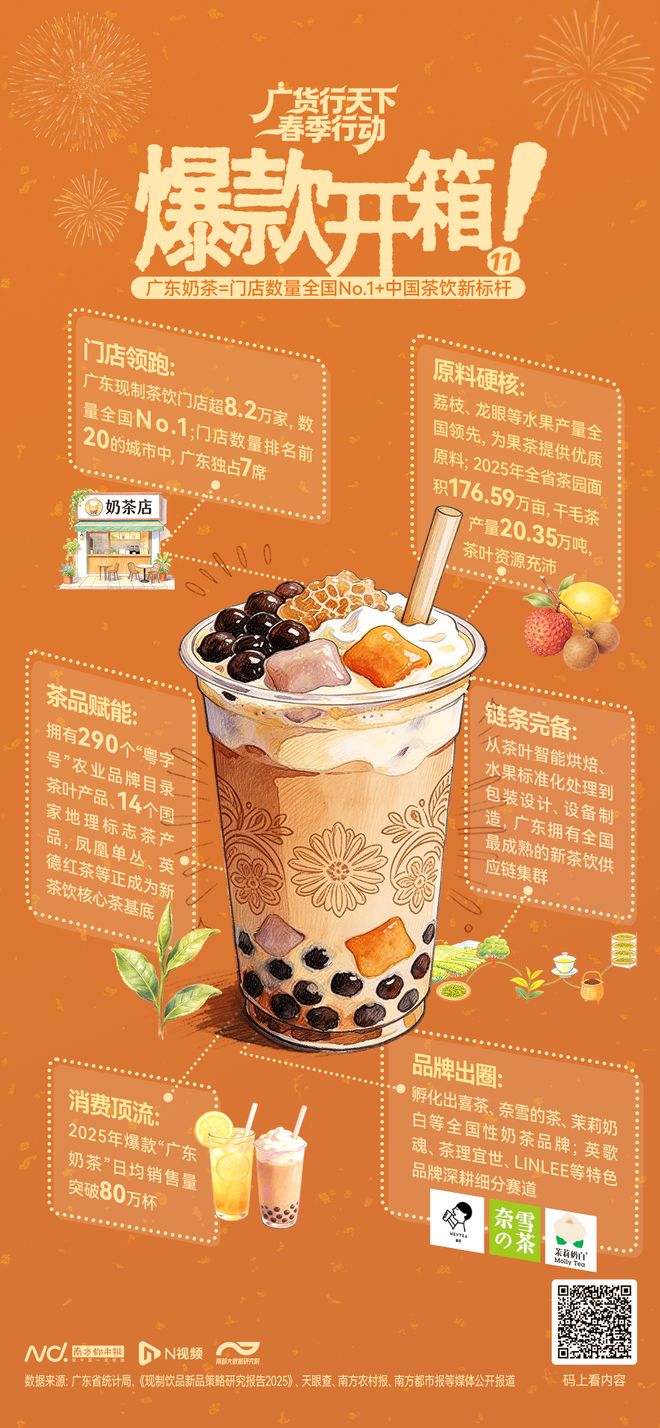
开箱广货爆款!全国每5家奶茶店1家在广东,“粤”饮越上头
Nan Fang Du Shi Bao· 2026-02-15 10:19
Core Insights - The article highlights the rise of Guangdong milk tea as a new benchmark in the tea beverage market, showcasing its integration into daily life and its significant market presence across China [2][4]. Group 1: Market Presence - Guangdong leads the nation with over 82,000 milk tea stores, contributing to a total of more than 415,000 ready-to-drink tea shops across China by September 2025 [2][5]. - Among the top 20 cities in terms of store count, Guangdong occupies 7 positions, indicating a dense network of milk tea outlets [2][5]. Group 2: Raw Material Advantage - The region benefits from a subtropical climate, producing leading quantities of lychee and longan, which provide fresh and high-quality ingredients for fruit teas and milk teas [3][5]. - By 2025, Guangdong's tea garden area is projected to reach 1.7659 million acres, with a dry tea production of 203,500 tons, ensuring a robust supply of tea leaves [3][5]. Group 3: Industry Structure - Guangdong has established a complete supply chain for new tea beverages, encompassing everything from intelligent tea leaf roasting and standardized fruit processing to packaging design and store operations [3][5]. - This efficient collaboration across various stages of production enhances raw material processing, product standardization, and brand expansion [3][5]. Group 4: Brand Development - The region has produced leading brands such as Heytea and Naixue's Tea, which have gained national recognition, alongside local brands that focus on niche markets [4][5]. - The combination of headlining brands and specialized local products allows Guangdong milk tea to effectively convey its unique characteristics and appeal across the country [4][5].
广货行天下,凤凰单丛、英德红茶香飘巴黎
Nan Fang Nong Cun Bao· 2026-02-13 12:34
Core Viewpoint - The event "Golden Horse Welcomes the Auspicious" Chinese-French Spring Festival Gala showcased Guangdong tea, specifically Fenghuang Dancong and Yingde Black Tea, highlighting their cultural significance and promoting "Guangdong Goods" on an international stage [3][4][15]. Group 1: Event Overview - The Spring Festival Gala was held on February 11, 2023, at the Chantilly Racecourse in Paris, co-hosted by the Chinese Embassy in France and the Hauts-de-France region [2][3]. - Over 600 guests received Fenghuang Dancong and Yingde Black Tea as special gifts, emphasizing the cultural heritage of Lingnan [4][10]. Group 2: Cultural Significance - Fenghuang Dancong and Yingde Black Tea are among the first products recognized in the China-Europe geographical indication mutual recognition list, symbolizing a cultural connection between Guangdong tea and Europe [8][9]. - The teas were featured during an informal meeting between the leaders of China and France in April 2023, further solidifying their role in cultural diplomacy [9][10]. Group 3: Historical Context - Guangdong tea has a long history of international trade, dating back to the Ming Dynasty when it was exported to Europe via Guangzhou [17][18]. - During the Qing Dynasty, Guangdong became a global center for tea trade, significantly influencing the development of European afternoon tea culture [18]. Group 4: Market Expansion - The event aims to deepen the penetration of Guangdong tea into the European market and promote cultural exchange and economic cooperation between China and France [12][15]. - Fenghuang Dancong is renowned for its unique flavor and has a strong export presence in Europe, North America, Japan, and Southeast Asia [21]. - Yingde Black Tea, produced in the "hometown of black tea," has been exported to over 70 countries and regions, establishing itself as a significant symbol of Chinese black tea globally [22]. Group 5: Venue Significance - The gala took place at the Chantilly Racecourse, known for its historical significance and as a major equestrian center in Europe, adding a touch of French romance to the event [24][25]. - The venue reflects the ongoing economic cooperation between the Hauts-de-France region and China, with numerous Chinese enterprises present in the area [30][31].
品牌引领,价值跃升|“四个农业”的广东实践④
Nan Fang Nong Cun Bao· 2026-02-13 02:33
Core Viewpoint - Guangdong is advancing its agricultural development through a focus on brand agriculture, which is seen as a key driver for enhancing competitiveness and breaking down barriers in agricultural product sales [8][9][12]. Brand Agriculture Development - The "14th Five-Year Plan" emphasizes the importance of brand agriculture as a means to connect various agricultural developments and enhance the core competitiveness of Guangdong products [8][9]. - Guangdong's media-driven initiatives are aimed at enhancing brand visibility and market penetration for local agricultural products [12][22]. Cultural Integration - The integration of culture into agricultural branding is exemplified by the "Father's Love Like Orchid" campaign, which connects the resilience of orchids with deep emotional ties, transforming traditional sales into a cultural experience [40][56]. - The "Year Fish" concept in Zhuhai merges traditional cultural elements with the seafood industry, leading to significant sales growth during festive seasons [58][70]. Market Expansion - Guangdong's agricultural products are increasingly penetrating national and international markets, with notable demand in regions like Beijing and Southeast Asia [19][76]. - The collaboration between Guangdong enterprises and businesses in other provinces, such as Hunan, has resulted in substantial sales agreements, exemplified by an 11 billion yuan contract for seafood products [87]. Innovative Marketing Strategies - The "Media+" initiative has led to innovative marketing strategies, including live streaming events that significantly boost product visibility and sales, as seen with the 192 million units of lychee sold during a promotional event [28][30]. - The use of social media platforms for marketing has transformed local farmers into influencers, enhancing the reach of agricultural products [35][39]. Future Outlook - Guangdong aims to continue leveraging its unique cultural heritage and innovative marketing strategies to expand its agricultural brand presence globally, with a focus on quality and cultural significance [109].