互联网泡沫破裂

Search documents
'Not Just Red Numbers On A Screen'—A Seasoned Investor Warns Most New Investors Have Never Seen A Real Crash When Conviction Is Truly Tested
Yahoo Finance· 2026-02-15 19:32
Market Conditions - Recent market behavior has led to a false sense of security among newer investors, contrasting with the realities of a true market crash experienced in 2008 [1] - The last significant prolonged market pain occurred during the 2007-2009 financial crisis and the 2000 dot-com collapse, where stocks not only dipped but continued to fall, with some indexes taking nearly a decade to recover [2] Investor Sentiment - Investors who experienced the 2008 crash reported significant emotional distress, with one noting a 50% drop in their portfolio within five months, highlighting the courage required to stay invested during such times [3] - Some investors were unable to cope with the downturn, leading to decisions such as moving to cash and realizing substantial losses, while others avoided checking their brokerage statements due to the emotional toll [3] Broader Economic Impact - The stress of a market downturn extends beyond portfolio losses, affecting employment and housing stability, as illustrated by comments from individuals who witnessed friends lose jobs and homes during the Great Recession [5] - The correlation between falling markets, rising unemployment, and tightening credit distinguishes a quick market dip from a true financial crisis, as seen in the aftermath of the 2008 crisis [5]
韩国央行:若美股出现类似互联网泡沫破裂时下跌,美国消费支出将减少1.7%
Xin Lang Cai Jing· 2026-01-16 05:04
Core Viewpoint - The Bank of Korea warns that a significant drop in the U.S. stock market, similar to the internet bubble burst, could lead to a sharp decrease in U.S. consumer spending, which would severely impact the South Korean economy [1][2]. Group 1: Impact of U.S. Stock Market on Consumer Spending - A 10% decline in the U.S. stock market is projected to reduce the annual consumption growth rate by approximately 0.3 percentage points [1][2]. - In the event of a drastic economic downturn akin to the internet bubble burst (approximately a 30% drop), consumption growth could decline by as much as 1.7 percentage points [1][2]. Group 2: Factors Affecting U.S. Consumer Purchasing Power - U.S. household purchasing power is influenced by factors such as inflation and labor market conditions, with consumption increasingly reliant on volatile stock prices and high-income households' spending behavior [1][2]. - The Bank of Korea anticipates that U.S. household purchasing power will continue to grow at a moderate pace, but significant downside risks related to employment and inflation remain [1][2]. Group 3: Income and Asset Disparity - The widening income and asset gap within U.S. households may increase their vulnerability to economic shocks [2][3]. - The South Korean economy is significantly affected by U.S. investments in artificial intelligence and household consumption demand, necessitating close monitoring of these risk factors [2][3].
美股会有长熊市吗?|投资小知识
银行螺丝钉· 2025-11-16 13:46
Group 1 - The article discusses historical market trends, highlighting that after the bursting of the "Nifty Fifty" bubble in the 1960s, the US stock market experienced a 10-year bear market, with the S&P 500's price-to-earnings ratio dropping to around 8 times [2] - It mentions that following the internet bubble burst in 2000, the Nasdaq fell by 80%, and the market faced additional challenges during the 2008 subprime mortgage crisis and the 2011 European debt crisis, leading to a prolonged bear market from 2001 to 2012 [2] - The article contrasts this with periods of relative economic stability where corporate earnings growth was strong, such as from the mid-1980s to 1999, which saw the longest bull market in history despite short bear markets like the 1987 stock market crash [2] Group 2 - It notes that after 2013, the US stock market gradually recovered from the subprime mortgage crisis [3]


CA Markets:达利欧警告,美联储泡沫中放水或酿更大风险
Sou Hu Cai Jing· 2025-11-07 09:06
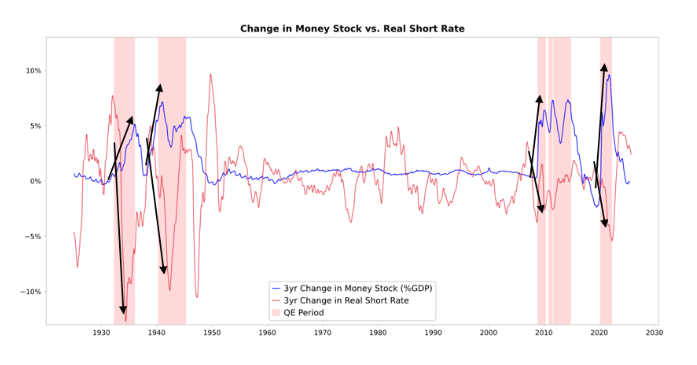
Core Viewpoint - Ray Dalio, founder of Bridgewater Associates, warns that the Federal Reserve's end to quantitative tightening (QT) is not a technical adjustment but a dangerous experiment that adds liquidity to an already inflated bubble [2][3] Group 1: Current Economic Environment - The current policy mix of expanding fiscal deficits, restarting monetary easing, and the AI narrative is pushing the U.S. towards a perilous end of a large debt cycle characterized by a liquidity-driven super bubble [2] - Historically, quantitative easing (QE) has been introduced during recession periods when asset valuations were low, inflation was subdued, and credit was frozen, providing significant policy space [3] - In contrast, the current environment features a S&P 500 earnings yield of only 4.4%, nearly inverted with the nominal yield of 10-year U.S. Treasuries at 4%, and a compressed equity risk premium of just 0.3% [3] Group 2: Risks of Current Policies - The economy is maintaining a 2% real growth rate, with an unemployment rate of 4.3% and inflation still above 3%, indicating overheating rather than recession [3] - The government continues to accumulate debt aggressively, and if the Fed resumes bond purchases, it effectively monetizes the fiscal deficit, creating a closed loop of debt monetization [3] - A significant expansion of the balance sheet alongside a simultaneous reduction in interest rates could lead the market to perceive this as fiscal dominance, where the central bank is forced to cover government overspending, potentially unanchoring inflation expectations [3] Group 3: Asset Impact and Market Dynamics - Liquidity will not be evenly distributed; QE tends to lower real interest rates and compress risk premiums, directly boosting assets that are most sensitive to discount rates, such as technology, AI, cryptocurrencies, and gold [3] - Dalio anticipates a short-term liquidity frenzy reminiscent of the 1999 internet bubble, with price-to-earnings multiples continuing to expand, benefiting both long-duration growth stocks and inflation-hedging assets [3] - Experts from CAMarkets note that behind this frenzy, issues such as wealth disparity, financial fragility, and inflationary pressures are likely to intensify, and when policies eventually shift, the cost of the bubble's collapse will exceed that of any historical cycle [3]
6月12日投资避雷针:盘中一度涨停 500亿券商股紧急澄清合并传闻
Xin Lang Cai Jing· 2025-06-12 00:08
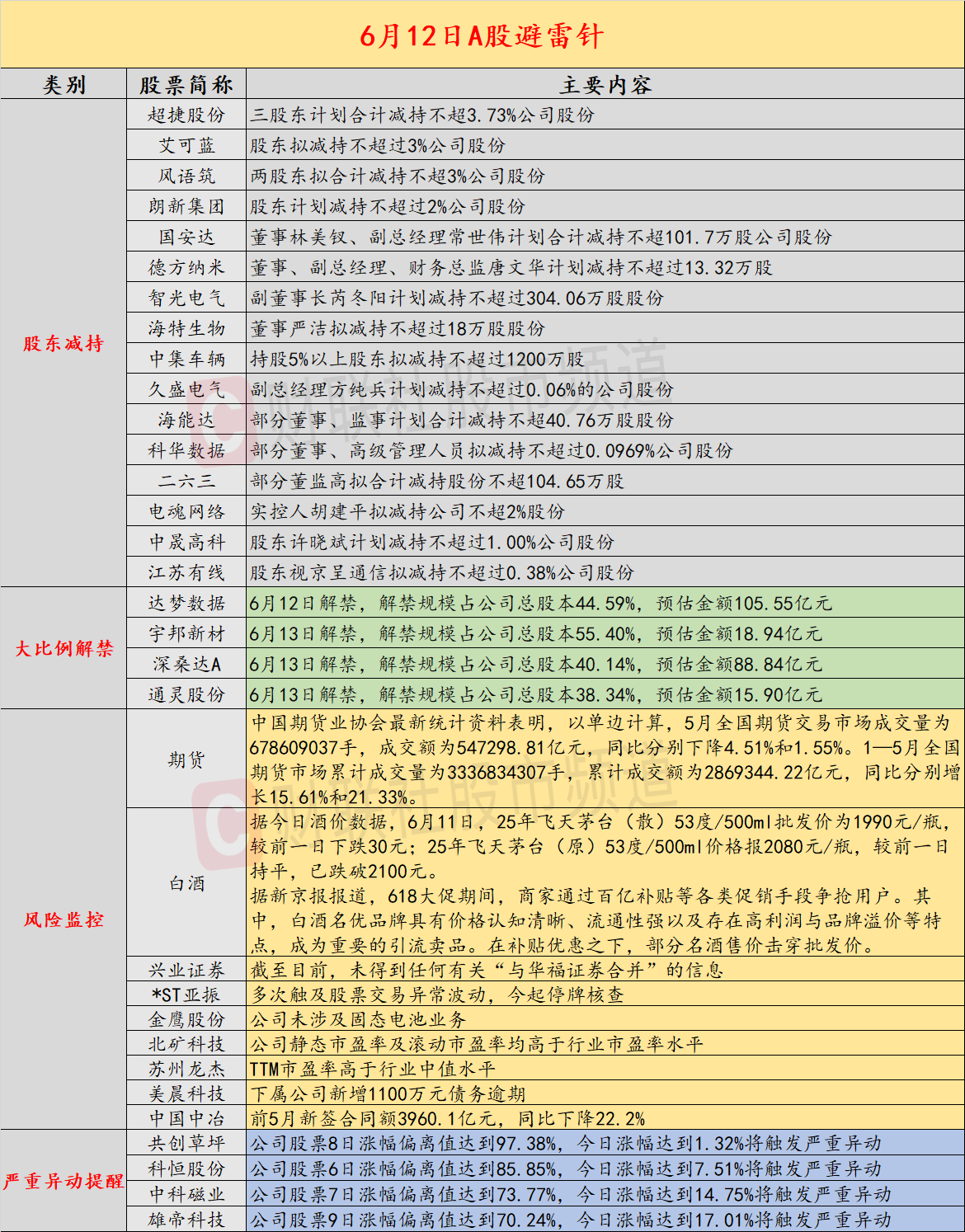
Economic Information - In May, the national futures market recorded a trading volume of 678,609,037 contracts and a transaction value of 5,472.99 billion yuan, representing a year-on-year decline of 4.51% and 1.55% respectively [2] - From January to May, the cumulative trading volume reached 3,336,834,307 contracts, with a cumulative transaction value of 28,693.44 billion yuan, showing year-on-year growth of 15.61% and 21.33% [2] - As of June 11, the wholesale price of 25-year Flying Moutai (bulk) was 1,990 yuan per bottle, down 30 yuan from the previous day, while the price of 25-year Flying Moutai (original) remained at 2,080 yuan per bottle [2] Company Alerts - Industrial Securities has not received any information regarding a merger with Huafu Securities [3] - *ST Yazhen has been suspended from trading for verification due to multiple instances of abnormal trading fluctuations [6] - Several companies, including Chaojie Co., Aikelan, and Fengyuzhu, have announced plans for share reductions by their shareholders, with reductions not exceeding 3% of total shares [8] Overseas Alerts - The US stock market saw all three major indices close lower, with the Nasdaq down 0.5% and Intel dropping over 6%, marking its largest single-day decline in two months [4] - In London, most base metals declined, with LME nickel down 1.13% at $15,145.00 per ton and LME copper down 1.12% at $9,647.00 per ton [5] - Jeffrey Gundlach, head of DoubleLine Capital, indicated that the US debt burden and interest payments have become unsustainable, suggesting that long-term US Treasuries are no longer considered truly risk-free investments [4]