
亚太股市反弹

Search documents
伊朗再次发射导弹!以色列,最新发声!亚太股市,集体拉升!
券商中国· 2026-03-11 00:51
Market Performance - The Asia-Pacific stock markets continue to rebound, with South Korea's KOSPI index rising over 3% and Japan's Nikkei 225 index increasing by more than 2% as of 8:15 AM [1] - The Australian S&P 200 index also saw an increase of 0.71% [1] South Korea's Economic Measures - South Korea's Finance Minister, Choo Kyung-ho, stated that the government is prepared to expand the existing market stabilization plan, which exceeds 100 trillion won, if necessary [2][3] - The government is closely monitoring international oil prices and is considering reducing fuel taxes to mitigate the impact of the Middle East conflict on the South Korean economy [3] - Choo emphasized that all available policy tools, including supplementary budgets, will be utilized to support citizens affected by rising oil prices [3] Oil Market Developments - The international oil prices experienced fluctuations, with WTI crude oil futures turning negative after previously rising over 6% [2] - The International Energy Agency (IEA) proposed the release of over 182 million barrels of oil reserves, marking the largest strategic oil reserve release in history [2] Geopolitical Tensions - The Iranian Revolutionary Guard announced military operations targeting U.S. bases in Iraq and Israel, indicating escalating tensions in the region [5][6] - Israeli officials stated that they do not seek a "never-ending war" with Iran and will coordinate with the U.S. on military actions [7] - The Israeli Defense Forces conducted airstrikes on various Iranian military and security facilities, further intensifying the conflict [8]


东南亚股市上周观望情绪浓厚,全球流动性宽松预期或提振亚太股
2 1 Shi Ji Jing Ji Bao Dao· 2025-08-24 23:38
Group 1: Global Market Overview - The global central bank meeting in Jackson Hole, Wyoming, is drawing attention, with an 80% probability of a 25 basis point rate cut by the Federal Reserve in September [1] - Investor sentiment is cautious, leading to mixed performance in the Asia-Pacific markets, with Southeast Asian stock markets mostly declining [1] - The Thai SET index fell by 0.48% to 1253.39 points, while the Vietnamese Ho Chi Minh index rose by 1.04% to 1647.03 points [1] Group 2: Economic Analysis of Thailand - Thailand's economy grew by 2.8% year-on-year in Q2, slightly above market expectations but lower than the previous quarter's 3.2% [2] - The economic growth rate decreased from 0.7% in Q1 to 0.6% in Q2, with exports being the main driver, although challenges from U.S. tariff policies and declining tourism are expected to hinder sustainability [2][4] - Capital Economics forecasts Thailand's GDP growth at 2.7% for 2025, only slightly above 2024's 2.5% [3] Group 3: Regional Economic Performance - Indonesia's GDP grew by 5.12% year-on-year in Q2, exceeding market expectations and marking the fastest quarterly growth since Q2 2023 [4] - Singapore's GDP grew by 1.4% quarter-on-quarter and 4.3% year-on-year in Q2, driven by pre-tariff export activities [5] Group 4: Stock Market Trends in Southeast Asia - Malaysia's stock market has faced continuous net selling for 20 days, with global funds selling $12.9 million worth of Malaysian stocks on August 21 [6] - Foreign investors' holdings in Thai stocks decreased by 24% in the first half of 2025 compared to the end of 2024, with the SET index down by 10.49% as of August 22 [7] - The decline in foreign investment in Thailand is attributed to political uncertainties and a lack of appeal in traditional business sectors compared to growing tech investments [7] Group 5: Monetary Policy Developments - Indonesia's central bank unexpectedly cut the benchmark interest rate by 25 basis points to 5%, marking the fourth cut this year [8] - Following the rate cut, the Indonesian stock market reacted positively, with the benchmark index rising over 1% [8] - Analysts remain optimistic about Indonesia's economic growth potential, with Citibank projecting a 5.4% growth target for 2026 [8]
亚洲市场“分化复苏”结构性支撑,新兴亚洲ETF(520580)放量拉涨
Sou Hu Cai Jing· 2025-05-15 06:02
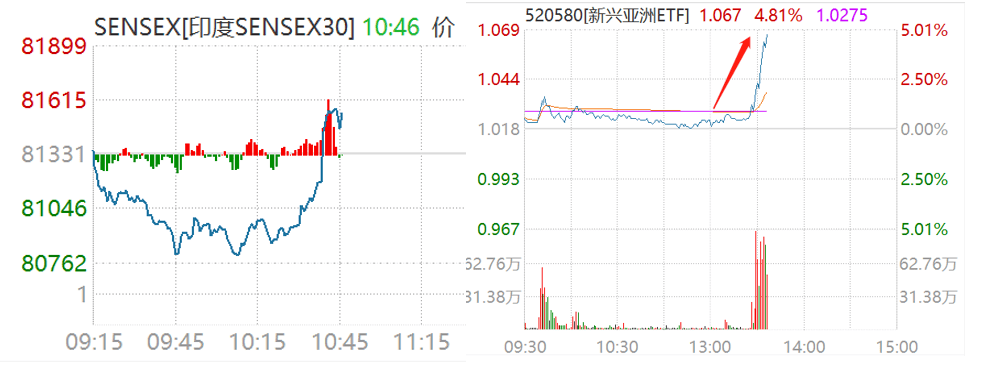
Core Insights - Emerging Asian markets continue to strengthen, with India's SENSEX index rising by 0.2% during intraday trading, while the emerging Asia ETF (520580) increased by 4.81%, reaching a new high of 1.067 yuan [1] - Following a de-escalation of geopolitical events, the SENSEX index recorded a significant single-day gain of 3.74%, the largest in recent times, with foreign investors purchasing 12.5 billion rupees (approximately 1.45 million USD) worth of Indian stocks [3] - Domestic institutional investors have also been active, buying over 1.5 billion USD worth of stocks within three days [3] Group 1: Market Performance - The SENSEX index's recent performance reflects a strategic repositioning of global funds towards more stable and politically neutral Asian economies due to volatility in U.S. Treasury yields and escalating geopolitical tensions [3] - The emerging Asia ETF (520580) tracks the Emerging Asia Select 50 Index, primarily investing in India, Indonesia, Malaysia, and Thailand, with India accounting for approximately 50% of its weight [3] Group 2: ETF Developments - The emerging Asia ETF has been included as a margin trading target, indicating its high quality in terms of asset size, number of holders, and liquidity, with an average daily trading volume of 700 million yuan since its listing on February 20, 2025 [4] - The inclusion in margin trading is expected to enhance liquidity and diversify the trading strategies available for the ETF [4]
东盟观察丨泰国连续降息支持经济,中马、中柬跨境人民币使用激增
2 1 Shi Ji Jing Ji Bao Dao· 2025-05-05 00:31
Market Performance - The Asia-Pacific stock market continues to show a warming trend, with most indices recording gains last week [1] - The Jakarta Composite Index in Indonesia rose by 2.05% to 6815.73 points, while the Singapore Straits Index increased by 0.56% to 3845.14 points [1] - Other notable gains include Malaysia's Kuala Lumpur Composite Index up 2.21% to 1542.49 points, and Thailand's SET Index up 3.45% to 1198.98 points [1] - Japan's Nikkei 225 Index led the gains with a 3.15% increase to 36830.69 points [1] Economic Outlook - The International Monetary Fund (IMF) forecasts that the growth rates for developed economies in the Asia-Pacific region will be 1.2% and 1.4% for the next two years, while emerging markets are expected to grow at 4.5% and 4.6% [3] - Thailand's central bank has lowered its benchmark interest rate from 2.00% to 1.75% to support the economy amid slowing inflation and growth [3][4] - Moody's has downgraded Thailand's economic outlook from stable to negative, citing significant impacts from global trade and economic growth [3] Monetary Policy - Thailand's recent interest rate cuts are seen as a preventive easing measure, reflecting a consensus among Southeast Asian monetary authorities to act proactively rather than waiting for U.S. rate cuts [4] - Experts predict that other Southeast Asian countries, such as Malaysia, the Philippines, and Vietnam, may follow suit with monetary policy easing in the second quarter [4] Cross-Border RMB Business - The cross-border RMB business has seen significant growth, with transactions between China and Malaysia reaching 102 billion yuan, a 27% increase year-on-year [6] - The increase in cross-border RMB usage is attributed to deepening monetary sovereignty and industrial trust between China and its trade partners [6] - The RMB is forming a new model of trade dominance within the RCEP framework, enhancing trade efficiency and local asset reserve attributes in the Asia-Pacific region [6]