
产业迁移

Search documents
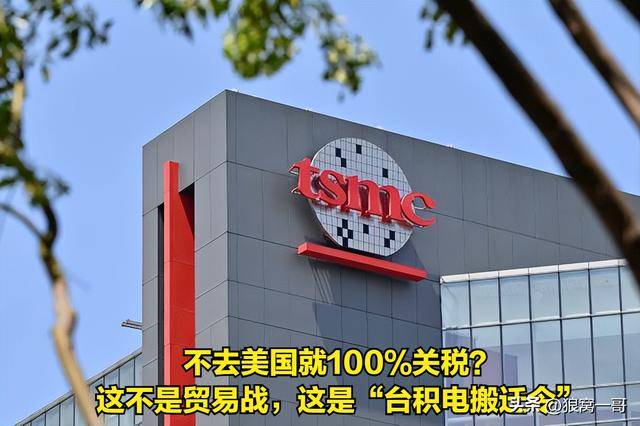
不去美国就100%关税?这不是贸易战,这是“台积电搬迁令”
Sou Hu Cai Jing· 2026-01-16 10:41
Core Viewpoint - The article discusses the strategic implications of the U.S. pushing for the relocation of 40% of Taiwan's semiconductor supply chain to the U.S., highlighting that this is not merely a trade agreement but a move to gain control over Taiwan's semiconductor ecosystem [2][26]. Group 1: Agreement Structure - The so-called "agreement" requires Taiwanese companies to invest at least $250 billion in U.S. production capacity and provide an additional $250 billion in credit guarantees, while the U.S. reduces tariffs from 20% to 15% as a form of "buying" compliance [3][4]. - Tariffs are used as a coercive tool, with a 100% tariff threat for companies that do not establish operations in the U.S., indicating that the U.S. is not merely inviting companies but compelling them to relocate [4][5]. - The exemption clauses are designed to bind future tax benefits to U.S. production capacity, effectively locking Taiwanese companies into the U.S. market [5]. Group 2: Ecological Impact - The relocation of 40% of the supply chain is not just a numerical change but poses a risk of ecological disruption, as the semiconductor industry relies on a complex ecosystem that includes equipment, materials, and skilled labor [13][14]. - The loss of core components could lead to a weakening of Taiwan's semiconductor industry, making it increasingly difficult to maintain competitive advantages and potentially triggering a chain reaction of further relocations [14]. Group 3: U.S. Strategic Logic - The U.S. aims to diminish Taiwan's strategic value by reducing its semiconductor industry's uniqueness, thereby transforming Taiwan from an indispensable partner to a replaceable one [15][26]. - The U.S. is preparing for various future scenarios by ensuring that it has control over critical semiconductor production, which reduces its dependency on Taiwan [26]. Group 4: Economic Viability - The necessity of using coercive measures like tariffs suggests that relocating production to the U.S. may not be economically viable, as the U.S. has higher manufacturing costs compared to Taiwan [16][18]. - The combination of tariffs, exemptions, and subsidies indicates a forced migration rather than a voluntary market-driven decision [16]. Group 5: Long-term Consequences for Taiwan - Taiwan may experience chronic job and tax base losses as key production moves to the U.S., leading to a decline in local economic activity [19]. - The binding of public credit to investments in the U.S. could amplify financial risks for Taiwan, impacting public resources if companies face difficulties [19]. - Taiwan's bargaining power and strategic value will diminish as critical production capabilities are relocated, leading to a potential revaluation of its importance in geopolitical negotiations [20]. Group 6: Conclusion - The article warns that the real concern is not just the U.S. rhetoric but the structural changes being implemented that could turn Taiwan's semiconductor industry into a resource for the U.S. rather than a protective asset for Taiwan [27].

中信建投:海南有望成为产业迁移的热土
Zheng Quan Shi Bao Wang· 2025-12-19 00:49
Core Viewpoint - The Hainan closure policy is a significant initiative in China's new round of reform and opening-up, characterized by unprecedented depth in institutional design and broad policy coverage [1] Group 1: Policy Framework - Hainan's free trade port policy system is built on "zero tariffs, low tax rates, and simplified tax systems," which significantly reduces operational costs for enterprises [1] - The financial sector in Hainan adopts a regulatory model of "freeing up the first line and controlling the second line," facilitating the liberalization and convenience of cross-border capital flows [1] - The establishment of the EF account system provides an upgraded infrastructure for financial openness [1] Group 2: Economic Opportunities - The policy dividends are expected to make Hainan a hotspot for industrial migration, with high-end manufacturing, air logistics, and digital economy industries likely to cluster in the region, creating new economic growth points [1] - Hainan's measures to relax visa policies and optimize the tourism environment effectively stimulate overseas consumption and enhance its status as an international tourism consumption center [1] Group 3: Demographic Changes - The relaxation of household registration policies and talent introduction plans in Hainan significantly promote population structure optimization and urbanization processes [1] - The influx of high-quality talent provides strong support for the construction of Hainan's free trade port [1] Group 4: Challenges and Future Outlook - The Hainan closure policy faces risks and challenges from deteriorating international economic and trade relations and rising global trade protectionism, which may restrict population migration [1] - Overall, the Hainan closure policy is expected to significantly enhance Hainan's position in the global value chain and inject new momentum into China's high-quality economic development [1] - Hainan needs to continue deepening policy implementation, strengthening risk prevention, and promoting the continuous achievement of new results in free trade port construction [1]

11月进出口点评:全球资本开支仍是出口主线
Orient Securities· 2025-12-10 03:16
Group 1: Export Performance - In November, exports saw a significant year-on-year increase of 5.9%, rebounding from a previous decline of -1.1%[6] - Exports to the US decreased by 28.6% year-on-year, indicating ongoing weakness in consumer goods exports[6] - Non-US regions showed resilience in import demand, particularly in capital goods, which outperformed consumer goods[6] Group 2: Market Dynamics - The demand for investment-related equipment remains a core driver of export recovery, especially in non-US markets[6] - The AI-related processing trade chain between China and other Asian regions continues to boost exports, with significant increases in integrated circuit exports[6] - The reduction of tariffs on fentanyl by the US has not diminished the confidence of Chinese manufacturers in expanding overseas[6] Group 3: EU Export Trends - Exports to the EU surged by 14.8% year-on-year in November, marking the highest growth rate for the year[6] - The sustainability of this growth is uncertain, as it may be driven by preemptive imports ahead of the upcoming carbon tax legislation in January 2026[6] - Overall, the export structure remains unchanged, with limited recovery expected in consumer goods exports until the end of Q1 next year[6]
间接贸易渠道和出海链对出口的支撑或将延续
Orient Securities· 2025-08-11 14:41
Export Performance - July exports increased significantly by 7.2% year-on-year, up from 5.9% in June[6] - Exports to the US saw a decline of 21.7% in July, compared to a 16.1% drop in June, primarily due to the upcoming expiration of tariff exemptions[6] - Exports to non-US regions, particularly ASEAN and Africa, showed strong performance with increases of 16.6% and 42.4% respectively[6] Trade Dynamics - The indirect trade channels are expected to continue supporting exports, particularly for intermediate and capital goods[6] - Capital goods exports to Southeast Asia and Africa maintained high growth rates, with cumulative year-on-year increases of 19.4% and 39.1% respectively over the first five months[6] - The delay in tariff exemption deadlines by the Trump administration has potentially stimulated a new wave of foreign trade orders[6] Market Outlook - The weakening demand in the US market is likely to continue affecting consumer goods exports in the short term[6] - The upcoming expiration of tariff exemptions may limit the support for direct exports to the US, especially for consumer products[6] - The overall import growth in July was supported by stable alternative supply channels for major commodities, with significant increases in imports of grains, soybeans, and crude oil[6]