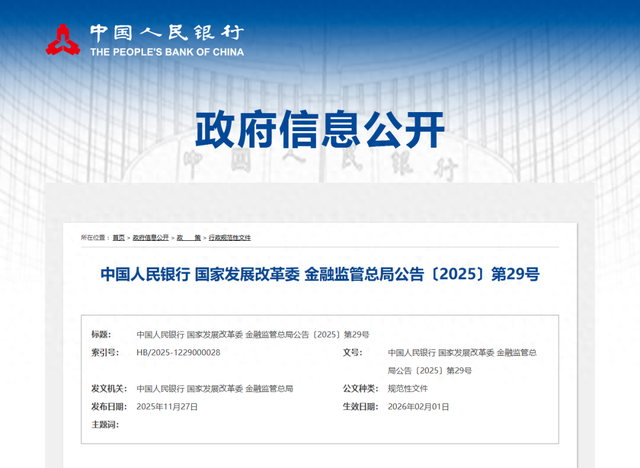
人民币现金收付规定

Search documents
人民币现金收付新规来了!这些情况可投诉举报→
新华网财经· 2026-02-01 10:49
Core Viewpoint - The article discusses the implementation of the "Regulations on Cash Payment and Services" by the People's Bank of China, aimed at maintaining the status of the Renminbi as legal tender and preventing the refusal of cash payments, effective from February 1 [2]. Summary by Sections Regulations on Cash Payment Behavior - The regulations establish basic requirements for cash payments, emphasizing that entities providing face-to-face services or online appointments must support cash payments and maintain reasonable change availability [3]. - For self-service models and locations with unified management, entities must clearly indicate payment methods and provide contact information for cash conversion services [3]. - In fully online transactions, entities are required to publicly announce payment methods in advance, respecting the public's right to know and choose [4]. - When delegating payment collection, the delegating party must require the delegate to accept cash through written agreements [5]. - Entities promoting digital governance must consider the public's need for cash and cannot discriminate against cash payments [5]. Requirements for Commercial Banks - Banks must comply with cash management laws and improve cash service quality to meet public and business needs [6]. - Banks with physical locations must handle cash deposits and withdrawals and provide cash services [7]. - Banks should ensure the number and layout of cash service points and self-service machines meet the diverse needs of different customer groups [7]. - Banks must manage the return of Renminbi properly to prevent the circulation of unfit currency and mitigate various business risks [12]. Handling Cash Payment Issues - In cases of cash payment difficulties, individuals should negotiate with the service provider and retain evidence of any refusal to accept cash, reporting issues through various consumer protection channels [8][18]. - The People's Bank of China will collaborate with relevant departments to address complaints and protect the public's legal payment rights [18].


人民币现金收付新规今起施行 遇这些情况可投诉举报
Yang Shi Xin Wen Ke Hu Duan· 2026-01-31 22:46
Core Viewpoint - The People's Bank of China, along with the National Development and Reform Commission and the Financial Regulatory Administration, has implemented the "Regulations on Cash Payment and Services" to uphold the legal status of the Renminbi, prevent the refusal of cash payments, and meet the diverse payment service needs of the public, effective from February 1 [1]. Summary by Relevant Sections Regulations on Cash Payment Behavior - The regulations establish basic requirements for cash payments based on classification management and universal applicability, including: - Cash payments must be supported in face-to-face services and transactions that can be completed offline, with reasonable change available [2]. - Self-service models and locations with unified management must clearly indicate payment methods and provide contact information for cash services [2]. - For fully online transactions, payment methods must be publicly disclosed in advance to respect the public's right to know and choose [2]. - When a payment unit entrusts another entity to collect payments, the entrusting party must require the acceptance of cash through written agreements [2]. - Digital governance and business model innovations must consider the public's need for cash and cannot discriminate against cash payments [2]. Requirements for Commercial Banks - Financial institutions must comply with cash management laws and improve cash service quality to meet public and business needs: - Banks with physical locations must handle cash deposit and withdrawal services [3]. - The number and layout of cash service points and self-service machines must meet the diverse needs of different customer groups [3][11]. - Banks must ensure the proper return of Renminbi and prevent the circulation of unfit currency [12][14]. Handling Cash Payment Issues - In cases of cash payment difficulties, parties should negotiate amicably with the payment unit to resolve disputes and retain evidence for complaints if cash is refused or discriminated against [5].

一批新规明天开始施行
Xin Lang Cai Jing· 2026-01-31 07:08
Group 1 - The "Commitment to Quality Certificate" management for agricultural products such as fruits and vegetables will be implemented starting February 1, ensuring that these products are free from banned pesticides and that residue levels of permitted substances do not exceed standards [1] - The "Live E-commerce Supervision Management Measures" will include regulations for digital human anchors, requiring identification and continuous consumer notifications for AI-generated content in live commerce starting February 1 [2] - The "Regulations on Cash Payment and Services" will prohibit businesses from refusing cash payments, except in legally mandated situations, and will prevent discrimination against cash transactions starting February 1 [3][4] Group 2 - The "National Reading Promotion Regulations" will support reading initiatives, particularly in rural and underdeveloped areas, and will focus on ensuring reading access for minors, the disabled, and the elderly starting February 1 [5] - The "Unified Social Credit Code Management Measures" will provide organizations with a unique, lifelong identification code for precise tracking and identification within the social credit system starting February 1 [6] - The "Administrative Law Enforcement Supervision Regulations" will enhance oversight of administrative law enforcement practices, focusing on preventing misconduct and ensuring compliance with legal standards starting February 1 [7]
2月起,这些新规将影响你我生活
Yang Shi Xin Wen· 2026-01-29 22:33
Group 1: Cash Payment Regulations - The People's Bank of China, in collaboration with the National Development and Reform Commission and the Financial Regulatory Bureau, has established new cash payment regulations that will take effect on February 1, 2026. These regulations mandate that cash payments must be supported in face-to-face services and online transactions, with sufficient change available [2] Group 2: Online Transaction Platform Rules - The State Administration for Market Regulation and the National Internet Information Office have jointly issued the "Supervision and Management Measures for Online Transaction Platforms," effective February 1, 2026. The measures prohibit unreasonable restrictions on the autonomous business activities of platform operators and the imposition of unreasonable fees or penalties [4] Group 3: Live E-commerce Supervision - The "Live E-commerce Supervision Measures," also effective February 1, 2026, focus on four main entities: live e-commerce platform operators, live room operators, marketing personnel, and service institutions. The measures require improved information disclosure, identity verification, and compliance audits [6] Group 4: Railway Services - Starting February 1, 2026, the "Quiet Carriage" service on railways will expand to include more train types, increasing the total number of trains offering this service to over 8,000 [8] Group 5: Administrative Law Enforcement - The "Administrative Law Enforcement Supervision Regulations" will be implemented on February 1, 2026, aimed at enhancing and standardizing administrative law enforcement supervision to promote strict and fair law enforcement [10] Group 6: Community Disaster Reduction Standards - The national standard for "Community Comprehensive Disaster Reduction Public Information Signs" will come into effect on February 1, 2026, providing guidelines for community disaster prevention and reduction efforts [11] Group 7: Lithium Battery Transport Standards - The "Safety and Multimodal Transport Technical Requirements for Lithium Battery Transport" standard will be implemented on February 1, 2026, establishing classifications and requirements for the transport of lithium batteries [13] Group 8: Coal Mine Safety Regulations - The new "Coal Mine Safety Regulations" will take effect on February 1, 2026, incorporating various disaster risk assessments and mandating that low-gas mines establish protocols to prevent gas anomalies [14] Group 9: Electronic Invoicing in Beijing - Starting February 1, 2026, all toll roads in Beijing will transition to electronic invoicing, eliminating paper invoices to enhance traffic efficiency and optimize public services [16] Group 10: Drone Flight Management in Shanghai - The "Interim Measures for the Safety Management of Civil Unmanned Aerial Vehicles" will be implemented on February 1, 2026, allowing certain drones to fly without prior declaration in suitable airspace [17]
拒收人民币现金,两家公司及相关责任人被处罚
Xin Lang Cai Jing· 2026-01-23 02:40
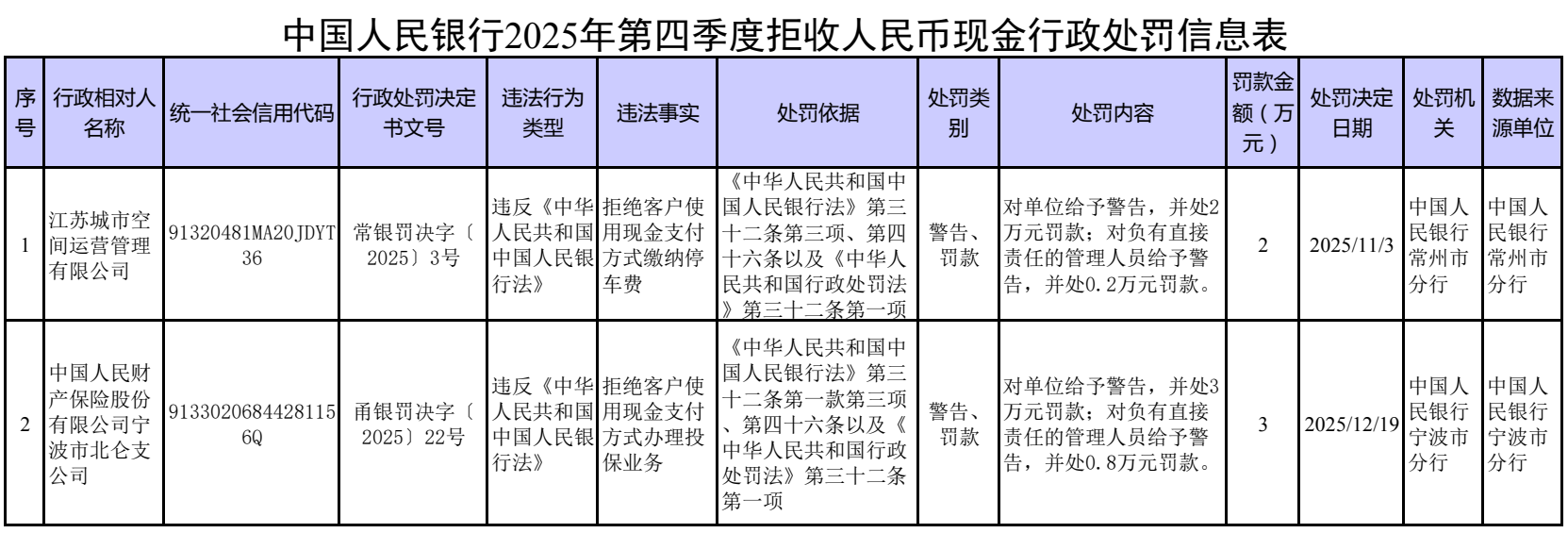
Core Viewpoint - The People's Bank of China has imposed economic penalties on two entities for refusing to accept cash payments, emphasizing the importance of respecting public payment choices and maintaining a harmonious cash circulation environment [1][7]. Group 1: Penalties Imposed - Jiangsu Urban Space Operation Management Co., Ltd. was fined 20,000 yuan for refusing cash payments for parking fees, with a direct responsible manager receiving a warning and a fine of 2,000 yuan [3][9]. - China Pacific Insurance Co., Ltd. Ningbo Beilun Branch was fined 30,000 yuan for refusing cash payments for insurance services, with a direct responsible manager receiving a warning and a fine of 8,000 yuan [4][10]. Group 2: Regulatory Framework - The People's Bank of China will continue to enforce regulations against the refusal of cash payments to protect consumer rights and uphold the legal status of the Renminbi [4][10]. - A new regulation titled "Regulations on Cash Payment and Service" will take effect on February 1, 2026, aimed at preventing the refusal of cash and ensuring diverse payment service needs are met [4][10]. Group 3: Compliance Requirements - Charging units and business entities must respect the public's right to choose legal payment methods and cannot refuse cash unless legally mandated [6][12]. - In cases where cash payments are feasible, entities must support cash transactions and provide appropriate services for cash payments in various scenarios, including technical failures [6][12].
央行对两家拒收人民币现金单位作出处罚
Jin Rong Shi Bao· 2026-01-23 01:32
Core Viewpoint - The People's Bank of China has imposed economic penalties on two entities for refusing to accept cash payments, emphasizing the importance of cash as a legal tender and its role in supporting the real economy and financial stability [1][3]. Group 1: Penalties Imposed - Jiangsu Urban Space Operation Management Co., Ltd. received a warning and a fine of 20,000 yuan for refusing cash payments for parking fees, with the responsible manager fined 2,000 yuan [1]. - China Pacific Insurance Co., Ltd.'s Ningbo Beilun branch was fined 30,000 yuan for refusing cash payments for insurance services, with the responsible manager fined 8,000 yuan [1]. Group 2: Regulations on Cash Payments - The newly established "Regulations on Cash Payment and Service" will be implemented to ensure cash payment acceptance in various scenarios, including face-to-face services and online transactions completed offline [2]. - Entities using self-service models must clearly indicate payment methods and cash acceptance policies, while fully respecting the public's right to know and choose payment options [2]. Group 3: Banking Sector Requirements - Financial institutions are required to provide cash deposit and withdrawal services at their branches and ensure that the layout of ATMs meets the needs of different customer groups [3]. - Banks must also manage cash circulation properly to prevent the distribution of unfit currency and support cash acceptance when acting as payment agents [3].
央行公布:对两家单位作出处罚!
Jin Rong Shi Bao· 2026-01-22 11:01
Core Viewpoint - The Chinese government is reinforcing the importance of cash payments and has introduced regulations to ensure that businesses do not refuse cash transactions, thereby protecting consumers' rights and maintaining the status of the Renminbi as the legal currency [2][4]. Group 1: Regulatory Actions - Jiangsu Urban Space Operation Management Co., Ltd. was fined 200,000 yuan for refusing to accept cash payments for parking fees, with an additional 2,000 yuan fine for the responsible management personnel [1]. - China People's Property Insurance Co., Ltd. Ningbo Beilun Branch was fined 300,000 yuan for refusing cash payments for insurance services, with an additional 8,000 yuan fine for the responsible management personnel [1]. Group 2: New Regulations - The new regulations, titled "Regulations on Cash Payment and Service," aim to create a conducive environment for cash circulation amidst diverse payment methods and will take effect on February 1 [2][3]. - The regulations require businesses to support cash payments in face-to-face service scenarios and ensure reasonable cash change availability [3]. Group 3: Banking Sector Requirements - Banks with physical locations must provide cash deposit and withdrawal services, and their layout should meet the needs of different customer groups [4]. - Banks are also required to manage cash flow properly to prevent the circulation of unfit currency and mitigate various business risks [4]. Group 4: Consumer Rights and Complaints - Consumers encountering refusal of cash payments are encouraged to negotiate with businesses and can report such incidents through consumer protection channels if necessary [4].
人民币现金收付新规下月起施行
Xin Lang Cai Jing· 2026-01-15 00:53
Core Viewpoint - The People's Bank of China, in collaboration with the National Development and Reform Commission and the Financial Regulatory Bureau, has established regulations to uphold the legal status of the Renminbi and prevent the refusal of cash payments, effective from February 1, 2026 [1] Group 1: Cash Payment Regulations - The regulations require that entities providing face-to-face services must support cash payments and maintain reasonable change availability [2] - Self-service models and locations like parks and schools must clearly indicate payment methods and provide contact information for cash-related inquiries [3] - Entities that delegate payment collection must ensure that the appointed parties accept cash through formal agreements [4] Group 2: Banking Sector Requirements - Banks must comply with cash management laws and enhance cash service quality to meet public and business needs [4] - Banks with physical branches must facilitate cash deposit and withdrawal services for individual clients [6] - Banks should ensure that the number and layout of cash service points and self-service machines meet the diverse needs of different customer groups [12][15] Group 3: Handling Cash Payment Issues - In cases of cash payment difficulties, entities should negotiate amicably to resolve disputes and protect rights [20] - Evidence of cash refusal or discriminatory practices should be documented for complaints through various consumer protection channels [21]

遇拒收现金可维权 人民币现金收付新规下月起施行
Yang Shi Xin Wen· 2026-01-14 22:22
Core Viewpoint - The People's Bank of China, along with the National Development and Reform Commission and the Financial Regulatory Bureau, has established regulations to uphold the status of the Renminbi as legal tender, prevent the refusal of cash payments, and meet the diverse payment service needs of the public. These regulations will take effect on February 1, 2026 [1]. Group 1: Regulations on Cash Payment Behavior - The regulations emphasize basic requirements for cash payments based on classification management and universal applicability. Key aspects include: - Cash payments must be supported in face-to-face services and transactions that can be completed offline, with reasonable change availability [2]. - Self-service models and locations with unified management must clearly indicate payment methods and cash acceptance [2]. - For fully online transactions, payment methods must be publicly disclosed in advance to respect the public's right to know and choose [2]. - When entrusting other units for cash collection, the principal must require the agent to accept cash through written agreements [2]. - Digital governance promotion and business model innovation must consider public cash usage needs and avoid discrimination against cash payments [2]. Group 2: Requirements for Commercial Banks - Financial institutions are required to enhance cash service quality and meet the needs of the public and businesses by: - Accepting personal customer deposits and providing cash services at physical bank branches [3]. - Ensuring the number and layout of cash service points and self-service machines meet the diverse needs of different customer groups [3]. - Properly managing the return of Renminbi to prevent the circulation of unfit currency and mitigate various business risks [3]. Group 3: Handling Cash Payment Issues - In cases of cash payment difficulties, parties should negotiate amicably with the service provider. If cash is refused or discriminatory measures are taken, evidence should be preserved for complaints through various channels, with the People's Bank of China and relevant departments addressing the issues promptly [5].
人民币现金收付新规!2月1日起实施
Xin Lang Cai Jing· 2026-01-12 06:39
Core Viewpoint - The People's Bank of China, along with other regulatory bodies, has established new regulations for cash transactions to uphold the status of the Renminbi as legal tender and to prevent the refusal of cash payments, effective from February 1, 2026 [3][4]. Group 1: Regulations on Cash Transactions - The new regulations require that entities providing face-to-face services must support cash payments and maintain reasonable change availability [3]. - For self-service models and locations with unified management, operators must clearly indicate payment methods and provide contact information for cash services [3]. - Entities conducting all transactions online must publicly disclose payment methods in advance, respecting the public's right to know and choose [3]. Group 2: Requirements for Financial Institutions - Banks must comply with cash management laws and improve cash service quality to meet public and business needs [5]. - Financial institutions are required to facilitate cash deposit and withdrawal services at their physical locations [5]. - Banks must ensure that the number and layout of cash service points meet the diverse needs of different customer groups [5]. Group 3: Handling Cash Payment Issues - In cases of cash payment difficulties, parties should negotiate amicably with the service provider and retain evidence for complaints if cash is refused or discriminated against [5]. - Complaints can be made through various channels, and the People's Bank of China will coordinate with relevant departments to address these issues promptly [5].