
现金支付

Search documents
人民币现金收付新规实施,线下是否落实?
Xin Lang Cai Jing· 2026-02-02 10:53
Core Viewpoint - The implementation of the new regulations by the People's Bank of China, in collaboration with the National Development and Reform Commission and the Financial Regulatory Bureau, mandates that cash payments must be supported in various transaction scenarios, ensuring accessibility for all consumers, particularly the elderly [1]. Group 1: Regulation Implementation - The new regulations, effective from February 1, require that cash payments be accepted in face-to-face services and that sufficient change is available [1]. - Violations include refusing cash payments from elderly customers or encouraging digital payment methods over cash [1]. Group 2: Observations from Retail Environments - In major chain stores like Ole Supermarket, cash payments are still accepted despite a push for digital payments, with staff available to assist customers using cash [3]. - Local markets, such as the Qing Shiqiao market, continue to facilitate cash transactions, highlighting the importance of cash for elderly shoppers [5]. - Convenience stores have adopted various digital payment methods but still accommodate cash payments upon request, indicating a balance between modern payment systems and traditional cash transactions [5]. Group 3: Challenges in Individual Retail - Some individual retail stores face challenges in providing cash change, with reports of vendors preferring digital payments and lacking sufficient change for cash transactions [7]. - The trend towards digital payments has led to a decline in cash acceptance in certain areas, but cash remains a preferred method for specific consumer groups [7].


人民币现金收付新规来了!这些情况可投诉举报→
新华网财经· 2026-02-01 10:49
Core Viewpoint - The article discusses the implementation of the "Regulations on Cash Payment and Services" by the People's Bank of China, aimed at maintaining the status of the Renminbi as legal tender and preventing the refusal of cash payments, effective from February 1 [2]. Summary by Sections Regulations on Cash Payment Behavior - The regulations establish basic requirements for cash payments, emphasizing that entities providing face-to-face services or online appointments must support cash payments and maintain reasonable change availability [3]. - For self-service models and locations with unified management, entities must clearly indicate payment methods and provide contact information for cash conversion services [3]. - In fully online transactions, entities are required to publicly announce payment methods in advance, respecting the public's right to know and choose [4]. - When delegating payment collection, the delegating party must require the delegate to accept cash through written agreements [5]. - Entities promoting digital governance must consider the public's need for cash and cannot discriminate against cash payments [5]. Requirements for Commercial Banks - Banks must comply with cash management laws and improve cash service quality to meet public and business needs [6]. - Banks with physical locations must handle cash deposits and withdrawals and provide cash services [7]. - Banks should ensure the number and layout of cash service points and self-service machines meet the diverse needs of different customer groups [7]. - Banks must manage the return of Renminbi properly to prevent the circulation of unfit currency and mitigate various business risks [12]. Handling Cash Payment Issues - In cases of cash payment difficulties, individuals should negotiate with the service provider and retain evidence of any refusal to accept cash, reporting issues through various consumer protection channels [8][18]. - The People's Bank of China will collaborate with relevant departments to address complaints and protect the public's legal payment rights [18].

大学生又开始用现金了?透露出什么信号?部分学生讲出了“内情”
Xin Lang Cai Jing· 2025-12-27 12:25
Core Insights - The use of cash among university students is increasing, with approximately 42% of students reporting frequent cash usage, up from 26.4% in 2022 [1][2] - Cash payments are particularly prevalent in specific settings, such as campus canteens and convenience stores, where the cash payment rate can reach 57% [1] Group 1: Reasons for Increased Cash Usage - Cash helps students control their spending, as they can physically see the amount of cash they have left, which encourages them to manage their expenses better [4][6] - In certain situations, cash is necessary due to limitations of mobile payment methods, such as poor network signals or device malfunctions, making cash a reliable backup [7][9] - Privacy concerns drive students to prefer cash payments, as mobile payment platforms can track personal spending habits and potentially expose sensitive information [10][12] - Cash payments are seen as a safeguard against various forms of financial fraud, with students opting for cash to avoid the risks associated with sharing bank details online [13][15] Group 2: Future Outlook - The trend indicates that while cash usage is rising among university students, mobile payments will not disappear but will coexist with cash payments in daily transactions [15]
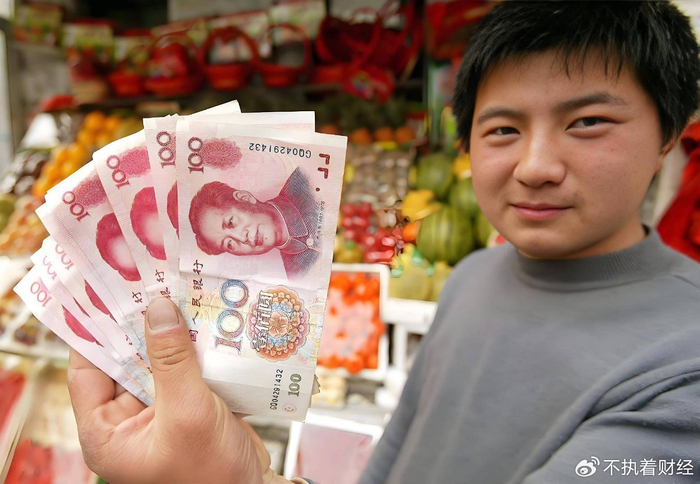
让现金支付不再“碰壁” 央行等三部门发布新规为你“撑腰”
Jin Rong Shi Bao· 2025-12-22 05:02
Core Viewpoint - The People's Bank of China, along with other regulatory bodies, has established the "Regulations on Cash Payment and Service of Renminbi" to enhance the cash payment environment amidst the growing trend of digital payments, ensuring that cash remains a viable payment option for all demographics [1][2]. Group 1: Principles of the Regulations - The regulations adhere to five fundamental principles: prioritizing financial services for the public, addressing emerging issues in cash transactions, implementing comprehensive measures, promoting collaborative governance, and enforcing legal penalties against entities that refuse cash payments [2]. Group 2: Requirements for Payment Scenarios - The regulations specify that cash payments must be supported in scenarios involving face-to-face services and transactions that can be completed in person, while also mandating clear signage regarding payment methods in self-service environments [3][4]. - Entities that conduct all transactions online must publicly disclose their payment methods in advance, respecting the public's right to know and choose [3]. Group 3: Banking Sector Obligations - Banks are required to facilitate cash deposit and withdrawal services, ensuring that their branches and ATMs are accessible to meet diverse customer needs, while also managing cash flow to prevent the circulation of unfit currency [5]. - In cases of cash payment refusal, the public is encouraged to negotiate with the service provider and report any discriminatory practices through official channels, with the central bank and relevant authorities committed to addressing such complaints [5].
让现金支付不再“碰壁”
Jin Rong Shi Bao· 2025-12-22 03:47
Core Viewpoint - The People's Bank of China, along with other regulatory bodies, has established the "Regulations on Cash Payment and Service" to enhance the cash circulation environment amidst the rise of digital payment methods, ensuring that cash remains a viable payment option for all demographics [1][2]. Group 1: Regulations Overview - The regulations aim to clarify the cash service obligations of various charging units, operating entities, and banking institutions, promoting a collaborative effort to maintain a cash-friendly environment [1][2]. - The regulations are based on five fundamental principles: serving the public, problem orientation, comprehensive measures, collaborative governance, and legal accountability [2]. Group 2: Payment Scenarios - The regulations specify that cash payments must be supported in scenarios involving face-to-face services and transactions that can be completed in person, ensuring reasonable cash availability [3]. - For self-service models and areas with unified management, operators must clearly indicate accepted payment methods and cash conversion options [3][4]. Group 3: Banking Sector Requirements - Banking institutions are required to provide cash deposit and withdrawal services, ensuring that their network and self-service machines meet the needs of various customer groups [5]. - In cases of cash payment difficulties, the public is encouraged to negotiate with the service provider and report any refusal or discriminatory practices through appropriate channels [5].
人民币现金支付,最新规定!
Xin Lang Cai Jing· 2025-12-21 11:27
Core Viewpoint - The People's Bank of China, along with the National Development and Reform Commission and the Financial Regulatory Bureau, has established new regulations regarding cash payments, which will take effect on February 1, 2026, to ensure the acceptance of cash as a legitimate payment method and to prevent discrimination against cash transactions [1][6]. Group 1: Regulations on Cash Payments - The new regulations mandate that payment units and business entities must respect the public's right to choose legal payment methods and cannot refuse cash payments or induce others to do so [5][6]. - Payment units and business entities are required to support cash payments in specific scenarios, including face-to-face services and online transactions that are completed offline [3][7][9]. - Cash payment-supporting entities must maintain adequate change and necessary conditions to ensure smooth cash transactions [3][12]. Group 2: Responsibilities of Payment Units and Financial Institutions - Payment units and business entities must clearly indicate accepted payment methods and provide contact information for cash payment services [10]. - Financial institutions are required to enhance cash service quality, including accepting cash deposits and providing face-to-face cash services [13][14]. - Institutions must also establish emergency cash service mechanisms to address sudden cash demands and ensure the availability of cash [14]. Group 3: Enforcement and Compliance - The People's Bank of China and its branches have the authority to supervise and inspect compliance with cash acceptance regulations, and violators will face penalties [15][16]. - The public is encouraged to report instances of cash refusal or discrimination against cash payments to local branches of the People's Bank of China [5][15].
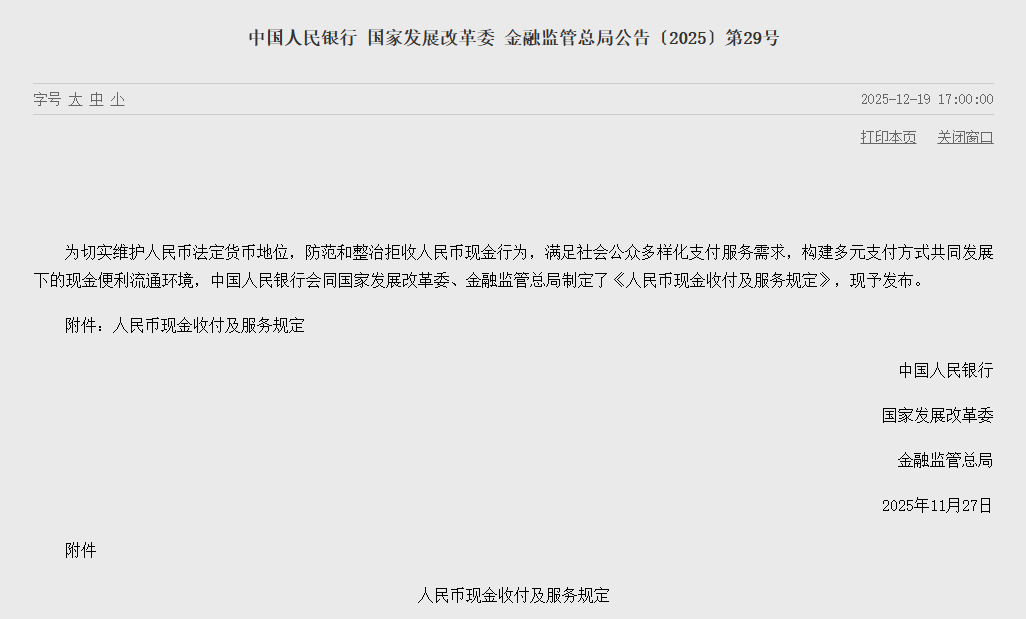
官方出手,不得拒收现金!
Zhong Guo Ji Jin Bao· 2025-12-19 16:39
Core Viewpoint - The People's Bank of China, in collaboration with the National Development and Reform Commission and the Financial Regulatory Bureau, has established the "Regulations on Cash Payment and Services in Renminbi" to uphold the legal status of the Renminbi and prevent the refusal of cash payments [1][2]. Group 1: Regulations Overview - The regulations aim to create a conducive environment for cash circulation while allowing diverse payment methods, based on relevant laws such as the People's Bank of China Law and the Commercial Banking Law [2]. - All public service charging units and business entities must respect the public's right to choose legal payment methods and cannot refuse cash payments unless legally mandated [2][3]. - Charging units and business entities must support cash payments in specific scenarios, including face-to-face services and transactions completed offline after online reservations [3]. Group 2: Cash Payment Support - Charging units must clearly display payment methods and provide contact information for cash payment services, especially in self-service scenarios [3]. - In cases where large amounts of coins or small denominations are presented, entities must negotiate solutions rather than refuse cash [5]. - Financial institutions are required to enhance cash service quality, including accepting cash deposits and providing adequate self-service machines to meet public demand [5][6]. Group 3: Compliance and Enforcement - The regulations stipulate that if charging units refuse cash or discriminate against cash payments, the public can gather evidence and report to local branches of the People's Bank of China for legal recourse [10]. - The People's Bank of China and its branches have the authority to supervise and inspect compliance with these regulations, ensuring that entities do not obstruct or evade checks [11]. - The regulations will take effect on February 1, 2026, and will be interpreted by the People's Bank of China in conjunction with the National Development and Reform Commission [13][12].
明年施行!关于人民币现金收付及服务,央行等三部门发文
Zhong Guo Zheng Quan Bao· 2025-12-19 12:50
Core Viewpoint - The People's Bank of China has announced new regulations to protect the legal status of the Renminbi and prevent the refusal of cash payments, effective from February 1, 2026, aiming to create a diverse payment environment that supports cash circulation [1]. Group 1: Regulations and Compliance - The new regulations clarify the cash service obligations of various entities, including charging units and financial institutions, to ensure the public's right to choose legal payment methods is respected [4]. - Charging units and businesses are prohibited from refusing cash payments, inducing others to refuse cash, or implementing discriminatory measures against cash payments [4][5]. Group 2: Cash Payment Requirements - The regulations outline five basic requirements for ensuring cash payments, including the necessity for face-to-face services to support cash payments and maintaining reasonable change availability [5]. - In self-service models, businesses must clearly indicate payment methods and provide contact information for cash services [5][6]. Group 3: Financial Institutions' Responsibilities - Financial institutions are required to enhance cash service quality and comply with relevant cash management laws to meet the needs of the public and businesses [9]. - Banks must ensure that cash deposit and withdrawal services are available at physical branches and that the number and layout of cash service points meet diverse customer needs [10][11]. Group 4: Public Engagement and Rights - The public is encouraged to maintain the integrity of the Renminbi and to resolve disputes amicably with charging units when facing cash payment issues [12]. - In cases of cash refusal or discrimination, the public should retain evidence and report through appropriate channels for timely resolution by the People's Bank of China [12].
提醒:家里有这两种现金的,尽快去银行兑换,避免后续麻烦
Sou Hu Cai Jing· 2025-12-13 11:23
Core Insights - The proportion of non-cash payments in China reached 87.3% in 2024, an increase of 16.5 percentage points since 2020, indicating a significant shift towards digital payment methods [1] - Despite the rise in non-cash payments, cash remains a vital payment method among rural areas and the elderly, with 67.2% of individuals aged 60 and above still using cash as their primary payment tool [1] Group 1: Cash Usage and Trends - The cash usage rate in rural areas remains high at 52.8%, highlighting the ongoing reliance on cash in these regions [1] - In 2024, approximately 3% of circulating banknotes, or 3.7 billion notes, were returned due to damage, indicating a notable issue with paper currency maintenance [3] Group 2: Damaged Currency Handling - Banks received an average of 286,000 taped banknotes daily in 2024, accounting for 15.7% of total exchange transactions, reflecting a common practice among the public to repair damaged notes [5] - Starting June 1, 2025, banks will implement stricter standards for accepting taped banknotes, rejecting those with tape covering more than 30% of the note's surface area [5] - The use of tape on banknotes compromises their anti-counterfeiting features, increasing the risk of counterfeit currency circulation [5] Group 3: Severe Damage to Banknotes - Banknotes with over 25% damage or those that are illegible or severely deteriorated must be exchanged at banks, as they are no longer suitable for circulation [8] - In 2024, banks received 820 million severely damaged banknotes, totaling approximately 32.7 billion yuan, with holders facing a loss of 1.58 billion yuan due to unidentifiable notes [8] - From July 2025, banks will exchange severely damaged notes based on the percentage of damage, meaning a 100 yuan note with 45% damage will only be exchanged for 55 yuan [8] Group 4: Preventive Measures for Currency Maintenance - To prevent damage to banknotes, it is advised to avoid folding them, keep them clean, store them in dry environments, and refrain from writing or attaching foreign objects to them [10] - Individuals should refuse to accept taped or damaged banknotes to avoid complications in future transactions [10]
当2025年你依旧使用现金支付.
Xin Lang Cai Jing· 2025-12-12 15:43
Core Viewpoint - The article discusses the recent developments in the investment banking sector, highlighting key trends and potential opportunities for investors [1] Group 1: Industry Trends - The investment banking industry is experiencing a significant shift towards digital transformation, with firms investing heavily in technology to enhance efficiency and client service [1] - There is an increasing focus on sustainable finance, with more investment banks integrating environmental, social, and governance (ESG) criteria into their operations and offerings [1] Group 2: Company Developments - Several leading investment banks reported strong quarterly earnings, driven by robust trading activities and advisory services, indicating resilience in the face of market volatility [1] - Mergers and acquisitions (M&A) activity has picked up, with a notable increase in deal volume compared to the previous year, suggesting a recovery in corporate confidence [1]
