
企业纾困

Search documents
让企业有切实的获得感
Jing Ji Ri Bao· 2026-02-02 00:05
Group 1 - The core viewpoint emphasizes the importance of continuous engagement between government and enterprises through regular meetings to address specific business challenges and improve the business environment [1][2] - Huzhou has implemented a mechanism of weekly government-enterprise talks for over three years, which has transformed these meetings into a systematic approach to problem-solving [2] - The focus on understanding the real needs of businesses allows for targeted and precise policy measures, moving away from broad, ineffective solutions to more tailored support [1][2] Group 2 - The integration of various policies and collaborative efforts among departments is essential for effectively addressing the complex issues faced by enterprises [1] - The sustained commitment to these meetings not only mobilizes resources but also instills confidence in businesses regarding their development prospects [2] - The approach taken by Huzhou serves as a model for optimizing the business environment and fostering the growth of the private economy through concrete actions [2]
进一步践行“金融五篇大文章”,助力区域上市公司脱困转型
Jin Rong Jie· 2025-12-29 04:04
Core Viewpoint - The successful completion of a rescue project for a listed company by China Great Wall Asset Management Corporation Beijing Branch demonstrates the company's professional capabilities and commitment to serving the real economy and mitigating financial risks [1] Group 1: Company Challenges - A listed company, once a star in its industry, faced liquidity crises and debt repayment pressures due to macroeconomic conditions and industry adjustments, necessitating an urgent resolution to its financial difficulties [2] Group 2: Risk Mitigation Strategies - The company implemented a comprehensive rescue plan focusing on optimizing debt structure, alleviating repayment pressures, and enhancing operational efficiency through various measures, including the establishment of a special rescue plan and the acquisition of long-term receivables [3] - A local state-owned capital management platform was introduced as a key partner to support the rescue plan, ensuring smooth project progression and risk control [3] Group 3: Outcomes and Benefits - The rescue plan significantly improved the company's financial situation by optimizing debt maturity structure and shedding inefficient assets, thereby enhancing liquidity and operational sustainability [4] - The funds from the rescue and asset recovery provided the company with resources for strategic transformation, allowing it to explore new areas such as renewable energy and green economy [4] - The project exemplified a successful practice of a "debt + equity" and "financing + intelligence" comprehensive rescue model, accumulating valuable experience for future similar initiatives [4] Group 4: Commitment to National Strategy - The company remains committed to its primary responsibility in non-performing asset disposal, aiming to enhance professional capabilities and innovate business models while contributing to the prevention and resolution of financial risks and supporting high-quality development of the real economy [5]
做空式纾困?派驻高管“自我举报”致上市公司被ST
Xi Niu Cai Jing· 2025-12-17 12:05
Core Viewpoint - The article discusses the challenges and controversies surrounding the asset management plans aimed at supporting private enterprises in China, particularly focusing on the case of Guizhou Bailing and Huachuang Securities, highlighting issues of control, compliance, and the effectiveness of such plans [2][5][10]. Group 1: Background and Initial Plans - In October 2018, the China Securities Association proposed asset management plans to support the development of private enterprises due to significant market volatility affecting A-shares, particularly impacting private companies with stock pledges [2]. - The asset management plans were designed to alleviate liquidity crises for promising private companies and to project a positive image of the industry fulfilling its social responsibility [2]. - In 2022, guidelines were issued to clarify the responsibilities of fund providers, emphasizing minimal intervention in company operations to protect the control rights of private enterprises [2]. Group 2: Controversies and Legal Disputes - Huachuang Securities' support plan for Guizhou Bailing has sparked significant controversy, leading to legal disputes between the two parties, with claims and counterclaims regarding the fulfillment of contractual obligations [4][5]. - The lawsuit initiated by Huachuang Securities against Guizhou Bailing's chairman, Jiang Wei, involves a claim of 1.761 billion yuan, with Jiang counter-suing for continued performance of the support agreement [5][6]. - The initial support plan involved Huachuang Securities providing 1.4 billion yuan in funding and acquiring an 11.54% stake in Guizhou Bailing, alongside a stock pledge loan of 361 million yuan [6][7]. Group 3: Management and Operational Issues - During the support period, Huachuang Securities allegedly failed to adhere to the agreed exit strategy, leading to a lawsuit for repayment of the principal and interest on the loans [8][9]. - The management of the support plan has raised concerns, as Huachuang Securities deployed a large team to oversee Guizhou Bailing, which contradicted the initial intent of the support plans to avoid control over the companies [11][12]. - Reports indicate that Huachuang Securities' actions may have negatively impacted Guizhou Bailing's financial performance, with significant declines in net profit following the initiation of the support plan [19][20]. Group 4: Broader Implications and Recommendations - The case exemplifies the structural contradictions and governance challenges faced by private enterprises during transitions and support processes, highlighting the need for clear rules and cooperation among stakeholders [22][25]. - Recommendations include establishing clear agreements regarding control rights, ensuring that support funds are used to enhance core business capabilities, and preventing conflicts of interest that could arise from control disputes [23][24]. - The article emphasizes that the essence of support mechanisms should be to assist companies without becoming a channel for capital competition or liquidation, advocating for a balanced approach to ensure long-term healthy development [25].



145亿,瑰丽酒店被摆上货架
投中网· 2025-12-17 04:10
Core Viewpoint - The article discusses the potential sale of assets from the Rosewood Hotel Group, owned by the Cheng family, amid financial difficulties faced by their real estate subsidiary, New World Development Group [4][5][10]. Group 1: Rosewood Hotel Group Overview - Rosewood Hotels, established 46 years ago, is known for its unique identity and has been significantly influenced by two generations of female leadership [7]. - The brand was founded by Caroline Rose Hunt, who expanded it internationally, with the first overseas hotel opening in Mexico City in 1998 [7][9]. - In 2011, the Cheng family acquired Rosewood and its five hotels for over $800 million, marking a new chapter for the brand under the leadership of Zheng Zhihua [8][9]. Group 2: Financial Challenges of New World Development - New World Development is facing severe liquidity challenges, with a reported loss of approximately HKD 171.26 billion for the fiscal year 2024, marking its first loss in nearly 20 years [17]. - The company's total borrowings reached HKD 1,464.88 billion, with HKD 322.1 billion due within 12 months, while cash reserves were only HKD 214.18 billion [17]. - The stock price of New World Development has plummeted by 87% compared to its peak in 2019, prompting the company to prioritize cash recovery and debt reduction [18]. Group 3: Asset Sale and Future Prospects - The potential sale of Rosewood assets is seen as a crucial move for the Cheng family to alleviate financial pressures [10]. - New World Development aims to recover HKD 26 billion by selling development projects and accelerating cash flow from mainland China and Hong Kong [18]. - The company has also proposed a debt restructuring plan, including a significant write-down of up to 50% on certain bonds, indicating the severity of its financial situation [19].


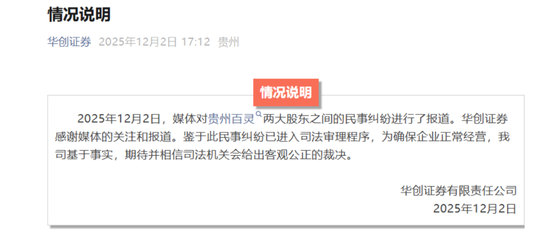
从14亿纾困到对簿公堂!华创证券与贵州百灵为何撕破脸?
Xin Lang Cai Jing· 2025-12-03 13:15
Core Viewpoint - The dispute between Guizhou BaiLing and Huachuang Securities, which began as a cooperation to alleviate financial difficulties, has escalated into a legal battle over control and financial obligations, with both parties presenting conflicting claims regarding the management and control of the company [1][3][40]. Group 1: Background of the Dispute - In 2019, Guizhou BaiLing's controlling shareholder Jiang Wei introduced Huachuang Securities as a rescue partner due to high debt and stock pledge rates, leading to a financial arrangement involving 1.4 billion yuan and stock pledges [4][40]. - Huachuang Securities provided 1.4 billion yuan through two asset management plans and acquired 161 million shares, representing 11.54% of Guizhou BaiLing's total shares [5][40]. - The two parties agreed to a strategic partnership, with Huachuang Securities stating it would not seek control over Guizhou BaiLing [7][42]. Group 2: Legal Proceedings and Claims - Huachuang Securities filed a lawsuit against Jiang Wei and others, claiming repayment of the 1.4 billion yuan principal and 361 million yuan from stock pledges, along with interest and penalties [1][3][45]. - Jiang Wei has accused Huachuang Securities of attempting to gain control over Guizhou BaiLing under the guise of financial assistance, leading to regulatory investigations [3][38]. - The legal dispute has reached the courts, with Huachuang Securities asserting its claims while Jiang Wei counters with allegations of misconduct by Huachuang Securities [1][3][48]. Group 3: Financial Implications - As of December 3, Guizhou BaiLing's stock price was 5.57 yuan per share, with a total market capitalization of 7.785 billion yuan, while the shares involved in the dispute were valued at approximately 1.944 billion yuan, exceeding the 1.761 billion yuan in claims [12][46]. - The financial arrangements included additional collateral, such as properties and receivables, to secure the investments made by Huachuang Securities [11][45]. - The ongoing litigation poses significant financial risks for Huachuang Securities, as the outcome will impact its asset quality and risk management practices [35].
“企业若遇困难,环保行政罚没款可缓缴”扬州市生态环境局出台环境执法新规
Yang Zi Wan Bao Wang· 2025-11-10 05:37
Core Points - The new environmental enforcement regulations in Yangzhou allow companies facing difficulties to defer or pay fines in installments, balancing strict enforcement with regulatory compassion [1][2] - Companies can apply for deferred payments if they encounter financial difficulties due to natural disasters, economic restructuring, or other significant economic activities [1] - Required documentation for deferral includes financial statements, tax declarations, and a written commitment to pay on time [1] Group 1 - The environmental department will approve applications with sufficient justification and complete documentation, issuing a notice for installment or deferred payment [1] - If an application is rejected, the company will be informed in writing, and they must ensure the authenticity of submitted materials [1][2] Group 2 - Companies that comply with the deferral agreement will not have their environmental credit ratings affected, while non-compliance may lead to credit downgrades [2] - The deferral applies only to administrative penalty fines, excluding confiscated illegal gains, with a maximum deferral period of six months and installment payments limited to three periods [2] - Failure to pay within the deferral period will result in court enforcement and additional penalties of 3% per day on the fine amount [2]
中经评论:奋力跑好全年经济“最后一棒”
Jing Ji Ri Bao· 2025-10-24 00:01
Economic Performance Overview - The fourth quarter's economic performance is crucial for achieving annual development goals and ensuring a smooth transition from the 14th Five-Year Plan to the 15th [1] - The overall economic growth rate of 5.2% in the first three quarters ranks among the top globally, with stable employment and improved price levels [1] Challenges and Risks - The economy faces significant challenges, including insufficient global economic growth, trade protectionism, and weak domestic demand, particularly in consumption [2] - Specific data shows that retail sales growth slowed to 3% in September, and fixed asset investment declined by 0.5% from January to September, marking the first negative growth since September 2020 [2] Policy Recommendations - Macro policies need to be strengthened and made more effective to support stable economic operation, with a focus on employment, enterprises, and market stability [3] - There is a call for expanding domestic demand through targeted actions to boost consumption and investment, particularly in the service sector and manufacturing upgrades [3] Support for Enterprises - Companies are facing challenges such as insufficient market demand and low profitability, necessitating targeted policy measures to alleviate these issues [4] - Emphasis is placed on optimizing the business environment and supporting the development of small and medium-sized enterprises, which are vital for job creation and economic vitality [4]
奋力跑好全年经济“最后一棒”
Jing Ji Ri Bao· 2025-10-23 21:37
Core Viewpoint - The economic performance in the fourth quarter is crucial for achieving annual development goals and ensuring a smooth transition from the 14th Five-Year Plan to the 15th Five-Year Plan [1][2] Economic Performance - The economy showed a stable growth trend in the first three quarters, with a GDP growth rate of 5.2%, ranking among the top of major global economies [1] - The total retail sales of consumer goods increased by 4.5% year-on-year in the first three quarters, but the growth rate dropped to 3% in September, marking a decline for four consecutive months [2] - Fixed asset investment decreased by 0.5% year-on-year from January to September, the first negative growth since September 2020, with private investment down by 3.1% [2] Policy Measures - The government has implemented more proactive macroeconomic policies to stabilize employment, businesses, markets, and expectations, ensuring stable economic operation [3] - Policies to boost consumption, such as the trade-in program for consumer goods, have led to double-digit growth in retail sales of certain categories [3] - There is a need for timely and flexible policy adjustments to address changing economic conditions [3] Support for Enterprises - Enterprises face challenges such as insufficient market demand and low profitability, necessitating targeted policy measures to alleviate their difficulties [4] - Improving the business environment and removing barriers to market entry are essential for fostering enterprise vitality, particularly for small and medium-sized enterprises [4] - The focus should be on ensuring that policy benefits translate into real support for enterprise development [4]
仕净科技:亏损高负债高质押之后 国资SPV拟3亿元资金纾困
2 1 Shi Ji Jing Ji Bao Dao· 2025-09-30 04:42
Core Viewpoint - The company is facing significant liquidity pressure and has entered into a cooperation agreement with state-owned entities to establish a special purpose vehicle (SPV) for financial relief, amounting to 301 million yuan [1] Group 1: Financial Measures - The SPV will implement a financial relief plan with an initial funding of up to 135 million yuan, of which approximately 72.5 million yuan will be used to acquire existing debts and 62.5 million yuan will be allocated as a special loan to ensure employee salaries and operational continuity [1] - The loan has a term of three years with a fixed annual interest rate of 4.5%, and the company is required to provide collateral and guarantees for the loan [1] Group 2: Shareholding Changes - As of September 1, the major shareholder Zhu Ye held 15.64% of the company's shares, with 98.43% of those shares pledged; another shareholder, Ye Xiaohong, held 4.27% with 99.96% pledged [1] - To repay pledged debts, Zhu Ye transferred 4.99% of the total share capital to the Scorpio No. 32 private equity fund, reducing his shareholding to 10.65% [1] Group 3: Financial Performance - In the first half of 2025, the company reported revenue of 1.057 billion yuan, a year-on-year decline of 48.24%, and a net loss attributable to shareholders of 120 million yuan [1] - The company's asset-liability ratio stands at 89.93%, indicating significant financial pressure [1]
仕净科技与国有机构签订合作协议
Zhi Tong Cai Jing· 2025-09-29 08:51
Core Viewpoint - The company is facing temporary liquidity difficulties and has announced a cooperation agreement with several partners to provide financial support and stabilize operations [1] Group 1: Cooperation Agreement - The company plans to sign a cooperation agreement with Suzhou Xingtai Industrial Development Co., Ltd., Suzhou Yangcheng Lake Digital Cultural and Creative Park Investment Co., Ltd., and Suzhou Surun Enterprise Consulting Management Co., Ltd. to address liquidity issues [1] - The agreement involves the establishment of a Special Purpose Vehicle (SPV) to provide financial support and mitigate debt risks [1] Group 2: Financial Details - The total subscribed capital of the newly established limited partnership, Suzhou Runjing Enterprise Management Partnership (Limited Partnership), is 301 million RMB [1] - Partners will contribute as follows: each of the two limited partners will contribute 150 million RMB, while the general partner will contribute 1 million RMB [1] - The initial capital contribution will not exceed 45% of the subscribed capital, with a total investment for liquidity support capped at 300 million RMB, and the first phase of funding not exceeding 135 million RMB [1]