信息存储

Search documents
【人民网】中国科研团队在铁电材料中发现一维带电畴壁
Ren Min Wang· 2026-01-26 02:31
Core Viewpoint - The research team from the Institute of Physics, Chinese Academy of Sciences, has discovered a one-dimensional charged domain wall in ferroelectric materials with a thickness and width approximately one hundred thousandth of a human hair, providing a scientific basis for developing devices with extreme storage density [1] Group 1: Research Findings - The discovery challenges the traditional belief that domain walls in three-dimensional crystals must be two-dimensional surfaces [1] - The potential applications of ferroelectric materials are significant in fields such as information storage, sensing, and artificial intelligence [1] Group 2: Storage Density Potential - Utilizing one-dimensional charged domain walls for information storage could increase storage density by several hundred times, theoretically reaching about 20TB per square centimeter [1] - This storage capacity is equivalent to storing 10,000 high-definition movies or 200,000 high-definition short videos on a device the size of a postage stamp [1]

我国铁电材料获重大突破 未来信息存储密度有望提升数百倍
Xin Lang Cai Jing· 2026-01-24 13:24
Core Insights - A research team from the Chinese Academy of Sciences has developed self-supporting ferroelectric thin films using laser methods, which could significantly enhance data storage capabilities for artificial intelligence devices [1] - The new one-dimensional charged domain walls in these films are expected to increase storage density by several hundred times, potentially reaching about 20TB per square centimeter, equivalent to storing 10,000 HD movies or 200,000 HD short videos on a device the size of a postage stamp [1] Group 1: Research and Development - The research focuses on ferroelectric materials that can spontaneously exhibit charge separation and ordered arrangement without an external electric field [1] - The study of ferroelectric materials and domain walls is at the forefront of material science and information technology, aiming to create high-performance devices to meet national strategic needs in information storage, artificial intelligence, and advanced technology [1] - The emergence of fluorite-structured ferroelectric materials presents new opportunities in this field, with research on these materials starting in 2018 [1] Group 2: Technological Implications - The precise control of internal polarization "switches" (ferroelectric domains) and their boundaries (domain walls) is crucial for developing the next generation of devices [1] - The discovery of new states of one-dimensional charged domain walls fills a gap in ferroelectric physics, potentially leading to advancements in various technological applications [1]
【新华社】极限密度!我国新成果有望让器件“存得更多 占得更少”
Xin Hua She· 2026-01-23 05:54
Core Viewpoint - The research team from the Chinese Academy of Sciences has discovered a one-dimensional charged domain wall in ferroelectric materials, which significantly enhances storage density, providing a scientific basis for developing devices with extreme density [1] Group 1: Research Findings - The thickness and width of the discovered domain wall are approximately one hundred thousandth of a human hair, challenging the traditional belief that domain walls in three-dimensional crystals must be two-dimensional surfaces [1] - The research results have been published in the international academic journal "Science" on January 23 [1] Group 2: Applications and Potential - Ferroelectric materials have immense potential in information storage, sensing, and artificial intelligence [1] - Utilizing one-dimensional charged domain walls for information storage could increase storage density by several hundred times, theoretically reaching about 20TB per square centimeter, equivalent to storing 10,000 HD movies or 200,000 HD short videos on a device the size of a postage stamp [1]
极限密度!我国新成果有望让器件“存得更多 占得更少”
Xin Hua She· 2026-01-23 01:04
Core Insights - The research team from the Chinese Academy of Sciences has discovered a one-dimensional charged domain wall in ferroelectric materials, which significantly enhances device storage density, providing a scientific basis for developing devices with extreme density [1] Group 1: Research Findings - The thickness and width of the one-dimensional charged domain wall are approximately one hundred thousandth of a human hair, challenging the traditional belief that domain walls in three-dimensional crystals must be two-dimensional surfaces [1] - This discovery has the potential to increase storage density by several hundred times, with theoretical estimates reaching about 20TB per square centimeter, equivalent to storing 10,000 HD movies or 200,000 HD short videos on a device the size of a postage stamp [1] Group 2: Applications and Implications - Ferroelectric materials have significant application potential in information storage, sensing, and artificial intelligence [1] - The findings have been published in the international academic journal "Science," indicating the research's relevance and impact in the scientific community [1]
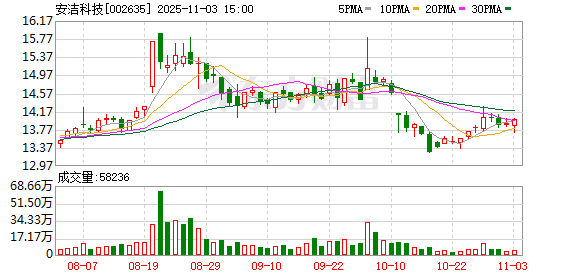
安洁科技:公司主营业务涵盖消费电子、新能源汽车以及信息存储等板块
Zheng Quan Ri Bao· 2025-11-03 09:13
Core Viewpoint - Anjie Technology is actively expanding its business in consumer electronics, new energy vehicles, and information storage, while also planning to adapt its product offerings based on market and customer demands [2] Group 1: Business Operations - The company's main business segments include consumer electronics, new energy vehicles, and information storage [2] - Anjie Technology is considering timely adjustments to its product or solution offerings in response to market and customer needs [2] Group 2: Corporate Actions - The company is in the process of acquiring a portion of equity from Anjieli Meiwai through its wholly-owned subsidiary, with the work progressing as planned [2] - The equity transfer has not yet been completed, and it is currently not expected to have a significant impact on the company's overall performance [2]


刚得诺奖的成果被做成芯片了
猿大侠· 2025-10-14 04:11
Core Viewpoint - The article discusses the recent advancements in Metal-Organic Frameworks (MOFs) and their application in creating ultra-miniature fluid chips, highlighting their potential to revolutionize computing by mimicking brain-like memory functions [1][20]. Group 1: MOF Technology and Applications - MOFs, once deemed "useless," have gained recognition after winning the Nobel Prize in Chemistry, leading to innovative applications such as fluid chips [1][20]. - The newly developed fluid chips can perform conventional calculations while also retaining previous voltage changes, resembling short-term memory similar to that of brain neurons [2][3]. - The creation of advanced fluid chips using MOF materials addresses the challenges of high-precision nano-channel devices, enabling adjustable non-linear ion transport [4][5]. Group 2: Device Structure and Functionality - Researchers constructed a layered nano-fluid transistor device (h-MOFNT) using Zr-MOF-SO₃H crystals, which features heterogeneous junctions for enhanced performance [7][8]. - The device exhibits non-linear proton transport characteristics, differing from typical diode behavior, indicating a threshold-controlled transport mechanism [12][13]. - The h-MOFNT demonstrated a memory effect, capable of retaining past voltage states, which could lead to applications in liquid-based information storage and brain-like computing [18][19]. Group 3: Historical Context and Future Potential - Historically, MOFs have been viewed as having significant theoretical potential but lacking practical applications, with over 100,000 related papers published but few achieving industrial application [25][26]. - The challenges faced by MOFs include structural stability issues and complex synthesis processes, which have hindered their widespread use [27][28]. - The emergence of MOF-based chips suggests that the material may not be "useless" but rather that suitable applications have yet to be fully explored [29].

刚得诺奖的成果被做成芯片了
量子位· 2025-10-13 03:35
Core Viewpoint - The article highlights the recent breakthrough in using Metal-Organic Frameworks (MOFs) to create ultra-miniature fluid chips, which can perform computations and exhibit short-term memory similar to brain neurons, challenging the previous notion that MOFs were "useless" [1][20]. Group 1: MOF Technology and Applications - MOFs, once considered theoretical with limited practical applications, have now been recognized for their potential in advanced computing technologies following their Nobel Prize acknowledgment [1][21]. - The newly developed fluid chip, made from MOF materials, can overcome limitations of traditional electronic chips by enabling advanced functionalities [3][5]. - The h-MOFNT device constructed from layered Zr-MOF-SO₃H crystals demonstrates unique ion transport properties, allowing for precise control over ionic movement [7][12]. Group 2: Device Characteristics and Performance - The h-MOFNT device exhibits non-linear proton transport characteristics, which differ from typical diode behavior, indicating a threshold-controlled transport mechanism [12][13]. - Experimental results show that the device can remember past voltage states, demonstrating fluid memory and learning capabilities, akin to electronic devices [16][18]. - The ability to create a small fluid circuit using multiple h-MOFNTs showcases the potential for complex computations and memory functions in liquid systems [16][19]. Group 3: Historical Context and Future Prospects - Historically, despite extensive research (over 100,000 related papers), the practical industrial application of MOFs has been limited due to issues like structural stability and production costs [25][27]. - The emergence of MOF-based chips suggests that the material may not be "useless," but rather that suitable applications were not previously identified [29]. - Future developments may lead to the realization of liquid-based information storage and brain-like computing systems through innovative design of heterogeneous constraint systems [19].