
信用债发行

Search documents
2025年信用债发行情况回顾:乘势扩容续创新,高结构分化态势延续
Dong Fang Jin Cheng· 2026-01-23 01:10
Report Industry Investment Rating No information provided in the content. Core Views of the Report - In 2025, the credit bond issuance interest rate center further declined. After the launch of the science - technology board in the bond market in May, the issuance of science - innovation bonds significantly increased. The continuous growth of industrial bond issuance drove the overall credit bond issuance to reach a new historical high. The net financing of credit bonds increased significantly year - on - year, with only a net financing gap in March [2]. - The financing differentiation pattern between urban investment bonds and industrial bonds intensified in 2025. Urban investment bond issuance continued to shrink, while industrial bond issuance increased significantly driven by the surge in central enterprise bonds. From the perspective of issuer qualifications, high - grade bonds expanded, while medium - and low - grade bonds contracted [2]. - In 2025, the industrial bond issuance scale grew steadily. Most industries saw an increase in industrial bond issuance, and the issuance was concentrated in a few industries. The issuance was also concentrated among leading enterprises, and large central enterprises contributed significantly to net financing [2][4]. - In 2025, urban investment bond issuance remained in a contraction trend, and the net financing gap widened year - on - year. Most regions saw a decline in issuance and an expansion of the net financing gap. The net financing gap of AA - rated urban investment bonds narrowed due to the decrease in maturity volume, but the net financing of medium - and high - grade urban investment bonds in some regions turned negative [4]. Summary According to Related Catalogs 1. Credit Bond Issuance in 2025 1.1 Overall Credit Bond Issuance - In 2025, the credit environment was loose, and the bond market yield was low. With policy dividends, industrial bond issuance increased significantly, driving the continuous expansion of credit bond issuance and a substantial increase in net financing. The total credit bond issuance was 13.9 trillion yuan, a year - on - year increase of 1.7%. The net financing was 2.3 trillion yuan, an increase of 4924 billion yuan year - on - year [7]. - The monthly issuance rhythm showed a "low - front, stable - back" characteristic. Most months had a year - on - year increase in issuance, and only March had a significant net financing gap due to interest rate hikes [12]. 1.2 Issuance Interest Rate - In 2025, the average credit bond issuance interest rate fluctuated at a low level, and the center moved down. The average issuance interest rate was 2.15%, a year - on - year decrease of 35.96bps. The main reasons were the loose monetary policy and the narrowing of credit spreads [15][16]. - Throughout the year, the issuance interest rates of major - term and all - grade credit bonds showed two rounds of rising and then falling. The interest rate was affected by factors such as the tightening of the capital market, policy adjustments, and the stock - bond seesaw effect [22]. 1.3 Issuance Term - In 2025, the weighted - average issuance term of credit bonds was 3.43 years, a year - on - year decrease of 0.17 years. It showed an upward trend in the first half of the year and a downward trend in the second half, mainly due to the increase in financing costs and the significant shortening of the issuance term of central enterprises [23]. 1.4 Cancellation of Issuance - In 2025, the scale of cancelled credit bond issuance was 276.16 billion yuan, a year - on - year increase of 0.34%. The cancellation was mainly due to market interest rate fluctuations and the adjustment of the financing strategies of central and local state - owned enterprises [28]. 2. Credit Bond Financing Structure in 2025 2.1 Financing Performance of Different - Grade Issuers - In 2025, the credit bond market showed a differentiation trend of high - grade expansion and medium - and low - grade contraction. The issuance of AAA - rated, AA + - rated, and AA - rated credit bonds was 9.80 trillion, 2.95 trillion, and 1.10 trillion yuan respectively [35]. 2.2 Financing Performance of Different - Nature Issuers - The credit bond market continued the differentiation trend of shrinking urban investment bond issuance and increasing industrial bond issuance. In 2025, the issuance of urban investment, industrial local state - owned enterprises, central enterprises, and private enterprises was 3.27 trillion, 5.44 trillion, 4.56 trillion, and 0.68 trillion yuan respectively [38]. 2.3 Financing Performance of Different Bond Types - In 2025, the bond types with large issuance scales were medium - term notes, ultra - short - term financing bills, private placement bonds, and general corporate bonds. The issuance of general corporate bonds and private placement bonds increased by more than 10% year - on - year [45]. - Low - grade issuers had a significantly higher proportion of private placement bond issuance. AAA - rated credit bonds were mainly issued in public - offering varieties, while AA + - rated and AA - rated credit bonds had a high proportion of private placement bonds [48][49]. 3. Industrial Bond Issuance in 2025 3.1 By Industry - In 2025, industrial bond issuance showed the characteristics of growth in most industries, contraction in some industries, and high industry concentration. Four industries had issuance exceeding one trillion yuan, and the public utility industry contributed the most to the increase in issuance [50]. 3.2 From the Issuer Dimension - Industrial bond issuance was concentrated among leading enterprises, and central enterprises became the core force of bond financing. The top 100 issuers contributed 43.6% of the issuance scale, and large central enterprises had a significant increase in issuance and net financing [55]. 4. Urban Investment Bond Issuance in 2025 4.1 Regional Financing Performance - In 2025, most regions saw a contraction in urban investment bond issuance and an expansion of the net financing gap. Only a few regions had an increase in issuance or positive net financing [61]. 4.2 Grade - Based Financing Performance - In 2025, the net financing of medium - and high - grade urban investment bonds in many places turned negative, while the net financing gap of AA - rated urban investment bonds narrowed due to the decrease in maturity volume [62].
【固收】各品种信用债发行环比普增,各行业信用利差整体上行——信用债周度观察(20250908-20250912)(张旭/秦方好)
光大证券研究· 2025-09-14 00:05
Group 1: Primary Market - In the week from September 8 to September 12, 2025, a total of 303 credit bonds were issued, with a total issuance scale of 372.67 billion yuan, representing a week-on-week increase of 123.89% [4] - Among the issued bonds, industrial bonds accounted for 120 issues with an issuance scale of 123.70 billion yuan, up 124.04% week-on-week, making up 33.19% of the total issuance [4] - Local government bonds had 136 issues with an issuance scale of 92.58 billion yuan, up 18.32% week-on-week, representing 24.84% of the total [4] - Financial bonds had 47 issues with an issuance scale of 156.40 billion yuan, up 373.94% week-on-week, accounting for 41.97% of the total [4] - The average issuance term for credit bonds was 2.97 years, with industrial bonds averaging 2.15 years, local government bonds 3.98 years, and financial bonds 2.20 years [4] - The overall average coupon rate for credit bonds was 2.27%, with industrial bonds at 2.19%, local government bonds at 2.46%, and financial bonds at 1.88% [4] - Six credit bonds were canceled during the week [4] Group 2: Secondary Market - In terms of credit spread, the largest increase for AAA-rated industries was in pharmaceuticals, up 5.6 basis points; for AA+-rated industries, the largest increase was in chemicals, up 6.9 basis points, while the largest decrease was in steel, down 49.2 basis points [5] - For AA-rated industries, the largest increase was in real estate, up 12.7 basis points, while the largest decrease was in commercial trade, down 1.5 basis points [5] - Among local government bonds, the largest increase in AAA-rated credit spreads was in Shaanxi, up 7.7 basis points, while the largest decrease was in Inner Mongolia, down 1.9 basis points [5] - For AA+-rated credit spreads, the largest increase was in Fujian, up 8.8 basis points, while the largest decrease was in Jilin, down 12.5 basis points [5] - The largest increase for AA-rated credit spreads was in Hebei, up 26.3 basis points, while the largest decrease was in Yunnan, down 0.9 basis points [5] Group 3: Trading Volume - The total trading volume of credit bonds was 1,199.55 billion yuan, representing a week-on-week decrease of 6.75% [6] - The top three categories by trading volume were commercial bank bonds, corporate bonds, and medium-term notes [6] - Commercial bank bonds had a trading volume of 379.95 billion yuan, down 15.44%, accounting for 31.67% of the total trading volume [6] - Corporate bonds had a trading volume of 332.49 billion yuan, up 6.12%, making up 27.72% of the total [6] - Medium-term notes had a trading volume of 272.84 billion yuan, down 4.65%, representing 22.75% of the total [6]


【固收】信用债发行环比增加,各行业信用利差整体上行——信用债周度观察(20250721-20250725)(张旭/秦方好)
光大证券研究· 2025-07-28 01:28
Group 1: Primary Market - In the week from July 21 to July 25, 2025, a total of 414 credit bonds were issued, with a total issuance scale of 592.83 billion, representing a week-on-week increase of 47.80% [3] - Among the issued bonds, industrial bonds accounted for 202 issues with a scale of 219.28 billion, a week-on-week increase of 24.66%, making up 36.99% of the total issuance [3] - City investment bonds totaled 166 issues with a scale of 109.63 billion, a week-on-week increase of 2.90%, representing 18.49% of the total [3] - Financial bonds had 46 issues with a scale of 263.92 billion, a week-on-week increase of 122.44%, accounting for 44.52% of the total [3] - The average issuance term for credit bonds was 3.35 years, with industrial bonds at 3.38 years, city investment bonds at 3.75 years, and financial bonds at 1.66 years [3] - The overall average coupon rate for credit bonds was 2.08%, with industrial bonds at 2.01%, city investment bonds at 2.25%, and financial bonds at 1.83% [3] - A total of 23 credit bonds were canceled during the week [3] Group 2: Secondary Market - Credit spreads increased across industries, with the largest increase in AAA-rated industries being in pharmaceuticals, which rose by 7.6 basis points, while electronics saw a decrease of 1.5 basis points [4] - For AA+ rated industries, real estate experienced the largest increase in credit spreads by 8.9 basis points, while building materials decreased by 15.3 basis points [4] - In the AA-rated category, electronics had the largest increase in credit spreads by 7.5 basis points, while building materials decreased by 0.5 basis points [4] - In terms of city investment bonds, the largest increase in AAA-rated credit spreads was in Shaanxi, which rose by 5.3 basis points, while Yunnan saw a decrease of 1.2 basis points [4] - For AA+ rated credit spreads, Fujian had the largest increase of 6.4 basis points, while Qinghai decreased by 1.2 basis points [4] - The largest increase in AA-rated credit spreads was in Hubei, which rose by 6.5 basis points, while Sichuan decreased by 2 basis points [4] Group 3: Trading Volume - The top three credit bonds by trading volume were commercial bank bonds, corporate bonds, and medium-term notes [5] - Commercial bank bonds had a trading volume of 573.26 billion, a week-on-week increase of 35.93%, accounting for 37.04% of the total trading volume [5] - Corporate bonds had a trading volume of 368.42 billion, a week-on-week increase of 1.83%, representing 23.81% of the total [5] - Medium-term notes had a trading volume of 327.90 billion, a week-on-week decrease of 4.54%, making up 21.19% of the total [5]

信用债 | 信用债融资季节性回落,科技创新债发行放量
Sou Hu Cai Jing· 2025-06-10 09:45
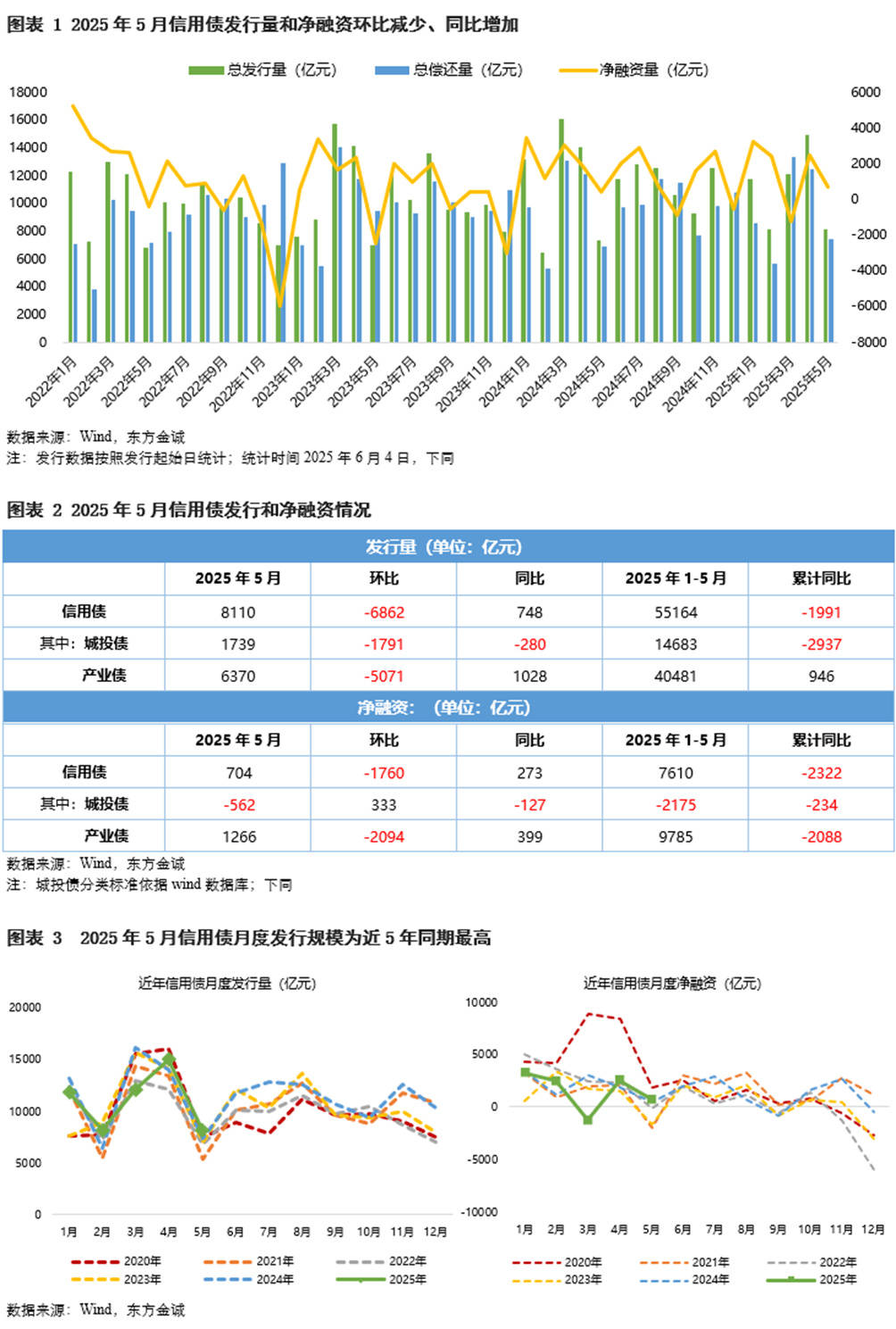
Overall Credit Bond Issuance Situation - In May, the total credit bond issuance was 811 billion yuan, a decrease of 45.8% month-on-month but an increase of 10.2% year-on-year. Net financing was 70.4 billion yuan, down 176 billion yuan month-on-month but up 27.3 billion yuan year-on-year [1][3][6] - The issuance of local government bonds (城投债) and industrial bonds (产业债) showed a divergence, with local government bonds decreasing in both month-on-month and year-on-year terms, while industrial bonds reached the highest level in the past five years for both issuance and net financing [1][3][9] Local Government Bonds - In May, local government bond issuance was 173.9 billion yuan, a decrease of 51.0% month-on-month and 1.6% year-on-year. The net financing gap was -56.2 billion yuan, with a cumulative decrease of 2.9 billion yuan year-on-year [6][9][30] - From January to May, over half of the provinces saw a decline in both issuance and net financing of local government bonds compared to the previous year, with 22 provinces experiencing negative cumulative net financing [1][39][40] Industrial Bonds - In May, industrial bond issuance was 637 billion yuan, down 44.3% month-on-month but up 19.2% year-on-year. Net financing was 126.6 billion yuan, a decrease of 62.3% month-on-month but an increase of 46.5% year-on-year [6][9][30] - Cumulatively, from January to May, industrial bond issuance was 4.05 trillion yuan, a slight increase of 2.4% year-on-year, while net financing decreased by 20.8% year-on-year [1][9][30] Issuance Structure by Rating - In May, the issuance of credit bonds across all ratings decreased month-on-month, with AAA-rated bonds seeing a slight increase year-on-year. The net financing gap for AA+ and AA-rated bonds narrowed both month-on-month and year-on-year [24][27] - The issuance of local government bonds across all ratings decreased month-on-month, with only AA-rated bonds showing a narrowing of the net financing gap year-on-year [27][30] Regional and Industry Analysis - In May, 25 provinces saw a decrease in local government bond issuance, with 17 provinces experiencing negative net financing. The top three provinces for issuance were Jiangsu, Shandong, and Zhejiang, all of which saw a month-on-month decrease [39][40] - For industrial bonds, most industries saw a month-on-month decrease in issuance, with 21 industries reporting positive net financing. Significant net financing was observed in public utilities, non-bank financials, and petrochemicals [2][39][41]
4月信用债月报 | 信用债发行环比增长,城投债和产业债融资分化
Xin Lang Cai Jing· 2025-05-13 08:42
Overall Credit Bond Issuance Situation - In April, credit bond issuance reached 1.49 trillion yuan, with month-on-month and year-on-year growth of 23.1% and 6.4% respectively, and net financing turned positive to 242.7 billion yuan, increasing by 366.3 billion yuan and 54.9 billion yuan compared to the previous month and the same month last year [5][4][10] - The overall issuance interest rates for credit bonds decreased month-on-month, influenced by the easing liquidity conditions [17] - The average issuance term for credit bonds extended to 3.80 years, an increase of 0.35 years from March [22] Credit Bond Issuance Structure - By rating, AAA-rated credit bonds saw an increase in issuance and net financing month-on-month and year-on-year, while AA+ rated bonds experienced an expanded financing gap [25][28] - By enterprise type, all types of industrial bonds saw an increase in issuance and net financing month-on-month, with only local state-owned enterprise bonds seeing a decrease year-on-year [31] - In terms of bond types, all bond categories except for directed tools saw an increase in net financing month-on-month, with corporate bonds and directed tools showing negative net financing [25][31] Regional and Industry Credit Bond Issuance Situation - In April, the issuance of local government bonds decreased in most provinces, with 19 provinces experiencing negative net financing [38][39] - The top three provinces for local government bond issuance were Jiangsu, Shandong, and Zhejiang, all of which had negative net financing [38] - In the industrial bond sector, most industries saw an increase in issuance month-on-month, with significant net financing in public utilities, food and beverage, and construction decoration sectors [42][43]

2025年4月信用债发行情况回顾:信用债发行环比增长,城投债和产业债融资分化
Dong Fang Jin Cheng· 2025-05-12 09:36
1. Report Industry Investment Rating - No relevant information provided in the report 2. Core Viewpoints of the Report - In April 2025, credit bond financing increased significantly due to seasonal factors and lower issuance rates, with the issuance volume reaching 1.49 trillion yuan, up 23.1% month - on - month and 6.4% year - on - year, and net financing turning positive [3][5]. - There was a continued divergence between urban investment bonds and industrial bonds in April. Urban investment bond issuance decreased month - on - month and year - on - year, with a widening net financing gap, while industrial bond issuance and net financing increased both month - on - month and year - on - year [3][5]. - In terms of issuance structure, in April, only AAA - rated credit bonds saw increases in issuance volume both month - on - month and year - on - year; AA - rated issuance accounted for 8.5%, down 3.0 pct from the previous month. By enterprise nature, most types of industrial bonds increased in issuance and net financing month - on - month, and by bond type, net financing of each bond type increased month - on - month, with only enterprise bonds and private placement notes having negative net financing [3][25]. 3. Summary According to the Table of Contents 3.1 Overall Credit Bond Issuance - In April, credit bond issuance volume and net financing increased both month - on - month and year - on - year, with net financing turning positive. The issuance volume was 1.49 trillion yuan, up 23.1% month - on - month and 6.4% year - on - year; net financing was 2427 billion yuan, up 3663 billion yuan month - on - month and 549 billion yuan year - on - year. From January to April, credit bond financing was weaker than in the same period of 2024 [5]. - Urban investment bond issuance decreased month - on - month and year - on - year, with a widening net financing gap month - on - month and a slight narrowing year - on - year. From January to April, issuance decreased 17.1% year - on - year to 1292.9 billion yuan, and the net financing gap widened by 124 billion yuan to - 163.1 billion yuan [9]. - Driven by seasonal factors and lower financing costs, industrial bond issuance in April was 1.14 trillion yuan, up 42.0% month - on - month and 9.7% year - on - year; net financing turned positive to 333.9 billion yuan, up 397.3 billion yuan month - on - month and 39.1 billion yuan year - on - year. From January to April, issuance was 3.41 trillion yuan, basically the same as the previous year, and net financing was 849.5 billion yuan, down 251.1 billion yuan year - on - year [9]. - In April, the overall credit bond issuance rate decreased month - on - month, and the weighted average issuance term of credit bonds lengthened month - on - month, with only private enterprise bonds having a shorter issuance term [17][22]. 3.2 Credit Bond Issuance Structure - By credit rating, in April, only AAA - rated credit bonds saw increases in issuance volume both month - on - month and year - on - year; AA - rated issuance accounted for 8.5%, down 3.0 pct from the previous month. AAA - rated credit bond net financing turned positive, the financing gap of AA + - rated credit bonds widened month - on - month, and the financing gap of AA - rated credit bonds narrowed month - on - month [25]. - For urban investment bonds, in April, issuance of all ratings decreased month - on - month, and only AA - rated slightly increased year - on - year. The financing gaps of AAA - rated and AA + - rated urban investment bonds widened both month - on - month and year - on - year. From January to April, issuance of AAA - rated, AA + - rated, and AA - rated urban investment bonds decreased 25.8%, 17.3%, and 10.7% year - on - year respectively [26]. - For industrial bonds, in April, only AA - rated industrial bond issuance decreased slightly by 4.8 billion yuan month - on - month, and net financing of all ratings increased month - on - month, with AAA - rated and AA - rated net financing turning positive. From January to April, AA + - rated and AA - rated industrial bond issuance decreased 3.0% and 6.7% year - on - year respectively, while AAA - rated increased slightly by 0.5% [28]. - By enterprise nature, in April, issuance and net financing of industrial bonds of all enterprise types increased month - on - month, and only industrial local state - owned enterprise bonds decreased year - on - year. From January to April, issuance of industrial local state - owned enterprise bonds, central enterprise bonds, and private enterprise bonds changed by - 8.4%, 17.4%, and - 9.7% year - on - year respectively, and only industrial local state - owned enterprise bonds had a year - on - year decrease in net financing [25][32]. - By bond type, in April, except for private placement notes, issuance of other bond types increased both month - on - month and year - on - year; net financing of each bond type increased month - on - month, and only general corporate bonds and private placement notes had year - on - year increases in net financing. From January to April, except for private placement notes, net financing of other bond types decreased compared to the previous year, and enterprise bonds and private placement notes had negative cumulative net financing [25][37]. 3.3 Regional and Industry Credit Bond Issuance - For urban investment bonds, in April, issuance decreased in most provinces month - on - month; from January to April, issuance and net financing decreased year - on - year in more than half of the provinces. In April, 16 provinces saw a month - on - month decrease in urban investment bond issuance, and 19 provinces had negative net financing, 4 more than the previous month [42]. - For industrial bonds, in April, credit bond issuance increased month - on - month and year - on - year in most industries; from January to April, cumulative net financing was negative in the coal, building materials, national defense and military industry, and textile and apparel industries, and issuance and net financing in most industries were weaker than in the previous year [42].