债券行情

Search documents
【申万固收】配置盘主导的债券行情能走多远?——近期市场反馈及思考10
申万宏源证券上海北京西路营业部· 2026-02-12 02:43
Core Viewpoint - The article discusses the sustainability of the bond market driven by allocation strategies, analyzing recent market feedback and considerations [2] Group 1: Market Dynamics - The bond market has shown resilience, with significant participation from institutional investors, indicating a strong demand for fixed-income assets [2] - Recent data suggests that the yield curve has flattened, which may impact future investment strategies and risk assessments [2] Group 2: Investment Strategies - Allocation-driven strategies are becoming increasingly prominent, with investors focusing on duration management and credit quality to navigate market volatility [2] - The article highlights the importance of macroeconomic indicators in shaping bond market trends, emphasizing the need for adaptive investment approaches [2] Group 3: Future Outlook - Analysts predict that the bond market may face challenges ahead, particularly if inflationary pressures persist and interest rates rise [2] - The potential for policy shifts by central banks could further influence market dynamics, necessitating a close watch on economic signals [2]


近期市场反馈及思考10:配置盘主导的债券行情如何演绎?
Shenwan Hongyuan Securities· 2026-02-11 13:11
Group 1 - The bond market in January was characterized by a correction of pessimistic expectations rather than a reinforcement of easing expectations, with banks and insurance companies increasing their allocation while brokers and funds sold off [9][10] - The bond market may enter a phase of compressed spreads, with various types of spreads being targeted for excess returns, as the market approaches critical points without clear negative signals [10][11] - The core factors driving the configuration-led market include the ability of funding costs and deposit rates to decrease further, and whether the 10-year government bond can break through key levels [10][11] Group 2 - The primary contradictions in the bond market include asset allocation rebalancing, capital outflow from the stock market, and expectations of rising prices, with the first two being the most critical [11][12] - The relationship between stocks and bonds in 2026 continues to reflect a rebalancing of asset allocation, with the stock market showing signs of strength but still needing to monitor capital flows into equities [14][15] - The insurance sector is shifting its liabilities towards dividend insurance, which may affect its preference for long-term bonds, while fixed-income funds are facing challenges in attracting new liabilities [14][17] Group 3 - The continuous decline in the scale of credit bond ETFs since the beginning of the year, with a drop of 101 billion to 514.2 billion, indicates a potential stabilization as selling pressure eases and valuation improves [21][22] - The strong performance of perpetual bonds in early January can be attributed to several factors, including easing valuation pressures and increased demand from insurance companies [24] - The current credit strategy suggests extending duration to 3-5 years for high-grade bonds, while focusing on specific sectors and grades that offer value [25] Group 4 - The core theme in the convertible bond market is pricing elasticity, with demand remaining high despite supply constraints due to maturing bonds and strong redemption expectations [26][29] - The strategy for convertible bonds emphasizes the importance of maintaining adequate positions to achieve relative returns, as low positions may hinder performance [27] - Excess returns in the convertible bond market are expected to come from elastic varieties, particularly those with low premium rates and smaller market caps [29]
六百万的瓜
Sou Hu Cai Jing· 2025-07-24 01:23
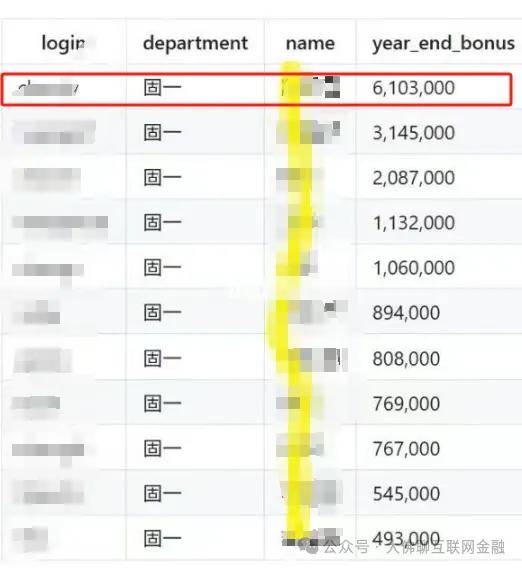
Core Viewpoint - A recent leak revealed the salary details of employees at a fund company, highlighting the high compensation of a fixed income manager, which sparked discussions about the disparity between fund managers' earnings and the returns for investors [1][2]. Group 1: Salary and Compensation - The fixed income manager, referred to as Manager Chen, reportedly has a monthly salary of 135,000 yuan and an annual bonus of 6.1 million yuan, leading to a total annual income of approximately 7.72 million yuan [1][2]. - The fund company later denied the authenticity of the leaked data, citing privacy concerns and reported the matter to the authorities [2]. Group 2: Fund Performance and Management Fees - In 2022, Manager Chen managed a fund with a scale of around 20 billion yuan, which is considered normal during favorable bond market conditions [3]. - The management fee for pure bond funds is typically around 3%, which could yield several million yuan in revenue for the company, especially if the fund includes equities, potentially increasing the fee to about 5% [3]. Group 3: Market Conditions and Future Outlook - The bond market has faced challenges since 2023, with lower profitability for short-term bonds compared to long-term bonds, which are more sensitive to interest rate changes [5]. - The expectation of future interest rate cuts by the Federal Reserve may influence bond prices, with a potential increase in demand for long-term bonds [5]. Group 4: Manager's Career and Performance - Manager Chen has a strong track record, with only 4 out of 73 funds he managed resulting in losses, giving him a success rate of approximately 94.5% [7]. - After 17 years at his previous company, Manager Chen left for a new position, reportedly due to dissatisfaction with salary caps in the financial industry, and is now on a compensation model that includes equity [6].