配置盘

Search documents
浙商证券浙商早知道-20260226
ZHESHANG SECURITIES· 2026-02-26 11:25
Market Overview - On February 26, the Shanghai Composite Index fell by 0.01%, the CSI 300 decreased by 0.19%, the STAR Market 50 rose by 0.85%, the CSI 1000 increased by 0.76%, the ChiNext Index dropped by 0.29%, and the Hang Seng Index declined by 1.44% [3][4] - The best-performing sectors on February 26 were telecommunications (+2.84%), electronics (+1.98%), defense and military (+1.52%), machinery and equipment (+1.41%), and steel (+1.33%). The worst-performing sectors were real estate (-2.25%), media (-1.45%), non-bank financials (-1.42%), retail (-1.22%), and food and beverage (-1.2%) [3][4] - The total trading volume for the A-share market on February 26 was 25,566 billion yuan, with a net outflow of 7.366 billion HKD from southbound funds [3][4] Important Insights - The report focuses on the fixed income credit bond market, analyzing the pricing dynamics around the Chinese New Year. Historical trends show a pattern of "rising before the festival, followed by divergence afterward," characterized by three phases: loose trading, expectation adjustments, and the establishment of macro themes [5] - The institutional buying patterns across the festival period indicate that insurance companies maintained stable net purchases, while funds followed market trends. Major banks increased net selling after the festival, and smaller banks and wealth management products are expected to see concentrated allocation windows post-festival [5] - The report highlights that the pricing power in the bond market is shifting from the allocation of institutional investors to trading dynamics as the festival approaches. Notable characteristics include major banks focusing on purchasing 7-10 year government bonds, while smaller banks tend to buy in the first half and sell in the second half of the period [5][6]
【申万固收】配置盘主导的债券行情能走多远?——近期市场反馈及思考10
申万宏源证券上海北京西路营业部· 2026-02-12 02:43
Core Viewpoint - The article discusses the sustainability of the bond market driven by allocation strategies, analyzing recent market feedback and considerations [2] Group 1: Market Dynamics - The bond market has shown resilience, with significant participation from institutional investors, indicating a strong demand for fixed-income assets [2] - Recent data suggests that the yield curve has flattened, which may impact future investment strategies and risk assessments [2] Group 2: Investment Strategies - Allocation-driven strategies are becoming increasingly prominent, with investors focusing on duration management and credit quality to navigate market volatility [2] - The article highlights the importance of macroeconomic indicators in shaping bond market trends, emphasizing the need for adaptive investment approaches [2] Group 3: Future Outlook - Analysts predict that the bond market may face challenges ahead, particularly if inflationary pressures persist and interest rates rise [2] - The potential for policy shifts by central banks could further influence market dynamics, necessitating a close watch on economic signals [2]


平安证券:26年1月利率债月报:再通胀对债市的影响路径-20260104
Ping An Securities· 2026-01-04 13:05
Report Industry Investment Rating - The report does not mention the industry investment rating. Core Viewpoints of the Report - In December 2025, the weakening of the US dollar and the improvement of risk appetite led to a steeper curve overseas, while in China, loose funds drove the yield curve to steepen. The bond market remained volatile due to the supply - demand contradiction at the long end [2]. - In 2026, the PPI is facing three positive factors: the tail - lifting factor, imported inflation, and the continued effectiveness of the "anti - involution" policy. Under the neutral scenario, the PPI is expected to turn positive in the second quarter of 2026 and reach around 1.2% by the end of the year. The mild re - inflation needs to resonate with other factors to significantly affect the bond market [3][55]. - Currently, the bond market is in a wait - and - see state. It is expected to remain volatile in the short term, lacking the motivation and space for trend trading. There are some structural opportunities, such as the follow - up rise opportunity of 5 - 7Y China Development Bank bonds and the compression opportunity of credit spreads [4]. Summary by Directory PART1: December 2025 - Curve Steepening Driven by Overseas and Domestic Factors Overseas - In December 2025, the Fed announced reserve management - style purchases (RMP) and continued to cut interest rates. The US dollar index weakened, liquidity improved, the US stock market rose, and risk appetite recovered. The US bond yield curve steepened due to factors like Fed's short - term bond purchase, market concerns about Fed independence, and rising commodity prices. Precious and industrial metals performed well, with copper benefiting from AI demand and gold and silver supported by geopolitical events [10][16]. Domestic - In November 2025, the domestic economic fundamentals showed a divergence between quantity and price, and in December, both supply and demand declined. The capital market was generally loose, and the overnight interest rate hit a new low for the year. The bond market remained volatile due to the long - end supply - demand contradiction, and the yield curve steepened [17][23]. - In terms of institutional behavior, large banks and insurance companies, as allocation players, increased their bond - buying in the secondary market in December. Large banks added some policy - related financial bonds and focused on 5 - 7 - year varieties. Insurance companies mainly added long - term treasury bonds. Trading players became conservative. Rural commercial banks mainly invested in certificates of deposit, funds reduced duration and mainly sold long - term treasury bonds, and wealth management products seasonally reduced bond allocation and slightly increased credit bond allocation [26][35][47]. PART2: How the 2026 Re - inflation Narrative May Affect the Bond Market 2026 PPI's Three Positive Factors - The tail - lifting factor can support the PPI to turn positive in the second half of 2026 even without new price - increasing factors [55]. - Imported inflation may occur as overseas capital expenditure and manufacturing investment are likely to rise in 2026. The US deficit rate may expand, and the Fed's new round of easing may release emerging market countries' capital expenditure demand [57]. - The "anti - involution" policy has shown a supporting effect on the PPI. Since August 2025, the month - on - month PPI of the mining industry has turned positive, driving the overall PPI to turn positive since October [60]. PPI Forecast under Different Scenarios - Under the pessimistic scenario, the PPI is expected to turn positive in the second half of 2026 with an average monthly PPI growth rate of 0%. Under the neutral scenario, with a monthly average PPI growth rate of 0.1%, the PPI is expected to turn positive in the second quarter of 2026 and reach around 1.2% by the end of the year. Under the optimistic scenario, with a monthly average PPI growth rate of 0.2%, the PPI is expected to turn positive in April 2026 and exceed 2% in the second half of the year [67]. PPI's Impact on the Bond Market - Historically, during the four PPI upward cycles since 2009, three typical upward periods were driven by the resonance of domestic and overseas demand or supply - demand. The PPI and the bond market generally move in the same direction, but there were several periods of divergence, mainly due to strong economic recovery expectations or PPI being mainly affected by the supply side while the domestic demand did not improve significantly and the monetary policy remained loose [69][71]. - In 2026, the mild re - inflation needs to resonate with other factors such as total demand, central bank's capital management, financial institutions' liability - side stability, and the flow of activated household deposits to significantly affect the bond market. The trading of typical total assets based on re - inflation may have limited odds [78]. PART3: Bond Market Strategy for January 2026 - In January 2026, the bond market may still be in a wait - and - see period. Potential risks include government bond supply pressure, the spring rally in the equity market, and the first - quarter credit boom. Potential positive factors include the possible relaxation of large banks' bond - allocation pressure and the relatively loose capital market, with a higher probability of a reserve - requirement ratio cut than an interest - rate cut in January [81]. - The bond market is expected to remain volatile in the short term, lacking the motivation and space for trend trading. Structurally, there are opportunities such as the follow - up rise of 5 - 7Y China Development Bank bonds and the compression of credit spreads in credit bonds [4][83].
固定收益市场周观察:债市波动加大
Orient Securities· 2025-12-23 14:12
Group 1: Report's Core Views - Recent bond market fluctuations have increased due to intense fluctuations in monetary policy expectations, leading to frequent band - trading by trading funds and amplifying market volatility. The market's view is that funds are difficult to tighten, and the bond market is difficult to rise significantly. Trading funds can conduct band operations based on changes in monetary policy expectations, but the bond market has limited space until the factors restricting the entry of allocation funds subside [6][9]. - The main reason for the cautious attitude of long - term bond - allocating funds such as banks and insurance companies towards the 2026 bond market includes expectations of a "good start" in financial, inflation, and economic data at the beginning of the year, government bond issuance front - loading, insurance "good start" product structure, weakening bond profit - making effects, and the spread of credit risks in some industries [6][12]. - After entering 2026, attention can be paid to whether there are changes in bank behavior. On one hand, banks' indicator pressure eases, which may enhance their bond - allocating motivation; on the other hand, strong credit reserve at the beginning of the year may put pressure on the capital side and restrict their bond - allocating demand. Near the end of the year, changes in the certificate of deposit market can be observed [6][13]. Group 2: This Week's Fixed - Income Market Concerns Overseas Data Release - This week, the US will release data such as the October durable goods orders monthly rate, and Japan will release the November unemployment rate [14][15]. Interest - Rate Bond Issuance - This week, the issuance scale of interest - rate bonds is expected to be 240 billion yuan, at a relatively low level compared to the same period. Among them, treasury bonds are expected to be issued with a scale of about 188 billion yuan, local bonds with a scale of 2.04 billion yuan, and policy - financial bonds with a scale of about 50 billion yuan [15]. Group 3: Interest - Rate Bond Review and Outlook 14 - Day Reverse Repurchase Initiation - Near the end of the year, the central bank initiated 14 - day reverse repurchases on Thursday and Friday, with a total reverse - repurchase investment of 657.5 billion yuan and a net withdrawal of 11 billion yuan. After adding the 30 - billion - yuan maturity of central bank bills, the open - market operations had a net investment of 19 billion yuan. The money market showed an increase in volume and a decrease in price [17][18]. Bond Market Sentiment Repair - Last week, the bond market's optimistic sentiment increased, and with the central bank's support for the year - end, most bond market interest rates were repaired. The extremely long - term bonds fluctuated greatly, rising significantly and then falling back to the previous week's level. The yields of most periodic interest - rate bonds were repaired, with the 3 - year China Development Bank bonds and Export - Import Bank bonds having the largest decline of about 5.5bp [32]. Group 4: High - Frequency Data Production End - Most of the operating rates declined. The blast furnace operating rate decreased from 78.6% to 78.5%, the semi - steel tire operating rate decreased from 71.6% to 71.4%, the PTA operating rate remained flat at 73.8%, and the asphalt operating rate slightly decreased from 27.8% to 27.6%. The year - on - year decline in the average daily crude steel output in early December narrowed, with a reading of - 11.3% [36]. Demand End - The year - on - year decline in the wholesale and retail sales of passenger car manufacturers both improved compared to last week. The year - on - year decline in the commercial housing transaction area remained large. The land premium rate of 100 large - and medium - sized cities increased, and the land transaction area increased. The export indices SCFI and CCFI increased by 3.1% and 0.6% respectively [36]. Price End - Crude oil prices declined, while copper and aluminum prices increased. Coal prices were divided, with the thermal coal futures settlement price remaining flat and the coking coal futures settlement price increasing by 7.9%. In the mid - stream, the building materials composite price index, cement index, and glass index changed by 0.7%, 0.4%, and - 1.1% respectively. The output of rebar increased, and the inventory decreased rapidly to 3.13 million tons, with the futures price increasing by 1.4%. In the downstream consumer end, the prices of vegetables, fruits, and pork changed by - 1.3%, 1.6%, and 0.2% respectively [37].
当下债市热点问题探讨
ZHONGTAI SECURITIES· 2025-12-21 10:13
Group 1: Report Industry Investment Rating - The report does not mention the industry investment rating [1][2][3] Group 2: Core Viewpoints of the Report - The current main logic of the bond market is the lack of incremental funds, and there is also a "debt repayment theory" that the bond market is repaying the over - drawn "debt" since December last year. The "debt repayment" in terms of bond yields is almost done, and the second stage is the return of the bond's duration through secondary - market influence on primary issuance [3][4][32] - There is short - term allocation value in the bond market, but it needs to be considered separately from the perspectives of banks and insurance. The bank's bond allocation value is weakened due to possible over - limit constraints of interest - sensitive assets, while the allocation value of local bonds is prominent from the insurance perspective [3][19][20] - The anti - reflexivity in the bond market supply - demand framework exists. The EVE indicator can adjust assumptions, and the urgency of the indicator decreases in the second year. The issuance structure of interest - rate bonds is not fixed, and the steepening market may reverse [3][13] - The "stock - strong and bond - weak" consensus expectation needs to be vigilant against the anti - reflexivity caused by over - concentrated expectations in the first quarter [4][37][39] Group 3: Summary According to Related Catalogs 1. Behind the Framework of Bond Market Supply and Demand: Where is the Reflexivity? - The impact of bond market supply and demand on the market mainly has two paths: the rise of equities leads to the decline of the bond market, the withdrawal of trading funds with unstable liabilities, and the over - limit of the bank's EVE indicator after long - term bonds are taken back to the balance sheet; the rise of equities leads to insurance institutions rebalancing to more stocks and less bonds, resulting in a change in the insurance product structure and a decrease in the demand for long - term bonds [8] - If the treasury bond issuance structure is determined by plans such as stable growth and the proportion of ultra - long bonds remains unchanged, the long - term bond supply and demand will face an annual - level "imbalance" logic [8] - The anti - reflexivity of bond market supply and demand lies in that problems that can be deduced perfectly may not have a large impact. The EVE indicator can be adjusted, and the issuance structure of interest - rate bonds is variable [3][13] 2. Abuse of the Concept of "Allocation Disk": Measuring the Current Allocation Value of Bonds - The insurance allocation disk's buying rhythm has been relatively stable, and it mainly has trading demand for 30 - year treasury bonds, while large - account allocation or amortized product accounts still use local bonds of the same term as allocation varieties [3][15][17] - From the bank's perspective, the EVA cost - performance of 30 - year treasury bonds is better than that of mortgage loan interest rates, but the bank's bond allocation value is weakened due to possible over - limit constraints of interest - sensitive assets. From the insurance perspective, the allocation value of local bonds is prominent [3][19][20] - The seasonal "red - start" market of bonds has been advancing year by year, resulting in the anti - reflexivity of seasonal failure this year [3][23] 3. Why Does the Stock - Bond Correlation Fail? - Since October, the rapid expansion of fixed - income + strategy products has not produced a strong profit - making effect. Under the recent market consensus expectation of "stock - strong and bond - weak", the hedging effect of the fixed - income + strategy is average [25][27] - The relationship between liquidity and assets is like that between flour and water. The increase in risk preference may have led to an increase in "flour" with little marginal change in "water", resulting in unstable trading liquidity, and more precise liquidity injection is needed to break the situation [28] 4. How to Quantitatively Understand the Widening of the Yield Spread? - The market generally agrees on the widening of the term spread, with differences mainly in quantification and duration. In December, the 30 - year to 10 - year spread has reached over 40BP, returning to the level at the end of 2022. The market may have over - drawn the rhythm of next year [29] - There may be new factors for the spread to widen further, such as the widening of the bond yield curve in other countries, the possible inadequacy of using the 2022 bull - market term spread to measure in case of a bull - bear conversion, and the possible inadequacy of the current priced term spread in case of re - inflation. However, if the long - term bond issuance term is adjusted from over 20 years to under 10 years, the spread may change from widening to narrowing [31] 5. Summary: The Current Main Line of the Bond Market - The main line of the current bond market is the lack of incremental funds, and the "debt repayment theory" also has a certain basis. The "debt repayment" in terms of bond yields is almost done, and the second stage is the return of the bond's duration [32][34] - In terms of strategy, the 30 - year bond has the highest short - term over - sold betting odds, but the space for one - sided direction betting is limited. The spread between special 6 and special 2 still has room for betting on regression. Medium - and short - term credit bonds and interest - rate bonds with a term of 5 years or less are relatively stable choices [4][37]
债市情绪偏谨慎
Tianfeng Securities· 2025-09-07 12:13
1. Report Industry Investment Rating The provided content does not mention the industry investment rating. 2. Core Viewpoints of the Report - The trading sentiment in the bond market this week was cautious. The trading volume of funds in the first half - week was small, and the duration of interest - rate bond funds decreased significantly. The purchasing power of the allocation portfolio remained weak, and the bullish power in the bond market was limited [9]. - The bond market vitality index continued to rise slightly. The index was compiled based on the historical quantile levels of bond market leverage ratio, turnover rate, bond fund duration, and the implied tax rate of China Development Bank bonds since 2022 and their correlation coefficients with the bond market trend [10]. - Most interest - rate bond funds have recorded negative returns in the past three months. Since August, the scale of equity funds has slightly declined, while the scale of bond funds has slightly increased. The issuance of newly established bond funds this week was still at a low level [89]. 3. Summary by Relevant Catalogs 3.1 Overall Sentiment - The bond market vitality index continued to rise slightly. As of September 5, the bond market vitality index increased by 2 pcts to 45% compared with August 29, and the 5D - MA increased by 5 pcts to 41% [10]. - Indicators of rising bond market vitality included the trading volume of the active 10Y China Development Bank bond / the balance of 9 - 10Y China Development Bank bonds (the rolling two - year quantile increased from 41% to 63%) and the turnover rate of 30Y treasury bonds (the rolling two - year quantile increased from 24% to 47%) [12]. - Indicators of falling bond market vitality included the median duration of medium - and long - term pure bond funds (the rolling two - year quantile decreased from 99.5% to 92.7%), the implied tax rate of 10 - year China Development Bank bonds (reverse) (the rolling two - year quantile decreased from 81% to 66%), and the excess level of the inter - bank bond market leverage ratio compared with the average of the past four years (the rolling two - year quantile decreased from 11% to 9%) [13]. 3.2 Institutional Behavior 3.2.1 Buying and Selling Strength and Bond Selection - In the current bond market, the order of net buying strength was funds > other product types > large banks > insurance > others > wealth management > rural financial institutions > foreign - funded banks > money market funds, and the order of net selling strength was joint - stock banks > city commercial banks > securities firms. For ultra - long bonds (bonds with a maturity of over 15 years), the order of net buying strength was insurance > funds > other product types > others > foreign - funded banks, and the order of net selling strength was large banks > joint - stock banks > rural commercial banks > securities firms > city commercial banks > wealth management [20]. - Different institutions had different bond preferences. Large banks mainly focused on 3 - 5Y interest - rate bonds; rural commercial banks, insurance companies, and wealth management products had no obvious main bond types; funds mainly focused on 1 - 3Y and 3 - 5Y interest - rate bonds; other product types mainly focused on 3 - 5Y interest - rate bonds [20][25]. 3.2.2 Trading Portfolio - As of September 5, the mean and median durations of the full - sample medium - and long - term pure bond funds decreased by 0.23 years and 0.31 years respectively compared with August 29, reaching 4.40 years and 4.21 years, and were at the 92.7% rolling two - year quantile [38]. - The median durations of pure interest - rate bond funds, interest - rate bond funds, and credit bond funds decreased by 0.64 years, 0.62 years, and 0.13 years respectively, reaching 5.10 years, 4.84 years, and 3.93 years, and were at the 90.0%, 90.0%, and 94.4% rolling two - year quantiles respectively [38][40]. - The median durations of high - performing interest - rate bond funds and credit bond funds decreased by 0.57 years and 0.09 years respectively, reaching 6.40 years and 4.54 years [40]. 3.2.3 Allocation Portfolio - The primary subscription demand for treasury bonds and policy - financial bonds was differentiated this week, with the demand for ultra - long bonds rising. The weighted average full - market multiples of treasury bonds decreased from 2.69 times to 2.66 times, while those of policy - financial bonds increased from 3.02 times to 3.54 times. For bonds with a maturity of 10Y and above, the weighted average full - market multiples of treasury bonds increased from 2.69 times to 3.02 times, and those of policy - financial bonds increased from 2.77 times to 3.74 times [54]. - Large banks' net buying of 1 - 3Y treasury bonds decreased in August. As of September 5, the cumulative net buying of 1 - 3Y treasury bonds this year was 6206 billion yuan [61]. - Rural commercial banks' cumulative net buying of bonds this year was significantly weaker than in previous years, mainly due to the weak net buying of short - term bonds within 1Y. However, the net buying of 7 - 10Y and over 10Y bonds was significantly higher than in previous years [71]. - Insurance companies' net buying of bonds was significantly higher than in previous years, mainly due to the strong buying of ultra - long bonds over 10Y. As of September 5, the ratio of cumulative net bond buying to cumulative premium income reached 45.95%, exceeding 42.62% at the end of September last year [78]. - Wealth management products' net buying of bonds in the secondary market had a slightly lower duration this week but remained at the highest level since February 23, 2024. As of September 5, the weighted average duration of cumulative net bond buying was 1.75 years, a decrease of 0.02 years compared with August 29 [86]. 3.3 Asset Management Product Tracking - Since August, the scale of equity funds has slightly declined, while the scale of bond funds has slightly increased. In September, the scale of bond funds and equity funds increased by 155 billion yuan and decreased by 305 billion yuan respectively compared with the previous month [89]. - The issuance of newly established bond funds this week was still at a low level, with a scale of only 32 billion yuan, down from 48 billion yuan in the previous week [89]. - This week, the net value increases of various types of bond funds have generally expanded, with credit bond funds performing better. The median annualized returns of pure interest - rate bond funds, interest - rate bond funds, and credit bond funds in the past week were 4.0%, 3.6%, and 3.8% respectively. Most pure interest - rate bond funds and interest - rate bond funds have recorded negative returns in the past three months [89].
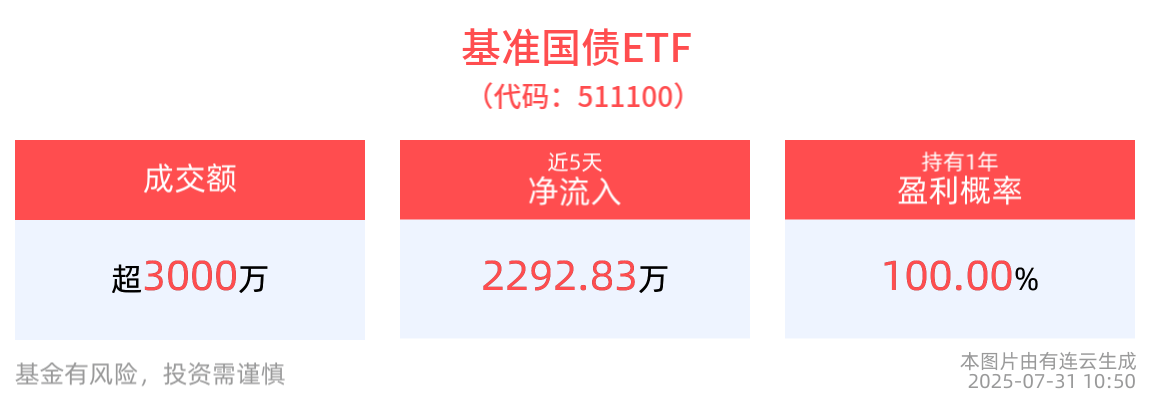
配置盘或再次形成对利率债的有力支撑,基准国债ETF(511100)上涨0.18%
Sou Hu Cai Jing· 2025-07-31 03:14
Group 1 - The benchmark government bond ETF (511100) has increased by 0.18% as of July 31, 2025, with a latest price of 109.35 yuan, and has accumulated a rise of 5.06% over the past year as of July 30, 2025 [1][2] - The average daily trading volume of the benchmark government bond ETF was 1.645 billion yuan over the past week, with a net inflow of 22.9268 million yuan recently [1][2] - Since its inception, the benchmark government bond ETF has recorded a maximum monthly return of 2.67%, a longest consecutive monthly gain of 9 months, and a longest cumulative gain of 6.94%, with a historical one-year holding profit probability of 100% [1] Group 2 - The benchmark government bond ETF tracks the Shanghai Stock Exchange's benchmark market-making government bond index, selecting approximately two recently listed bonds from various maturities, currently comprising 21 bonds [2] - According to Zhongyou Securities, after previous adjustments in the bond market, the configuration is gradually returning, and the market structure is becoming more balanced, with government bond supply expected to slow down significantly from August [2] - The current market sentiment is more influenced by volatility than by fundamental shocks, and the odds of long-term interest rates declining are gradually improving [2]