
光伏产业链价格走势

Search documents
供需双弱格局延续 光伏产业链多环节价格跌势未止
Zheng Quan Shi Bao Wang· 2025-11-27 13:23
硅业分会指出,硅料市场价格在弱势中能够保持稳定的主要原因来自供需两侧的共同支撑。供应端,硅 料企业稳价意愿坚决。本月两家头部企业执行了较大幅度的减产降负荷计划,市场延续了供应收缩的态 势。更重要的是,产业链上下游对于"价格失稳将导致全链受损"的后果都有较为清晰的共识。需求端, 尽管硅片环节在减产,但下游企业对短期内硅料价格持稳仍抱有预期,因此并未大幅削减采购计划,尤 其是维持了对颗粒硅的既有采购规模,为价格提供了底部支撑。 从供需基本面看,11月尽管供应端有显著收缩,但需求端同步大幅减产,预计本月社会库存仍将呈现小 幅累积,但增量较为有限。硅业分会认为,当前市场持稳的核心支撑逻辑并未改变:一是供应端的主动 收缩对价格形成托底;二是产业链形成的"一荣俱荣、一损俱损"的稳价共识依然坚定。综上,预计短期 内,多晶硅市场将继续维持弱势平稳的运行态势。 行业咨询机构InfoLink的观察显示,当前硅料厂家库存随着下游采购减缓而有上升趋势,整体供大于求 的状态仍未改善,甚至有趋于恶化的迹象,一线厂家自身对于库存的容忍提高,在售价方面仍响应政策 坚挺价格,短期出现降价清理库存的机率较小,12月签订发货价格与11月持平。然而 ...
需求不足致光伏产业链价格羸弱 部分电池片厂家已开始亏损现金流
Zheng Quan Shi Bao Wang· 2025-11-21 13:44
中国有色金属工业协会硅业分会发布的数据显示,本周,多晶硅N型复投料成交均价为5.32万元/吨,N 型颗粒硅成交均价为5.05万元/吨,均环比持平。 值得注意的是,尽管下游硅片、电池片价格均出现不同程度下滑,且部分硅片企业已开始逐步减产以应 对需求疲软,但多晶硅实际成交价仍维持稳定。 硅业分会指出,本周多晶硅价格持稳主要有两方面原因,一是供应端收缩有效对冲了需求走弱的影响。 西南地区受枯水期等因素制约,部分企业已大幅减产甚至停产,预期11月国内多晶硅产量将降至12万吨 以内,环比降幅约14%,一定程度上缓解了供应压力。二是产业链上下游形成隐性共识。在当前相对脆 弱的市场环境下,多晶硅价格下跌非但不能有效刺激需求,反而会破坏7月以来逐步建立的企稳预期, 甚至可能引发整个产业链价格体系崩盘。因此,多晶硅企业的稳价意愿十分坚决。 "尽管近期下游减产将削弱对多晶硅的短期需求,但在供应已同步收紧、社会库存本已高企的背景下, 上下游企业对于供需变化的容忍度较高。"硅业分会判断,当前多晶硅市场需求较弱、稳价意愿较强, 且后者影响更为显著。因此预计短期内,在供应收缩的支撑及维护产业链整体稳定的共识下,多晶硅价 格将继续维持弱势 ...
部分光伏股早盘走高 9月光伏产业链价格持续走高 上游价格涨幅高于下游
Zhi Tong Cai Jing· 2025-10-09 02:52
Core Viewpoint - The photovoltaic sector has seen a rise in stock prices, driven by increasing prices across the supply chain since September, particularly in polysilicon, wafers, cells, and modules [1] Group 1: Stock Performance - New Energy (01799) increased by 7.07%, reaching HKD 9.24 [1] - Flat Glass (601865) rose by 5.56%, reaching HKD 12.52 [1] - GCL-Poly Energy (03800) gained 3.73%, reaching HKD 1.39 [1] - Xinyi Solar (00968) increased by 3.22%, reaching HKD 3.85 [1] Group 2: Price Trends - Since September, prices for polysilicon, wafers, cells, and photovoltaic modules have risen, with upstream prices increasing more than downstream prices [1] - Photovoltaic glass prices are recovering due to reduced production from leading companies, lower industry inventory, and a contraction in supply [1] Group 3: Market Outlook - The overall market is currently weak following a period of pre-installation demand, with centralized projects driving installation needs [1] - Future price trends in the photovoltaic supply chain are expected to stabilize, influenced by the strength of terminal module price support and anti-competitive measures [1]
TrendForce集邦咨询:头部企业“抱团”涨价 光伏产业链价格易涨难跌
Zhi Tong Cai Jing· 2025-09-04 05:52
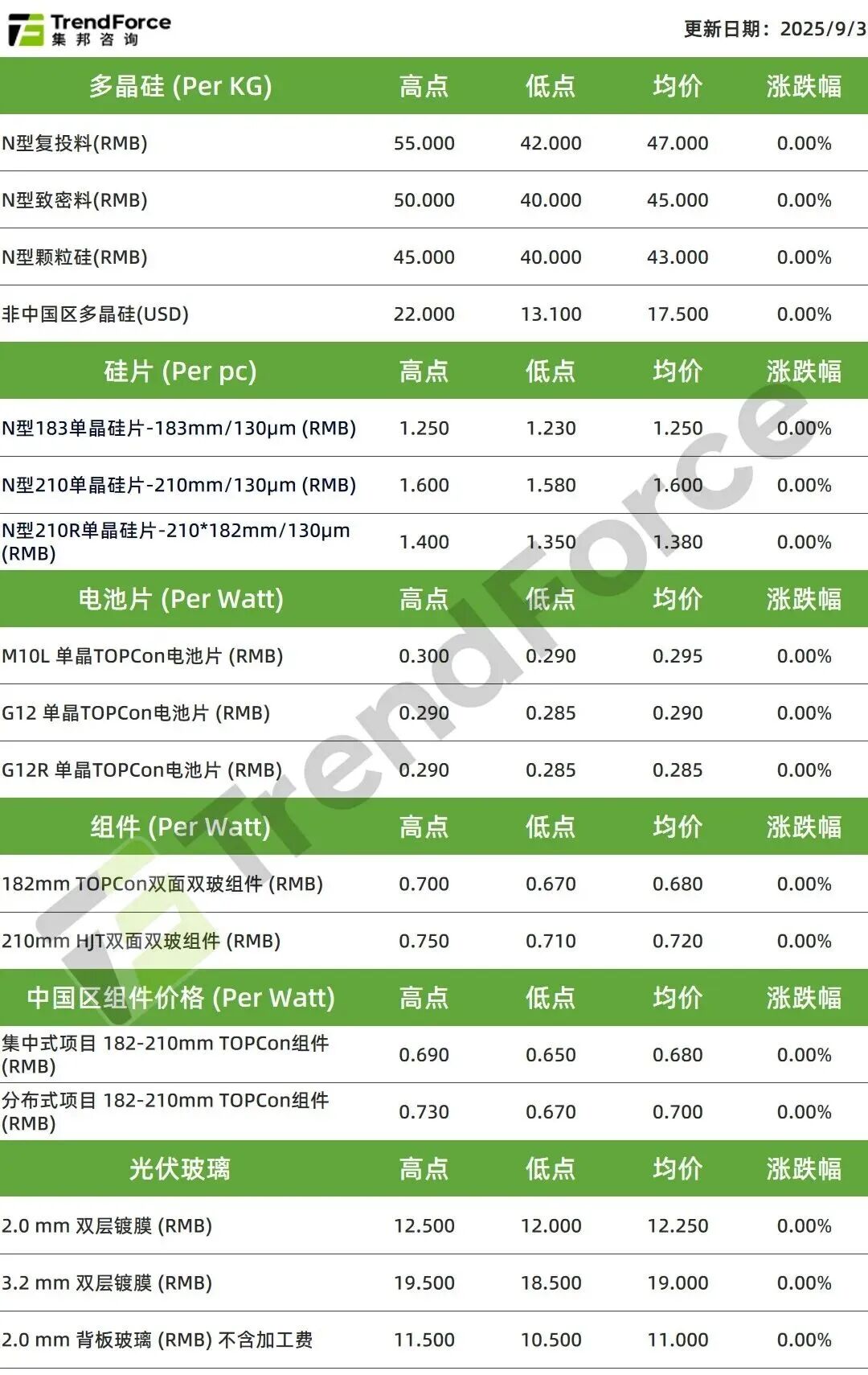
Core Insights - The price of polysilicon is expected to remain strong in the short term due to anticipated production cuts after the October hydropower season and expectations regarding silicon material storage policies [1][2] - Despite structural oversupply in the wafer market, upstream cost pressures and supply-demand balance for certain sizes are providing support for wafer prices, which are expected to have upward momentum [1][3] - The price trend for photovoltaic modules is optimistic, with expectations of stability and gradual increases supported by costs, policies, and demand, although the likelihood of price reductions is low [1][6] Polysilicon - The supply of polysilicon continues to increase, with monthly output expected to reach around 130,000 tons, an increase of approximately 8,000 tons from August [2] - Market transactions remain cautious, with lower purchasing intentions from downstream customers, leading to a cautious market sentiment [2] - Driven by national "anti-involution" policies, polysilicon prices have not declined with the supply-demand fundamentals, instead showing a tendency to rise [2] Wafer - Current wafer inventory levels are stable, but there are significant structural issues, particularly with 210RN wafers experiencing oversupply while 183N and 210N sizes maintain a healthier balance [3] - The demand for 183N and 210N wafers is relatively balanced, supporting price increases, while the 210RN size faces weak demand [3] - The rising upstream silicon prices are providing solid cost support for wafers, leading to expected price increases for 183N and 210N sizes [3] Battery Cells - The inventory levels for battery cells are relatively healthy, but there is a clear structural divergence in supply and demand [4] - The demand for 210N high-efficiency cells is showing positive trends, providing strong support for prices [4] - Battery prices are expected to follow the upward trend of silicon wafer prices, indicating a challenging market environment [4][5] Photovoltaic Modules - The continuous rise in upstream prices is pushing up production costs for downstream modules, yet terminal demand remains weak [6] - Despite manufacturers raising quotes to above 0.7 RMB per watt, actual transaction prices are around 0.68 RMB per watt, indicating a struggle to pass on cost increases [6] - The production forecast for September indicates a slight increase, with no significant decline in demand, further supporting price stability [6]

光伏组件进入量价齐缩阶段 产业链价格短期难反弹
Zheng Quan Shi Bao Wang· 2025-06-05 12:10
Core Viewpoint - The silicon material market is currently experiencing limited transaction volumes and stable prices, with expectations for future price movements largely dependent on new order signings [1][2]. Group 1: Silicon Material Prices - The average transaction price for N-type recycled silicon is 37,500 yuan/ton, N-type granular silicon is 34,500 yuan/ton, and P-type polysilicon is 31,300 yuan/ton, all remaining stable compared to the previous week [1]. - The procurement demand for silicon materials from downstream sectors remains, but the pricing pressure from buyers is strong, with offers dropping to between 32,000 yuan/ton and 34,000 yuan/ton [2]. Group 2: Production and Supply Dynamics - The current production capacity of polysilicon manufacturers is stable, with 11 companies operating at reduced loads, and the overall supply is expected to remain stable in the short term [1][3]. - By May 2025, China's polysilicon production is projected to reach 101,600 tons, reflecting a month-on-month increase of 2.52% [1]. Group 3: Silicon Wafer and Battery Prices - The average transaction prices for N-type G10L, G12R, and G12 silicon wafers are 0.95 yuan/piece, 1.10 yuan/piece, and 1.30 yuan/piece, respectively, all remaining unchanged from the previous week [2]. - The average prices for battery cells, including 183N and 210RN, are stable at 0.25 yuan/W and 0.265 yuan/W, while the price for 210N cells has decreased to 0.265 yuan/W [3][4]. Group 4: Module Market Conditions - The demand for terminal components is currently weak, with major manufacturers reducing production and mid-to-small-sized manufacturers initiating cutbacks [5]. - The price range for TOPCon double-glass modules is approximately 0.60 yuan/W to 0.72 yuan/W, while HJT module prices range from 0.72 yuan/W to 0.83 yuan/W [4][5].
多晶硅价格有望止跌企稳
news flash· 2025-05-22 23:23
Group 1 - The core viewpoint of the article indicates that the price of polysilicon has stabilized after a period of increase driven by a "rush to install" in the photovoltaic industry [1] - Despite the recent price increases across the photovoltaic supply chain, the overall supply-demand mismatch in the solar industry has not significantly improved, leading to insufficient momentum for continued price rises [1] - Following the "rush to install," polysilicon prices have seen a decline but are now showing signs of stabilization, with expectations that prices will remain within the current range for some time [1]