
光伏出口退税政策调整

Search documents
光伏“退税补贴时代”将结束 企业如何应对?
Jing Ji Ri Bao· 2026-02-05 06:22
Core Viewpoint - The Ministry of Finance and the State Taxation Administration announced the cancellation of the export VAT refund for photovoltaic products starting April 1, 2026, marking the end of a decade-long support policy aimed at nurturing the solar industry in China [1][2]. Group 1: Policy Background and Rationale - The export VAT refund policy was introduced in October 2013 to support the recovery of the solar industry during a challenging period marked by anti-dumping investigations and market shrinkage [1]. - The policy aimed to enhance international competitiveness by offsetting costs and encouraging companies to explore overseas markets, thus helping the industry overcome domestic market bottlenecks [1]. - The cancellation of the export VAT refund is seen as a necessary adjustment in response to the solar industry's evolution and the need for high-quality development, as the industry now holds over 70% of the global market share [2]. Group 2: Impacts of Policy Change - Short-term effects may include a temporary surge in exports, leading to increased production and export figures within the industry [3]. - In the medium to long term, leading companies with technological advantages and strong brand recognition are expected to strengthen their bargaining power, while those relying solely on low prices may face reduced demand [3]. - The policy change is likely to accelerate the exit of small and medium-sized enterprises lacking core technologies and low-profit margins, while top-tier companies with advanced technology and cost control will likely expand their market share [3]. Group 3: Strategic Recommendations for Companies - Companies must enhance their capabilities for international expansion by focusing on technology and brand value, investing in R&D for next-generation battery technologies and improving product efficiency [4]. - A global strategy should be adopted, transitioning from merely exporting to establishing a local presence in key markets, which is essential for mitigating trade risks and understanding local market needs [4]. - Companies should optimize their entire cost structure through digitalization and intelligent management, while exploring new applications such as space photovoltaics and deepening the integration of photovoltaic and energy storage systems to create new market demands and profit opportunities [4].
光伏“退税补贴时代”将结束 带来哪些影响?
Jing Ji Ri Bao· 2026-02-05 00:47
Core Viewpoint - The Ministry of Finance and the State Taxation Administration announced the cancellation of the export VAT refund for photovoltaic products starting April 1, 2026, marking the end of a decade-long support policy aimed at nurturing the solar industry in China [1][2]. Group 1: Policy Background and Rationale - The export VAT refund policy was introduced in October 2013 to support the recovery of the solar industry during a challenging period marked by anti-dumping investigations and market shrinkage [1]. - The policy aimed to enhance international competitiveness by offsetting costs and encouraging companies to explore overseas markets, thus helping the industry overcome domestic market bottlenecks [1]. - As the solar industry has grown to capture over 70% of the global market, the initial support measures have begun to show adverse effects that conflict with the goals of high-quality development [2]. Group 2: Impacts of Policy Change - The cancellation of the export VAT refund is expected to lead to a temporary surge in exports as companies rush to ship products before the policy takes effect [3]. - In the medium to long term, leading companies with technological advantages and strong brand recognition will likely strengthen their bargaining power, while those relying solely on low prices may face reduced demand [3]. - The policy shift is anticipated to accelerate the exit of smaller companies and outdated capacities that lack core technologies and operate on thin profit margins [3]. Group 3: Strategic Recommendations for Companies - Companies must enhance their capabilities for international operations by focusing on technology and brand value to achieve premium pricing [4]. - There is a need for global expansion, transitioning from merely exporting to establishing a local presence in key markets to mitigate trade risks and better serve local demands [4]. - Firms should optimize their entire cost structure through digital and intelligent management practices, while also exploring new applications such as space photovoltaics and integrated solar-plus-storage systems to create new market opportunities [4].
【能源广角】光伏“退税补贴时代”将结束
Sou Hu Cai Jing· 2026-02-04 22:52
Core Viewpoint - The Ministry of Finance and the State Taxation Administration announced the cancellation of the export VAT rebate for photovoltaic products starting April 1, 2026, marking the end of a policy that has supported the industry for over a decade [2][3] Group 1: Policy Background and Rationale - The export VAT rebate policy was introduced in October 2013 to support the recovery of China's photovoltaic industry during a challenging period marked by anti-dumping investigations and market shrinkage [2] - The policy aimed to enhance international competitiveness by offsetting costs and encouraging companies to explore overseas markets, thus helping the industry overcome domestic market bottlenecks [2] - The cancellation of the rebate is seen as a necessary adjustment in response to the industry's maturity and the need for high-quality development, as the sector now holds over 70% of the global market share [3] Group 2: Impacts of Policy Change - The adjustment may lead to a temporary surge in exports as companies rush to capitalize on existing orders, potentially inflating production and export figures in the short term [4] - In the medium to long term, leading companies with technological advantages and strong brand recognition are expected to strengthen their bargaining power, while those relying solely on low prices may face reduced demand [4] - The exit of smaller companies and outdated capacities is anticipated, as the market will favor firms with core technologies and effective cost control [4] Group 3: Strategic Recommendations for Companies - Companies are encouraged to enhance their capabilities for international expansion by focusing on technology and brand value, investing in R&D to create barriers in next-generation battery technologies and product efficiency [5] - A global strategy is recommended, shifting from merely exporting to establishing a local presence, which is essential for understanding and serving local markets effectively [5] - Firms should optimize their entire cost structure through digital and intelligent management, exploring new applications like space photovoltaics and integrating photovoltaic systems with energy storage to create new market demands and profit opportunities [5]

光伏“退税补贴时代”将结束
Jing Ji Ri Bao· 2026-02-04 22:13
Core Viewpoint - The Ministry of Finance and the State Taxation Administration announced the cancellation of the export VAT refund for photovoltaic products starting April 1, 2026, marking the end of a decade-long support policy aimed at nurturing the solar industry in China [1][2]. Group 1: Policy Background and Rationale - The export VAT refund policy was introduced in October 2013 to support the recovery of the solar industry during a challenging period marked by anti-dumping investigations and market shrinkage [1]. - The policy aimed to enhance international competitiveness by offsetting costs and encouraging companies to explore overseas markets, thus helping the industry overcome domestic market bottlenecks [1]. - The cancellation of the export VAT refund is seen as a necessary adjustment in response to the solar industry's evolution, which now holds over 70% of the global market share [2]. Group 2: Impacts of Policy Change - Short-term effects may include a temporary surge in exports, leading to increased production and export figures within the industry [3]. - In the medium to long term, leading companies with technological advantages and strong brand recognition are expected to strengthen their bargaining power, while those relying solely on low prices may face reduced demand [3]. - The exit of smaller companies and outdated capacities is anticipated, benefiting technologically advanced firms that have established overseas production and localized services [3]. Group 3: Strategic Recommendations for Companies - Companies are encouraged to enhance their capabilities for international expansion by focusing on technology and brand value to achieve premium pricing [4]. - There is a need for global operational strategies, including accelerating overseas production and promoting supply chain localization to better serve local markets [4]. - Firms should optimize their entire cost structure through digital and intelligent management, exploring new applications such as space photovoltaics and deepening the integration of photovoltaic and energy storage systems to create new market demands and profit opportunities [4].
光伏出口退税将取消,行业有望迈入高质量发展
Ge Long Hui· 2026-01-13 00:27
Core Viewpoint - The Ministry of Finance and the State Taxation Administration will cancel the VAT export tax rebate for photovoltaic products starting April 1, 2026, which is expected to increase export costs and reduce profitability for photovoltaic and energy storage companies in the short term. However, this policy may lead to a long-term shift towards high-quality development in the photovoltaic industry, with a focus on technological innovation and brand building [1][2][3]. Short-term Impact - The cancellation of the export tax rebate is expected to increase the export costs for photovoltaic module companies, with leading enterprises projected to lose between 1 to 2 billion yuan annually in tax rebates, resulting in a profit reduction of 46-51 yuan per 210R photovoltaic module. This may lead to a surge in export orders before the policy takes effect, boosting short-term industry demand [2][3]. Long-term Impact - The removal of the export tax rebate is anticipated to accelerate the elimination of outdated production capacity, with a shift towards technological innovation and brand development. High-efficiency components like BC and TOPCon 3.0 are expected to command higher premiums, becoming mainstream in future exports. Leading companies are likely to expand their market share as the competitive landscape improves [3]. Energy Storage Outlook - The impact on energy storage profits is expected to be limited, with leading companies likely to manage price transmission effectively. The policy aims to optimize supply and raise entry barriers for exports, benefiting industry leaders with overseas production capacity. The global energy storage market is projected to grow significantly, with new installations expected to reach 255 GWh in 2025, 407 GWh in 2026, and 538 GWh in 2027, reflecting a CAGR of 45.3% [4]. Investment Strategy - Investment opportunities in the photovoltaic sector are recommended along three main lines: 1. Focus on leading energy storage companies benefiting from domestic and overseas demand [4]. 2. Monitor leading companies across the supply chain that are likely to maintain their competitive edge as outdated capacity is cleared [4]. 3. Invest in companies pioneering new technologies, particularly in high-efficiency battery components and emerging materials like perovskite batteries [4].

股市必读:美畅股份(300861)1月12日董秘有最新回复
Sou Hu Cai Jing· 2026-01-12 18:40
Core Viewpoint - The company, Meichang Co., Ltd. (300861), is actively monitoring policy changes in the photovoltaic industry and is prepared to adjust its sales strategies accordingly, particularly in light of the upcoming cancellation of export tax rebates starting April 1, 2026 [2]. Group 1: Company Performance - As of January 12, 2026, Meichang Co., Ltd. closed at 16.09 yuan, reflecting a 2.22% increase with a turnover rate of 3.32% and a trading volume of 139,900 shares, resulting in a transaction value of 223 million yuan [1]. - On the same day, the net inflow of main funds into Meichang Co., Ltd. was 4.6184 million yuan, indicating positive engagement from major investors [3]. Group 2: Industry Insights - The company specializes in the research, production, and sales of diamond wire, which is a critical consumable in the photovoltaic silicon wafer cutting process. Currently, its applications and customer base are primarily focused on the photovoltaic industry [2]. - The company is aware of technological advancements in other fields, including aerospace, but currently does not have direct downstream customers in that sector [2].
4月1日起执行!光伏出口退税全面取消,行业影响几何
Bei Jing Shang Bao· 2026-01-11 13:01
Core Viewpoint - The cancellation of the export VAT rebate for photovoltaic products marks the end of the "rebate subsidy era," significantly impacting component manufacturers and potentially leading to a surge in exports before the policy takes effect [1][3][5]. Policy Changes - The Ministry of Finance and the State Taxation Administration announced the cancellation of the export VAT rebate for photovoltaic products effective April 1, 2026, with a reduction in the rebate rate for battery products from 9% to 6% until the end of 2026 [3][4]. - The announcement includes a list of 249 products related to photovoltaic and 22 battery products affected by the policy change [4]. Industry Impact - The cancellation of the export VAT rebate is expected to have a significant impact on component manufacturers, with predictions of a "rush to export" before the policy takes effect [5][6]. - Major manufacturers such as JinkoSolar, Trina Solar, JA Solar, and LONGi Green Energy reported substantial losses in the first three quarters of 2025, with JinkoSolar's overseas revenue exceeding 60% of its total revenue [5][6]. Market Dynamics - The Chinese Photovoltaic Industry Association indicated that the adjustment of export VAT rebates could help stabilize overseas market prices, which have been declining due to fierce competition [4][10]. - The industry is experiencing a shift from "price competition" to "value competition," as companies will need to focus on technological upgrades and high-value segments to maintain competitiveness [10][11]. Regulatory Environment - Recent meetings involving the China Photovoltaic Industry Association and leading polysilicon companies addressed concerns about monopolistic practices and market regulation, indicating a tightening regulatory environment [8][9]. - The cancellation of export rebates and potential changes in the polysilicon storage plan are seen as part of a broader effort to combat "internal competition" within the industry [10].




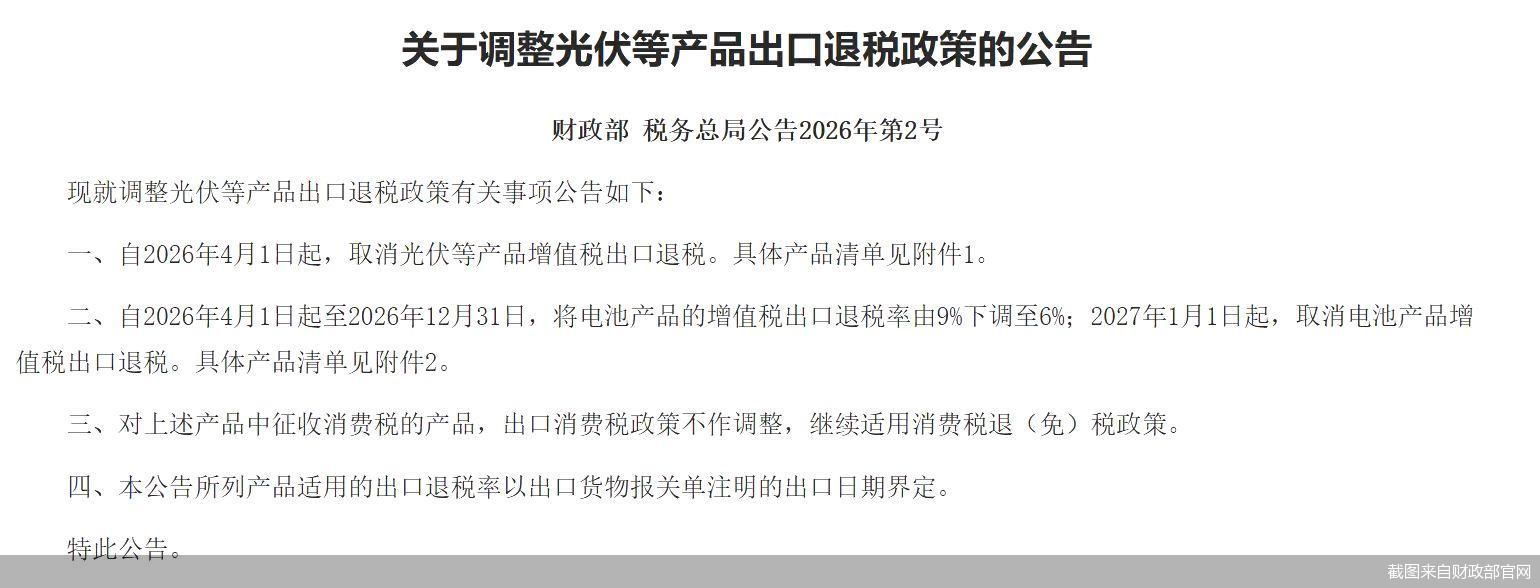
光伏出口退税政策调整 中国光伏行业协会发声
Zhong Guo Zheng Quan Bao· 2026-01-10 00:43
Core Viewpoint - Since 2024, China's photovoltaic products are facing increasingly fierce competition in overseas markets, leading to a continuous decline in export prices, characterized by a "volume increase and price decrease" trend [1] Group 1: Market Dynamics - Some companies are engaging in low-price competition during exports, converting export tax rebates into negotiation space, which results in financial resources originally intended to offset domestic VAT burdens being transferred to foreign buyers [1] - This situation effectively transforms the export tax rebate policy into a subsidy for overseas end markets, causing profit losses for domestic companies and significantly increasing the risk of international trade frictions such as anti-subsidy and anti-dumping measures against China's photovoltaic industry [1] Group 2: Policy Recommendations - Timely reduction or cancellation of export tax rebates for photovoltaic products can help promote a rational return of foreign market prices, reduce the risk of trade frictions, and alleviate the national fiscal burden, leading to a more reasonable and efficient allocation of fiscal resources [1] - Although adjusting export tax rebates is not the only solution to the "internal competition externalization" issue, it is beneficial in the long run to curb the rapid decline in export prices and lower the probability of trade frictions [1] Group 3: Recent Policy Changes - The Ministry of Finance and the State Taxation Administration announced a policy on November 2024, stating that from December 1, 2024, the export tax rebate rate for photovoltaic silicon wafers, batteries, and components will be reduced from 13% to 9% [1]