
全球减贫

Search documents
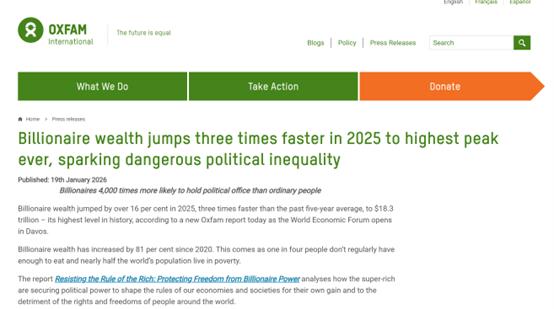
亿万富翁财富飙升,3000人坐拥18.3万亿美元
3 6 Ke· 2026-01-20 00:38
Group 1 - The report by Oxfam indicates that by 2025, the wealth of global billionaires is projected to reach a record $18.3 trillion [1] - The number of billionaires surpassed 3,000 last year, with their total wealth increasing by 16%, equivalent to $2.5 trillion, which is three times the average growth rate over the past five years [3] - Since 2020, the wealth of global billionaires has surged by 81%, marking the past decade as the "golden decade for billionaires" [3] Group 2 - The report highlights that the global poverty rate is roughly at the same level as in 2019, with nearly half of the world's population living in poverty [3] - Billionaires are noted to leverage their wealth for political power and media control, with examples including Elon Musk's involvement in U.S. government affairs and Jeff Bezos owning The Washington Post [3][4] - The likelihood of billionaires holding public office is 4,000 times greater than that of ordinary individuals, exacerbating social inequality and diverting efforts to address poverty [4] Group 3 - Oxfam calls for governments to implement plans to reduce inequality, including taxing billionaires to diminish their power and establishing stronger regulations on lobbying and campaign financing [4] - The 56th World Economic Forum is set to take place in Davos, Switzerland, focusing on the theme of "spirit of dialogue" to address global challenges [4] - Oxfam has been releasing inequality-related reports annually since 2014 during the Davos forum, predicting the emergence of at least five trillionaires in the next decade [4] Group 4 - The "Big and Beautiful Act" introduced by Trump is expected to provide tax cuts for the wealthy, resulting in a 3% income increase for individuals earning over $1 million annually [5]

广西入选全球减贫案例创新高
Guang Xi Ri Bao· 2025-12-30 02:13
Core Viewpoint - The 2025 Global Poverty Reduction Partnership Seminar held in Beijing announced the sixth edition of "Global Poverty Reduction Cases," featuring 108 cases, with 13 from Guangxi, marking a historical high for regional case numbers [1] Group 1: Seminar Overview - The seminar focused on "Strengthening Partnership Cooperation to Address Poverty Challenges," aiming to deepen cooperation in poverty reduction, share experiences among countries, explore resilient development models, enhance knowledge sharing, and promote the implementation of the UN 2030 Sustainable Development Agenda [1] - The cases were jointly released by seven organizations, including the China International Poverty Reduction Center, the World Bank, and the Food and Agriculture Organization of the United Nations [1] Group 2: Case Collection and Highlights - A total of 840 cases were collected from 40 countries and regions, emphasizing the sustainability and replicability of poverty reduction models, the operability of technologies, and inclusivity for vulnerable groups [1] - Notably, the "Millennium Terraces 'One Field Produces Five Metals' - Agricultural Cultural Heritage Poverty Reduction Case from Longsheng Autonomous County, Guangxi" was highlighted as one of the six representative cases shared at the seminar [1] Group 3: Historical Context - Since the launch of the first global poverty case collection in June 2018, six editions have been conducted, collecting over 4,500 poverty reduction cases and recommending 637 cases from 88 countries and regions [1] - During the "14th Five-Year Plan" period, Guangxi had a total of 34 cases selected for the global poverty reduction cases [1]
共同推进全球减贫事业发展
Ren Min Ri Bao· 2025-12-17 22:11
Core Viewpoint - The 2025 Global Poverty Reduction Partnership Seminar held in Beijing emphasized the importance of international cooperation in addressing global poverty challenges, particularly in the context of the UN's 2030 Sustainable Development Agenda [1][2]. Group 1: Seminar Overview - The seminar was co-hosted by multiple organizations, including the China International Poverty Reduction Center and the Food and Agriculture Organization of the United Nations [2]. - The event featured the release of the "Global Poverty Case Collection 2025," which aims to provide useful references for developing localized poverty reduction policies in developing countries [2]. - The seminar has been held nine times since its inception in 2017, serving as a crucial platform for sharing poverty reduction experiences and exploring cooperation paths among governments, international organizations, and practitioners [2]. Group 2: Key Challenges and Solutions - Current global poverty governance faces challenges such as climate change, regional conflicts, and economic slowdown, which create uncertainties in implementing the UN's 2030 Sustainable Development Agenda [1]. - Participants agreed on the necessity of strengthening international partnerships in poverty reduction and innovating cooperation models to advance global poverty alleviation efforts [1]. - The FAO representative highlighted the need for transforming agricultural food systems to ensure that no one is left behind in the fight against poverty [2].
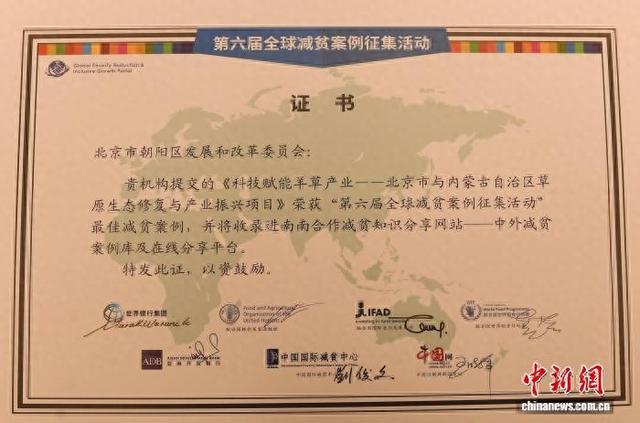
北京朝阳科技赋能羊草产业入选全球最佳减贫案例
Zhong Guo Xin Wen Wang· 2025-12-11 13:53
Core Viewpoint - The "Sheep Grass Planting Project" in Chaoyang District, Beijing, has been recognized as a successful case in global poverty alleviation, showcasing the integration of technology and industry collaboration to enhance ecological governance and increase local income [1][7]. Group 1: Project Overview - The project aims to combat soil salinization in the Keshiketeng Banner, where salinization has caused an average annual crop yield loss of 40%, equating to a direct economic loss of 230 million yuan [1][2]. - The project has introduced the "Zhongke Sheep Grass," a high-quality variety developed by the Chinese Academy of Sciences, which is well-suited for saline-alkali land and can survive for nearly 30 years after a single planting [3][8]. Group 2: Economic Impact - The project has led to an increase in local income, with an average additional income of over 1,000 yuan per mu (approximately 0.067 hectares) once the sheep grass reaches maturity [2][4]. - Approximately 300 local residents have been employed through the project, contributing to job creation and economic development in the region [2][4]. Group 3: Implementation Strategy - A four-party collaboration mechanism has been established, involving research institutions, enterprises, local collectives, and farmers, to ensure effective project implementation [2][4]. - The project provides financial support to farmers, including subsidies for land use and guaranteed income increases, while also offering training in sheep grass cultivation techniques [4][5]. Group 4: Environmental Benefits - The project has significantly improved soil conditions, with a decrease in soil pH and an increase in vegetation coverage, contributing to the restoration of degraded saline-alkali land [2][8]. - The ecological restoration model developed through this project demonstrates a dual benefit of economic gain and environmental improvement, aligning with the United Nations Sustainable Development Goals [8][9]. Group 5: Future Prospects - The success of the "Zhongke Sheep Grass" project is expected to inspire further innovations in ecological governance and rural development, contributing to the construction of a significant ecological safety barrier in northern China [8][9]. - The Chaoyang District plans to continue enhancing the project by improving production and marketing connections, aiming for standardization and branding of the sheep grass industry [9].

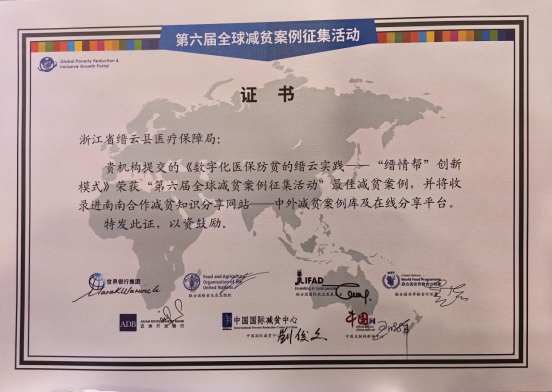
水滴公司参与共建“缙情帮”创新模式 入选全球最佳减贫案例
智通财经网· 2025-12-11 06:33
Core Viewpoint - The 2025 Global Poverty Reduction Partnership Seminar held in Beijing highlighted the importance of collaborative efforts in addressing poverty challenges, showcasing the "Jinqing Help" innovative model by Waterdrop Company as a global best practice in poverty alleviation [1][2]. Group 1: Global Poverty Reduction Case Collection - The "Global Poverty Reduction Case Collection" initiative aims to gather original and outstanding poverty alleviation cases from around the world, promoting successful practices through published case collections and visual products [2]. - Since its launch in 2018, the initiative has received over 4,500 poverty alleviation cases, with 637 selected from 88 countries and regions, generating positive responses both domestically and internationally [2]. - The initiative has become an important global public product, providing decision-makers and practitioners with effective solutions to real community challenges [2]. Group 2: "Jinqing Help" Model - The "Jinqing Help" project, initiated by Waterdrop Company in collaboration with local government and health authorities, addresses the issue of poverty caused by medical expenses in Jinyun County, Zhejiang Province [4]. - The project shifts from "passive relief" to "proactive poverty prevention," utilizing a closed-loop process to identify and assist individuals facing high medical costs [5]. - By integrating multiple support channels, the project has successfully reduced the financial burden on individuals, with a total assistance amount of 16.22 million yuan, leading to a 16.14% reduction in personal medical expenses [7][9]. Group 3: Future Prospects - Waterdrop Company plans to continue collaborating with local governments to replicate and promote the successful experiences of the "Jinqing Help" model, expanding diverse assistance channels to benefit more families in need [9]. - The "Jinqing Help" model has received several accolades, including recognition as the best application in Zhejiang Province's digital society and a third prize in the National Smart Medical Insurance Competition, establishing it as a benchmark in poverty prevention [9].

全球减贫伙伴研讨会聚焦分享中外减贫智慧
Xin Hua She· 2025-12-11 01:52
Core Viewpoint - The 2025 Global Poverty Partnership Seminar emphasizes the importance of strengthening international cooperation to address the ongoing challenges of global poverty, aligning with the United Nations' 2030 Sustainable Development Agenda, particularly the goal of eradicating poverty [1][2] Group 1 - The seminar gathered representatives from over 20 countries and international organizations to discuss strategies for advancing poverty alleviation efforts [1] - Participants highlighted the need for deeper experience sharing and innovative cooperation models to make progress in global poverty reduction [1] - The event serves as a significant platform for governments, international organizations, academia, and practitioners to exchange experiences and explore collaborative pathways in poverty alleviation [2] Group 2 - Multiple poverty alleviation case studies were shared during the seminar, showcasing innovative practices in areas such as agricultural technology assistance, vocational education collaboration, and empowering smallholder farmers [2] - The "Global Poverty Case Collection 2025" was released, providing valuable references for developing localized poverty reduction policies in developing countries [2]

乌兹别克斯坦总统:乌贫困率降至6.6% 愿以自身经验助力全球减贫
Zhong Guo Xin Wen Wang· 2025-11-05 06:10
Core Viewpoint - Uzbekistan's President Mirziyoyev announced a significant reduction in the country's poverty rate from 35% to 6.6% through ongoing reforms, expressing a willingness to share this experience to aid global poverty alleviation efforts [1] Group 1: Poverty Reduction Achievements - Uzbekistan has successfully reduced its poverty rate to 6.6% from 35% in recent years through continuous reforms [1] - The government is focused on building a welfare state by improving the social security system, expanding education and employment opportunities, and enhancing support for vulnerable groups [1] Group 2: Global Cooperation and Initiatives - The President emphasized the need for international cooperation to address persistent issues of poverty and development imbalance [1] - A proposal was made to establish a "Global Social Equity Fund" to support poverty alleviation and social projects in developing countries, alongside the creation of new international financial mechanisms to achieve sustainable development goals [1] Group 3: Areas for Collaboration - Mirziyoyev called for enhanced cooperation in education, labor protection, and migration protection, advocating for coordinated development of technological progress and employment policies [1] - He suggested hosting an international forum in Tashkent focused on the social protection of migrants and their families, sharing Uzbekistan's experiences in ecological protection and socio-economic development in the Aral Sea region [1]
全国乡村工匠超过13万人
Ren Min Ri Bao· 2025-10-16 22:09
Core Points - The Ministry of Agriculture and Rural Affairs held the 2025 China Farmers' Harvest Festival International Exchange Promotion event in Beijing, focusing on the theme "Craftsmanship and Beautiful Countryside in Harmony" [1] - Over 100 rural craftsmen from 27 provinces showcased their skills, highlighting their role as vital contributors to rural development and poverty alleviation in China [1] - The number of rural craftsmen in China has exceeded 130,000, contributing to the employment and income increase of over 5 million people in rural areas [1] Summary by Categories Event Overview - The event aimed to promote rural craftsmanship and its significance in rural development [1] - It featured skill demonstrations from rural craftsmen, emphasizing their cultural heritage and contributions to local communities [1] Government Initiatives - The Ministry of Agriculture and Rural Affairs, along with six other departments, has implemented a rural craftsman training program to discover traditional handicrafts and support the development of rural specialty industries [1] - The initiative encourages the protection and inheritance of traditional handicraft skills while integrating them with modern technology and fashion culture [1] International Cooperation - The event advocated for enhanced international exchanges and cooperation among rural craftsmen, including cross-border skill training, exhibitions, and cultural exchanges [1] - It aims to leverage the role of rural craftsmen in global poverty alleviation through international collaboration projects [1]
维度推进金砖合作机制提质升级
Xin Hua Wang· 2025-08-12 06:25
Core Viewpoint - The BRICS cooperation mechanism has become an essential force in the global governance system, and the BRICS countries should further enhance consensus and advance cooperation across various fields to contribute to stable and sustainable global economic growth and a more inclusive global governance system [1] Group 1: Economic Cooperation - BRICS countries should significantly expand trade relations, leveraging their strong trade potential as they account for nearly one-fifth of global merchandise trade, with strong industrial complementarity among members [2] - In investment cooperation, BRICS nations should promote mutual openness and win-win cooperation, encouraging investment collaboration and lowering entry barriers to achieve resource synergy in supply chains [2] - The rapid development of the digital economy presents a unique opportunity for BRICS countries to accelerate their growth, with China and India being major players in this sector [2] Group 2: Globalization and Trade Agreements - The BRICS countries should seize the opportunities presented by the Belt and Road Initiative, aligning it with their development strategies to attract more members and deepen cooperation [3] - There is a need to explore the signing of a BRICS free trade agreement to facilitate communication, establish common standards, promote factor mobility, optimize trade processes, and reduce entry barriers [3] Group 3: Global Governance Participation - BRICS countries should actively participate in global governance, addressing challenges through a shared global governance perspective [5] - In public health, BRICS nations should work towards improving the global public health governance system and enhance cooperation in vaccine and drug research to combat pandemics [5] - In climate change, BRICS countries should implement the UN 2030 Sustainable Development Agenda and engage in practical cooperation on green economy development and carbon neutrality [5] - Strengthening collaboration in global poverty alleviation is essential, utilizing China's successful experiences in conjunction with the realities of other countries [5]