全球央行宽松周期

Search documents
CA Markets:突破4380美元1月5日纽约期金标志性行情双重逻辑解析
Sou Hu Cai Jing· 2026-01-05 08:10
Core Viewpoint - On January 5, 2026, the New York Mercantile Exchange (COMEX) gold futures experienced significant volatility, driven by geopolitical tensions and expectations of interest rate cuts by the Federal Reserve, leading to a notable increase in trading volume and price [1][11]. Group 1: Trading Data and Price Movements - The main gold futures contract opened at $4,358.2 per ounce, showing a $27 increase from the previous close, but faced selling pressure early on [4]. - A turning point occurred at 11:30 AM when news of U.S. military actions against Venezuela triggered a surge in safe-haven buying, pushing prices up to $4,368.7 per ounce by the end of the Asian session [5]. - By the end of the trading day, gold futures closed at $4,382.5 per ounce, marking a $51.3 increase and a 1.18% rise, with a trading volume of 2.8 million contracts, a 23% increase from the previous day [9]. Group 2: Driving Factors Behind Price Increase - The surge in gold prices was primarily driven by heightened geopolitical risks due to U.S. military actions in Venezuela, which led to increased safe-haven demand [12]. - Additionally, market expectations for a 25 basis point rate cut by the Federal Reserve in March 2026 rose to 62%, further supporting gold prices as lower interest rates reduce the opportunity cost of holding non-yielding assets like gold [14]. - Central banks' continued accumulation of gold reserves also provided long-term support for prices, with significant increases in holdings reported from countries like India and China [15]. Group 3: Market Participants' Behavior - Institutional investors, such as Bridgewater and BlackRock, increased their positions in gold futures based on long-term strategies related to geopolitical risks and interest rate expectations, contributing significantly to the price increase [17]. - Retail investors exhibited behavior driven by short-term market sentiment, with a notable increase in buying activity following the news of military actions, leading to a spike in trading volume [19]. Group 4: Historical Context and Comparison - The trading dynamics of January 5, 2026, were markedly different from January 2025, where the primary driver was inflation concerns, resulting in lower trading volumes and price fluctuations [22]. - The current market environment reflects a more complex interplay of geopolitical tensions, monetary policy expectations, and central bank actions, indicating a more sustained upward trend in gold prices compared to the previous year [23].

金价冲高回落,现在是上车的好时机吗?
Sou Hu Cai Jing· 2025-10-27 17:02
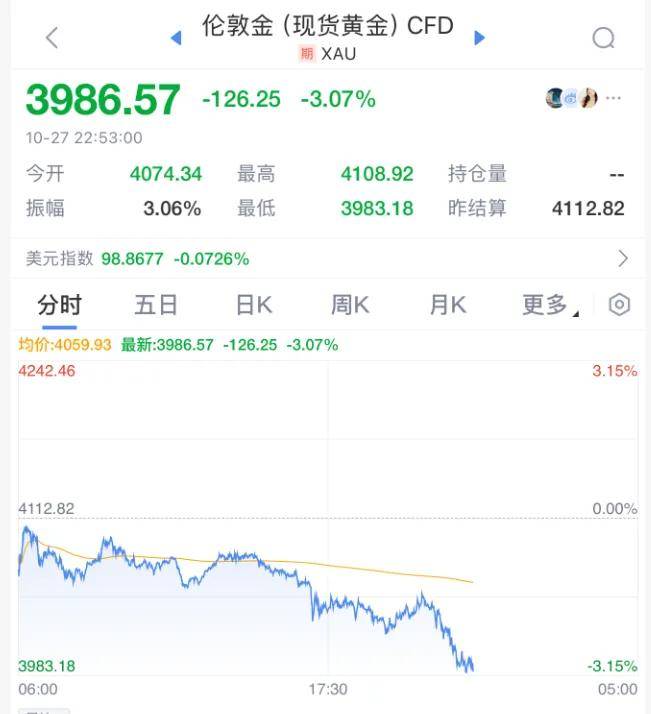
Core Viewpoint - Recent fluctuations in gold prices, including a drop of over 3% below $4000 and $3900, are driven by multiple factors, raising questions about the long-term investment logic of gold and how investors should position themselves [1][3]. Group 1: Factors Driving Gold Price Movements - Concerns over the U.S. dollar credit system have intensified, with the national debt exceeding $37 trillion, marking a historical peak in GDP ratio since World War II, and risks of government shutdown exacerbating market fears [3]. - Escalating trade tensions, particularly between the U.S. and China, have heightened risk aversion, increasing gold's appeal as a traditional safe-haven asset [3]. - Central banks globally are returning to a loose monetary policy, with a 90% probability of further rate cuts anticipated by the market following the Federal Reserve's recent actions [3]. Group 2: Market Sentiment and Technical Analysis - The gold market may have entered a high-level consolidation phase, with short-term sentiment indicators suggesting overheating, which could lead to increased volatility [5]. - Some short-term factors that supported previous price increases are reversing, such as easing U.S.-China tensions and stabilizing European political conditions, which may lead to significant price fluctuations in the future [7]. Group 3: Long-term Outlook and Institutional Predictions - Despite short-term volatility, the long-term logic for gold as a reserve asset remains intact, with 95% of surveyed central banks planning to increase their gold holdings in the next 12 months [7]. - Global gold ETFs saw a net inflow of 145.6 tons in September 2025, bringing total holdings to 3837.7 tons, indicating strong ongoing demand [7]. - Historical comparisons show that gold has experienced significant long-term price increases, suggesting potential for further appreciation in the current cycle [7]. Group 4: Investment Strategy Recommendations - Investors are advised to focus on strategic allocation rather than short-term speculation, with a recommendation to allocate approximately 15% of their portfolio to gold as a hedge against currency credit risks and geopolitical uncertainties [11]. - Gold-related funds are suggested as a preferred investment vehicle due to their liquidity and lower entry barriers, while physical gold and futures are recommended for more knowledgeable investors [11].
世界步入新周期:当其他央行降息路走不动时 美联储重新出发了
Feng Huang Wang· 2025-09-18 02:30
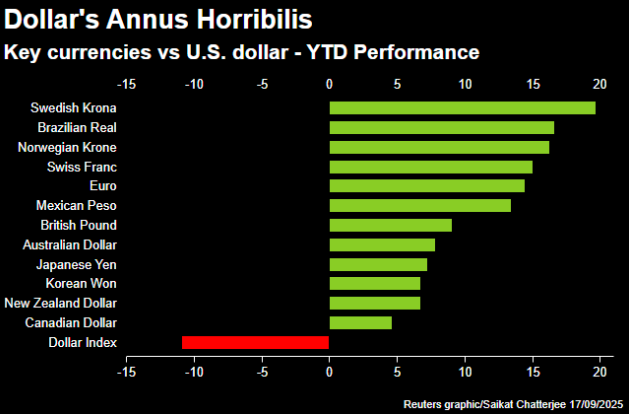
Core Viewpoint - The Federal Reserve is preparing to initiate a rate-cutting cycle, a rare occurrence in the current century, while many non-U.S. central banks are concluding their own rate-cutting cycles [1][2]. Group 1: Federal Reserve Actions - The Federal Reserve has restarted its easing cycle after announcing a cumulative rate cut of 100 basis points over three consecutive months since December [1][3]. - Following the recent 25 basis point cut, the Fed is expected to continue lowering rates in the remaining meetings of the year, with the median forecast suggesting only one additional cut next year [3][4]. Group 2: Global Central Bank Divergence - The Fed's actions are seen as diverging from other major central banks, which are expected to implement only modest rate cuts of 40-60 basis points by the end of next year [4]. - The European Central Bank (ECB) and the Swiss National Bank are perceived to have concluded their rate-cutting cycles, while the Bank of Japan is slowly increasing rates [4]. Group 3: Currency Market Implications - The divergence in monetary policy is likely to have immediate effects on the foreign exchange market, with the U.S. dollar weakening after a period of relative stability [5]. - The euro has appreciated significantly, with a 15% increase against the dollar this year, raising concerns for the ECB regarding inflation targets [5][7]. Group 4: Stock Market Reactions - Historically, Fed easing has been a positive factor for global stock markets, especially when it leads to a "soft landing" for the economy [8]. - Since April, expectations of a dovish Fed and optimism surrounding technology stocks have driven global stock indices to new highs, with some analysts suggesting that the market is still in the early stages of an upward cycle [8].