全面降息降准

Search documents
央行发布会:结构性降息来了!
Sou Hu Cai Jing· 2026-01-19 09:16
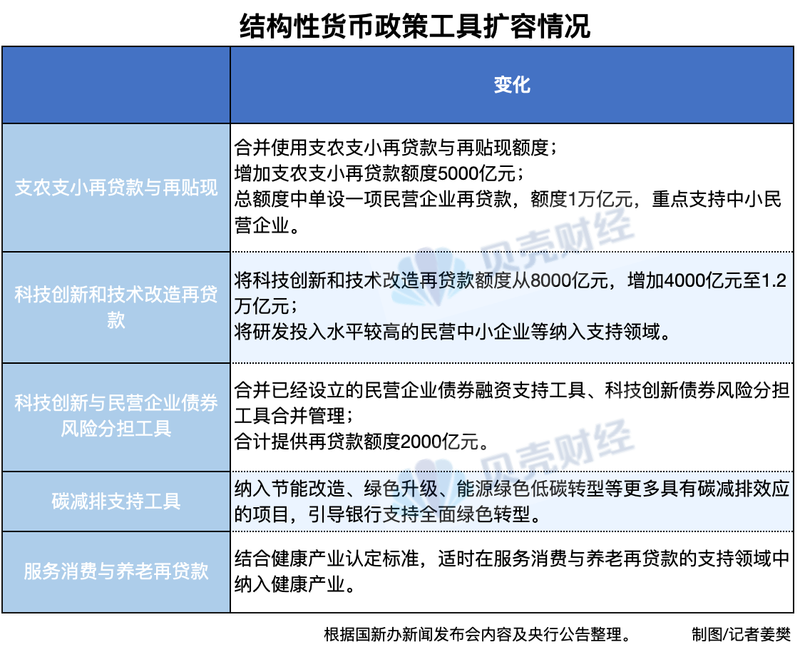
Core Viewpoint - The central bank has introduced a series of monetary policy measures aimed at reducing the cost of obtaining policy funds for banks, encouraging them to lend more to key sectors such as small and micro enterprises, technological innovation, and green industries. However, it will take time for these measures to benefit the real economy [2]. Group 1: Monetary Policy Measures - The central bank announced a targeted interest rate cut of 0.25% for various structural monetary policy tools, with the one-year interest rate reduced from 1.50% to 1.25% [2][3]. - The measures include expanding the support scope and funding scale of structural policy tools and lowering the down payment ratio for commercial properties [3]. Group 2: Structural Monetary Policy Tools - Five structural monetary policy tools have been expanded to focus on supporting private enterprises, technology, green development, and consumption [7][12]. - Specific measures include increasing the quotas for agricultural and small enterprise loans, establishing a dedicated "re-loan for private enterprises," and enhancing support for technology innovation and transformation [8]. Group 3: Impact on Enterprises and Individuals - The cost of borrowing for banks has decreased, incentivizing them to offer cheaper loans to small and micro enterprises, technology companies, and farmers. While this does not directly lower mortgage or deposit rates, it signals a downward trend in loan rates [6][11]. - The central bank aims to create a favorable financial environment for consumption and domestic demand through structural tools that direct credit to consumption-related sectors [10]. Group 4: Future Monetary Policy Outlook - The central bank has indicated that there is still room for further interest rate cuts and reserve requirement ratio reductions, as the average reserve requirement ratio is currently at 6.3%, which is above historical levels [13][14]. - The stability of the RMB exchange rate and the bank's profitability provide a conducive environment for potential future rate cuts [14].

央行开启“定向降息”释放哪些信号?
Xin Lang Cai Jing· 2026-01-15 17:24
Group 1 - The central bank has introduced multiple monetary policy measures, including a 0.25 percentage point reduction in various structural monetary policy tool rates and an expansion of their scope and scale, aimed at stimulating financing in specific sectors [1][2] - The reduction in rates for structural monetary policy tools will lower the one-year interest rate from 1.50% to 1.25% for tools such as loans supporting agriculture and small businesses, technology innovation, and carbon reduction [1][2] - The central bank's policies are designed to provide targeted support to the real economy, particularly in sectors like small and micro enterprises, technology innovation, and green transformation [2][3] Group 2 - The central bank has expanded five structural monetary policy tools, focusing on technology innovation, private enterprises, green development, and consumption, signaling a strong commitment to financial support for specific industries [3][4] - Policies aimed at supporting private enterprises have been emphasized, particularly for small and medium-sized enterprises, which face challenges in financing [4] - The central bank aims to create a conducive monetary environment to boost consumption and expand domestic demand, enhancing the effectiveness of financial support for consumption [4] Group 3 - There is still room for comprehensive interest rate cuts and reserve requirement ratio reductions, as the average reserve requirement ratio is currently at 6.3% [5] - The central bank's recent adjustments to structural monetary policy tool rates may create space for further policy rate cuts, with expectations of a potential reduction of 20-30 basis points within the year [5][6] - The reduction in the minimum down payment ratio for commercial property loans to 30% is expected to facilitate inventory reduction in the commercial real estate market [6] Group 4 - The central bank encourages financial institutions to enhance their foreign exchange risk management services, aiming to maintain the stability of the RMB exchange rate amid complex external conditions [7][8] - Financial institutions are urged to provide a variety of foreign exchange hedging products to help enterprises manage exchange rate fluctuations effectively [8]
事关定向降息、楼市去库存,央行新年送出货币政策“大礼包”
Xin Jing Bao· 2026-01-15 13:17
Core Viewpoint - The People's Bank of China (PBOC) has introduced several monetary policy measures aimed at stimulating specific sectors of the economy through targeted easing, including a 0.25 percentage point reduction in the interest rates of various structural monetary policy tools [1][2]. Group 1: Monetary Policy Adjustments - The PBOC has lowered the interest rates of structural monetary policy tools from 1.50% to 1.25%, impacting loans for agriculture, small businesses, technological innovation, and carbon reduction [2][3]. - The adjustments in structural monetary policy tools are designed to direct credit resources more efficiently into encouraged sectors, thereby improving the effectiveness of financial services to the real economy [3][4]. Group 2: Expansion of Structural Monetary Policy Tools - The PBOC has expanded the scale and scope of five structural monetary policy tools, focusing on technology innovation, private enterprises, green development, and consumption [4][6]. - Specific measures include increasing the quota for agricultural and small business loans by 500 billion yuan and raising the quota for technological innovation loans from 800 billion yuan to 1.2 trillion yuan [6]. Group 3: Support for Private Enterprises - The PBOC has acknowledged the financing challenges faced by medium-sized private enterprises and has implemented policies to enhance financial support for small and medium-sized private businesses [7]. - The central bank aims to create a conducive monetary environment to boost consumption and expand domestic demand, enhancing the adaptability and effectiveness of financial support for consumption [7]. Group 4: Real Estate Market Support - The minimum down payment ratio for commercial property loans has been reduced to 30%, which is expected to facilitate inventory reduction in the commercial real estate market [10]. - This policy aligns with broader regulatory intentions to support the real estate market and stimulate retail consumption and business services [10]. Group 5: Future Monetary Policy Outlook - The PBOC indicates that there is still room for further reductions in the reserve requirement ratio and policy interest rates, given the current economic conditions and stability of the RMB exchange rate [8][9]. - Analysts predict that the central bank may lower policy rates by 20-30 basis points within the year, following the recent adjustments [9].