
定向降息

Search documents
1月黄金ETF流入440亿,AUM达3330亿创纪录
Sou Hu Cai Jing· 2026-02-14 02:59
Core Insights - In January 2026, China's gold ETF saw an inflow of approximately 44 billion RMB, marking the second-highest monthly inflow in history and achieving a fifth consecutive month of net inflows [2] - The total assets under management (AUM) for gold ETFs reached a record high of 333 billion RMB, with gold holdings increasing by 38 tons to a new record of 286 tons [2] - Key factors driving investor interest include strong gold price increases, expectations of targeted interest rate cuts and monetary easing leading to lower government bond yields, and heightened geopolitical uncertainties globally and regionally [2] Investment Trends - Domestic institutional investors, previously limited in participation, have shown a significant increase in preference for gold ETFs [2] - Initial data indicated a short-term outflow of funds following a dip in gold prices in early February, but market demand quickly rebounded, indicating overall resilience in the investment landscape [2]


央行开年“降息红包”:小微企业迎来融资春天
Sou Hu Cai Jing· 2026-01-19 09:42
Group 1 - The central point of the news is the People's Bank of China (PBOC) implementing a targeted interest rate cut to support small and micro enterprises, with a reduction of 0.25 percentage points in the re-lending rate for agriculture and small businesses [2][4] - The new interest rates are set at 0.95% for 3-month loans and 1.25% for 1-year loans, specifically aimed at benefiting small and micro enterprises rather than larger corporations or sectors with excess capacity [2][4] - This targeted approach is designed to lower the borrowing costs for commercial banks, which in turn can provide financial support to small and micro enterprises, effectively channeling resources to those who can create jobs and drive technological innovation [2][6] Group 2 - For example, a hypothetical agricultural cooperative with a loan of 5 million yuan would save 12,500 yuan annually due to the interest rate reduction, which is equivalent to the cost of hiring an additional temporary worker [5] - The estimated annual savings in interest payments for small and micro enterprises across the country could fund the construction of three Hong Kong-Zhuhai-Macao Bridges, highlighting the significant impact of this policy [5] - The PBOC's strategy emphasizes a shift from broad monetary easing to a more precise approach, indicating a commitment to supporting businesses that focus on real economic activities [4][6]

央行开启“定向降息”释放哪些信号?
Xin Lang Cai Jing· 2026-01-15 17:24
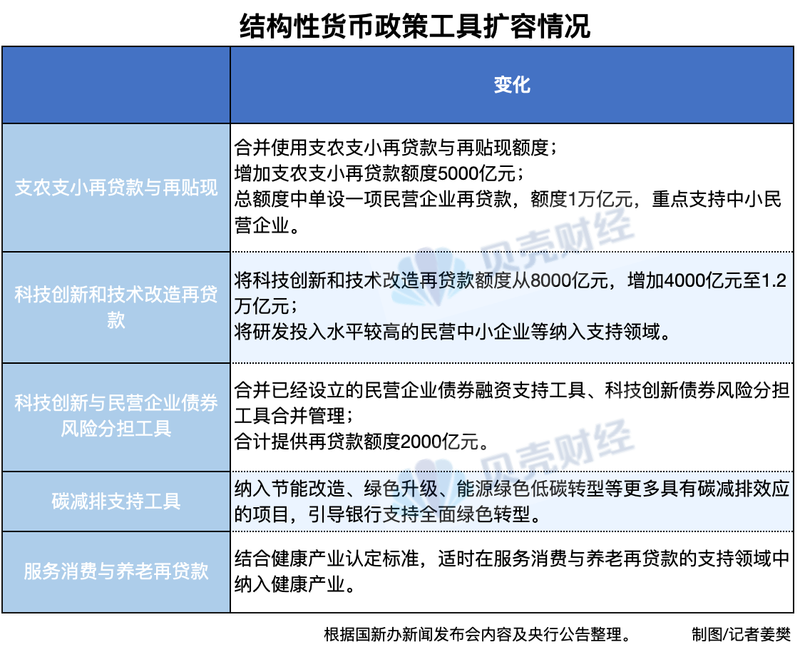
Group 1 - The central bank has introduced multiple monetary policy measures, including a 0.25 percentage point reduction in various structural monetary policy tool rates and an expansion of their scope and scale, aimed at stimulating financing in specific sectors [1][2] - The reduction in rates for structural monetary policy tools will lower the one-year interest rate from 1.50% to 1.25% for tools such as loans supporting agriculture and small businesses, technology innovation, and carbon reduction [1][2] - The central bank's policies are designed to provide targeted support to the real economy, particularly in sectors like small and micro enterprises, technology innovation, and green transformation [2][3] Group 2 - The central bank has expanded five structural monetary policy tools, focusing on technology innovation, private enterprises, green development, and consumption, signaling a strong commitment to financial support for specific industries [3][4] - Policies aimed at supporting private enterprises have been emphasized, particularly for small and medium-sized enterprises, which face challenges in financing [4] - The central bank aims to create a conducive monetary environment to boost consumption and expand domestic demand, enhancing the effectiveness of financial support for consumption [4] Group 3 - There is still room for comprehensive interest rate cuts and reserve requirement ratio reductions, as the average reserve requirement ratio is currently at 6.3% [5] - The central bank's recent adjustments to structural monetary policy tool rates may create space for further policy rate cuts, with expectations of a potential reduction of 20-30 basis points within the year [5][6] - The reduction in the minimum down payment ratio for commercial property loans to 30% is expected to facilitate inventory reduction in the commercial real estate market [6] Group 4 - The central bank encourages financial institutions to enhance their foreign exchange risk management services, aiming to maintain the stability of the RMB exchange rate amid complex external conditions [7][8] - Financial institutions are urged to provide a variety of foreign exchange hedging products to help enterprises manage exchange rate fluctuations effectively [8]
事关定向降息、楼市去库存,央行新年送出货币政策“大礼包”
Xin Jing Bao· 2026-01-15 13:17
Core Viewpoint - The People's Bank of China (PBOC) has introduced several monetary policy measures aimed at stimulating specific sectors of the economy through targeted easing, including a 0.25 percentage point reduction in the interest rates of various structural monetary policy tools [1][2]. Group 1: Monetary Policy Adjustments - The PBOC has lowered the interest rates of structural monetary policy tools from 1.50% to 1.25%, impacting loans for agriculture, small businesses, technological innovation, and carbon reduction [2][3]. - The adjustments in structural monetary policy tools are designed to direct credit resources more efficiently into encouraged sectors, thereby improving the effectiveness of financial services to the real economy [3][4]. Group 2: Expansion of Structural Monetary Policy Tools - The PBOC has expanded the scale and scope of five structural monetary policy tools, focusing on technology innovation, private enterprises, green development, and consumption [4][6]. - Specific measures include increasing the quota for agricultural and small business loans by 500 billion yuan and raising the quota for technological innovation loans from 800 billion yuan to 1.2 trillion yuan [6]. Group 3: Support for Private Enterprises - The PBOC has acknowledged the financing challenges faced by medium-sized private enterprises and has implemented policies to enhance financial support for small and medium-sized private businesses [7]. - The central bank aims to create a conducive monetary environment to boost consumption and expand domestic demand, enhancing the adaptability and effectiveness of financial support for consumption [7]. Group 4: Real Estate Market Support - The minimum down payment ratio for commercial property loans has been reduced to 30%, which is expected to facilitate inventory reduction in the commercial real estate market [10]. - This policy aligns with broader regulatory intentions to support the real estate market and stimulate retail consumption and business services [10]. Group 5: Future Monetary Policy Outlook - The PBOC indicates that there is still room for further reductions in the reserve requirement ratio and policy interest rates, given the current economic conditions and stability of the RMB exchange rate [8][9]. - Analysts predict that the central bank may lower policy rates by 20-30 basis points within the year, following the recent adjustments [9].
中国央行下调结构性工具利率0.25个百分点
Sou Hu Cai Jing· 2026-01-15 09:28
Group 1: Monetary Policy Changes - The People's Bank of China announced a 0.25 percentage point reduction in the structural monetary policy tool rate, effective January 19, lowering the one-year re-lending and re-discount rates to 1.25% [2] - The re-lending quota for technological innovation was increased from 800 billion to 1.2 trillion yuan, with a separate quota of 1 trillion yuan for private enterprises [2] - The minimum down payment ratio for commercial property loans was reduced to 30%, while residential mortgage rates remained unchanged [3] Group 2: Market Reactions - The A-share market reacted positively to the policy, with brokerages and technology sectors seeing a boost, although there were concerns about funds not flowing into infrastructure and real estate [5] - Precious metals surged, with gold surpassing $4,630 per ounce and silver reaching a historical high of $92, driven by global rate cut expectations and increased demand from the photovoltaic and AI industries [5] Group 3: Impact on Individuals and Enterprises - For individuals, the pressure on existing mortgage holders may ease, but the downward trend in deposit rates could reduce annual interest on a 100,000 yuan fixed deposit by approximately 200 yuan [8] - Technology and manufacturing sectors are expected to benefit from low-cost financing, while demand for silver in the photovoltaic and new energy vehicle sectors is driving up industrial metal prices [10] - Export-oriented companies face pressure due to the appreciation of the yuan, which is squeezing profits in industries like textiles and home appliances [11] Group 4: International Dynamics - The political pressure on the Federal Reserve has intensified, with former President Trump calling for rate cuts and initiating a criminal investigation against Powell, which raises concerns about the independence of the central bank [7] - If the Federal Reserve implements rate cuts, a weaker dollar could lead to capital inflows into emerging markets, benefiting A-shares and RMB assets [13] - Japan's plan to raise interest rates to 0.75% may create risks associated with carry trade unwinding due to diverging policies from the US and Europe [13]
央行定调“保持流动性充裕”,业界预计今年或降息2次
Xin Lang Cai Jing· 2026-01-08 00:25
Core Viewpoint - The People's Bank of China (PBOC) is expected to implement flexible monetary policies, including interest rate cuts and reserve requirement ratio (RRR) reductions, to maintain ample liquidity in 2026 [1] Monetary Policy Expectations - The PBOC is anticipated to cut interest rates twice in 2026, with each cut ranging from 20 to 30 basis points (0.2% to 0.3%) [1] - The first and second cuts are preliminarily expected to occur in the first half and second half of the year, respectively [1] - There is a possibility of targeted interest rate reductions for residential mortgages through significant downward adjustments to the 5-year LPR (Loan Prime Rate) to stabilize the real estate market [1] Reserve Requirement Ratio Adjustments - The PBOC is projected to reduce the reserve requirement ratio 1 to 2 times in 2026, with a reduction magnitude of 0.5% to 1% [1] - Attention is drawn to the potential implementation of an RRR cut before the Spring Festival [1]
风险偏好回升施压债市
Qi Huo Ri Bao· 2025-08-19 22:30
Group 1 - The Ministry of Finance, the People's Bank of China, and the Financial Regulatory Administration issued a detailed implementation plan for the personal consumption loan interest subsidy policy, which is expected to stimulate consumption and support domestic demand while potentially delaying overall interest rate cuts [1] - The central bank's second-quarter monetary policy report emphasizes maintaining policy continuity and stability, with a focus on solidifying credit support and preventing fund circularity, indicating a shift towards structural regulation rather than an increase in total credit [2] - The current market shows a strong stock performance but weak bond performance, with multiple factors such as tax period cash flow tightening and rising stock market volumes contributing to a downward adjustment in the bond market [3] Group 2 - The bond market's adjustment is limited due to the need for further recovery in domestic demand, and stability in the bond market requires signals of liquidity support from the central bank [3] - The central bank's increased reverse repurchase operations on August 19 showed initial signs of stabilization in the bond market, with attention on the upcoming MLF operations and fluctuations in funding rates [3] - The report highlights the need to address excessive low-price competition in certain industries and promote consumption to achieve reasonable price recovery, which will be a key policy direction moving forward [2]