
科技创新与技术改造再贷款

Search documents
落实个人信用修复,防范化解风险
HTSC· 2026-02-11 02:25
Investment Rating - The industry investment rating is "Overweight" [8] Core Insights - The report emphasizes the importance of personal credit repair policies and the collaboration between fiscal and monetary policies to support high-quality development [3][5] - The social comprehensive financing cost has decreased, with the weighted average interest rate for new loans at approximately 3.15%, down 10 basis points from September [2] - The report highlights the rapid growth of asset management products, which is changing the deposit structure and maintaining liquidity stability [4] Summary by Sections Section 1: Personal Credit Repair and Risk Prevention - The central bank has introduced a one-time personal credit repair policy to support individuals with overdue information under 10,000 yuan after full repayment, aiming to stimulate micro-entity vitality [4] Section 2: Financing Costs and Credit Structure - The weighted average interest rates for general loans and corporate loans have decreased to 3.55% and 3.10%, respectively, while personal housing loan rates remained stable at 3.06% [2] - Loans for technology, green finance, inclusive finance, and digital economy sectors have shown significant year-on-year growth, with increases of 11.5%, 20.2%, 10.9%, and 14.1% respectively [2] Section 3: Fiscal and Monetary Policy Collaboration - The central bank has increased the quotas for re-loans aimed at technological innovation and small enterprises by 900 billion yuan, alongside a dedicated 1 trillion yuan for private enterprises [3] - The green loan balance reached 44.8 trillion yuan, reflecting a 20.2% year-on-year growth, indicating a robust green finance market [3] Section 4: Liquidity and Credit Governance - The report suggests observing liquidity from a combined perspective of asset management products and bank deposits, noting an 8.1% year-on-year growth in total liquidity indicators [4] - The overall social financing environment remains loose, supporting the ongoing credit repair initiatives [4] Section 5: Future Monetary Policy Directions - The central bank aims to maintain reasonable growth in financial totals and implement moderately loose monetary policies, focusing on price recovery and risk prevention [5] - The report outlines the need for improved market-based interest rate formation and transmission mechanisms to better reflect loan market rates [5]




人行辽宁省分行:多渠道为实体经济提供“真金白银”
Xin Hua Cai Jing· 2026-01-31 01:49
Core Viewpoint - The People's Bank of China Liaoning Branch is committed to implementing a moderately loose monetary policy to support the real economy and promote high-quality development, effectively utilizing various monetary policy tools to provide substantial financial support to the economy and reduce overall financing costs. Group 1: Financing Growth - The People's Bank of China Liaoning Branch has guided financial institutions to meet the effective financing needs of the real economy, resulting in an increase of 121.9 billion RMB in new loans in 2025, with a year-on-year growth of 2.35% in loan balance [1] - Among the new loans, six major state-owned banks contributed 102.2 billion RMB, with a year-on-year growth of 4.2%, while joint-stock banks added 4.53 billion RMB, which is an increase of 31.1 billion RMB compared to the previous year [1] Group 2: Credit Structure Optimization - The People's Bank of China Liaoning Branch has utilized various structural monetary policy tools to guide funds towards key areas and weak links, deploying approximately 77 billion RMB in central bank funds through tools like re-loans for technological innovation and consumer services, which has stimulated financial institutions to issue around 370 billion RMB in various loans [2] - Future plans include establishing special quotas such as "Le Gou Loan" and "Silver Hair Loan" to support loans for consumer services and the elderly care industry, ensuring comprehensive coverage of re-loans for agriculture and small enterprises in key areas [2] Group 3: Sustainable Interest Rate Environment - The People's Bank of China Liaoning Branch aims to optimize the interest rate environment as a crucial part of improving the business environment, continuously guiding a steady decline in overall financing costs and strengthening the supervision of interest rate policies to maintain market competition [2] - In December, the interest rates for newly issued corporate loans and inclusive micro-loans decreased by 248 basis points and 271 basis points, respectively, compared to the end of 2020, demonstrating significant effectiveness in reducing financial burdens on the real economy [2]
找准金融“支点” “撬动”科技创新
Jin Rong Shi Bao· 2026-01-20 01:39
Core Viewpoint - The Chinese financial sector is increasingly focusing on supporting technological innovation through various financial instruments and policies, particularly emphasizing low-cost credit and the development of a dedicated bond market for technology enterprises [1][2][3][6]. Group 1: Financial Support for Innovation - The People's Bank of China (PBOC) has prioritized enhancing financial services for high-quality development in the real economy, specifically targeting technological innovation [1]. - The PBOC has increased the quota for re-loans for technological innovation and technological transformation from 800 billion to 1.2 trillion yuan, expanding support to private small and medium-sized enterprises with high R&D investment [3][6]. - Banks are innovating products such as intellectual property pledge financing and specialized loans for equipment upgrades to better meet the financing needs of technology enterprises [4][5]. Group 2: Low-Cost Credit and Its Impact - Low-cost credit is crucial for technology companies, especially during R&D and capacity expansion phases, with structural monetary policy tools facilitating this support [2]. - As of the end of Q3 2025, 275,400 technology-oriented small and medium-sized enterprises received loans, with a loan balance of 3.56 trillion yuan, reflecting a year-on-year growth of 22.3% [2]. Group 3: Innovation in Credit Evaluation - Traditional credit assessment models struggle to meet the financing needs of technology enterprises, which often rely on intellectual assets rather than physical assets [4][5]. - Banks are adopting new evaluation systems that consider intellectual property, R&D investment, and core team capabilities to facilitate financing for technology firms [5]. Group 4: Development of Technology Bonds - The introduction of technology innovation bonds provides a new channel for direct financing, addressing the mismatch in financing terms for technology enterprises [6]. - Since the launch of the technology bond market, 1.8 trillion yuan in technology innovation bonds have been issued, with significant participation from various financial institutions [6][7].
央行发布会:结构性降息来了!
Sou Hu Cai Jing· 2026-01-19 09:16
Core Viewpoint - The central bank has introduced a series of monetary policy measures aimed at reducing the cost of obtaining policy funds for banks, encouraging them to lend more to key sectors such as small and micro enterprises, technological innovation, and green industries. However, it will take time for these measures to benefit the real economy [2]. Group 1: Monetary Policy Measures - The central bank announced a targeted interest rate cut of 0.25% for various structural monetary policy tools, with the one-year interest rate reduced from 1.50% to 1.25% [2][3]. - The measures include expanding the support scope and funding scale of structural policy tools and lowering the down payment ratio for commercial properties [3]. Group 2: Structural Monetary Policy Tools - Five structural monetary policy tools have been expanded to focus on supporting private enterprises, technology, green development, and consumption [7][12]. - Specific measures include increasing the quotas for agricultural and small enterprise loans, establishing a dedicated "re-loan for private enterprises," and enhancing support for technology innovation and transformation [8]. Group 3: Impact on Enterprises and Individuals - The cost of borrowing for banks has decreased, incentivizing them to offer cheaper loans to small and micro enterprises, technology companies, and farmers. While this does not directly lower mortgage or deposit rates, it signals a downward trend in loan rates [6][11]. - The central bank aims to create a favorable financial environment for consumption and domestic demand through structural tools that direct credit to consumption-related sectors [10]. Group 4: Future Monetary Policy Outlook - The central bank has indicated that there is still room for further interest rate cuts and reserve requirement ratio reductions, as the average reserve requirement ratio is currently at 6.3%, which is above historical levels [13][14]. - The stability of the RMB exchange rate and the bank's profitability provide a conducive environment for potential future rate cuts [14].

央行开启“定向降息”释放哪些信号?
Xin Lang Cai Jing· 2026-01-15 17:24
Group 1 - The central bank has introduced multiple monetary policy measures, including a 0.25 percentage point reduction in various structural monetary policy tool rates and an expansion of their scope and scale, aimed at stimulating financing in specific sectors [1][2] - The reduction in rates for structural monetary policy tools will lower the one-year interest rate from 1.50% to 1.25% for tools such as loans supporting agriculture and small businesses, technology innovation, and carbon reduction [1][2] - The central bank's policies are designed to provide targeted support to the real economy, particularly in sectors like small and micro enterprises, technology innovation, and green transformation [2][3] Group 2 - The central bank has expanded five structural monetary policy tools, focusing on technology innovation, private enterprises, green development, and consumption, signaling a strong commitment to financial support for specific industries [3][4] - Policies aimed at supporting private enterprises have been emphasized, particularly for small and medium-sized enterprises, which face challenges in financing [4] - The central bank aims to create a conducive monetary environment to boost consumption and expand domestic demand, enhancing the effectiveness of financial support for consumption [4] Group 3 - There is still room for comprehensive interest rate cuts and reserve requirement ratio reductions, as the average reserve requirement ratio is currently at 6.3% [5] - The central bank's recent adjustments to structural monetary policy tool rates may create space for further policy rate cuts, with expectations of a potential reduction of 20-30 basis points within the year [5][6] - The reduction in the minimum down payment ratio for commercial property loans to 30% is expected to facilitate inventory reduction in the commercial real estate market [6] Group 4 - The central bank encourages financial institutions to enhance their foreign exchange risk management services, aiming to maintain the stability of the RMB exchange rate amid complex external conditions [7][8] - Financial institutions are urged to provide a variety of foreign exchange hedging products to help enterprises manage exchange rate fluctuations effectively [8]
事关定向降息、楼市去库存,央行新年送出货币政策“大礼包”
Xin Jing Bao· 2026-01-15 13:17
Core Viewpoint - The People's Bank of China (PBOC) has introduced several monetary policy measures aimed at stimulating specific sectors of the economy through targeted easing, including a 0.25 percentage point reduction in the interest rates of various structural monetary policy tools [1][2]. Group 1: Monetary Policy Adjustments - The PBOC has lowered the interest rates of structural monetary policy tools from 1.50% to 1.25%, impacting loans for agriculture, small businesses, technological innovation, and carbon reduction [2][3]. - The adjustments in structural monetary policy tools are designed to direct credit resources more efficiently into encouraged sectors, thereby improving the effectiveness of financial services to the real economy [3][4]. Group 2: Expansion of Structural Monetary Policy Tools - The PBOC has expanded the scale and scope of five structural monetary policy tools, focusing on technology innovation, private enterprises, green development, and consumption [4][6]. - Specific measures include increasing the quota for agricultural and small business loans by 500 billion yuan and raising the quota for technological innovation loans from 800 billion yuan to 1.2 trillion yuan [6]. Group 3: Support for Private Enterprises - The PBOC has acknowledged the financing challenges faced by medium-sized private enterprises and has implemented policies to enhance financial support for small and medium-sized private businesses [7]. - The central bank aims to create a conducive monetary environment to boost consumption and expand domestic demand, enhancing the adaptability and effectiveness of financial support for consumption [7]. Group 4: Real Estate Market Support - The minimum down payment ratio for commercial property loans has been reduced to 30%, which is expected to facilitate inventory reduction in the commercial real estate market [10]. - This policy aligns with broader regulatory intentions to support the real estate market and stimulate retail consumption and business services [10]. Group 5: Future Monetary Policy Outlook - The PBOC indicates that there is still room for further reductions in the reserve requirement ratio and policy interest rates, given the current economic conditions and stability of the RMB exchange rate [8][9]. - Analysts predict that the central bank may lower policy rates by 20-30 basis points within the year, following the recent adjustments [9].
央行下调各类结构性货币政策工具利率0.25个百分点,释放哪些信号?
Xin Lang Cai Jing· 2026-01-15 08:09
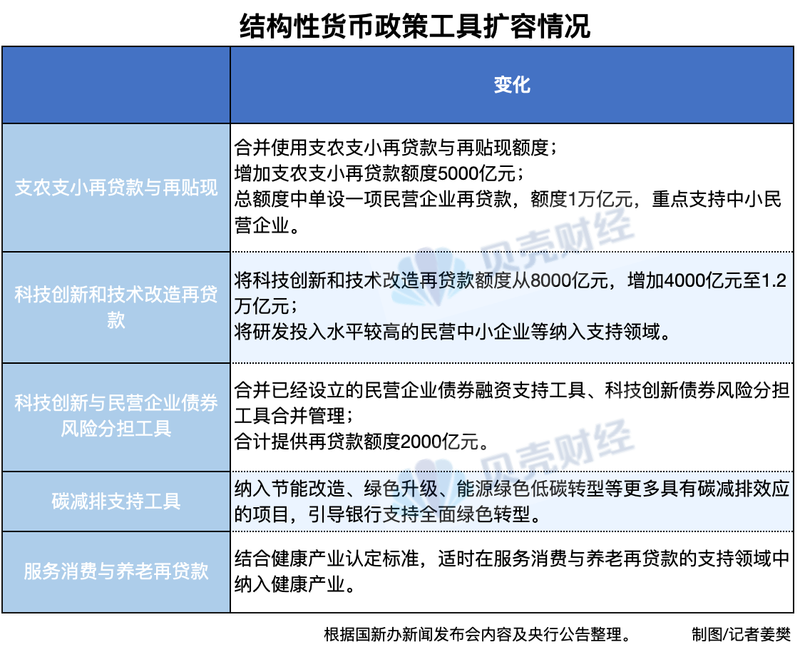
Core Viewpoint - The People's Bank of China (PBOC) has lowered the interest rates of various structural monetary policy tools by 0.25 percentage points, with the one-year rate for relending now at 1.25%, aimed at supporting economic transformation and optimization [1] Group 1: Monetary Policy Adjustments - The recent interest rate cut is the second reduction since May 2025, reflecting a commitment to flexible and effective monetary policy tools [1] - The rate for most structural monetary policy tools, including those for agriculture and small enterprises, has decreased from 1.50% to 1.25% [1] Group 2: Economic Support and Efficiency - The reduction in structural monetary policy tool rates is expected to lower financing costs in specific sectors, encouraging banks to lend at lower rates to small and micro enterprises, technology innovation, and green transformation [1][2] - The targeted nature of structural policy tool rate cuts allows for more precise allocation of credit resources to weak links and key areas, enhancing the efficiency of fund utilization [2] Group 3: Policy Signals and Future Directions - The interest rate cut sends a clear signal of the government's commitment to financial support for specific industries, which may boost business confidence and stabilize market expectations [4] - The PBOC's recent work meeting emphasized the importance of maintaining a moderately loose monetary policy, with a focus on stabilizing economic growth and ensuring reasonable price recovery [4] - Future monetary policy will prioritize the integration of existing policies and enhance the efficiency of current measures rather than simply increasing them [5] Group 4: Specific Measures and Support - The PBOC plans to increase the quota for agricultural and small enterprise relending by 500 billion yuan, with a separate quota of 1 trillion yuan designated for private enterprises [5] - The quota for technology innovation and technical transformation relending will be increased from 800 billion yuan to 1.2 trillion yuan, expanding the support scope to include high R&D investment private small and medium enterprises [5] - The PBOC will merge existing risk-sharing tools for technology innovation and private enterprise bonds, providing a total relending quota of 200 billion yuan [6]

中国人民银行广东省分行行长张奎:强化金融支持“创新湾区”建设
Zheng Quan Shi Bao Wang· 2025-08-30 14:39
Core Viewpoint - The financial sector in the Guangdong-Hong Kong-Macao Greater Bay Area is enhancing its support for high-quality development through improved financial policies and services, particularly for technology-driven enterprises [1] Group 1: Financial Support for Innovation - Focus on breakthroughs in new productivity technologies, strengthening financial support for the "Innovation Bay Area" construction, and promoting technology financial service innovations [2] - Encourage financial institutions and technology enterprises to issue technology innovation bonds, expanding the range of cities and institutions for comprehensive financing cost pilot programs [2] Group 2: Financial Support for Industry - Emphasize financial support for urban renewal projects, integrating technology innovation and industrial structure optimization into the urban renewal process [3] - Promote sustainable development capabilities through financial support for traditional industries and emerging sectors, enhancing the innovation capacity of the Greater Bay Area [3] Group 3: Financial Support for Connectivity - Increase financial support for major cooperation platforms like Hengqin and Qianhai, optimizing the spatial layout of technological innovation [4] - Facilitate the integration of the Greater Bay Area into the global innovation network through improved financial service rules and mechanisms [4] Group 4: Financial Support for Sustainability - Utilize carbon reduction support tools and promote the issuance of green bonds in international markets, aligning with global sustainability standards [5] - Encourage financial institutions to provide differentiated financial services based on companies' carbon footprints and sustainability disclosures, leading the way in green trade [5]
让科技和金融“双向奔赴”,七部门推出15项重磅举措
Di Yi Cai Jing· 2025-05-22 15:25
Group 1 - The core viewpoint of the news is the introduction of 15 policy measures aimed at enhancing the synergy between technology and finance, focusing on various aspects such as venture capital, monetary credit, capital markets, technology insurance, and the bond market [1][8] - The policies aim to address the financing challenges faced by technology enterprises by innovating financial tools and creating low-cost financing channels [2][4] - The People's Bank of China has increased the scale of re-loans for technological innovation and technological transformation from 500 billion to 800 billion yuan, while reducing the re-loan interest rate from 1.75% to 1.5% [2][3] Group 2 - A "Technology Board" has been established in the bond market to support the issuance of technology innovation bonds, with nearly 100 institutions having issued such bonds totaling over 250 billion yuan [3][4] - Long-term capital is crucial for the development of technology enterprises, with various pilot projects initiated to attract long-term capital, including expanding the scope of equity investment pilot projects and increasing the duration of merger loans [4][5] - The policy measures emphasize the need for collaboration among various departments to effectively implement technology finance initiatives, transitioning from a "fiscal mindset" to a "financial mindset" [7][8]