关税与通胀关系

Search documents
美财长贝森特出席众议院听证会与民主党激烈交锋 援引百年数据称关税不推高通胀
Sou Hu Cai Jing· 2026-02-05 01:08
Group 1 - The core viewpoint of the article revolves around U.S. Treasury Secretary Becerra's testimony at a House Financial Services Committee hearing, where he engaged in a heated debate with Democratic lawmakers regarding tariffs, Federal Reserve independence, and exchange rate policy [1][2] - Becerra stated that "tariffs will not lead to inflation," citing a study from the San Francisco Fed, and corrected his previous assessment from January 2024 that tariffs would raise inflation, asserting that the U.S. economy has continued to grow and inflation has decreased since the implementation of tariffs [1] - The hearing highlighted significant partisan divisions in U.S. Congress regarding economic policy, with Democratic lawmakers challenging Becerra's statements and accusing him of being a "puppet" for Trump, reflecting ongoing uncertainty about the future direction of economic policies under the Trump administration [2] Group 2 - On the issue of Federal Reserve independence, Becerra expressed support but emphasized that this independence must be based on public trust, criticizing the Biden administration for allowing high inflation, which he believes has eroded that trust [2] - Becerra reiterated support for a strong dollar policy and mentioned that the U.S. Treasury attracted a record inflow of foreign funds into government bonds last year, predicting a slight decline in the yield of 10-year U.S. Treasury bonds [2]
贝森特听证“火星四射”:否认关税导致通胀,被喷当特朗普走狗
Hua Er Jie Jian Wen· 2026-02-04 22:32
Core Viewpoint - The hearing highlighted significant partisan divisions regarding the Trump administration's economic policies, particularly on tariffs, Federal Reserve independence, and financial regulation, raising investor concerns about future policy directions [1][2]. Tariff Dispute - Treasury Secretary Mnuchin asserted that tariffs would not lead to inflation, citing a Federal Reserve report based on 150 years of data, which was met with fierce criticism from Democratic lawmakers [3]. - Democratic representatives challenged Mnuchin's stance, with claims that rising prices in their districts contradicted his assertions, emphasizing the burden of increased costs on consumers [3]. Federal Reserve Independence - Mnuchin expressed support for the Federal Reserve's independence in monetary policy but emphasized the need for accountability, linking the Fed's credibility to public trust [4]. - He stated that the President has the right to comment on Fed decisions, which raised concerns about potential political interference in monetary policy [4]. Currency Policy - Mnuchin reaffirmed the administration's commitment to a strong dollar policy, although this stance has been questioned in light of recent protectionist trends [5]. - He noted that despite criticisms, U.S. Treasury bonds attracted record foreign investment, indicating confidence in U.S. financial markets [5]. Market Comments and Regulation - During the hearing, Mnuchin defended Trump's social media comments regarding stock purchases, dismissing calls for an investigation into potential market manipulation [6]. - He criticized previous regulatory actions as reactive rather than preventive, suggesting that the focus had shifted away from essential safety and soundness issues [6]. Housing and Community Banking - Mnuchin highlighted the need for affordable housing and called for tailored regulations to support community banks, which he believes are crucial for a thriving banking ecosystem [8][9]. - He linked rising housing prices to increased immigration, suggesting that demand pressures contributed to affordability issues [8]. Overall Hearing Dynamics - The hearing was marked by intense exchanges, with Democratic lawmakers accusing Mnuchin of acting as a mouthpiece for Trump, leading to a chaotic atmosphere [10][11]. - Mnuchin's responses to questions were often combative, reflecting a contentious political environment and raising questions about his ability to effectively communicate policy positions [11][12].
高关税时代通胀为何“不按套路出牌”?两项研究揭示背后逻辑
Jin Shi Shu Ju· 2026-01-06 03:19
Core Insights - Recent studies indicate that the high tariffs imposed in the U.S. have not led to the significant inflation that many economists predicted, with historical data suggesting that tariff increases often slow down price rises instead [1][2] - Both studies conclude that while tariffs may cause a slight increase in inflation, the overall impact is limited due to reduced consumer and business demand, which dampens economic growth [1][2] Group 1: Tariff Impact on Inflation - Research from the San Francisco Fed shows that a 1% increase in tariffs correlates with a 0.6% decrease in inflation rates, contradicting traditional economic expectations [1] - A separate study from Northwestern University found that while tariffs can lead to a minor uptick in inflation, the negative effects on demand from reduced trade and manufacturing activity offset this impact [2] Group 2: Economic Growth and Employment - Despite the tariffs, the U.S. economy has shown overall growth since their implementation, although signs of weakness are emerging, such as stagnation in job growth since April of last year [2] - A key manufacturing index fell to a 14-month low in December, indicating potential challenges ahead for the manufacturing sector [2] Group 3: Actual vs. Nominal Tariff Rates - Economists highlight that due to loopholes and exemptions in tariff regulations, the effective average tariff rate in the U.S. is 14.1%, significantly lower than the nominal rate of 27.4% [3] - Historical context is provided, noting that the current level of tariffs has not been seen since the 1930s, raising questions about the applicability of past economic patterns to the present situation [3]
鲍威尔的国士考验(上)
Sou Hu Cai Jing· 2025-08-25 18:14
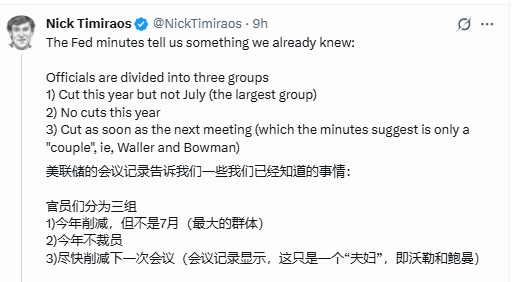
Group 1: Federal Reserve and Monetary Policy - Federal Reserve Chairman Powell emphasizes the importance of patience amid increasing inflation pressures, maintaining a reasonable judgment on interest rate cuts [1] - The June FOMC dot plot indicates nearly half of the members expect two rate cuts within the year, while seven members oppose any cuts, showcasing historical divisions [1] - Powell asserts that the current monetary policy is appropriately positioned despite external pressures, including criticism from the White House regarding the Fed's renovations [1] Group 2: Tariffs and Economic Impact - The total tariffs collected by the U.S. in June amounted to $28 billion, with annualized tariffs potentially exceeding $300 billion and an effective tariff rate nearing 10% [2] - Tariff totals are projected to rise to $80 billion by 2024, with an increase of $220 billion attributed to the new trade war initiated by Trump [2] - The impact of tariffs on trade volume is significant, as exceeding a 25% tariff could lead to reduced trade and tax revenue [2] Group 3: Tariffs and Inflation - Tariffs and currency depreciation are equivalent policy tools that can influence international balance of payments by altering relative prices [3] - Tariffs not only directly raise prices but can also indirectly increase inflation by enhancing net exports and stimulating demand [3] Group 4: Immigration Policy and Inflation - The mainstream view suggests that immigration enforcement will reduce labor supply, thereby increasing inflation pressure, but this may not fully capture the demand dynamics [6] - Trump's immigration policies have led to a significant increase in deportations, with projections indicating nearly 1 million deportations by 2025, potentially impacting GDP and inflation [6] - The interaction between tariffs, immigration policy, and fiscal policy creates a complex inflationary environment for the U.S. economy, complicating future Federal Reserve decisions [6]

美联储主席热门人选布拉德:关税不会导致通胀,已和贝森特交谈
Jin Shi Shu Ju· 2025-08-13 00:54
Group 1 - Former St. Louis Fed President Brad discussed his recent conversation with Treasury Secretary Mnuchin regarding the search for a new Fed Chair, expressing his willingness to advance in any way desired [2] - President Trump is a vocal critic of current Fed Chair Powell, whose term lasts until mid-May next year, and is looking for a successor who aligns with his views on interest rate cuts [2] - Mnuchin is compiling a list of candidates that includes NEC Director Hassett, former Fed Governor Warsh, current Fed Governor Waller, and former President Bush's economic advisor Summers [2] Group 2 - Brad supports lowering interest rates, stating that tariffs do not lead to inflation but have slowed the economy this year, predicting that the Fed will adopt this view [2][3] - He emphasized the importance of preparing for success in the role of Fed Chair, aiming for low and stable inflation while respecting the Fed's independence under the Federal Reserve Act [3] - White House Economic Council Chair Milan refuted the belief that tariffs would lead to long-term higher prices, stating there is no evidence of inflation caused by tariffs [3][4] Group 3 - Following the release of the CPI report showing a July inflation rate of 2.7%, which is above the Fed's 2% target but slightly below Wall Street expectations, Brad predicted that the FOMC would begin cutting rates in September, potentially reducing the benchmark rate by a full percentage point within the next year [3] - Both Milan and Brad highlighted the importance of Fed independence, especially in light of Trump's public criticisms of policymakers for not cutting rates [4] - Trump reiterated his demand for a 3 percentage point rate cut, criticizing Powell for being "late" in his decisions, while Brad acknowledged Trump's right to his opinion based on his experience in the real estate market [4]
新美联储通讯社:如何看待美联储内部降息分歧,未来几个月的通胀数据很重要
Hua Er Jie Jian Wen· 2025-07-10 03:43
Core Viewpoint - The Federal Reserve is experiencing significant internal debate regarding the impact of tariffs on inflation and the appropriate response, which may disrupt its previously unified stance [1][2]. Group 1: Federal Reserve's Position - The Federal Reserve is not expected to lower interest rates this month, but Chairman Powell has indicated that the threshold for rate cuts may be lower than in the spring due to tariff-related inflation concerns [2][5]. - Powell's recent comments suggest a middle ground approach, where moderate price readings or weak employment data could justify a rate cut before the end of summer [2][7]. - The internal division within the Federal Reserve is highlighted by differing opinions on whether tariffs will lead to sustained inflation, with some officials advocating for a wait-and-see approach [5][6]. Group 2: Tariff Impact on Inflation - The recent adjustments to Trump's tariff policy have altered the conditions for potential interest rate cuts, with concerns about stagflation arising from earlier tariff increases [5][6]. - There is currently no significant evidence of consumer price increases related to tariffs, although many officials expect to see such effects in upcoming June and July data [5][6]. - The debate centers around whether businesses will pass on increased costs to consumers, with some officials cautioning against premature conclusions [6][7]. Group 3: Future Data and Strategy - The upcoming inflation data will serve as a critical test for the Federal Reserve's internal divisions regarding tariff impacts and the management of costs if predictions are incorrect [6][7]. - Powell's stance provides tactical flexibility for the Federal Reserve, allowing for potential rate cuts based on economic conditions without fully committing to a specific inflation outlook [7].