
劳动力囤积

Search documents
dbg markets:美联储无力干预就业危机
Sou Hu Cai Jing· 2025-11-13 01:17
Group 1 - Analysts are struggling to determine the rate of deterioration in the job market, with no significant signs of weakness currently evident from various private surveys and alternative data sources [1] - The end of government shutdown has reduced policy uncertainty, while improvements in global trade have boosted confidence among export-oriented companies, leading to a resurgence in investor risk appetite [3] - The chief economist at RSM indicated that the era of "labor hoarding" in the U.S. job market has officially ended, with AI technology fundamentally altering job demand structures [3] Group 2 - A recent report revealed that Goldman Sachs' layoff tracker has surpassed levels seen at the onset of the pandemic in 2019, predicting a rise in the unemployment rate from 4.3% to 4.5% over the next six months [4] - The probability of the unemployment rate increasing by 0.5 percentage points or more has reached 20%-25%, indicating a concerning trend for the labor market [4] - The current slowdown in the labor market is attributed to structural unemployment caused by factors such as AI replacement and immigration policy adjustments, which differ from cyclical unemployment [4]


美国“裁员潮”密集爆发,就业市场警报拉响
Hua Er Jie Jian Wen· 2025-11-05 03:01
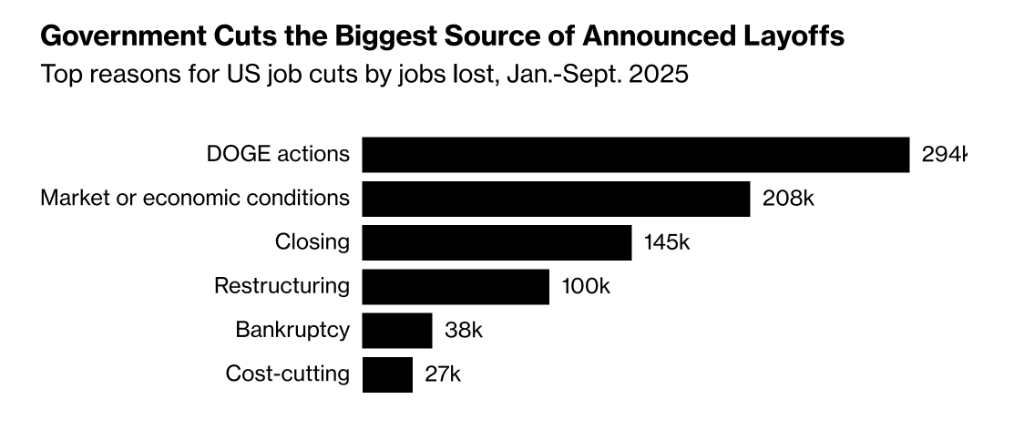
Core Insights - The phenomenon of "labor hoarding" among U.S. employers appears to be coming to an end, as major companies like Starbucks and Amazon announce layoffs, signaling a potential shift in the job market [1][2] - The total number of layoffs announced in the U.S. has reached nearly 950,000 as of September this year, marking the highest level for the same period since 2020 [3] Group 1: Layoff Trends - The layoffs are widespread across various sectors, with government jobs being particularly affected, accounting for nearly 300,000 job cuts this year [3] - The technology and retail sectors have also seen significant layoffs, with Southwest Airlines conducting large-scale layoffs for the first time in its history [3] - The data from private firms like Challenger, Gray & Christmas is becoming increasingly important due to the lack of timely information from official sources [3] Group 2: Shift in Employment Strategy - The recent wave of layoffs indicates a major shift in corporate hiring strategies, moving away from the previously stable "low hiring, low firing" model [6] - Companies are now more willing to cut labor costs to protect profits, influenced by advancements in artificial intelligence and automation [6] - Over 60% of executives believe that AI will eventually replace some entry-level jobs, contributing to the decision to reduce workforce [6] Group 3: Economic Outlook and Market Sentiment - Economists have differing views on the future of the job market, with some, like Federal Reserve Chairman Jerome Powell, remaining optimistic about a gradual cooling rather than a severe downturn [7] - Concerns are rising among market observers regarding layoffs in non-tech sectors, particularly in transportation and retail, which could signal deeper issues [7] - There is an increasing demand for temporary workers as companies remain cautious about long-term hiring, reflecting uncertainty about the economic outlook [7]
美就业市场陷入“诡异”僵局,美联储已提前嗅到危机?
Jin Shi Shu Ju· 2025-08-25 05:13
Core Viewpoint - The labor market has become a central focus for the Federal Reserve, highlighting its vulnerabilities and potential risks to the economy [1] Group 1: Employment Trends - The unemployment rate remains low, and employers are not strongly inclined to lay off workers; however, hiring intentions among businesses are also weak [2] - The hiring rate in June was only 3.3%, down from 3.9% in February 2020 and significantly lower than 4.6% in November 2021 [3] - The current low hiring and low layoff environment has created challenges for job seekers, particularly for young individuals and low-income workers [4] Group 2: Economic Implications - If the current trends of low hiring and low layoffs continue, even a slight increase in layoffs could lead to a net decrease in employment [5] - A potential rise in the layoff rate from 1% to 1.3% could result in layoffs exceeding 2 million, which the economy may struggle to absorb without increased hiring [5] - The recent survey by the Conference Board indicates that one-fifth of U.S. employers plan to slow hiring in the second half of 2025, nearly double the proportion from the previous year [6] Group 3: Federal Reserve Concerns - The Federal Reserve is increasingly concerned about the weak employment growth, which could lead to a downward spiral in the labor market [6] - Economic conditions that lead to net job losses could trigger a self-reinforcing cycle of reduced spending by businesses and consumers, potentially resulting in a recession [6]
“不裁人,但也不招人”!美联储担心的就业风险是什么?
Hua Er Jie Jian Wen· 2025-08-25 01:21
Core Insights - The U.S. job market is in a precarious balance characterized by low hiring and low layoffs, which, while maintaining a stable unemployment rate, poses significant risks to economic stability [1][3] - Federal Reserve Chairman Jerome Powell highlighted the changing risk balance in achieving dual mandates of employment and inflation, noting that recent employment growth has been weaker than expected [1][3] - The current labor market is described as "peculiar," with immigration restrictions limiting labor supply, counteracting reduced demand [1][3] Employment Dynamics - The hiring rate in June was only 3.3%, lower than the 3.9% during the early pandemic and significantly below the 4.6% seen in November 2021 [2] - Layoffs in June accounted for just 1% of total employment, close to the historical low of 0.9% during a strong job market in 2021 [2][3] - The phenomenon of "labor hoarding" is prevalent, where employers are reluctant to lay off workers due to past experiences of difficulty in rehiring [2][3] Risks of Employment Imbalance - Analysts warn that even a slight increase in layoffs could trigger a downward spiral in employment, making it difficult for the economy to absorb job losses [3][4] - In June, approximately 1.6 million workers were laid off, with a potential increase to over 2 million if the layoff rate rises to 1.3%, the pre-pandemic level [3][4] - A recent survey indicated that 20% of U.S. employers plan to slow hiring by the second half of 2025, nearly double the rate from the previous year [4] Impact on Job Seekers - The current low hiring and layoff environment negatively affects job prospects, particularly for younger individuals and low-income workers, leading to prolonged job searches [4]