化工周期反转

Search documents
美伊冲突持续叠加春耕旺季,硫磺与钾肥供需或进一步紧张
Guotou Securities· 2026-03-22 10:49
Investment Rating - The report maintains an investment rating of "Outperform the Market - A" for the chemical industry [6]. Core Insights - The chemical industry is currently at the bottom of a four-year down cycle, with indicators suggesting a potential turning point in 2026. The China Chemical Product Price Index (CCPI) has dropped 39% from its peak in 2021, indicating historical low levels [19][20]. - The supply-demand dynamics for sulfur and potassium fertilizers are expected to tighten due to geopolitical tensions and seasonal agricultural demand, particularly in the context of the ongoing US-Iran conflict [1][12]. - The report highlights the shift in the global chemical landscape, with Chinese companies gaining market share due to cost advantages, while European firms are reducing capacity due to high energy and compliance costs [20]. Summary by Sections 1. Core Insights - The chemical industry is poised for a potential recovery in 2026 after a prolonged down cycle, with signs of stabilization in profitability and capital expenditure [19]. - Geopolitical tensions, particularly in the Middle East, are impacting the supply of sulfur and potassium fertilizers, leading to increased prices and potential supply shortages [1][12]. 2. Chemical Sector Performance - The chemical sector has underperformed recently, with a significant drop in the sector index compared to broader market indices [27][29]. - In the past week, all 26 sub-sectors within the basic chemical industry experienced declines, with notable drops in phosphorus and nitrogen fertilizers [33]. 3. Price and Margin Analysis - Sulfur prices have surged, with current spot prices at 5,300 CNY/ton, reflecting a year-on-year increase of 117.21% [2]. - The report suggests that the profitability of sulfur iron ore acid production may become more favorable compared to traditional sulfur acid production due to rising sulfur prices [11]. 4. Supply and Demand Dynamics - The report anticipates a supply-demand gap for sulfur of over 10 million tons in 2026 if geopolitical tensions persist, particularly affecting imports from the Middle East [3][4]. - For potassium fertilizers, the report indicates a projected supply-demand gap of 236,000 tons in 2026, exacerbated by geopolitical risks affecting trade routes and production [12]. 5. Investment Opportunities - The report recommends focusing on companies positioned to benefit from the tightening supply of sulfur and potassium, such as Yuegui Co. and Yara International [11][12]. - It also highlights the potential for value re-evaluation of leading chemical companies in China due to their competitive advantages in the global market [20].
转债市场观点更新及热点交流
2026-01-16 02:53
Summary of Conference Call Notes Industry Overview - The convertible bond market remains in a tight supply-demand situation, with an overall reduction exceeding 100 billion in 2025 and an estimated maturity scale of over 80 billion in 2026. The issuance speed of new bonds is insufficient to offset the maturity volume, supporting convertible bond prices [1][3] - Regulatory attitudes and the willingness of listed companies to issue bonds are key factors affecting the scale of the convertible bond market. Despite a significant number of convertible bonds being delisted, there has been no clear regulatory easing, and technology growth companies still show strong issuance intent, potentially leading to a concentrated issuance period [1][4] Key Insights and Arguments - The market for convertible bonds in 2025 performed better than expected, with indices continuously breaking new highs and absolute prices and valuation levels reaching historical peaks. Despite a decrease in cost-effectiveness, confidence in the convertible bond market remains strong due to the ongoing rise in the equity market and investor optimism about a bull market [3][7] - The high abandonment rate of triggered strong redemptions may be linked to regulatory concerns about excessive convertible bond redemptions or company considerations. It is anticipated that up to 1 trillion in new bonds will be issued in 2026, with significant contributions from sectors like power equipment and electronics [6][1] Demand and Market Confidence - Demand remains robust, driven by fixed-income funds participating in equity market trends and large-scale fixed-income allocations by banks and insurance companies. This demand is a significant driver for the convertible bond market, maintaining confidence for 2026 despite potential regulatory pressures on the equity market [7][1] - Current valuations are at a high point, with bonds priced at 100 reaching 37% of their peak, suggesting a need for a shift in perspective regarding investment strategies. Attention should be paid to changes in institutional attitudes and previous support factors [8][1] Specific Company Insights - **Energy Saving Wind Power**: This company faces challenges due to wind abandonment limits, electricity prices, and wind conditions, leading to a noticeable profit decline. However, its valuation is gradually showing cost-effectiveness [10][11] - **Fujian Energy**: The company is impacted by the Taiwan Strait situation, causing delays in offshore wind project approvals. Despite this, favorable wind conditions and declining coal prices in 2026 are expected to positively influence profits. The company is under pressure to meet a 5% growth target for 2027, leading to a decision for mid-term dividends to enhance shareholder returns [11][13] - **New Feng Ming and Hengyi Petrochemical**: These mid-cap blue-chip companies are viewed positively in the context of low valuations in the chemical sector. A cyclical reversal is anticipated in the chemical industry by 2027, with confirmed production cuts in the PTA sector, making these stocks recommended investment targets [2][14] Additional Considerations - The current market environment suggests that chasing high prices may not be meaningful, and adjustments should be made for future allocations. Each valuation pullback presents a golden opportunity for active investment, focusing on theme rotation and duration selection [9][1]
草酸行业展望及华鲁恒升观点更新
2025-11-14 03:48
Summary of the Conference Call on Oxalic Acid Industry and Hualu Hengsheng's Insights Industry Overview - The oxalic acid industry is experiencing significant growth, with Hualu Hengsheng benefiting from an expansion to an annual production capacity of 700,000 tons, indicating a strong potential for price increases in oxalic acid [1][4] - The demand for oxalic acid is rapidly increasing in key sectors such as pharmaceuticals, rare earths, and new energy, with consumption in these areas doubling year-on-year, suggesting a positive outlook for oxalic acid demand [9][10] Company Insights - Hualu Hengsheng is expected to see substantial benefits from the anticipated recovery in the prices of its products, including oxalic acid, urea, and other chemicals, particularly in 2026 [1][4] - The company has a competitive edge due to its integrated production processes, allowing for flexible switching between the production of ethylene glycol, dimethyl oxalate, and oxalic acid, which enhances cost control and profitability [2][13][14] - Future growth drivers for Hualu Hengsheng include upgrades to existing facilities, the release of urea production capacity, and the launch of new TDI projects, which are expected to contribute significantly to the company's overall performance [5][15] Market Dynamics - The macroeconomic outlook for the chemical industry is positive, with signs of a recovery in capital expenditures since 2025 and a potential increase in demand driven by domestic policies and overseas interest rate cuts [7] - On a micro level, the growth rate of new chemical plants has slowed significantly since 2024, with some segments experiencing zero new capacity additions, which, combined with increasing demand for quality chemical materials, is expected to lead to a supply-demand recovery [8] Competitive Landscape - The oxalic acid market is characterized by high concentration, with Hualu Hengsheng holding a significant market share, providing it with competitive and pricing power [11] - Current operating rates among manufacturers are around 80%, with recent signs of price increases, indicating a favorable market outlook without immediate plans for new capacity additions [11] Price Trends - The price of oxalic acid has been on a downward trend over the past two years, currently around 3,000 RMB per ton, but is expected to rebound as supply tightens. Historical prices have reached 5,000 to 6,000 RMB per ton, suggesting significant price elasticity if demand improves [12] Future Growth Areas - Hualu Hengsheng is also exploring potential growth in TDI projects and other bulk chemical products like DMF and formic acid, which are expected to benefit from the overall recovery of the industry and collaborative pricing strategies [16]

“反内卷”或成化工周期反转起点?机构持续看好,化工ETF(516020)20日吸金超3.1亿元!
Xin Lang Ji Jin· 2025-08-13 12:14
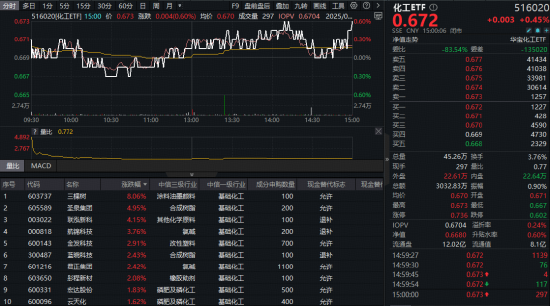
Group 1 - The chemical sector experienced a rise on August 13, with the chemical ETF (516020) reaching a peak intraday increase of 0.6% and closing up 0.45% [1] - Key stocks in the sector included SanKe Tree, which surged by 8.06%, and Shengquan Group and Lianhong Xinke, both rising over 4% [1] - The chemical ETF has seen significant net subscriptions, with over 310 million yuan in net inflows across 15 of the last 20 trading days [1][3] Group 2 - The chemical sector is responding to a call for "anti-involution," with the China Nonferrous Metals Industry Association advocating for better collaboration across the lithium industry [3] - Analysts believe that the "anti-involution" initiative could mark a turning point for the chemical sector, with recent high-level meetings emphasizing this goal [3][4] - The chemical industry currently has a relatively high operating rate, with core products operating above 65%, indicating a healthier competitive landscape compared to other sectors like photovoltaics [4] Group 3 - The chemical ETF (516020) is tracking a specialized index with a price-to-book ratio of 2.09, which is at a low point historically, suggesting a favorable long-term investment opportunity [4] - The industry faces challenges such as overcapacity and intensified competition, but recent policies aim to optimize industry structure and encourage consolidation [5] - The ETF provides exposure to major market leaders and various sub-sectors within the chemical industry, making it a strategic investment vehicle for capturing growth opportunities [5]