北京中轴线文化

Search documents
京气神儿丨影像里的中轴记忆
Ren Min Wang· 2025-11-14 13:18
Core Insights - The article highlights the significance of Beijing's central axis, which stretches approximately 7.8 kilometers from Yongdingmen to Bell and Drum Towers, connecting key landmarks such as Tiananmen and the Forbidden City [2] Group 1 - The central axis is referred to as "the backbone of Beijing," emphasizing its cultural and historical importance [2] - Li Xin, a researcher and documenter of the central axis culture, has dedicated decades to capturing its essence through photography, creating a "visual diary" [2] - The photographic documentation provides invaluable empirical evidence for studying the evolution of architectural forms, spatial scales, and landscape views along the central axis [2] Group 2 - The captured moments illustrate the central axis as a "living heritage," showcasing its authenticity and vitality [2] - The visual language used in Li Xin's work resonates with the public, bridging historical narratives with contemporary experiences [2] - The article asserts that the charm of Beijing's central axis is not only rooted in its historical grandeur but also vibrantly alive in the present [2]
《北京中轴线传说》作者杨建业:从口头传说到文化密码
Zhong Guo Xin Wen Wang· 2025-11-14 08:48
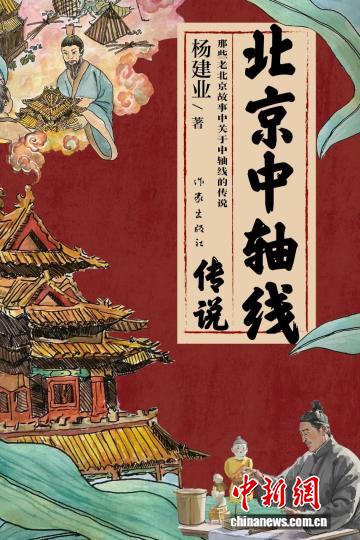
Core Perspective - The book "Beijing Central Axis Legends" by Yang Jianye presents the cultural significance of the Central Axis of Beijing through the lens of oral literature, aiming to enhance readers' understanding of this newly recognized World Heritage site [1][2]. Group 1: Author's Intent and Cultural Value - Yang Jianye emphasizes that while pride in the Central Axis has grown over the past decade, many people remain unaware of the legends surrounding it, which are crucial to its cultural identity [2]. - The author aims to make the rich oral traditions accessible, allowing readers to experience the charm of the Central Axis in a more vivid and relatable manner [2]. - He believes that legends serve as a parallel cultural system to historical records, enriching the understanding of the Central Axis's history and significance [2]. Group 2: Approach to Storytelling - Yang Jianye identifies himself as a storyteller rather than a researcher, acknowledging the variations in oral legends and the subjective nature of their retelling [3]. - He maintains that while the details of legends may differ, their core messages remain intact, focusing on the emotional resonance of the narratives [4]. - The author strives to preserve the essence of these stories in written form, ensuring they remain engaging and relatable [4]. Group 3: Themes in the Legends - The legends often celebrate the wisdom of craftsmen and the spirit of traditional brands, reflecting the value of labor and creativity in the construction of the Central Axis [4]. - Stories related to traditional brands, particularly in the Qianmen area, reveal the hidden knowledge and success behind these establishments, showcasing the community's appreciation for craftsmanship [4]. - Yang Jianye views these legends as a means for ordinary people to express their admiration for labor and creativity, reinforcing the cultural identity tied to the Central Axis [4]. Group 4: Role of Legends in Cultural Preservation - Legends play a vital role in preserving the cultural essence of the Central Axis, acting as the "soul" that complements the physical historical sites [5]. - The author believes that these enduring tales enhance public recognition and appreciation of the Central Axis, facilitating cultural transmission [5]. - Yang Jianye's personal experiences growing up near the Central Axis contribute to the authenticity and richness of the legends presented in the book [5].

酒店 外籍游客爱住中轴线附近
Bei Jing Shang Bao· 2025-10-30 14:17
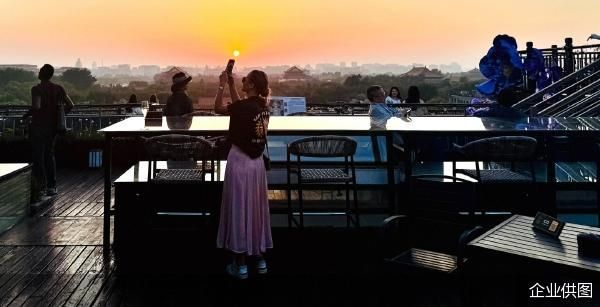
Core Insights - The accommodation choices for inbound tourists in Beijing are diversifying from "core landmarks" to "urban depth" [1][11] - The Tiananmen/Wangfujing area remains the top choice for inbound tourists, while areas along the central axis, such as Qianmen and Yongdingmen, are gaining popularity [3][6] Accommodation Trends - Tiananmen/Wangfujing area continues to dominate the list of top hotel regions for inbound tourists, with a significant increase in foreign visitors at hotels like the Tiananmen Yifei Hotel, which saw a 134% year-on-year growth in foreign guest numbers [3][4] - The geographical location and cultural experiences are primary reasons for tourists choosing hotels near Tiananmen and the Forbidden City [3][4] Cultural Experience Offerings - Hotels are enhancing payment convenience and providing English training for staff to better assist foreign tourists [4] - Various cultural experiences are being offered, including traditional crafts and guided tours of historical sites, to attract inbound tourists [8] Young Tourist Demographics - There is a noticeable increase in younger tourists, with 60-70% of inbound visitors being from younger demographics, who prefer longer stays and diverse experiences [7][8] Business Traveler Preferences - Business travelers constitute a significant portion of inbound tourists, with core business districts like Sanlitun and Guomao being popular choices [9][10] - The occupancy rate of foreign guests in hotels near the Yansha Center reached approximately 40.1%, reflecting a 4.3 percentage point increase year-on-year [9] Emerging Areas - The Jingong/Panjia Garden area has emerged as a new favorite among tourists seeking affordable accommodation while still being close to cultural experiences [11] - The trend indicates a shift in tourist preferences towards unique cultural experiences and cost-effective options, expanding the appeal of non-core areas [11]

申遗成功!这条7.8公里的“龙脉”,藏着北京的千年密码
凤凰网财经· 2025-08-26 13:26
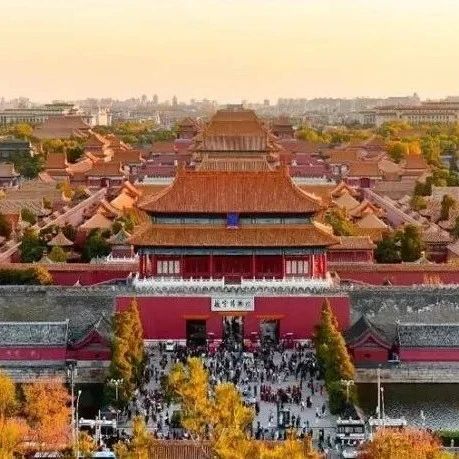
Core Viewpoint - The article celebrates the one-year anniversary of the successful UNESCO World Heritage application for Beijing's central axis, highlighting its historical significance and cultural value as a representation of Chinese civilization [1][3][6]. Group 1: Historical Significance - The Beijing central axis is described as the longest and most complete urban axis in the world, predating Paris's Champs-Élysées by 500 years and Washington's axis by 3,000 years [16]. - Spanning 7.8 kilometers from Yongdingmen to Bell and Drum Towers, it connects over 20 landmarks, each with its own historical narrative [18][20]. - The Forbidden City, located on this axis, houses 1.8 million cultural relics, each telling a story of Chinese civilization [22]. Group 2: Cultural Artifacts - The article introduces the "Zhongzhou National Treasures" postage stamp album, featuring 80 stamps and 5 bookplates that encapsulate the essence of the Forbidden City's treasures [10][13]. - Each stamp serves as a "mobile museum," allowing collectors to engage with Chinese history and culture [15][28]. - The collection includes various categories of cultural artifacts, such as paintings, ceramics, metals, jade, and furniture, showcasing the richness of Chinese heritage [69]. Group 3: Limited Edition and Collectibility - The "Zhongzhou National Treasures" album is limited to 2,000 sets, each with a unique serial number, enhancing its collectible value [88][92]. - The album is presented in a luxurious dark red hard shell packaging, symbolizing the grandeur of the Forbidden City [89]. - The opportunity to own this collection is framed as a rare chance to connect with China's cultural legacy, especially in light of the central axis's recent recognition [96][98].
“影见中轴”主题影像展启幕,约200幅作品述说北京中轴线古今
Xin Jing Bao· 2025-08-07 12:51
Core Viewpoint - The "Shadow of the Axis - Beijing Central Axis Thematic Image Exhibition" showcases the historical and cultural significance of Beijing's central axis through a blend of contemporary photography and historical images, emphasizing urban heritage and preservation efforts [1][2]. Group 1: Exhibition Overview - The exhibition covers an area of approximately 600 square meters and includes three thematic sections: "Harmony and Unity," "Beauty in Diversity," and "Endless Vitality," featuring a total of 192 photographic works and two films [1][2]. - The exhibition integrates AI technology and artistic installations, creating an immersive space that combines art, science popularization, and a social gathering area [1]. Group 2: Participation and Contributions - The "Four Seasons Central Axis" photography collection attracted over 200 participants, including professional photographers and amateur enthusiasts, resulting in around 200 selected works from over 750 submissions [2]. - The exhibition also includes nine award-winning pieces from the "Cultural Heritage Transmission and Innovation Competition" provided by the Beijing Central Axis Foundation, enriching the overall content [2]. Group 3: Historical Context and Comparisons - Historical images from the Beijing Urban Planning and Design Institute document significant buildings and urban scenes from the 1950s and 1960s, filling a gap in the historical narrative from a "New China perspective" [2]. - The exhibition features 14 sets of comparative images from the same viewpoints, showcasing the transformation of the old city environment due to heritage preservation efforts [2]. Group 4: Youth Engagement and Internationalization - The "Endless Vitality" section highlights youth contributions, including drawings and voiceovers by elementary school students, adding a generational perspective to the narrative of the central axis [3]. - The exhibition adopts an international approach, presenting content in Chinese, English, and French, and plans to host regular events such as "Central Axis Salons" and "Public Open Days" for community engagement [3].
《北京中轴线世界文化遗产》发布
Ren Min Ri Bao Hai Wai Ban· 2025-08-04 01:49
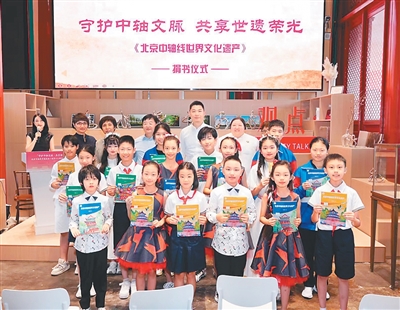
Group 1 - The core viewpoint of the news is the launch of the book series "Beijing Central Axis World Cultural Heritage," aimed at helping young students understand the essence of Chinese traditional culture through the lens of the Beijing Central Axis [1][3] - The book series is designed for students aged 6 to 15, featuring a "three-color three-level" design concept that caters to different educational stages [1] - The content for lower primary students focuses on the theme "Amazing Central Axis," incorporating interactive elements such as poetry reading and cultural anecdotes, while higher primary and middle school levels delve into historical interpretations and global comparisons [1][2] Group 2 - The launch event also included the introduction of a course titled "Central Axis and World Cultural Heritage" by Tencent Digital Education Lab, which involved live demonstrations by students [2]
千年中轴跃然方寸,中国邮政推出系列珍藏邮品
Xin Jing Bao· 2025-07-27 23:03
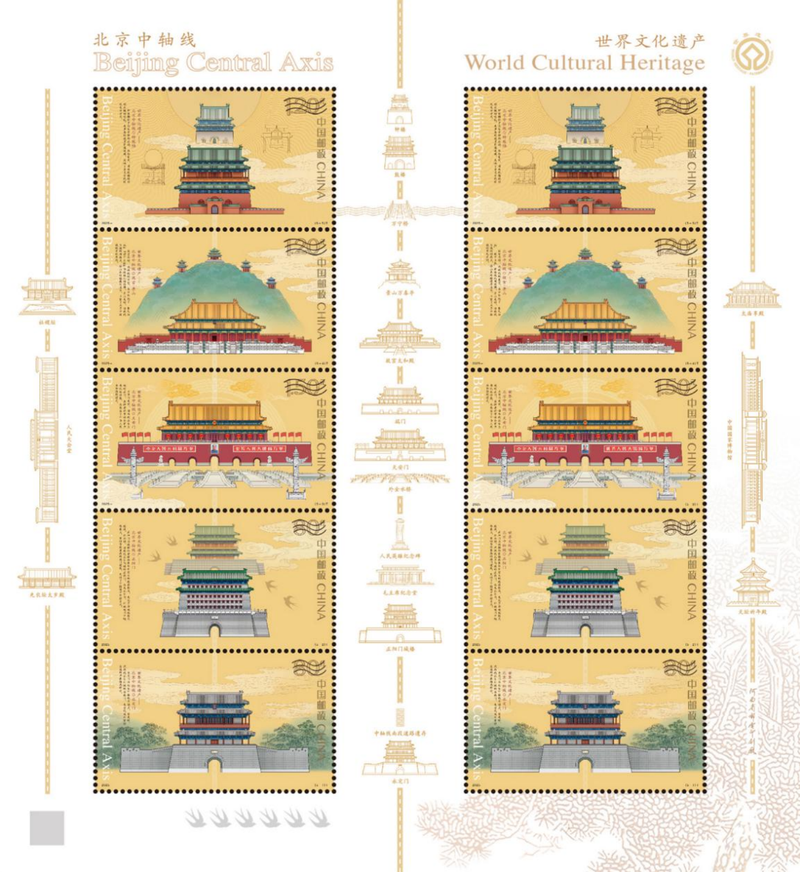
Core Viewpoint - The issuance of the special stamps and cultural products themed around the "Beijing Central Axis" marks the one-year anniversary of its UNESCO World Heritage status, showcasing the historical and cultural significance of the site through various collectible items [1][7]. Group 1: Special Stamp Issuance - On July 27, 2025, China Post will release a set of five special stamps titled "World Cultural Heritage - Beijing Central Axis," featuring iconic structures such as Yongdingmen, Zhengyangmen, Tiananmen, the Forbidden City, and the Bell and Drum Towers, with a total face value of 5.50 yuan [1][2]. - The stamps are designed by renowned designer Wang Huming, utilizing a symmetrical layout that reflects traditional Chinese architectural aesthetics and creates a visual journey along the central axis [4][6]. - The design incorporates special techniques such as cold stamping and fluorescent ink, enhancing the visual appeal and representing the grandeur of the Beijing Central Axis [4][6]. Group 2: Cultural Products and Thematic Collections - The first-day cover features a map of the current Beijing Central Axis, designed to resemble an ancient scroll, blending modern and traditional elements to convey the depth of cultural heritage [6][7]. - A cultural album titled "Masterpiece of China's Ideal Urban Order" includes various stamp resources and showcases the beauty of traditional Chinese architecture through detailed illustrations and photographs [9]. - Creative products like the "Furuizhong Axis" keychain set and the "Six Ancient Capitals" fridge magnet set aim to integrate the cultural significance of the central axis into everyday life, appealing to collectors and enthusiasts [10].
“唱响中轴”文艺演出在京举办 多层次展现历史文化底蕴
Zhong Guo Xin Wen Wang· 2025-07-27 20:54
Core Viewpoint - The event "Singing the Axis" showcases the cultural heritage and architectural beauty of Beijing's central axis, marking the one-year anniversary of its successful UNESCO World Heritage application [1][2] Group 1: Event Overview - The 39th Mass Cultural Performance Season in Dongcheng District, Beijing, features a variety of performances celebrating the central axis [1] - The event is organized by the Dongcheng District Cultural and Tourism Bureau, with support from various local cultural institutions [1] Group 2: Performances and Highlights - The performance includes segments titled "New Voices of the Axis," "Cultural Heritage," and "Harmonizing the Future," highlighting the historical and cultural significance of the central axis [1] - A "music bus" takes the audience on a journey along the central axis, featuring performances such as the rap "The Most Beautiful Central Axis" and songs like "Tiananmen" and "Beijing Bell and Drum Tower" [1] - The youth band performs "Golden Eaves," while a dance titled "Ritual State" illustrates the symmetry of the axis through traditional gestures [1] - The poetry recitation "The Backbone of the Central Axis" narrates the rich history and promising future of the central axis [1][2] Group 3: Artistic Contributions - The Beijing Quyi Troupe presents a fast-paced performance that highlights the stunning architecture along the 7.8-kilometer central axis [2] - The Dongcheng District Children's Palace choir performs "Beijing Swallows," reflecting on the cultural evolution along the axis [2] - The dance "Ink Dance" artistically represents the historical depth and changes of the central axis through movement [2]
书写“京味三部曲”,网文作家花清袂讲述他与北京中轴线的故事
Xin Jing Bao· 2025-07-27 07:06
Core Viewpoint - The article highlights the recognition of the online literary work "Revelation: Tian Gong Jing Zuo" by author Hua Qingmei (real name Gao Xishun) at the 8th China "Online Literature+" Conference, marking his second award in this category. This work is part of his "Beijing Flavor Trilogy," which focuses on the cultural significance of Beijing's central axis and its heritage [1][2]. Group 1: Author's Achievements and Works - Hua Qingmei's work "Revelation: Tian Gong Jing Zuo" is recognized as part of the "Beijing Flavor Trilogy," which explores the cultural heritage of Beijing's central axis [1][2]. - The trilogy includes "Jing Ji Ren Jia" and "Jing Hua Tian Jiao," with each work contributing to the narrative of Beijing's cultural heritage and the successful application for UNESCO World Heritage status [4][5]. - The author emphasizes the responsibility of online writers to preserve and amplify traditional culture through their works, viewing online literature as a medium for cultural dialogue [1][6]. Group 2: Themes and Cultural Significance - "Revelation: Tian Gong Jing Zuo" continues the exploration of Beijing's intangible cultural heritage, specifically focusing on the intersection of traditional craftsmanship and modern technology, such as AIGC (Artificial Intelligence Generated Content) [2][4]. - The trilogy reflects a narrative arc that captures the critical three-year period leading up to the successful UNESCO application for the central axis, showcasing the collective efforts of individuals in preserving cultural heritage [4][5]. - The author expresses a vision for the future of Beijing's cultural innovation, emphasizing the integration of traditional heritage with technological advancements [7].

胡政阳:思政教师原来还是博主“宫殿君”
Zhong Guo Qing Nian Bao· 2025-07-26 22:40
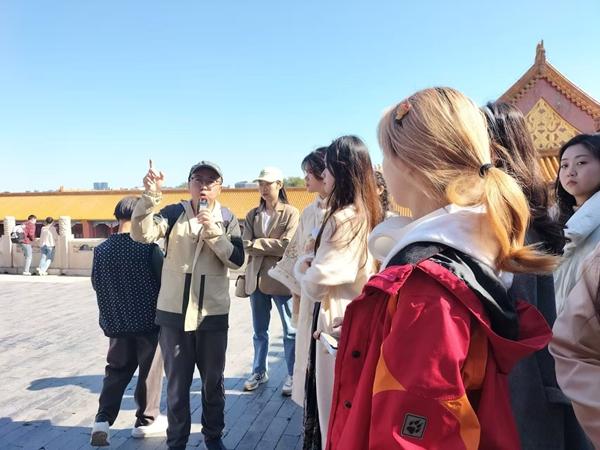
Core Viewpoint - The article highlights the integration of Beijing's central axis cultural resources into ideological and political education, emphasizing the importance of traditional culture in enhancing the appeal of such courses [1][2][4][6]. Group 1: Cultural Integration in Education - The professor believes that any point along the Beijing central axis can be connected to ideological education, enhancing students' understanding of their cultural heritage [2]. - The professor has developed a multi-dimensional teaching system that combines drama, palace culture, traditional culture, and ideological education [4]. - The courses offered, such as "The Palace Museum and Chinese Traditional Culture," allow students to explore the cultural significance of the central axis [4][5]. Group 2: Historical and Cultural Significance - The Beijing central axis is described as a "red axis," rich in educational resources related to the history of the New Democratic Revolution [5]. - The professor emphasizes the importance of using historical and cultural narratives to make ideological education more relatable and engaging for students [5][6]. - The successful inclusion of the Beijing central axis in the World Heritage List has increased public awareness and appreciation, leading to improved protective measures [6].