厂商关系

Search documents
广东粤强酒业发文谈厂商关系:任何傲慢的管控、短视的盘剥都已不合时宜
Cai Jing Wang· 2025-12-30 10:58
Core Viewpoint - The article emphasizes the need for wine companies to shift their perspective on distributors, recognizing them as valuable partners rather than mere cost centers, to foster a sustainable and prosperous business ecosystem [1][2][3] Group 1: Current Industry Challenges - The wine industry is facing high inventory levels, price inversions, and slowing growth, leading to strained relationships between manufacturers and distributors [1] - Some wine companies are pressuring distributors to take on excess inventory, sacrificing their profits for the sake of the manufacturers' performance [1][2] - The traditional view of distributors as "subordinates" or "inventory movers" is detrimental, as it undermines the collaborative nature of the relationship [1][3] Group 2: Importance of Distributor Relationships - Many wine companies still operate under a "zero-sum game" mentality, believing that if distributors profit, the manufacturers' profits will decrease [2] - Distributors are losing at least 10% of their profits to manufacturers, leading to decreased loyalty and market vitality [2] - Recognizing distributors as "value partners" rather than "cost centers" is crucial for long-term success [2] Group 3: Recommendations for Improvement - Wine companies should transition their assessment of distributors from focusing solely on payment amounts to considering actual sales performance and market cultivation [2] - A shift in mindset is necessary to abandon the illusion of "inventory-based" growth and to ensure that distributors earn reasonable profits [2][3] - Implementing digital tools for transparent data sharing on inventory and sales can enhance collaboration and operational integration between manufacturers and distributors [3] - Establishing joint ventures with core distributors and involving regional small distributors can amplify the value of manufacturer-distributor cooperation [3]
解读白酒“最差三季报”:至暗时刻的破与立(二)| 逆势增长4.54%,20家上市白酒企业合同负债达390亿元!渠道信心从何而来?
Mei Ri Jing Ji Xin Wen· 2025-11-07 02:35
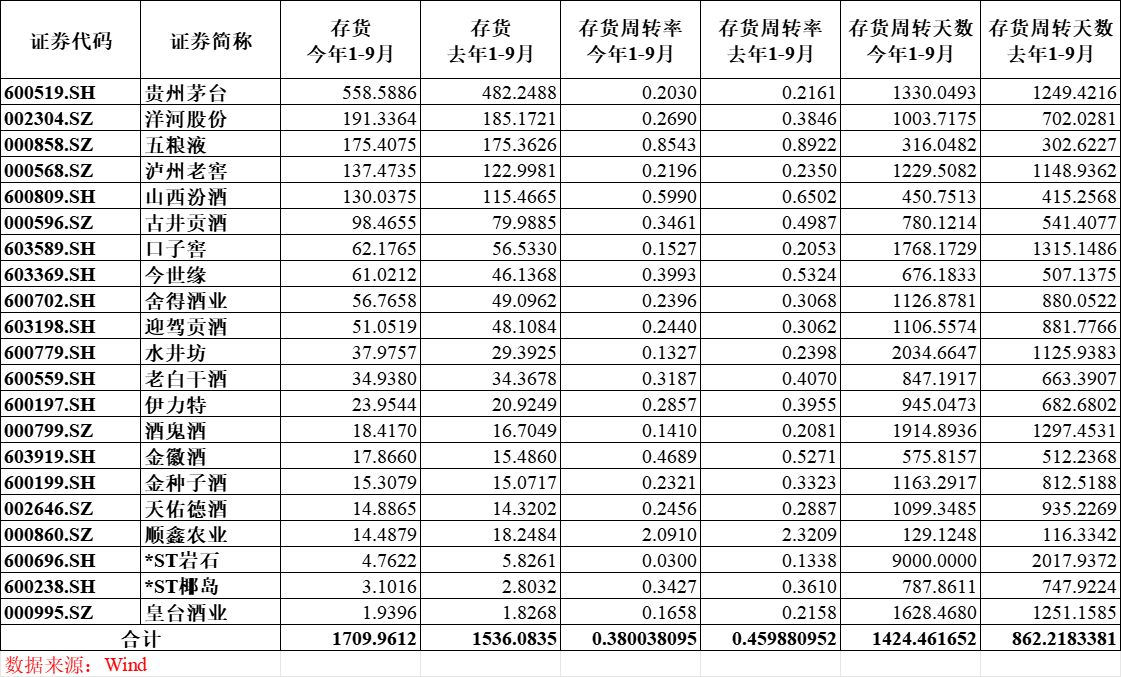
Core Viewpoint - The A-share liquor industry reported its worst performance in a decade for Q3 2025, with 20 listed companies (excluding Shunxin Agriculture) achieving a total revenue of 312.09 billion yuan and a net profit of 122.49 billion yuan, both down approximately 7% year-on-year [1][2] Financial Performance - The total revenue and net profit of the liquor industry have significantly declined, indicating a pronounced pressure on the industry [1] - Only Kweichow Moutai and Shanxi Fenjiu managed to maintain growth in both revenue and net profit amidst the overall decline [1] - The total contract liabilities for 20 liquor companies reached 39 billion yuan, reflecting a year-on-year increase of 4.54%, despite the overall performance downturn [1][6] Inventory and Turnover - The total inventory of 21 listed liquor companies rose to 170.99 billion yuan, a year-on-year increase of 11.32%, with an average inventory turnover period extending to 1424 days, up 65.21% from the previous year [2][4] - The increase in inventory turnover days signals significant pressure on channel inventory [4] Market Response - The market reacted calmly to the poor performance reports, with the China Securities Liquor Index rising by 1.72% on October 31, indicating that investors have already digested the performance pressures [1] - The stability in contract liabilities suggests that confidence in the industry and companies remains intact, despite the challenges [2][7] Channel Dynamics - The increase in contract liabilities is primarily driven by leading liquor companies, with four out of six major firms reporting year-on-year growth [7] - Companies are shifting from a simple sales model to a service-oriented approach, focusing on channel health and profitability for distributors [8][9] Innovative Sales Models - New sales models are emerging, such as the "Wan Shang Alliance" by Zhenjiu Li Du, which emphasizes no stockpiling and allows for returns, thereby reducing inventory risks [10][11] - The introduction of commission-based systems and unified pricing strategies aims to alleviate financial pressure on distributors and ensure transparent profit distribution [12] Conclusion - The growth in contract liabilities and the evolving relationships between manufacturers and distributors highlight the industry's resilience and potential for recovery, as companies prioritize channel health and collaborative strategies [12][13]






“618”伊始白酒再现低价大促苗头,力度不及去年同期
Di Yi Cai Jing· 2025-05-26 07:36
Core Viewpoint - The white liquor industry is facing challenges due to conflicts between traditional offline distribution models and e-commerce sales, particularly highlighted during the "618" promotional event, where low-price promotions have re-emerged, raising concerns about the impact on pricing structures and market dynamics [1][2][6]. Group 1: E-commerce Impact - E-commerce platforms have initiated low-price promotions for premium liquor, with prices for 53-degree Feitian Moutai dropping below 2000 yuan per bottle, which is lower than the market average [1]. - The intensity of this year's "618" promotions is less than in previous years, with fewer participants and less aggressive discounting, indicating a potential shift in market dynamics [2][6]. - The control over pricing by liquor companies has weakened as e-commerce platforms have started to establish their own trading companies, complicating the ability of liquor companies to manage pricing effectively [6]. Group 2: Market Dynamics - The overall performance of major liquor companies is expected to decline starting from the second half of 2024 into the first quarter of 2025, influenced by a sluggish consumption market and proactive measures taken by companies to manage inventory [6]. - Some second and third-tier liquor companies are struggling, with reports of significant price reductions online compared to offline sales, indicating a potential oversupply or desperate measures to stimulate sales [6][7]. - The current market environment is characterized by intense competition and slow sales, leading to innovative but concerning practices such as selling opened or discounted products to stimulate consumption [7]. Group 3: Future Outlook - Industry experts express concerns about the long-term market outlook, suggesting that the current challenges may persist for several years, with a potential market recovery taking 3 to 5 years [7][8]. - Discussions among liquor companies at recent earnings meetings have shifted focus towards consumer behavior changes, internationalization, and channel reforms, with little emphasis on addressing e-commerce challenges [8].