
渠道健康

Search documents
飞天茅台,批发价回升!
Zhong Guo Zheng Quan Bao· 2025-12-14 09:39
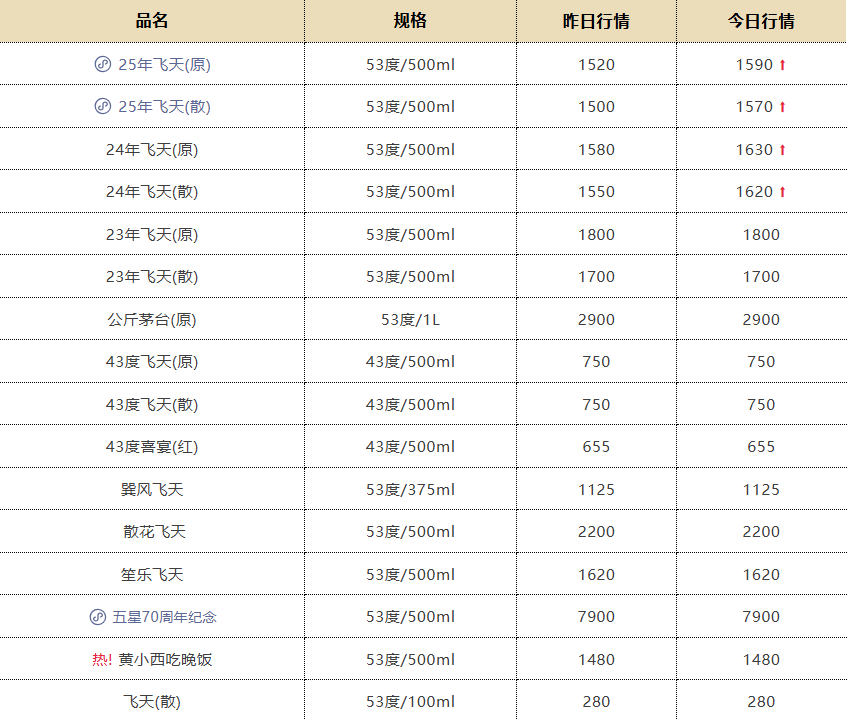
Core Viewpoint - The high-end liquor market, led by Moutai and Wuliangye, is experiencing a price correction, with Moutai's prices rebounding after previously falling below the official guidance price, indicating a shift in the industry's focus towards channel health and genuine consumer demand [1][2][4]. Price Trends - On December 14, 2025, the wholesale price of 53-degree 500ml Moutai rose to 1590 RMB per bottle, an increase of 70 RMB from the previous day, while the price had previously dropped to 1495 RMB per bottle on December 12, falling below the official guidance price of 1499 RMB [1][2]. - The price of Moutai has shown a consistent downward trend throughout the second half of the year, dropping below 2000 RMB in June, 1800 RMB in August, and 1700 RMB by the end of October [4]. Industry Challenges - The liquor industry is undergoing a deep adjustment, with a need to balance channel inventory and consumer demand, leading to a shift from maintaining price benchmarks to ensuring healthy operations for distributors [1][5]. - Other major liquor brands are also facing pressure, with prices for core products declining compared to the beginning of the year, indicating a broader industry trend [5]. Strategic Responses - Moutai has implemented a volume control policy to alleviate pressure on distributors, including a temporary halt on product distribution until January 1, 2026, to prevent forced selling during a financially tight period for distributors [4][6]. - The new chairman of Moutai emphasized a balanced approach between short-term and long-term strategies, focusing on digital transformation and channel integration to adapt to the current market conditions [6]. Market Dynamics - The focus of competition is shifting from price maintenance to value realization and channel health, with industry leaders recognizing the need to clear speculative bubbles and return to rational consumption [7]. - The restructuring of the pricing system is seen as a necessary process for the industry to recover from speculative pressures, with the potential for stronger brands to optimize their internal structures during this period [7].


解读白酒“最差三季报”:至暗时刻的破与立(二)| 逆势增长4.54%,20家上市白酒企业合同负债达390亿元!渠道信心从何而来?
Mei Ri Jing Ji Xin Wen· 2025-11-07 02:35
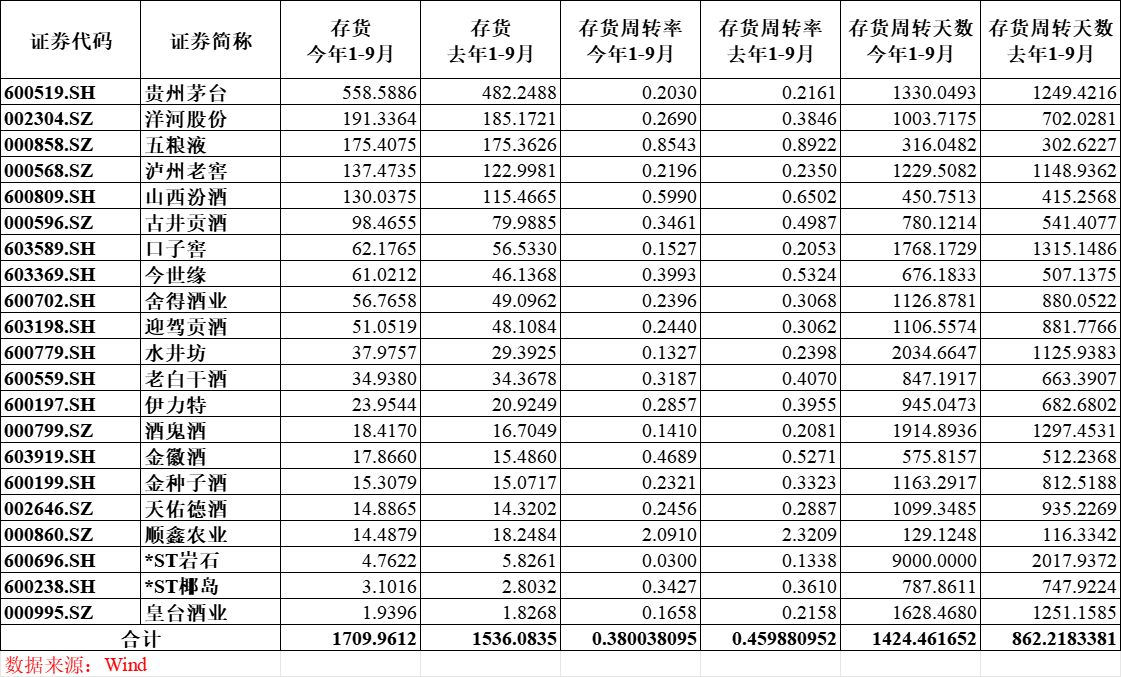
Core Viewpoint - The A-share liquor industry reported its worst performance in a decade for Q3 2025, with 20 listed companies (excluding Shunxin Agriculture) achieving a total revenue of 312.09 billion yuan and a net profit of 122.49 billion yuan, both down approximately 7% year-on-year [1][2] Financial Performance - The total revenue and net profit of the liquor industry have significantly declined, indicating a pronounced pressure on the industry [1] - Only Kweichow Moutai and Shanxi Fenjiu managed to maintain growth in both revenue and net profit amidst the overall decline [1] - The total contract liabilities for 20 liquor companies reached 39 billion yuan, reflecting a year-on-year increase of 4.54%, despite the overall performance downturn [1][6] Inventory and Turnover - The total inventory of 21 listed liquor companies rose to 170.99 billion yuan, a year-on-year increase of 11.32%, with an average inventory turnover period extending to 1424 days, up 65.21% from the previous year [2][4] - The increase in inventory turnover days signals significant pressure on channel inventory [4] Market Response - The market reacted calmly to the poor performance reports, with the China Securities Liquor Index rising by 1.72% on October 31, indicating that investors have already digested the performance pressures [1] - The stability in contract liabilities suggests that confidence in the industry and companies remains intact, despite the challenges [2][7] Channel Dynamics - The increase in contract liabilities is primarily driven by leading liquor companies, with four out of six major firms reporting year-on-year growth [7] - Companies are shifting from a simple sales model to a service-oriented approach, focusing on channel health and profitability for distributors [8][9] Innovative Sales Models - New sales models are emerging, such as the "Wan Shang Alliance" by Zhenjiu Li Du, which emphasizes no stockpiling and allows for returns, thereby reducing inventory risks [10][11] - The introduction of commission-based systems and unified pricing strategies aims to alleviate financial pressure on distributors and ensure transparent profit distribution [12] Conclusion - The growth in contract liabilities and the evolving relationships between manufacturers and distributors highlight the industry's resilience and potential for recovery, as companies prioritize channel health and collaborative strategies [12][13]




面对行业转型阵痛,古井贡酒主动调整积蓄能量
Jing Ji Guan Cha Wang· 2025-10-30 10:47
Core Viewpoint - The financial performance of Gujinggong Liquor in Q3 2025 shows a temporary decline in revenue and net profit, reflecting the broader challenges faced by the liquor industry during a period of deep adjustment [1] Industry Overview - The liquor industry is experiencing a structural adjustment, moving from high growth to a new phase characterized by "volume shrinkage, price decline, and high inventory" [1] - The China Alcoholic Drinks Association reports a continuous decline in liquor production and a significant slowdown in industry growth [1] - In the first half of 2025, 59.7% of liquor companies reported reduced operating profits, and 50.9% experienced a decline in revenue [2] Company Strategy - Gujinggong Liquor is proactively adjusting its development pace, prioritizing channel health over short-term performance [2] - The company is reducing inventory pressure on distributors by minimizing stock deliveries, thereby alleviating financial strain on them [2] - Digital systems are employed for precise delivery based on actual market demand, helping to control inventory risks [2] Marketing and Sales - The company has adopted a "hard marketing" model, focusing on direct market engagement to enhance product sales, contrasting with traditional bulk stock strategies [3] - Gujinggong Liquor's e-commerce business is thriving, with significant growth in online sales channels, including a 160% year-on-year increase in GMV during promotional events [5] - The company is expanding into emerging e-commerce platforms to adapt to changing consumer purchasing habits [5] Brand Development - Gujinggong Liquor is enhancing its brand influence through international collaborations, such as its participation in the Osaka World Expo [5] - The company is focusing on product innovation, introducing "light" concepts to cater to younger consumers' preferences for healthier drinking options [7] - The shift towards value reconstruction in the liquor industry is evident, with the company positioning itself for higher quality development despite short-term performance pressures [7]


茅台保健酒“壮士断腕”?上市仅一年多的台源酒被传停产
Sou Hu Cai Jing· 2025-08-07 03:31
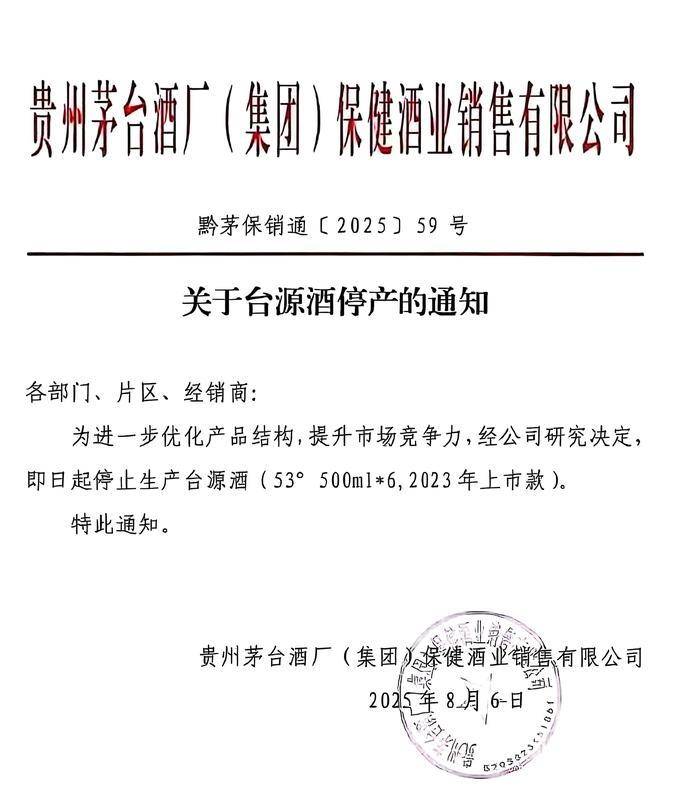
Core Viewpoint - The internal document regarding the suspension of Taiyuan liquor production by Moutai Health Wine Company has raised significant market attention, indicating a strategic move to optimize product structure and enhance market competitiveness [1][3]. Group 1: Company Actions - Moutai Health Wine Company has decided to stop the production of Taiyuan liquor, which was a key product in the 100 yuan price range, citing the need to optimize product structure and improve market competitiveness [1]. - The company has not officially confirmed the suspension, with staff stating that they have not received any related notifications and that Taiyuan liquor remains available for purchase on the iMoutai app [3]. Group 2: Market Dynamics - The price of Taiyuan liquor has significantly dropped in the market, with official pricing at 156 yuan per bottle, while some e-commerce platforms list it for around 57 yuan, indicating a severe price imbalance [5]. - The competitive landscape for Taiyuan liquor is challenging, with established brands and numerous smaller enterprises in the Moutai Town area exerting downward pressure on prices [7]. Group 3: Industry Insights - Industry experts suggest that the potential suspension of Taiyuan liquor may be a strategic decision to address channel health and long-term brand value rather than merely responding to short-term performance pressures [8]. - Despite the challenges, Taiyuan liquor achieved over 1 billion yuan in sales in the past year, demonstrating initial market success, although it struggled with low terminal distribution rates and narrow channel profit margins [8].
2025年中期策略会速递:舍得酒业:渠道减负,保持定力
HTSC· 2025-06-06 03:00
Investment Rating - The investment rating for the company is maintained as "Buy" with a target price of RMB 70.68 [8]. Core Views - The company focuses on long-term healthy and stable development, with recent operational performance under pressure but showing signs of recovery during the May Day holiday [2][4]. - The company emphasizes channel health and inventory reduction, expecting to achieve a breakthrough after a period of adjustment [1][4]. - The company aims to enhance brand influence and sales through targeted marketing strategies, particularly focusing on core products and younger demographics [3][4]. Summary by Sections Operational Performance - The company reported a challenging Q1 but maintained stable sales for its flagship product during the May Day holiday, with a focus on graduation banquets [2]. - The company has successfully reduced inventory levels, with over half of its distributors maintaining healthy inventory levels (2-3 months of stock) [2]. Financial Projections - The company forecasts net profits of RMB 413 million, RMB 445 million, and RMB 501 million for 2025, 2026, and 2027 respectively, representing a CAGR of 13% [5]. - The expected EPS for 2025, 2026, and 2027 is RMB 1.24, RMB 1.33, and RMB 1.51 respectively [5]. Market Strategy - The company is committed to long-term strategies, focusing on four core products and leveraging both online and offline channels to drive sales [4]. - The company plans to cultivate consumer habits and enhance product quality, branding, and cultural aspects to adapt to market changes [3][4].
