原油牛市

Search documents
黄金,即将打破僵局!
Sou Hu Cai Jing· 2026-02-27 02:36
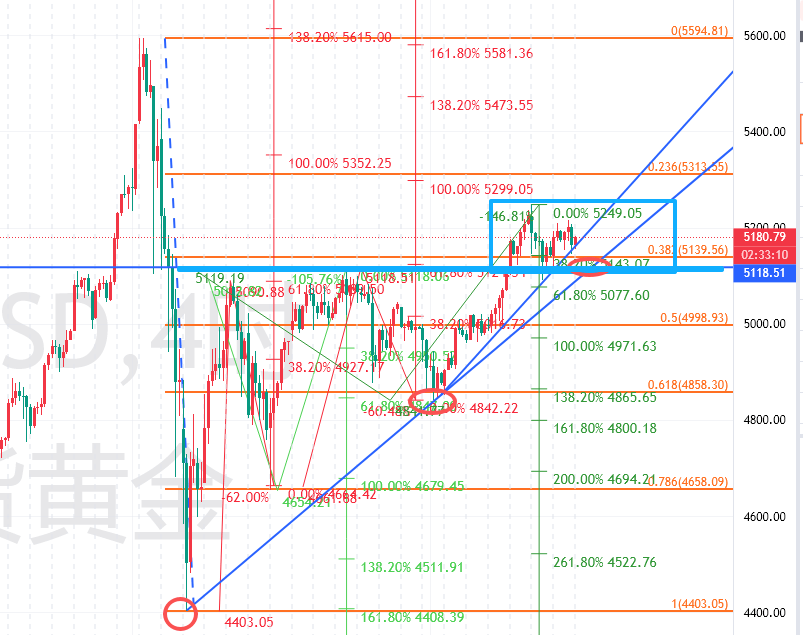
Core Insights - The article emphasizes the importance of having strict trading principles and discipline in trading, suggesting that without these, technical skills are rendered ineffective [1][2][3] Trading Principles - Frequent trading should be avoided; the focus should be on making money rather than just executing trades for the sake of it [1][2] - Position sizes for international commodities like gold and silver should be controlled between 3% to 5%, while domestic futures should maintain a risk rate below 30% [2] - Stop-loss orders are crucial for survival in the market, and holding onto losing positions is discouraged [2] - Traders should only engage with market conditions they understand, as there are always opportunities available [2] - Maintaining personal conviction and not following the crowd is essential to avoid confusion and regret in trading decisions [2] Market Analysis - The gold market is currently experiencing volatility, with potential upward targets of $5300 and $5440-$5460, while downward targets could reach $4900-$4850 [3][4] - Silver has shown a weaker recovery compared to gold, having dropped nearly 50% since late January, while gold has regained most of its losses [4] - The oil market is projected to experience a bull market this year, with short-term support at $62-$63 and long-term targets of $95-$100 [9]

油价大反转来了?巴克莱:"过剩危机"是假象,原油多年牛市即将开启!
华尔街见闻· 2026-01-31 01:14
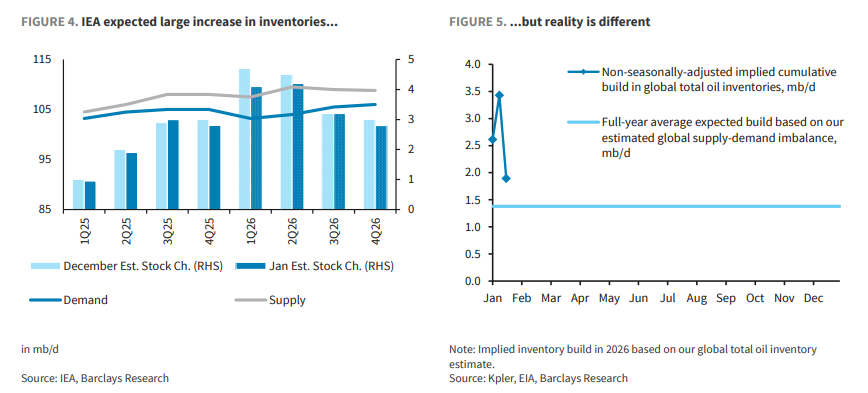
Core Viewpoint - Barclays presents a contrarian view against the prevailing market sentiment, arguing that the concerns over an oil supply surplus are overstated and that the current situation is not the beginning of a bear market but rather a final emotional mismatch before a multi-year upcycle starting in the second half of 2026 [1][10]. Group 1: Misjudgment of Supply and Demand - The market's narrative of a supply surplus is fundamentally flawed, as it relies heavily on forecasts from IEA and EIA predicting a surplus of 3-4 million barrels per day by 2026, which Barclays contests [2][4]. - Real data does not support the notion of a 4 million barrels per day surplus, as both land-based commercial inventories and offshore floating storage are significantly below the levels suggested by these models [4][6]. - The issue lies not in a miscalculation of supply but in a systematic underestimation of actual demand, with discrepancies in demand forecasts exceeding 2 million barrels per day among different institutions [6][9]. Group 2: Refinery Profits and Market Signals - Global refining profits remain robust even during the seasonally weak winter months, indicating that refineries are incentivized to continue operations [9]. - The Brent and WTI futures curve maintains a backwardation structure, suggesting that the spot market is paying a premium for immediate supply rather than being suppressed by an oversupply [9]. Group 3: Future Supply Dynamics - The real turning point for the oil market will occur after a shift in the "non-OPEC supply paradigm," with the U.S. shale oil production expected to plateau or even decline slightly after reaching a peak of approximately 13.6 million barrels per day in 2025 [10][11]. - Barclays predicts that by 2028-2030, the annual net increase in non-OPEC oil supply could approach zero, indicating a significant change in supply dynamics [12]. - The decline in OPEC+'s available spare capacity is anticipated to occur around 2027, which could lead to a market shift from price-driven cycles to supply-constrained cycles [13][14]. Group 4: Market Implications and Investment Outlook - The current phase is viewed as a "pricing undervaluation stage" within a multi-year upcycle, with energy stocks already outperforming despite oil prices not fully breaking out [16]. - A differentiation is occurring in the market, where the quality of upstream resources and reserve longevity are becoming core valuation metrics, while traditional defensive labels are being replaced by "supply scarcity" considerations [17]. - The next narrative for oil is not about where prices will drop to, but rather about confirming the start of a multi-year bull market [19].


油价大反转来了?巴克莱:"过剩危机"是假象,原油多年牛市即将开启!
Hua Er Jie Jian Wen· 2026-01-30 04:11
Core Viewpoint - Barclays presents a contrarian view against the prevailing market sentiment of an impending oil surplus, arguing that the concerns over supply excess are overstated and that significant changes will occur post-2026 [1][11]. Group 1: Misjudgment of the Market - The narrative of an oil surplus is fundamentally flawed, as the market has relied on IEA and EIA forecasts predicting a surplus of 300,000 to 400,000 barrels per day by 2026 [2]. - Barclays emphasizes that if a surplus truly existed, it would be reflected in inventory levels, which is not the case [3][4]. - Current data shows that the anticipated surplus of 4 million barrels per day has not materialized, with commercial inventories and floating storage significantly below model predictions [4][10]. Group 2: Underestimated Demand - The issue lies not in a "disappearing oil" scenario but in the systematic underestimation of actual demand levels, with discrepancies in demand forecasts exceeding 2 million barrels per day among different institutions [7]. - Even during the seasonally weak winter months, global refining margins remain robust, indicating ongoing operational incentives for refineries [9]. Group 3: Future Supply Dynamics - Barclays predicts that the real turning point for oil supply will occur after the non-OPEC supply paradigm shifts, particularly post-2026 [11]. - The assumption that U.S. shale oil production will quickly fill any gaps is becoming less reliable, with forecasts indicating that U.S. production will plateau around 13.6 million barrels per day by 2025 and may decline slightly by 2027 [12]. - New international projects, while numerous, will not ramp up production as quickly as the market expects, and will primarily serve to offset natural declines rather than create net new supply [12]. Group 4: Market Implications - If demand continues while spare capacity diminishes, oil prices will need to rise to find equilibrium [14]. - The shift in supply dynamics suggests a transition from a price-driven cycle to one constrained by supply, with AI efficiencies not being sufficient to suppress prices but rather to meet existing demand [15]. - Barclays asserts that the current phase is not the end of the cycle but rather a "pricing undervaluation stage" within a long-term upward cycle, with energy stocks already outperforming despite oil prices not fully breaking through [16][17].