发现式智能

Search documents
杜少雷、安波、杨凯峪,三位世界级 AI 科学家加入MiroMind
机器之心· 2026-03-13 02:43
Core Viewpoint - MiroMind is advancing its mission of building "Discoverable Intelligence" by appointing three distinguished AI scientists to lead key areas of its Heavy Duty Solver engine, focusing on reasoning, runtime, and verifiable AI [1][2][13]. Group 1: Key Appointments - Dr. Du Shaolei has been appointed as Lead Scientist for Reasoning Models & Training, bringing expertise in machine learning theory and large-scale reasoning model training [3][4]. - Professor An Bo has been appointed as Lead Scientist for Runtime & Agent Systems, with a strong background in multi-agent systems and AI decision-making [5][7][8]. - Dr. Yang Kaiyu has been appointed as Lead Scientist of the Verifiable AI Lab, focusing on verifiable reasoning and formal proof systems [11][12]. Group 2: Responsibilities and Contributions - Dr. Du will construct the end-to-end reasoning model training system, enhancing the reasoning capabilities of MiroMind's Heavy Duty Solver [4]. - Professor An will lead the design and evolution of the system execution architecture, integrating reasoning models with verification core to create reliable and scalable systems [8]. - Dr. Yang will establish the Verifiable AI Lab, aiming to develop technologies that ensure machine-checkable correctness guarantees, enhancing the reliability of AI outputs [12]. Group 3: Company Vision and Goals - MiroMind aims to create a general-purpose solver that not only appears correct but can be formally verified, addressing complex real-world problems [2][16]. - The company targets high-risk sectors such as software engineering, financial services, healthcare, legal compliance, and scientific research, providing trustworthy AI capabilities [17].


盛大科技战略调整聚焦AI新方向,股价历史波动引关注
Jing Ji Guan Cha Wang· 2026-02-13 22:39
Recent Events - The founder of Shengda Group, Chen Tianqiao, released an internal letter on February 6, 2026, outlining the technological direction of MiroMind, focusing on "discovery-based intelligence" and "general solvers," while avoiding the general chatbot arena [1] - The emphasis is on promoting AI development through causal reasoning and systematic innovation, which may indirectly impact Shengda Technology's business ecosystem [1] Stock Recent Trends - Historical data indicates that Shengda Technology's stock price experienced multiple fluctuations in December 2025, including a surge of 5.34% on December 29 and a drop of 5.00% on December 17 [2]
陈天桥携MiroThinker 1.5开年登场:跑赢万亿模型,实现小模型大智能
Tai Mei Ti A P P· 2026-01-08 04:45
Core Insights - MiroMind team has launched MiroThinker 1.5, a flagship search intelligence model, which emphasizes "discovery-based intelligence" as a path to true general artificial intelligence [2][3] - The model aims to reconstruct understanding of the world under unknown conditions, focusing on research, verification, and correction rather than sheer data accumulation [2] Model Performance - MiroThinker 1.5 operates with 30 billion parameters, achieving performance comparable to larger models with 1 trillion parameters, demonstrating a high efficiency-to-intelligence ratio [3] - The model's cost per call is as low as $0.07, which is 1/20th of the cost of its competitor Kimi-K2-Thinking, while also providing faster inference [5] Interactive Scaling Concept - MiroThinker introduces "Interactive Scaling," shifting the focus from internal parameter expansion to external information interaction, enhancing reasoning capabilities [6][9] - The model is designed to function like a "scientist," emphasizing verification and correction over memorization, thus avoiding the pitfalls of traditional large models [8][10] Training Mechanism - The training process incorporates a "reason-verify-correct" loop, allowing the model to engage with external data for validation, which helps mitigate logical errors [9][12] - MiroThinker employs a time-sensitive training mechanism that restricts the model to only interact with information available before a given timestamp, ensuring realistic decision-making [12] Verification and Correction - The model encourages breaking down key judgments into verifiable sub-hypotheses and actively seeking external evidence, making the evidence-gathering process the primary training goal [11] - It emphasizes iterative verification, where reasoning is treated as a revisable process, allowing for adjustments based on conflicting evidence [11]
MiroMind发布全球最强搜索智能体模型MiroThinker 1.5,以“发现式智能”挑战传统大模型路径
3 6 Ke· 2026-01-06 09:06
Core Insights - MiroMind team has launched its flagship search intelligence model, MiroThinker 1.5, which emphasizes "discovery intelligence" rather than merely increasing parameter size [1][2] - The model aims to reconstruct understanding of the world under unknown conditions, focusing on research, verification, and correction [1] - MiroThinker 1.5 demonstrates high performance with significantly fewer parameters compared to larger models, achieving results comparable to those with 1 trillion parameters [2][7] Performance Evaluation - MiroThinker-v1.5-30B operates with only 1/30 of the parameters yet matches the performance of many 1 trillion parameter models [2] - In key benchmark tests, MiroThinker-v1.5-235B ranks among the top globally, showcasing its efficiency [2][6] Competitive Analysis - MiroThinker-v1.5-30B shows competitive performance against Kimi-K2-Thinking, which has 30 times more parameters, with a significantly lower inference cost of $0.07 per call, just 1/20 of Kimi-K2-Thinking's cost [7] - The model's performance in the BrowseComp-ZH benchmark indicates that larger models do not necessarily equate to stronger performance [7] Technological Innovations - MiroThinker 1.5 introduces "Interactive Scaling," shifting focus from internal parameter expansion to external information interaction, enhancing model performance [8][9] - The model employs a "scientist mode" for reasoning, emphasizing evidence-seeking and iterative verification to avoid hallucinations and ensure accuracy [9][12] Training Methodology - The training process incorporates a time-sensitive sandbox, ensuring the model learns to make predictions based on past information without future leakage [14] - MiroThinker 1.5 is trained to actively seek evidence, verify hypotheses, and correct itself, fostering a robust reasoning process [12][13] Market Applications - MiroMind's predictive capabilities have been demonstrated in stock market scenarios, accurately forecasting stock performance amidst market fluctuations [15][19] - The model is positioned to impact major tech companies, with upcoming events likely to influence stock prices and market dynamics [25]
陈天桥代季峰打响2026大模型第一枪:30B参数跑出1T性能
量子位· 2026-01-06 05:48
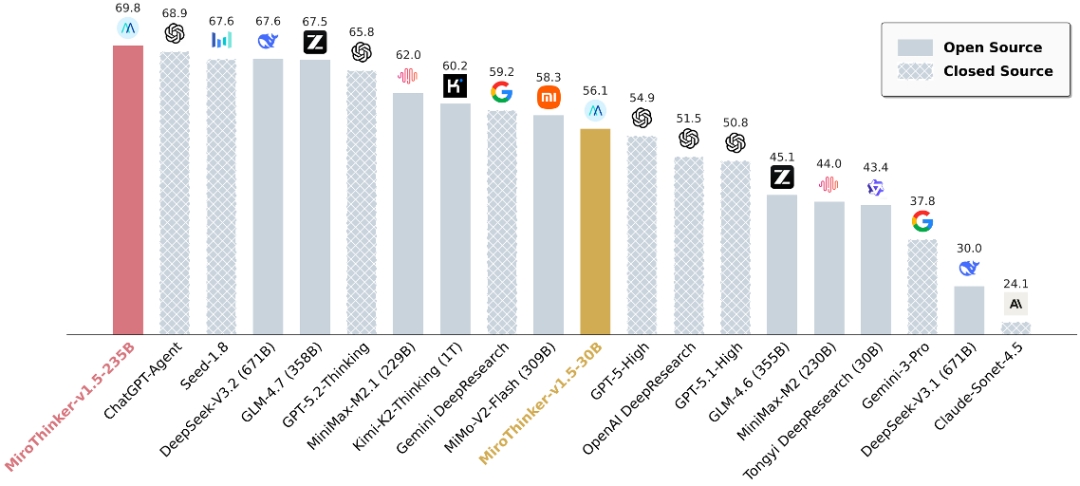
Core Viewpoint - MiroThinker 1.5, developed by MiroMind, is positioned as a leading AI model in the intelligent agent field, showcasing superior performance in various benchmark tests compared to other top models like GPT-5-High and Gemini-3-Pro [1][3][5]. Performance Evaluation - MiroThinker 1.5 achieved notable scores in benchmark tests: - HLE-Text: 39.2% - BrowseComp: 69.8% - BrowseComp-ZH: 71.5% - GAIA-Val-165: 80.8% [3][4]. - It surpassed ChatGPT-Agent's previous record in BrowseComp, establishing itself in the global top tier [5]. Model Efficiency - MiroThinker 1.5 operates with significantly fewer parameters (30B and 235B) compared to competitors, achieving comparable or superior results through high efficiency [7][8]. - The model's inference cost is notably low at $0.07 per call, which is only 1/20 of Kimi-K2-Thinking's cost, while also demonstrating faster inference speeds [8]. Development Team and Background - The MiroMind team, responsible for MiroThinker 1.5, previously excelled in predicting outcomes in decentralized markets, showcasing their expertise in model development [9][10]. Interactive Scaling and Model Training - MiroThinker 1.5 incorporates a novel approach called Interactive Scaling, which emphasizes interaction with the external environment during both training and inference phases, enhancing its reasoning capabilities [46][58]. - The model employs a feedback loop in its reasoning process, allowing for iterative verification and correction, which contrasts with traditional models that rely heavily on memorization [48][57]. Predictive Capabilities - MiroThinker 1.5 demonstrates a robust ability to make predictions based on real-time data, as evidenced by its analysis of sports events and video game release timelines, showcasing a logical and evidence-based approach [15][35][41]. - The model's predictions are structured to avoid reliance on past knowledge, instead focusing on current information and real-world interactions [52][63]. Conclusion - MiroThinker 1.5 represents a significant advancement in AI model development, prioritizing interaction and evidence-based reasoning over sheer parameter size, thus redefining the landscape of intelligent agents [64].

刚刚,蝉联Future X全球榜首的MiroMind发布全球最强搜索智能体模型
机器之心· 2026-01-05 06:09
Core Viewpoint - MiroMind team has launched its flagship search intelligence model MiroThinker 1.5, emphasizing the concept of "discovery intelligence" as a path to true general artificial intelligence, focusing on external information interaction rather than merely increasing internal parameters [1][10]. Group 1: Model Performance and Comparison - MiroThinker 1.5-30B achieved performance comparable to many 1 trillion parameter models while using only 1/30 of the parameter scale [4]. - In key benchmark tests, MiroThinker 1.5-235B ranked among the top globally, demonstrating its effectiveness despite a smaller parameter size [4]. - MiroThinker 1.5-30B exhibited a significantly lower inference cost of $0.07 per call, which is only 1/20 of the cost of Kimi-K2-Thinking, while also providing faster inference [9]. Group 2: Interactive Scaling and Training Mechanism - MiroMind team has shifted from traditional scaling laws focused on internal parameter expansion to "Interactive Scaling," which emphasizes external information interaction to enhance model performance [10][12]. - The training process encourages models to engage in evidence-seeking behaviors, breaking down key judgments into verifiable sub-hypotheses and actively querying external data [19]. - The model is trained under strict temporal visibility constraints, ensuring it learns to make judgments based only on past information, thus avoiding future leakage [17][20]. Group 3: Unique Training Approaches - MiroThinker 1.5 employs a "scientist mode" rather than a "test-taker mode," focusing on verification and correction rather than memorization [11]. - The model's training paradigm includes a time-sensitive training sandbox, which forces it to operate under real-world conditions of incomplete information and noise [18]. - The training emphasizes iterative verification and self-correction, allowing the model to adjust its hypotheses based on conflicting evidence [19]. Group 4: Market Predictions and Applications - MiroMind has demonstrated its predictive capabilities in stock market scenarios, accurately identifying stocks with high potential for upward movement amidst market noise [22][25][30]. - The model is also applied to predict significant events that may impact major companies, providing insights into potential market reactions and volatility [31].

陈天桥旗下盛大AI东京研究院于SIGGRAPH Asia正式亮相,揭晓数字人和世界模型成果
机器之心· 2025-12-22 04:23
Core Insights - Shanda Group's Shanda AI Research Tokyo made its debut at SIGGRAPH Asia 2025, focusing on "Interactive Intelligence" and "Spatiotemporal Intelligence" in digital human research, reflecting the long-term vision of founder Chen Tianqiao [1][10] - The article discusses the systemic challenges leading to the "soul" deficiency in current digital human interactions, which is a significant barrier to user engagement despite substantial investments in visual effects [2][3] Systemic Challenges - **Long-term Memory and Personality Consistency**: Current large language models (LLMs) struggle with maintaining a stable personality over extended conversations, leading to "persona drift" and inconsistent narrative logic [3] - **Lack of Multimodal Emotional Expression**: Digital humans often exhibit "zombie-face" phenomena, lacking natural micro-expressions and emotional responses, which diminishes immersive experiences [3] - **Absence of Self-evolution Capability**: Most digital humans operate as passive systems, unable to learn from interactions or adapt to user preferences, hindering their evolution into truly intelligent entities [3] Industry Consensus - Experts at the SIGGRAPH Asia conference reached a consensus that the bottleneck in digital human development has shifted from visual fidelity to cognitive and interaction logic, emphasizing the need for long-term memory, multimodal emotional expression, and self-evolution as core competencies [13][10] Introduction of Mio - Shanda AI Tokyo Research introduced Mio (Multimodal Interactive Omni-Avatar), a framework designed to transform digital humans from passive entities into intelligent partners capable of autonomous thought and interaction [16][22] - Mio's architecture includes five core modules: Thinker (cognitive core), Talker (voice engine), Facial Animator, Body Animator, and Renderer, which work together to create a seamless interaction loop [20][21] Performance Metrics - Mio achieved an overall Interactive Intelligence Score (IIS) of 76.0, representing an 8.4 point improvement over previous technologies, setting a new performance benchmark in the industry [25][22] Future Outlook - The development of Mio signifies a paradigm shift in digital human technology, moving focus from static visual realism to dynamic, meaningful interactive intelligence, with potential applications in virtual companionship, interactive storytelling, and immersive gaming [22][25] - Shanda AI Tokyo Research has made the complete technical report, pre-trained models, and evaluation benchmarks of the Mio project publicly available to foster collaboration in advancing this field [28]

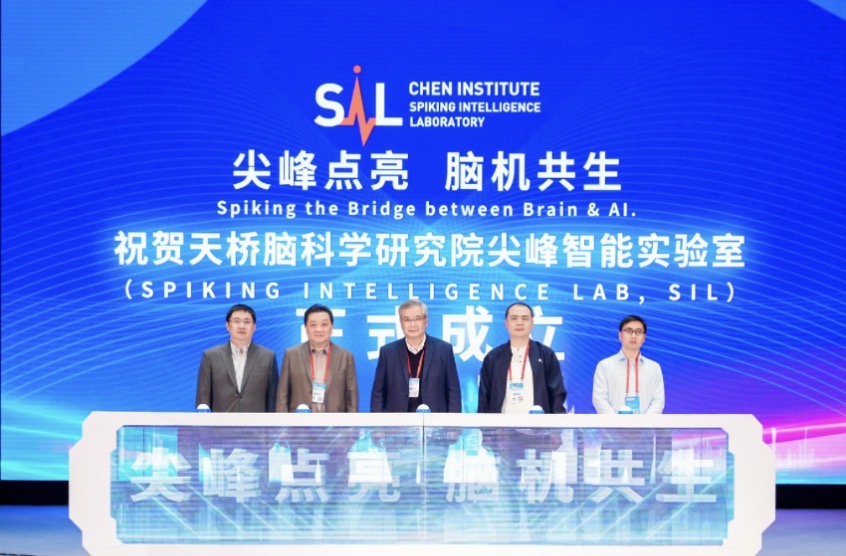
天桥脑科学研究院宣布成立尖峰智能实验室
Xin Hua Cai Jing· 2025-12-13 12:29
Core Insights - The Tianqiao Brain Science Research Institute has established the Spiking Intelligence Lab (SIL) to focus on brain-like models and spiking neural networks, aiming to explore the deep integration of artificial intelligence and human intelligence [1][5] - The concept of "Discoverative Intelligence" was introduced by Chen Tianqiao, and the Spiking Intelligence Lab serves as a key implementation platform for this idea [2] Group 1: Research and Development Focus - The lab emphasizes the development of brain-like models with neural dynamics, inspired by the human brain's efficiency, which operates at approximately 20 watts while supporting complex functions of billions of neurons [5] - The lab aims to create a "whole-brain architecture" that combines spiking communication and dynamic coding with the intricate structure of dendritic neurons, enhancing perception, memory, and cognitive abilities [5] Group 2: Institutional Transformation - The establishment of the Spiking Intelligence Lab marks a shift from an "external" donation-based model to an "in-house" research model, allowing the institute to recruit top talent and independently determine research directions [6] - This transition enables the institute to accelerate the transformation of the "Discoverative Intelligence" concept from theory to practical technological outcomes [6] Group 3: Strategic Positioning in Brain Science - As one of the largest private brain science research institutions globally, the Tianqiao Brain Science Research Institute has made significant contributions to brain science research over its nine years of operation [10] - The institute has previously collaborated with Fudan University and other institutions to establish cutting-edge laboratories focusing on brain-machine interfaces and mental health, contributing to advancements in the field [10] - The institute has hosted over 300 international and interdisciplinary academic conferences, promoting knowledge dissemination and engagement in cutting-edge technology [10]
天桥脑科学研究院成立尖峰智能实验室 支持“发现式智能”
Di Yi Cai Jing· 2025-12-13 08:28
Group 1 - The newly established Spiking Intelligence Lab (SIL) aims to develop brain-like models and spiking neural networks, focusing on the deep integration of artificial intelligence and human intelligence [1] - The lab is led by Professor Li Guoqi and is a non-profit research institution under the Tianqiao Brain Science Research Institute, which seeks to provide key capabilities for the "discovery-based intelligence" proposed by founder Chen Tianqiao [1] - The research emphasizes the importance of neural dynamics, contrasting with mainstream AI models that rely on scaling parameters, and aims to create a comprehensive brain architecture with strong perception, memory, and thinking capabilities [1][2] Group 2 - Chen Tianqiao highlighted the limitations of the "scale path" based solely on data and computing power, advocating for a "structural path" that resembles the "cognitive anatomy" of intelligence [2] - The Tianqiao Brain Science Research Institute plans to invest over $1 billion to build dedicated computing clusters to support young scientists in exploring structural mechanisms and validating new hypotheses in neuroscience [2] - The first brain-like spiking model, "Shunxi 1.0," developed by Li Guoqi's team, demonstrates breakthroughs in brain-like computing and large model integration, providing a new technical route for the next generation of AI [2][3] Group 3 - The current mainstream model architecture, based on the Transformer framework, faces resource consumption bottlenecks and limitations in processing long sequences due to its reliance on simple point neuron models [3] - The "Shunxi 1.0" model is characterized by "small data, high performance," requiring only about 2% of the data used by mainstream models while achieving comparable performance in various language understanding and reasoning tasks [3] - The model has successfully completed full training and inference on domestic GPU platforms, showcasing the feasibility of building a new ecosystem for domestically controlled large model architectures [3]
天桥脑科学研究院成立尖峰智能实验室,支持“发现式智能”
Di Yi Cai Jing· 2025-12-13 08:23
Core Insights - The establishment of the Spiking Intelligence Lab (SIL) aims to develop brain-like models with neuro-dynamic characteristics, focusing on the integration of artificial intelligence and human intelligence [1][3] - The lab is led by Professor Li Guoqi and is part of the Tianqiao Brain Science Research Institute, which seeks to provide key capabilities for the "discovery-based intelligence" proposed by founder Chen Tianqiao [1][3] Research Focus - The lab emphasizes the importance of neuro-dynamics, contrasting with mainstream AI models that rely on scaling parameters, and aims to create a full-brain architecture with strong perception, memory, and thinking capabilities [3] - The research will support the construction of a full-brain architecture that operates with approximately 20 watts of power, similar to the human brain, which has complex operations supported by billions of neurons [3] Funding and Resources - The Tianqiao Brain Science Research Institute plans to invest over $1 billion to build dedicated computing clusters to provide resources for young scientists, focusing on structural exploration rather than scaling [4] - This investment aims to foster interdisciplinary innovation and support the verification of memory mechanisms and new neuro-dynamic hypotheses [4] Technological Advancements - The lab has developed the first brain-like pulse model, "Shunxi 1.0," which achieves breakthroughs in brain-like computing and large model integration, offering a new technical route for the next generation of AI [4][5] - The "Shunxi 1.0" model requires only about 2% of the data volume compared to mainstream models while achieving comparable performance in various language understanding and reasoning tasks [5]