
国家‘十五五’规划

Search documents
李家超:香港最新财政预算案创新务实 主动对接国家“十五五”规划
Zhong Guo Xin Wen Wang· 2026-02-25 09:06
Core Viewpoint - The Hong Kong government's latest budget proposal emphasizes innovative and pragmatic measures to align with the national "14th Five-Year Plan," focusing on technology and finance to empower diversified development in Hong Kong [1][2] Group 1: Economic Measures - The budget aims to enhance industrial development and create a hub for high-end talent, thereby strengthening Hong Kong's core competitiveness and economic momentum [1] - The improvement in public finances is attributed to a favorable economic outlook and increased tax revenue, leading to a faster-than-expected recovery [1] Group 2: Support for Citizens and Businesses - The budget includes practical measures to increase support for citizens and small to medium-sized enterprises, optimize healthcare services, and respond to social needs [1] - There is a commitment to continue integrating and utilizing financial resources effectively to support infrastructure development, particularly in the Northern Metropolis area [1] Group 3: Debt and Market Development - The budget proposes to increase the scale of bond issuance and introduce more long-term bonds to support infrastructure projects and promote the diversification of Hong Kong's bond market [1]
李家超:《财政预算案》积极从“AI+”和“金融+”两条主线推进 增强经济动能
Zhi Tong Cai Jing· 2026-02-25 06:01
Core Viewpoint - The Hong Kong government, led by Chief Executive John Lee, has introduced the 2026-2027 Fiscal Budget, focusing on innovative and practical measures to enhance economic development and improve citizens' livelihoods, aligning with the national "14th Five-Year Plan" [1][2] Group 1: Economic Measures - The budget emphasizes the dual themes of "AI+" and "Finance+" to boost industrial development and attract high-end talent, thereby strengthening Hong Kong's core competitiveness [1] - The government anticipates a faster-than-expected improvement in public finances due to economic recovery and increased tax revenue, allowing for practical measures to support citizens and small businesses [1] Group 2: Infrastructure and Financial Strategy - The budget proposes continued integration and effective use of financial resources, with a focus on infrastructure development, particularly in the Northern Metropolis area [1] - Plans include increasing the scale of bond issuance and offering more long-term bonds to support infrastructure projects and promote the diversification of the local bond market [1]
李家超:《财政预算案》积极从“AI+”和“金融+”两条主线推进 增强经济动能
智通财经网· 2026-02-25 05:58
Core Viewpoint - The Hong Kong government has introduced a series of innovative and pragmatic measures in the 2026-2027 budget to enhance economic development and improve citizens' livelihoods, focusing on "AI+" and "Finance+" initiatives [1][2] Group 1: Economic Measures - The budget aims to strengthen Hong Kong's core competitiveness and economic momentum through diversified development and support for small and medium-sized enterprises [1] - The government plans to increase public spending moderately while optimizing healthcare services to address the needs of various social strata [1] Group 2: Infrastructure and Financial Strategy - Continuous integration and effective use of financial resources are emphasized, with a focus on supporting infrastructure development, particularly in the Northern Metropolis area [1] - The budget proposes to increase the scale of bond issuance and issue more long-term bonds to support infrastructure projects and promote the diversification of the local bond market [1]
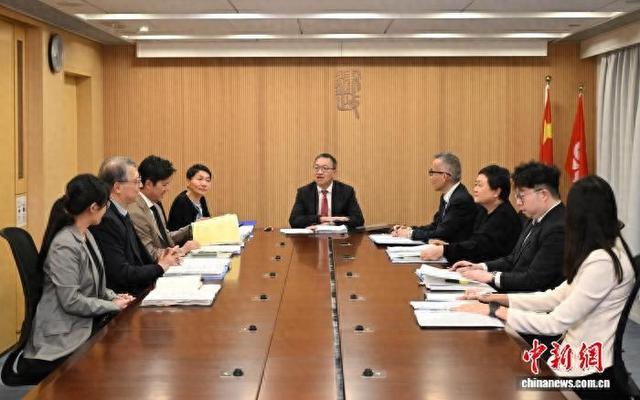
香港律政司成立对接国家“十五五”规划高层预备小组
Xin Lang Cai Jing· 2026-02-20 13:32
Core Viewpoint - The Hong Kong Special Administrative Region (HKSAR) government has established a high-level preparatory group within the Department of Justice to align with the national "14th Five-Year Plan," aiming for comprehensive and precise strategic deployment to enhance Hong Kong's role in national development [1][3]. Group 1 - The preparatory group is led by the Secretary for Justice, Paul Lam, and the Deputy Secretary for Justice, Cheung Kwok-kwan, with members including various legal commissioners and policy specialists [3]. - The first meeting of the preparatory group focused on key development areas, resource allocation, and staffing in relation to the national "14th Five-Year Plan" [3]. - Following the plan's release, the preparatory group will transition into a drafting group to expedite the alignment of Hong Kong's five-year plan with the national strategy, aiming to better integrate and serve the national development agenda [3]. Group 2 - Paul Lam emphasized that Hong Kong can leverage its international, high-level, and reputable legal and dispute resolution services within the national "14th Five-Year Plan" [3]. - The group will actively contribute to the training of international legal talents and enhance Hong Kong's role in the construction of a higher-level rule of law in China [3].

李家超:香港将从五方面主动对接国家“十五五”规划
Zhong Guo Xin Wen Wang· 2026-02-10 09:38
Core Viewpoint - Hong Kong will actively align with the national "14th Five-Year Plan" through a comprehensive five-year development plan focusing on five key areas to leverage its unique advantages and address current challenges [1][2] Group 1: Key Areas of Focus - Strengthening Hong Kong's position as an international financial center in alignment with the national strategy for building a financial powerhouse [2] - Enhancing Hong Kong's status as an international shipping center to support the national strategy for building a transportation powerhouse and deepen cooperation with the Guangdong-Hong Kong-Macao Greater Bay Area port cluster [2] - Reinforcing Hong Kong's role as a trade center to align with the national strategy for a strong domestic market and trade powerhouse, emphasizing the "bringing in and going out" role [2] - Establishing Hong Kong as an international innovation and technology center in line with the national strategy for high-level technological self-reliance [2] - Developing Hong Kong into a hub for high-end talent to support national strategies in education, technology, and talent development [2] Group 2: Implementation Strategies - The government will create a systematic policy framework for precise strategic deployment in key development areas [2] - There will be a focus on enhancing administrative efficiency and governance reforms to better integrate a proactive government with an efficient market [2] - Maintaining an international business environment to ensure transparency and fairness for foreign enterprises and international institutions in Hong Kong [2] - Deepening economic and trade cooperation mechanisms between the mainland and Hong Kong, including the arrangement for closer economic and trade relations (CEPA) [2] - Accelerating the development of the Northern Metropolis to support the establishment of an international innovation and technology center [2] - Promoting regional integration and efficient connectivity within the Guangdong-Hong Kong-Macao Greater Bay Area [2]
更主动、更系统对接国家发展战略的重要标志
Ren Min Ri Bao· 2026-02-08 19:27
Group 1 - The Hong Kong government, led by Chief Executive John Lee, is actively aligning with the national "14th Five-Year Plan" and will formulate its own five-year plan for the first time, marking a significant shift in governance and a proactive approach to national development strategies [1][2] - The establishment of a five-year plan is seen as an innovative practice to enhance the administrative-led system, reflecting the government's commitment and responsibility [1] - The five-year plan is viewed as a strategic choice to align Hong Kong's strengths with national needs, which is crucial for the region's integration into the broader national development framework [1][2] Group 2 - The formulation of a five-year plan is expected to boost confidence among domestic and international investors regarding Hong Kong's development [2] - The five-year plan will facilitate better alignment with national development strategies, providing a solid foundation for Hong Kong's long-term growth [2] - The plan is considered a necessary response to various risks and challenges, aiming to accelerate Hong Kong's development and enhance its role in serving the national development agenda [2]
澳门中联办举行2026年新春酒会
Xin Hua She· 2026-02-06 01:36
Core Viewpoint - The central government emphasizes the importance of maintaining national security and promoting economic diversification in Macau, highlighting the achievements of the past year and setting goals for 2026 [1][2]. Group 1: Achievements and Progress - In 2025, Macau successfully held the eighth Legislative Assembly election and achieved a record high in tourist visits, showcasing the effectiveness of the "One Country, Two Systems" principle [1]. - The collaboration between the central government and local authorities has led to significant advancements in various sectors, reflecting strong support from the mainland [1]. Group 2: Future Goals and Initiatives - For 2026, the focus will be on achieving breakthroughs in economic diversification, enhancing governance efficiency, and fostering patriotic sentiments among residents [1]. - The local government aims to align with national development plans and continue public administration reforms while addressing citizens' needs and promoting a safe and inclusive environment [2].
积极财政政策靠前发力,推动实现经济“开门红”
2 1 Shi Ji Jing Ji Bao Dao· 2026-01-29 22:55
Core Viewpoint - The issuance of local government bonds in China has reached 584.7 billion yuan since the beginning of the year, with a significant focus on special bonds to support key projects and stimulate economic growth in 2026 [1] Group 1: Bond Issuance Overview - As of January 27, 2023, 5,847 billion yuan of local bonds have been issued, with new special bonds accounting for 1,962 billion yuan, representing 33.6% of the total [1] - The planned issuance of local bonds for the first quarter exceeds 25,000 billion yuan, marking the highest level for the same period in three years [1] Group 2: Bond Structure and Mechanism - The first quarter's planned issuance includes 7,644 billion yuan of new special bonds and 12,106 billion yuan of refinancing special bonds, making up over 75% of the total issuance plan [2] - New special bonds will focus on high-quality projects that can quickly generate tangible results, while refinancing bonds will primarily be used to repay maturing debts and optimize financing costs [2] - The "self-examination and self-issuance" pilot program is expected to expand, enhancing issuance efficiency and local autonomy [2] Group 3: Management and Regulatory Framework - The use of local special bonds will be subject to stricter regulatory oversight, with a negative list management model to exclude non-revenue-generating projects [3] - There will be a focus on the entire lifecycle management of project funds, ensuring efficient and controlled use of resources [3] - Performance evaluation results will be linked to the allocation of local debt quotas, incentivizing local governments to improve project quality [3] Group 4: Strategic Focus and Investment Areas - New special bonds will support major projects outlined in the national "14th Five-Year Plan," focusing on infrastructure related to food security, energy security, and supply chain stability [3] - There will be an emphasis on emerging industries such as low-altitude economy, quantum technology, aerospace, and artificial intelligence [3] - The mechanism for using special bonds as project capital will be optimized, increasing the capital ratio limit to attract more social capital for major strategic projects [4]
香港特区立法会通过主动对接国家“十五五”规划议案
Xin Hua She· 2026-01-22 14:22
Core Viewpoint - The Hong Kong Legislative Council passed a motion to formulate a development vision for the Hong Kong Special Administrative Region (SAR) that aligns with the national "14th Five-Year Plan" [1] Group 1: Legislative Action - The motion emphasizes that integrating into the national development framework is essential for ensuring sustainable and high-quality development in Hong Kong [1] - The motion urges the SAR government to actively develop a medium- to long-term development vision [1] - The goal is to incorporate the relevant development vision into the national planning system [1]
对接国家“十五五”规划 香港财库局定下金融业四大重点方向
智通财经网· 2026-01-22 07:05
Core Viewpoint - The Hong Kong Financial Services and the Treasury Bureau has outlined a mid-to-long-term vision to integrate the financial sector with national development, focusing on enhancing market advantages, supporting high-quality economic development, deepening internal and external connectivity, and safeguarding financial security [1][2]. Group 1: Enhancing Market Advantages - Hong Kong's market is characterized by high openness and internationalization, with robust legal frameworks and talent aggregation. The bureau aims to enhance stock market competitiveness, facilitate the return of Chinese concept stocks, strengthen offshore RMB business, and attract family offices by optimizing the tax system to boost asset management competitiveness [1]. Group 2: Supporting High-Quality Economic Development - The bureau plans to promote fintech to assist mainland tech companies in raising funds in Hong Kong, explore new opportunities in bulk commodities and gold trading, accelerate the development of green finance, and deepen cooperation with the Greater Bay Area carbon market pilot [1]. Group 3: Deepening Internal and External Connectivity - The bureau will expand connectivity through existing frameworks like Stock Connect and Bond Connect, including initiatives such as incorporating real estate investment trusts into connectivity schemes and optimizing cross-border payment systems. Hong Kong aims to act as a "super connector" to help mainland enterprises expand internationally and attract foreign businesses and capital [2]. Group 4: Safeguarding Financial Security - The "14th Five-Year Plan" emphasizes the need to improve the macro-prudential management system. The Hong Kong government will work closely with regulatory bodies to enhance market supervision, prevent systemic risks, and improve cross-border risk monitoring in collaboration with national financial management departments [2].