地方债市场

Search documents
快问快答之2026年大类资产配置机遇与挑战
East Money Securities· 2026-02-11 09:11
1. Report Industry Investment Rating - Not provided in the content 2. Core Viewpoints of the Report - The People's Bank of China will continue to implement a moderately loose monetary policy in 2026, and there is still room for reserve requirement ratio cuts and interest rate cuts [6]. - The 10 - year Treasury bond yield is in a narrow - range corridor. In the short term, the bond market sentiment may remain warm before the Spring Festival, but attention should be paid to the key resistance level. In the medium term, the bond market may face headwinds, and caution is needed when participating in ultra - long - term bond assets [7]. - In 2026, the local bond market will "front - load" issuance, and funds will be focused on new infrastructure construction, urban renewal and public services, intelligent upgrading of traditional major infrastructure, resolving stock debt risks, and industrial upgrading and national security - related fields [8][9][10][11]. - In 2026, the global attractiveness of Chinese fixed - income assets may increase, but the allocation power of overseas investors may not be the decisive factor affecting the bond yield trend [12]. - In the context of a volatile domestic stock market, investors can focus on four bond market allocation opportunities: the allocation and trading value of interest - rate bonds, the coupon advantage of high - quality credit bonds, the enhanced elasticity opportunity of convertible bonds, and the diversification value of international allocation [14] 3. Summary by Relevant Catalogs 1.1 Central Economic Work Conference and Monetary Policy in 2026 - The People's Bank of China will implement a moderately loose monetary policy, increasing counter - cyclical and cross - cyclical adjustment. There is still room for reserve requirement ratio cuts (the current average legal deposit reserve ratio is 6.3%) and interest rate cuts (stable RMB exchange rate, narrowing bank net interest margin, and maturing long - term deposits) [6] 1.2 Bond Market Pattern in 2026 - The 10 - year Treasury bond yield is around 1.8% - 1.9%. In the short term, the bond market sentiment may be warm before the Spring Festival, but attention should be paid to the 1.80% resistance level. In the medium term, the bond market may face headwinds, and caution is needed when participating in ultra - long - term bond assets [7] 1.3 Inclination of Local Bond Market Scale in 2026 - Funds will be focused on new infrastructure construction (related to new technologies), urban renewal and public services, intelligent upgrading of traditional infrastructure, resolving stock debt risks (about 6 trillion special refinancing bonds for debt replacement will be basically issued), and industrial upgrading and national security - related fields [8][9][10][11] 1.4 Global Attractiveness of Chinese Fixed - Income Assets in 2026 - Chinese fixed - income assets can effectively diversify risks in a global asset portfolio. With the appreciation of the RMB against the US dollar, their global attractiveness may increase, but the influence of overseas investors may not be decisive [12] 1.5 Bond Market Allocation Opportunities in 2026 - Interest - rate bonds: Provide a stable foundation for portfolio construction and trading opportunities for investors with certain trading abilities [15] - High - quality credit bonds: Focus on high - quality urban investment bonds in economically strong regions and industrial bonds in strategic industries [16] - Convertible bonds: Select bonds related to policy - supported sectors and pay attention to valuation [17] - International allocation: Chinese interest - rate bonds can attract foreign capital, and some high - quality Chinese dollar bonds can be a useful supplement [18]
2025年地方债市场回顾与2026年展望
Sou Hu Cai Jing· 2026-01-25 05:45
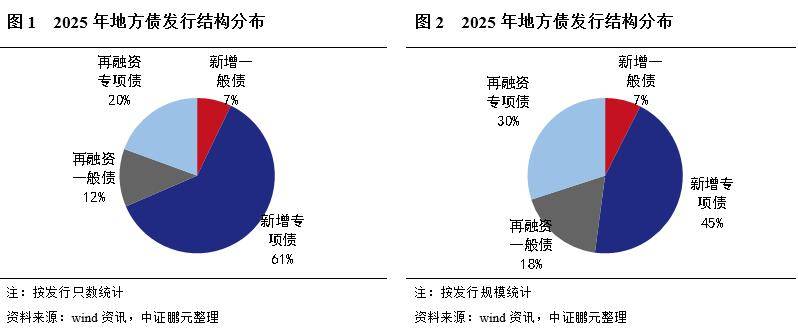
Core Viewpoint - The local government bond market in 2025 is characterized by a significant increase in general bond issuance due to rising fiscal deficits, an unexpected surge in special bonds to address government arrears, a notable decline in bonds allocated for infrastructure, and a longer issuance period influenced by fiscal pressures and rising interest rates [1][2][3]. Group 1: 2025 Local Bond Market Overview - In 2025, a total of 1,678 new bonds were issued, with an issuance scale of 53,616.89 billion yuan, representing a year-on-year increase of 26.55% and 14.03% respectively [2][3]. - The issuance of general bonds reached 7,700.21 billion yuan, accounting for 96.25% of the fiscal deficit, while special bonds amounted to 45,916.68 billion yuan, exceeding the limit by 4.36% [2][3]. - The average issuance period for local bonds extended to 14.47 years, reflecting the local governments' strategy to manage fiscal pressures [19]. Group 2: Policy Environment in 2025 - The fiscal policy shifted from "active" to "more active," with an increased fiscal deficit rate set at around 4%, up by 1 percentage point from the previous year [27]. - Local government special bonds were primarily utilized for "clearing debts," with a focus on addressing overdue payments to enterprises [28]. - The establishment of a Debt Management Department by the Ministry of Finance aims to enhance monitoring and management of government debt risks [29]. Group 3: Local Government Financial Performance - Economic growth rates for most provinces declined in the first three quarters of 2025, with 24 provinces experiencing a slowdown compared to the first half of the year [30]. - Public fiscal revenue showed slight growth, while government fund revenues saw a significant decline, indicating ongoing challenges in the real estate market [31][33]. - Net financing from local bonds increased in most provinces, with notable growth in Shanghai and Ningxia, while five provinces experienced a decrease [34]. Group 4: Outlook for 2026 - The local bond issuance scale is expected to rise further in 2026 to support domestic demand and debt resolution, with projections indicating a total issuance of approximately 10.7 trillion yuan [36]. - The "stock-bond seesaw effect" is anticipated to remain prominent, with local bond market interest rates likely to experience fluctuations [37]. - Optimization of special bond usage management is expected, with a potential decrease in funding proportions for certain areas [38].