基金监管

Search documents
私募基金与公募基金的差异在哪里?
Sou Hu Cai Jing· 2026-02-22 04:45
Core Viewpoint - Public funds are accessible to the general public with low entry thresholds, while private funds target specific qualified investors with higher entry requirements [1][2] Group 1: Fund Characteristics - Public funds require a minimum subscription amount of only 1 or 10 yuan, while private funds require qualified investors to have financial assets of at least 3 million yuan or an average annual income of 500,000 yuan over the last three years [1] - Public funds are subject to stricter regulations regarding investment scope, holding ratios, and information disclosure, requiring regular reports to ensure transparency [1][2] - Private funds have more flexible regulatory requirements and primarily disclose information to specific investors rather than the public [1] Group 2: Investment Scope and Strategies - Public funds typically invest in standardized assets such as listed stocks, bonds, and money market instruments, while private funds can invest in a broader range of non-standardized assets, including equity in unlisted companies, private bonds, derivatives, and alternative investments [1][2] - Investment strategies for private funds are more diverse, including hedging, leverage, and value investing, compared to the more limited strategies of public funds [1][2] Group 3: Operational Models and Fees - Public funds generally operate on an open-ended basis, allowing investors to buy or redeem shares at any time, whereas private funds often use closed or semi-closed models with lock-up periods [2] - The fee structure for public funds is more transparent, mainly consisting of management and custody fees, while private funds typically charge performance fees based on profit-sharing in addition to fixed fees [2] Group 4: Risk and Return Profiles - Public funds have lower overall risk due to strict regulations, limited investment scope, and diversified investments, resulting in more stable returns [2] - Private funds, with their broader investment scope and flexible strategies, carry higher risk but also have the potential for greater returns [2]
小红书禁言基金实时估值博主?教程帖文仍不断,少数还能查询
Bei Jing Shang Bao· 2026-02-05 08:20
Core Viewpoint - Xiaohongshu has implemented a ban on certain "real-time fund valuation bloggers," indicating regulatory scrutiny on platforms providing fund valuation services [1] Group 1: Regulatory Actions - The regulatory body highlighted concerns in a report on January 29, 2026, regarding the reintroduction of "real-time fund valuation" features by some fund sales institutions and unlicensed third-party platforms [1] - These features, which include "net value reference" and "sector rise and fall," may mislead investors and dilute fund product returns, prompting the need for regulation [1] - The report emphasized that fund sales institutions and third-party platforms must enhance self-inspection and remove misleading features like "real-time valuation," "increased positions leaderboard," and "real trading leaderboard" [1] Group 2: Current Platform Activity - Despite the ban on certain bloggers, many new posts related to "real-time fund valuation" have been published on Xiaohongshu since February, guiding investors to check fund valuations [1] - Some posts provide links to third-party platforms, such as "Estimate Assistant," allowing users to view real-time estimated gains and net values by entering fund codes [1]
7月起医保内分娩费用个人“零自付”
Xin Lang Cai Jing· 2026-01-23 19:56
Group 1: Healthcare Policy Initiatives - The Hunan Provincial Medical Security Work Conference outlined seven key tasks for 2026, focusing on enhancing public healthcare access and benefits [1] - The province will implement a "zero out-of-pocket" policy for childbirth expenses covered by medical insurance starting July 1, 2026, and will expand maternity insurance coverage to include flexible workers and migrant workers [1] - A long-term care insurance system will be initiated for insured employees in the second half of the year, along with improvements to rehabilitation and palliative care payment models [1] Group 2: Medical Governance and Regulation - Strengthening medical governance through adjustments in the medical insurance catalog to improve reimbursement rates and address unreasonable hospitalization rates [1] - The province aims to enhance fund supervision by addressing issues like fund misappropriation and excessive medical treatments, and will develop a unified knowledge base for pre-approval and real-time audits [1] - The establishment of a "Regulatory Xiangjun" brand to promote effective oversight in the healthcare sector [1] Group 3: Digital Transformation and Service Optimization - The province is advancing digitalization in healthcare services, including online processing for chronic diseases and high-frequency medical matters, aiming for a more efficient service experience [2] - The introduction of the "Xiang Medical Insurance Heart Service" to enhance convenience in payment methods and service accessibility [2] - Promotion of cross-departmental data sharing and the development of a cloud-based medical insurance system to improve service delivery [2] Group 4: Maternal and Child Health Services - The introduction of six "Fertility-Friendly Service Packages" to address the health needs of women and children throughout their life cycles, aimed at reducing the costs of childbirth and caregiving [3][4] - Each service package includes both basic and upgraded personalized services to cater to varying community needs, with a focus on accessibility and precision in service delivery [4] - The initiative is a collaborative effort involving multiple provincial departments to enhance maternal and child health service quality and improve public satisfaction [5]
人社部:完善基金监管制度规则和监管体系,健全社会保险精算制度
Xin Lang Cai Jing· 2026-01-20 12:46
Core Viewpoint - The Ministry of Human Resources and Social Security emphasizes the continuous deepening of social security reforms to ensure timely and adequate pension payments and to enhance support for low-income groups [1] Group 1: Social Security Reforms - The national overall planning system for pensions will be improved and implemented to ensure timely and full pension payments [1] - A mechanism for determining and adjusting benefits will be established, with a stronger focus on low-income groups [1] - The coverage of enterprise annuities will be expanded, and the personal pension system will be implemented cautiously [1] Group 2: Regulatory Enhancements - The regulatory system and rules for funds will be improved, along with the investment operation supervision [1] - A long-term assessment mechanism will be promoted, and the actuarial system for social insurance will be enhanced [1]
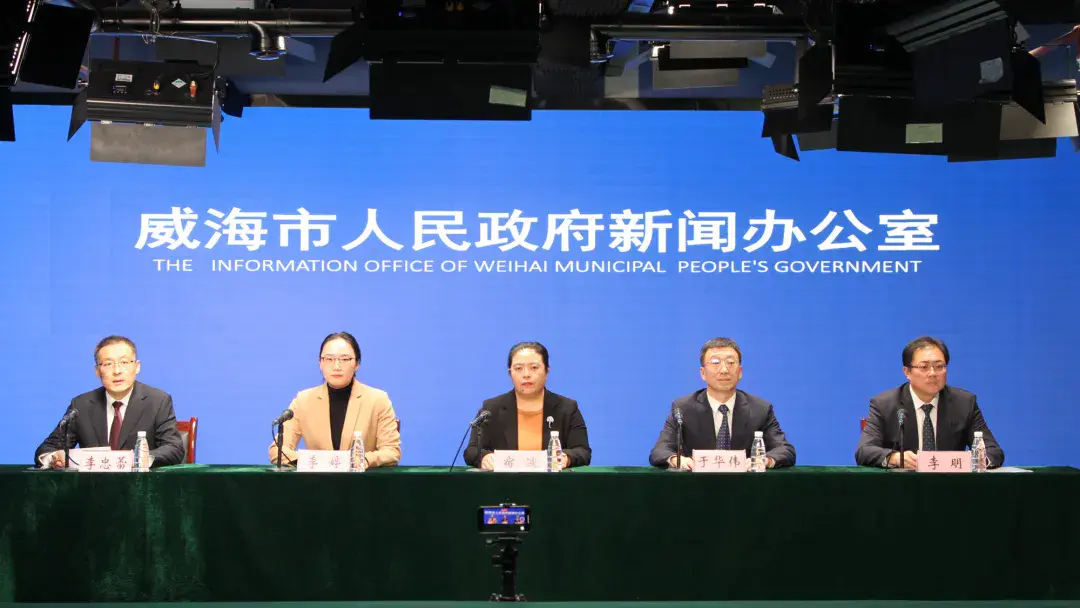
威海医保“十四五”交出亮眼答卷:改革发展成果惠及全民
Qi Lu Wan Bao· 2026-01-13 10:25
Core Viewpoint - During the "14th Five-Year Plan" period, Weihai's medical insurance department has focused on enhancing public health and satisfaction through continuous reforms and improvements in medical insurance services [3][10]. Group 1: Fund Operation and Security - The medical insurance fund in Weihai has been operating smoothly, with both employee and resident insurance funds remaining within a sustainable range [3]. - A total of 94.69 million yuan has been recovered or denied in fund supervision efforts [3]. Group 2: Benefit Guarantee Mechanism - The outpatient mutual insurance guarantee mechanism has been fully established, with reimbursement rates for inpatient care at over 80% for employees and 65% for residents [3]. - Outpatient reimbursements have reached 11.69 million instances, totaling 1.098 billion yuan [4]. - The major illness insurance system has been enhanced, with a maximum reimbursement rate of 90% and a cap of 900,000 yuan, totaling 609 million yuan paid out [4]. Group 3: Collaborative Development and Governance - The integration of medical, insurance, and pharmaceutical sectors has been emphasized, with 890 types of drugs and 40 categories of medical supplies included in centralized procurement [5]. - The price of diabetes medication has dropped by 88%, from 600 yuan to 75 yuan per box, and the average price of cochlear implants has decreased by 68% [5]. Group 4: Payment Mechanism - The implementation of the DRG payment system has led to a 16% reduction in average hospitalization costs compared to the end of the "13th Five-Year Plan" [6]. - The number of drugs in the medical insurance directory has increased from 2,709 to 3,159, with 600 types of negotiated drugs now included [6]. Group 5: Fund Supervision - The Weihai medical insurance bureau has maintained a high-pressure stance against fraud, recovering 25.83 million yuan through self-inspection and proactive measures [8]. - A total of 4,513 cases of non-compliance with medical insurance reimbursement have been identified, involving 89.47 million yuan in medical expenses [8]. Group 6: Service System - The establishment of a "15-minute medical insurance service circle" has been achieved, with 858 service stations handling over 100,000 transactions annually [9]. - The "Weihai Medical Insurance" app has facilitated online services for 1.34 million users, with over 85% of medical institutions adopting electronic insurance certificates [9].

济宁持续深化医保领域改革创新,便民利民落到实处
Qi Lu Wan Bao· 2025-12-16 03:32
Core Viewpoint - The healthcare security system in Jining City is a crucial pillar for people's livelihood, focusing on addressing issues related to medical accessibility and affordability during the 14th Five-Year Plan period [1] Group 1: Outpatient Guarantee Improvement - Jining City prioritizes enhancing outpatient guarantee levels to alleviate the financial burden of outpatient expenses for the public [2] - The city has upgraded outpatient coverage for employees by optimizing reimbursement ratios and payment limits, significantly increasing outpatient expense protection [4] - Policies targeting chronic diseases like hypertension and diabetes have been implemented, resulting in an average reduction of over 200 million yuan in personal burdens annually for millions of patients [4] Group 2: Fund Supervision and Security - A comprehensive fund supervision system has been established to ensure the safety of medical insurance funds, which are vital for public health [5] - Jining has innovated regulatory methods by creating a multi-departmental collaboration mechanism to combat fraud and enhance oversight [5][6] - As of November this year, 1,592 medical institutions were processed, recovering 80.087 million yuan in funds and imposing fines totaling 12.7379 million yuan [7] Group 3: Service Reform and Accessibility - The city has focused on reforming medical insurance services to address public needs, making processes more efficient and accessible [8] - Efforts to expand the network of medical insurance service points have been made, ensuring that high-frequency services are available close to residents [8] - The promotion of digital services, including the use of electronic medical insurance credentials, has improved the efficiency of medical services [9] Group 4: Future Outlook - Jining's medical insurance system aims to continue enhancing service levels, focusing on diverse needs for outpatient services and expanding direct settlement for maternity medical expenses [9] - Plans include further standardization of grassroots service points and the development of a comprehensive online service system for medical insurance [9]

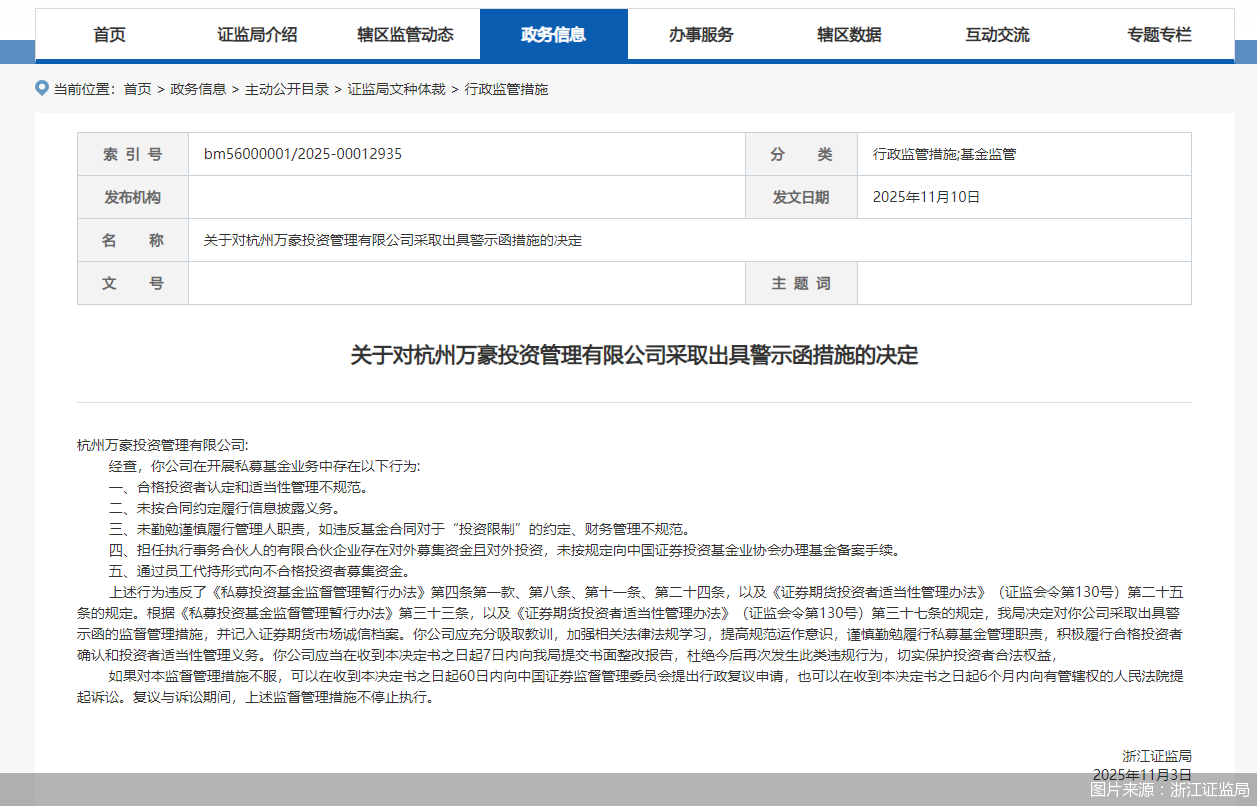
因开展私募基金业务存多项违规行为,杭州万豪投资被监管警示
Bei Jing Shang Bao· 2025-11-10 14:04
Core Points - Zhejiang Securities Regulatory Bureau issued a warning letter to Hangzhou Marriott Investment Management Co., Ltd. for non-compliance in private fund operations [1] - The company failed to properly identify qualified investors and manage suitability, did not fulfill information disclosure obligations as per contracts, and violated investment restrictions [1] - Qiu Zhijun, the legal representative and general manager of Hangzhou Marriott Investment, was held primarily responsible for the company's issues and also received a warning letter [1] Summary by Categories - **Regulatory Actions** - Zhejiang Securities Regulatory Bureau decided to take supervisory measures against Hangzhou Marriott Investment by issuing a warning letter and recording it in the securities market integrity archive [1] - Qiu Zhijun, as the legal representative, was also subjected to a warning letter and recorded in the integrity archive for failing to fulfill responsibilities [1] - **Compliance Issues** - The company exhibited irregularities in the recognition of qualified investors and suitability management [1] - There were failures in adhering to contractually agreed information disclosure obligations and financial management practices [1] - The company raised funds from unqualified investors through employee holding arrangements, violating multiple regulations [1]