
复合策略

Search documents
2025收官盛宴!超百家私募管理人的“财富共鸣”,不容错过!
私募排排网· 2026-01-04 03:33
Core Insights - The private equity industry is experiencing significant growth, with over 100 private equity firms surpassing 10 billion yuan in assets by October 2025, marking a return to the "double hundred era" [2] - By the end of November, over 600 firms among the 7,000 existing securities private equity firms achieved annual growth, with nearly 100 firms elevating their scale by two levels or more, indicating strong momentum in the industry [2] - The total management scale of domestic private equity funds exceeded 22 trillion yuan by the end of October, further rising to 22.09 trillion yuan by the end of November, reflecting a robust increase in both industry scale and product issuance [2] - The average return for 5,116 private equity products with performance data was notable, with quantitative long and subjective long strategies showing strong performance, achieving average returns of ***% and ***% respectively [2] Industry Trends - The private equity sector is characterized by a diverse range of products, with over 12,000 new products registered in 2025, indicating a growing variety and sustained high issuance enthusiasm [2] - The industry is at a critical juncture, facing opportunities and uncertainties, particularly regarding the continuation of the easing cycle in 2026 and the potential for quantitative strategies to maintain their success from 2025 [2] - A VIP roadshow event titled "Hearing Wealth" is set to commence on January 5, 2026, featuring leading private equity managers focusing on annual reviews and future outlooks, particularly in quantitative and subjective strategies [2]


复合策略最新10强揭晓!榜首喜世润看涨黄金至8000美元!
Sou Hu Cai Jing· 2025-12-26 10:58
Core Viewpoint - The composite strategy, which combines multiple investment strategies, aims to reduce risk and stabilize returns, showing significant advantages over single strategies in terms of volatility smoothing, enhanced returns, and scale expansion [1]. Summary by Categories Performance of Composite Strategies - As of December 12, 2025, there are 428 composite strategy products with reported performance this year, ranking third in quantity after quantitative long and subjective long strategies [1]. - The average return of composite strategies this year is 26.52%, placing it fifth among 16 secondary strategies [2]. Performance by Company Size - Among private equity firms with assets between 50-100 billion, composite strategies yield the highest average return of 34.39% this year [2]. - The median return for firms with over 100 billion in assets is 25.63% [2]. - The average return for composite strategies across all company sizes is 26.52%, with a median return of 19.83% [3]. Top Performing Composite Strategy Products - In the top private equity category, composite strategy products have an average return of 28.86% and a median return of 25.53% [4]. - The top product, "喜世润黄金1号A类份额" managed by 关歆 from 喜世润投资, has a notable performance this year [5][6]. - In the 10-50 billion category, the top product is "天辉霍格1号" managed by 张洲 from 天辉(上海)私募, with a strong focus on quantitative investment strategies [8][7]. - For the 0-10 billion category, "蚂金青山进取一号" managed by 吕鑫 from 巨熊 leads with a significant advantage in returns [11][10].
复合策略最新10强揭晓!榜首喜世润看涨黄金至8000美元!国源信达、昭融汇利上榜
私募排排网· 2025-12-24 10:00
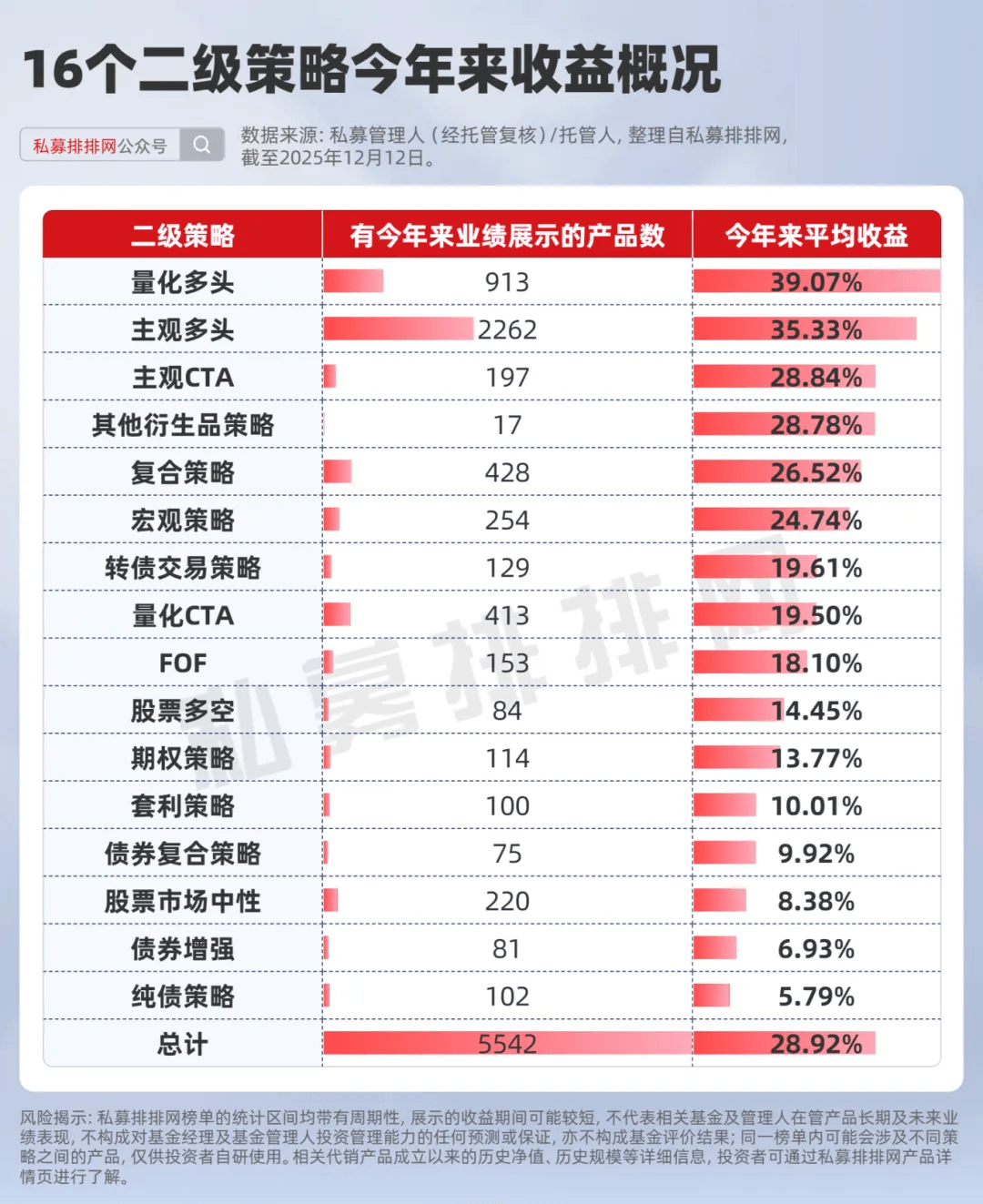
Core Viewpoint - The article discusses the advantages of composite strategies in investment management, highlighting their ability to reduce risk and stabilize returns compared to single strategies. It emphasizes the performance of composite strategy products in the private equity market, showcasing their growing popularity and effectiveness in achieving superior returns [2][3]. Summary by Sections Composite Strategy Overview - Composite strategies involve the simultaneous use of multiple investment strategies to achieve better risk-adjusted returns. The goal is to create a synergistic effect where the combined performance exceeds that of individual strategies [2]. Performance Metrics - As of December 12, 2025, there are 428 composite strategy products with reported performance this year, ranking third in quantity after quantitative long and subjective long strategies. The average return for composite strategies this year is 26.52%, placing them fifth among 16 secondary strategies [2][3]. Secondary Strategy Performance - The performance of various secondary strategies is as follows: - Quantitative Long: 913 products, 39.07% average return - Subjective Long: 2262 products, 35.33% average return - Subjective CTA: 197 products, 28.84% average return - Composite Strategy: 428 products, 26.52% average return - Overall average return across all strategies is 28.92% [3]. Company Size Analysis - Among private equity firms, those with assets between 50-100 billion have the highest average return for composite strategies at 34.39%. The median return is highest for firms over 100 billion at 25.63% [4]. Top Performing Products - In the top private equity category, the leading composite strategy product is managed by Xishirun Investment, achieving an average return of ***%. The second place is held by Guoyuan Xinda, with three products listed among the top ten [5][6]. Insights from Fund Managers - Guoyuan Xinda's product, managed by Zhang Gengyuan, has shown strong performance, benefiting from his extensive experience in global macroeconomic assessment and value-driven trend investing [8]. Mid-Sized Private Equity Performance - For firms with assets between 10-50 billion, the average return for composite strategies is 21.42%, with a median of 17.07%. The top products in this category have a performance threshold of ***% [9][10]. Small Private Equity Performance - In the 0-10 billion category, composite strategies have an average return of 27.85% and a median of 19.86%. The top products in this segment also have a performance threshold of ***% [13][14]. Conclusion - The article highlights the growing trend and effectiveness of composite strategies in the private equity market, showcasing their potential for higher returns and stability across different company sizes and strategy types [2][3][4].

产品备案数量仅次于股票策略,私募多资产策略为何越来越火?
Xin Lang Cai Jing· 2025-11-27 05:43
Core Insights - Multi-asset strategy private equity products have gained popularity in 2023, with 1,400 products registered from January to October, second only to stock strategy products [1] - The appeal of multi-asset strategies is attributed to significant global asset price fluctuations expected in 2024-2025, evolving investor demands for risk-return matching, and the search for absolute returns by long-term funds [1][8] Performance Overview - As of November 14, multi-asset strategy products have an average annual return of 20.37%, ranking just below stock strategies, with a slightly higher Sharpe ratio and lower volatility and drawdown [2][3] - The performance metrics for various strategies are as follows: - Stock Strategy: 29.54% average return, 93.14% positive return ratio, 35.96% volatility [3] - Multi-Asset Strategy: 20.37% average return, 91.73% positive return ratio, 25.84% volatility [3] - Composite Fund: 18.98% average return, 96.34% positive return ratio, 39.15% volatility [3] - Futures and Options: 13.79% average return, 82.49% positive return ratio, 48.73% volatility [3] - Bond Strategy: 8.46% average return, 92.10% positive return ratio, 11.76% volatility [3] Sub-strategy Performance - Among sub-strategies, macro strategies outperform in average return, positive return ratio, and Sharpe ratio [4] - Macro Strategy: 25.09% average return, 97% positive return ratio, 25.48% volatility [5] - Composite Strategy: 21.14% average return, 90.93% positive return ratio, 1.63 Sharpe ratio [7] - Arbitrage Strategy: 8.87% average return, 89.95% positive return ratio, lowest volatility and drawdown [7] Market Dynamics - The macro strategy focuses on dynamic allocation across major asset classes based on global macroeconomic analysis [6] - Bridgewater's "All Weather Strategy" exemplifies macro strategies, aiming for stable performance across different economic environments [6] - Local macro strategy firms like Honghu and Banxia are emerging as key players in the market [7] Challenges and Considerations - Successfully implementing multi-asset strategies requires more than just combining different assets; it necessitates creating a synergistic portfolio [8] - The complexity of the Chinese market, with significant differences in Sharpe ratios and economic cycles, demands experienced management and a tailored methodology [8] - A robust IT system covering research, trading, risk control, and operations is essential for distinguishing the capabilities of multi-asset strategy private equity firms [8]

成长的关键在于“认识自己”
Qi Huo Ri Bao Wang· 2025-11-06 03:14
Core Viewpoint - Shanghai Zhujin Investment's options team, led by Yu Bin, achieved the championship in the options category of a trading competition, despite facing a challenging market environment that negatively impacted their performance compared to the previous year [1] Group 1: Trading Strategy and Performance - Yu Bin initially developed a trading system based on technical analysis, achieving a win rate of 38% with a profit-loss ratio of 2.5:1, but faced a nearly 20% drawdown due to market volatility [2] - After a critical turning point in 2017, Yu Bin shifted focus to options, particularly the dual-selling strategy on the SSE 50 ETF options, which yielded an annual return of about 10% [3] - The introduction of a diversified strategy combining futures directional analysis with options volatility management improved the win rate to 70%, although the profit-loss ratio decreased to 1:1, resulting in a more stable "stair-step" profit curve [3] Group 2: Team Collaboration and Risk Management - The importance of team collaboration is emphasized, with each member playing a crucial role in strategy development, opportunity identification, planning, execution, and risk control [4] - A comprehensive risk management system was established, consisting of three lines of defense: logical risk control based on fundamental support, position risk control through diversification, and capital risk control with a warning mechanism for different product styles [5] Group 3: Personal Growth and Trading Philosophy - Yu Bin highlights the significance of self-awareness in a trader's growth, advocating for a balance between risk and return while recognizing personal trading styles [6] - The philosophy of trading as a marathon emphasizes the importance of maintaining a clear mind over excessive monitoring of the market, showcasing a sustainable path to success [6]