
风控体系

Search documents
让人工智能金融应用“跑起来”
Jin Rong Shi Bao· 2026-01-12 01:55
Group 1 - The core viewpoint emphasizes the mutual empowerment of artificial intelligence (AI) and finance, which is a necessary outcome of the development of both sectors, providing strong support for their high-quality growth [1] - The People's Bank of China aims to promote the application of AI in finance in a proactive, stable, safe, and orderly manner, highlighting the need for institutional support and overcoming technical bottlenecks [1][2] - The development of AI in finance should focus on real demands from the real economy, ensuring deep integration of technological innovation with business scenarios [1] Group 2 - The top-level design includes the issuance of the "Opinions on Deepening the Implementation of 'Artificial Intelligence+' Action" in August 2025, which sets the direction for AI applications in various sectors, including finance [2] - Challenges in the development of "AI + Finance" include the need for stronger governance of technological ethics, risks of model homogeneity, inherent flaws in algorithm architecture, and challenges in data governance and security [2] - To address these challenges, a collaborative approach involving financial security, risk prevention, and an innovative application environment is essential, requiring deep exploration of institutional frameworks and continuous improvement of collaborative mechanisms [2] Group 3 - Looking ahead to the 14th Five-Year Plan, the focus will be on safety, innovation, and ecological collaboration, with policies guiding the development direction and establishing a tiered risk prevention system [3] - Key areas for AI empowerment in finance include credit financing, risk management, and customer service, aiming for effective implementation of AI applications [3] - Strengthening collaboration among government, enterprises, and research institutions is crucial for technological breakthroughs in financial models, alongside investing in talent to support sustainable AI applications in finance [3]
中金所拟修订交易规则 交易者适当性制度升级
Zheng Quan Ri Bao Wang· 2026-01-09 14:26
Core Viewpoint - The China Financial Futures Exchange (CFFEX) is proposing revisions to its trading and settlement rules, seeking public feedback on the draft regulations to enhance the regulatory framework and improve risk management practices in futures trading [1]. Group 1: Regulatory Enhancements - The revised trading rules will incorporate new legal bases, including the Futures and Derivatives Law and relevant regulations from the China Securities Regulatory Commission (CSRC) [1]. - The scope of the trading rules will be expanded to cover not only futures trading but also related activities, ensuring comprehensive regulatory oversight [1]. Group 2: Adaptation to Registration System - The trading rules will align with the registration system, specifying that only products registered with the CSRC can be listed on the exchange, including futures and options contracts [1]. Group 3: Trader Suitability and Risk Management - The rules will upgrade the trader suitability system, requiring members to establish and execute suitability protocols, ensuring that clients are fully informed of trading risks and that products match their risk tolerance [1]. - Members must continuously assess client information and risk capacity, enhancing client management practices [1]. Group 4: Reporting and Risk Control - A new reporting system for algorithmic trading will be introduced, mandating members and clients to report relevant information to ensure the security and order of the trading system [1]. - The trading rules will also refine the risk control framework, detailing procedures for handling exceptional situations and optimizing self-regulatory and dispute resolution mechanisms [1].
银河证券卷入雷根资产违约风波!
Xin Lang Cai Jing· 2025-12-12 09:14
Core Viewpoint - The article discusses the ongoing legal and financial repercussions faced by investors and the brokerage firm Galaxy Securities due to the collapse of the Regan Asset Management Company, which has been implicated in a payment crisis and suspected fundraising fraud. Group 1: Investor Experiences - A 62-year-old investor, Ms. Cai, invested 5 million yuan in the "Regan All-Weather Fund" through Galaxy Securities, only to face a payment crisis in 2023, leading to legal actions against the fund's management [1][25] - Reports indicate that 52 investors purchased the Regan fund through Galaxy Securities, totaling nearly 100 million yuan in investments, with many seeking legal recourse [1][25][37] Group 2: Regulatory Violations - Galaxy Securities is accused of multiple violations, including allowing unqualified investors to purchase funds and making misleading promises of capital protection and guaranteed returns [1][25][29] - The firm received warnings for inadequate due diligence in its private fund sales, which may have led to high-risk products being sold to low-risk investors [1][25][29] Group 3: Legal Proceedings and Settlements - Ms. Cai reported Galaxy Securities for illegal activities in fund sales and was offered a settlement of 92% of her principal, contingent on withdrawing her complaint, which she later found was not honored [1][31] - Another investor, Mr. Huang, faced similar issues, having been misled about the fund's risk level and the existence of a "white list" of approved products, which Galaxy Securities later denied [1][33][35] Group 4: Financial Performance of Galaxy Securities - Despite the ongoing crisis, Galaxy Securities reported significant financial growth, with revenues of 22.75 billion yuan in the first three quarters of 2025, a 44.39% increase year-on-year, and a net profit of 10.97 billion yuan, up 57.51% [1][40][42] - The firm’s total assets reached 861.09 billion yuan, reflecting a 16.76% increase from the previous year, and it has expanded its client base to over 18 million [1][40][42] Group 5: Fund Management and Investment Strategy - The Regan fund did not adhere to its initial investment strategy, which was supposed to focus on Hong Kong IPOs, instead diverting funds to other private equity products [1][29] - The fund's management has been accused of using various channels to mislead investors about the true nature of their investments, which has raised concerns about the integrity of the investment process [1][29][39]



私募基金管理规模创新高
Jing Ji Ri Bao· 2025-12-08 01:00
Core Insights - The private equity fund industry in China has reached a record management scale of 22.05 trillion yuan, with a month-on-month increase of 1.31 trillion yuan as of the end of October [1] - The growth in private equity funds is driven by the recovery of existing fund net values rather than new product launches, indicating a solid foundation for the industry [1][2] - The dual drivers of private securities and private equity funds enhance the industry's ability to withstand risks and meet diverse asset allocation needs of investors [1] Fund Management and Scale - As of the end of October, there are 19,367 registered private fund managers managing 137,905 funds, with a total management scale of 22.05 trillion yuan [1] - The private securities investment fund's scale has surpassed 7 trillion yuan for the first time, with new filings in October reaching 429.2 billion yuan, accounting for over 60% of all new filings [1] - The private equity and venture capital funds have respective scales of 11.18 trillion yuan and 3.56 trillion yuan, with month-on-month growth rates of 1.8% and 2.3% [3] Market Dynamics - The recovery of the secondary market and the release of profit-making effects are significant engines for growth, with the A-share market's upward trend boosting the net value of private equity products [2] - Increased investor risk appetite and favorable policies, such as long-term stock investment trials for insurance funds, contribute to the steady expansion of private fund scales [2] Regulatory Environment - The tightening of regulations, including the cleanup of shell private funds and the introduction of new supervisory guidelines, is accelerating the industry's process of elimination [4] - The average management scale of existing fund managers is expanding, indicating a rational selection of large, compliant institutions over smaller ones [4] - The trend of "quality over quantity" reflects a transformation in development logic, promoting a healthier market ecology and enhancing resource allocation efficiency [4] Future Outlook - The main line of development for private equity funds is expected to be regulated and professional internal growth, leading to a more transparent and competitive asset management ecosystem [4]
国金租赁王秀丽:躬身实践 做行业生态优化者
Di Yi Cai Jing· 2025-12-03 03:55
Core Insights - The article highlights the leadership of Wang Xiuli in the financing leasing industry, emphasizing her commitment to development and risk control as fundamental principles [1][4][5] - It outlines the strategic direction and operational management of the company under her guidance, focusing on the integration of technology, finance, and industry [4][6] Group 1: Strategic Development - Since its establishment in 2011, the company has focused on aligning with national strategic initiatives, particularly in Shanghai's "Five Centers" and the Yangtze River Delta integration [4] - The company has concentrated on strategic emerging industries and essential sectors, with over 90% of investments directed towards artificial intelligence, advanced manufacturing, and life sciences [4][5] - The company has facilitated the introduction and delivery of over 70 multi-purpose aircraft and more than 150 vessels, supporting low-altitude economy and national shipbuilding initiatives [4] Group 2: Financial Innovation - The company has developed a comprehensive financial service system addressing the entire lifecycle of enterprises, launching customized solutions like "Sci-tech Quick Loan" and "Low-carbon Flash Rental" [4][6] - It has achieved nearly 100 billion yuan in leasing asset investments and generated over 5 billion yuan in tax revenue, connecting with over a thousand enterprises across numerous cities [5][6] - The company has been proactive in green finance, with 63.96% of leasing assets in the green sector, and has established the first cross-strait green low-carbon project in the industry [6][7] Group 3: Risk Management - The company has transitioned its risk management approach from passive to proactive, developing a credit risk quantification management system certified by Moody's [7] - It has implemented a dual protection system for property and debt rights, enhancing the balance between business innovation and compliance risk control [7] - The company has maintained high asset quality for several consecutive years through effective organizational restructuring and process reengineering [7] Group 4: Talent Development - The company recognizes talent as a core competitive advantage and has established a comprehensive talent cultivation and incentive system [8] - It prioritizes selecting individuals with strong curiosity, self-drive, and a commitment to lifelong learning [8] - The company has built a professional team that embodies the spirit of excellence and has become a talent hub in the leasing industry [8] Group 5: Industry Outlook - The company believes that financing leasing aligns with market efficiency principles, with increasing demand as the market economy develops [8] - It emphasizes the importance of adapting to market needs and enhancing service depth and breadth to support the modernization of industrial chains [8]

深耕缝隙市场 场景金融激发银行普惠新动能
Zhong Guo Zheng Quan Bao· 2025-11-24 20:16
Group 1 - The core viewpoint of the articles highlights the rapid growth of inclusive finance in China, with significant increases in loans to small and micro enterprises and agricultural sectors, indicating a strong focus on addressing financing needs in these areas [1][4][6] - By the end of Q3, the balance of inclusive loans for small and micro enterprises reached 36.5 trillion yuan, a year-on-year increase of 12.1%, while inclusive agricultural loans amounted to 14.1 trillion yuan, with an increase of 1.2 trillion yuan since the beginning of the year [1] - Various banks, such as Wuhan Zhongbang Bank and Beijing Rural Commercial Bank, are leveraging digital empowerment and collaborative efforts to effectively meet the financing demands of key groups like small enterprises and agricultural entities [1][2][4] Group 2 - Beijing Rural Commercial Bank has established a specialized team to coordinate financing for small enterprises, resulting in over 1,500 company visits and financing support exceeding 2.5 billion yuan this year [2] - Wuhan Zhongbang Bank has created a credit system covering the entire industrial chain, transforming tax credit and transaction data into lending power, with an agricultural loan balance of 6.359 billion yuan, growing 24.71 percentage points faster than overall loan growth [2][4] - Shanghai Rural Commercial Bank has issued nearly 17 billion yuan in loans to support over 2,000 enterprises in parks and associations, focusing on providing warmer services to key customer groups [3] Group 3 - Financial regulatory authorities emphasize the importance of enhancing financial adaptability to promote sustainable economic development, aiming to expand the coverage of inclusive finance to small, private, and agricultural sectors [4][6] - The non-performing loan ratio for commercial banks stood at 1.52% at the end of Q3, with a provision coverage ratio of 207.15%, providing a solid foundation for innovations in inclusive finance [6] - Local banks are developing differentiated risk control models based on their understanding of local economic conditions, with Beijing Rural Commercial Bank and Wuhan Zhongbang Bank implementing innovative approaches to manage risks effectively [7]
成长的关键在于“认识自己”
Qi Huo Ri Bao Wang· 2025-11-06 03:14
Core Viewpoint - Shanghai Zhujin Investment's options team, led by Yu Bin, achieved the championship in the options category of a trading competition, despite facing a challenging market environment that negatively impacted their performance compared to the previous year [1] Group 1: Trading Strategy and Performance - Yu Bin initially developed a trading system based on technical analysis, achieving a win rate of 38% with a profit-loss ratio of 2.5:1, but faced a nearly 20% drawdown due to market volatility [2] - After a critical turning point in 2017, Yu Bin shifted focus to options, particularly the dual-selling strategy on the SSE 50 ETF options, which yielded an annual return of about 10% [3] - The introduction of a diversified strategy combining futures directional analysis with options volatility management improved the win rate to 70%, although the profit-loss ratio decreased to 1:1, resulting in a more stable "stair-step" profit curve [3] Group 2: Team Collaboration and Risk Management - The importance of team collaboration is emphasized, with each member playing a crucial role in strategy development, opportunity identification, planning, execution, and risk control [4] - A comprehensive risk management system was established, consisting of three lines of defense: logical risk control based on fundamental support, position risk control through diversification, and capital risk control with a warning mechanism for different product styles [5] Group 3: Personal Growth and Trading Philosophy - Yu Bin highlights the significance of self-awareness in a trader's growth, advocating for a balance between risk and return while recognizing personal trading styles [6] - The philosophy of trading as a marathon emphasizes the importance of maintaining a clear mind over excessive monitoring of the market, showcasing a sustainable path to success [6]
天府银行股权、业绩“双承压”,国资增资难解治理困局
Sou Hu Cai Jing· 2025-10-02 22:49
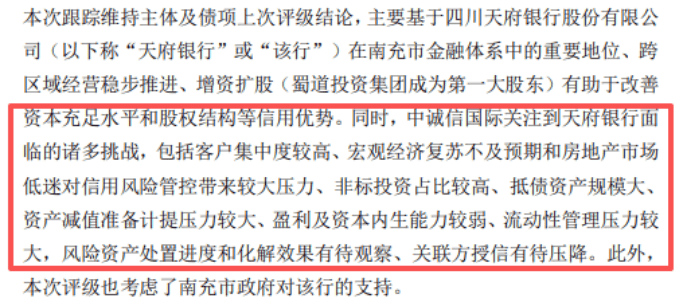
Core Viewpoint - Tianfu Bank is facing significant challenges, including a decline in performance, asset quality issues, and instability in its shareholder structure, which could impact its future operations and governance [1][2][6]. Group 1: Shareholder Structure and Capital Operations - A 10% stake in Sichuan Tianfu Financial Leasing, a subsidiary of Tianfu Bank, will be auctioned on October 18 with a starting price of 126 million yuan [1][2]. - The bank's core shareholders are under financial distress, with several among the top 12 shareholders becoming executors or facing consumption restrictions, further stressing the stability of the bank's equity structure [2][5]. - In 2024, Tianfu Bank initiated a 5 billion yuan capital increase, bringing the state-owned shareholding ratio to 55.96%, with Shudao Group becoming the largest shareholder at 23.35% [1][2]. Group 2: Financial Performance - In 2024, Tianfu Bank reported a main business revenue of 2.399 billion yuan, a year-on-year decline of 2.48%, and a net profit of 334 million yuan, down 21.60% from the previous year, marking the fourth consecutive year of revenue decline [3][4]. - The bank's total assets reached 259.968 billion yuan by the end of 2024, with a significant increase since 2010, yet net profit has decreased, indicating poor asset operational efficiency [4][6]. Group 3: Asset Quality and Regulatory Issues - As of the end of 2024, Tianfu Bank's non-performing loan (NPL) rate stood at 2.10%, significantly higher than the national average of 1.76% for city commercial banks [5][6]. - The bank has faced regulatory penalties twice within six months, highlighting internal control weaknesses across its operations, including account management and loan approval processes [5][6]. - The bank's NPL balance was 3.115 billion yuan, with a provision coverage ratio of 195.18%, indicating challenges in managing and disposing of non-performing assets [5]. Group 4: Strategic Challenges and Future Outlook - Despite ongoing capital operations, including acquiring a 43.6% stake in a village bank, the effectiveness of these moves in mitigating risks remains uncertain, especially given the bank's current financial strain and high non-performing assets [6]. - The bank's decline from a peak net profit of over 2 billion yuan in 2015 to 334 million yuan in 2024 reflects broader challenges faced by small and medium-sized city commercial banks amid market changes [6].
在“既要又要”时代,一支团队的收益“多源公式”
中国基金报· 2025-08-28 23:09
Core Viewpoint - The article emphasizes the importance of a systematic approach to achieve stable returns in a low-interest, high-volatility market environment, highlighting the need for diversified income sources and rigorous risk control [1][17]. Group 1: Investment Environment - Investors are experiencing unprecedented anxiety due to high risks in the stock market and unsatisfactory returns from financial products [1]. - The market demand has shifted, creating a new investment challenge: how to design financial products that capture excess returns while strictly controlling drawdowns [1]. Group 2: Performance of Investment Products - The article presents the performance of several products managed by Wu Jianghong's team, showcasing their ability to maintain low volatility and strong performance over time [2]. - Specific products mentioned include: - 汇添富保鑫: 近半年业绩 1.41%, 近一年业绩 3.51% [2] - 汇添富鑫享添利: 近半年业绩 2.80%, 近一年业绩 6.07% [2] - 汇添富双鑫添利: 近半年业绩 2.27%, 近一年业绩 5.65% [2] - 汇添富稳健盈和: 近半年业绩 2.57%, 近一年业绩 6.00% [2] - 汇添富实业债: 近半年业绩 4.45%, 近一年业绩 10.13% [2] Group 3: Investment Methodology - The team employs a specialized division of labor, allowing each member to focus on their area of expertise, which enhances the overall investment strategy [5][6]. - The investment approach includes pursuing a broader spectrum of alpha by diversifying income sources across various asset classes, including bonds and stocks [7]. - The team emphasizes strict control of drawdowns and risk exposure, aiming for consistent positive returns regardless of market complexity [8][9]. Group 4: Focus on Convertible Bonds - Wu Jianghong's expertise lies in convertible bonds, which are viewed as low-error-cost equity assets that provide both debt protection and equity-like flexibility [11]. - The team identifies three types of convertible bond opportunities: - Bonds with asymmetric risk-reward profiles [12]. - Undervalued bonds from high-quality companies [13]. - Bonds from cyclical growth industries [13]. Group 5: Expansion of Investment Capabilities - Wu Jianghong has expanded his investment capabilities beyond convertible bonds to include equity investments, focusing on undervalued assets across various sectors [15]. - The investment strategy emphasizes diversification not only by industry but also by factors, ensuring a balanced exposure to different market conditions [15]. Group 6: Systematic Approach to Stability - The article concludes that true "stable returns" stem from a comprehensive system that includes diversified income sources, a rigorous risk control framework, and deep asset knowledge [17].

挖槽!印度人信用低,这次是踢到钉了了!
Xin Lang Cai Jing· 2025-06-06 08:24
Group 1 - The article highlights a case of credit risk in international trade, where an Indian businessman, Anil, attempted to defraud a Chinese supplier, Chen Mo, by delaying payment after placing a large order for Bluetooth headphones [1][2] - Chen Mo had taken precautions by insuring the shipment with export credit insurance, which allowed him to initiate a claims process upon Anil's refusal to pay [1] - The legal actions taken by Chen Mo, including freezing Anil's company's bank accounts and filing a lawsuit, demonstrate the importance of having a robust risk management system in place for international transactions [1][2] Group 2 - Following the exposure of Anil's fraudulent behavior on industry forums, his e-commerce platform experienced a significant drop in order volume, leading to a loss of business partnerships and potential investments [2] - Ultimately, Anil was forced to settle the dispute by paying the full amount owed, including late fees and legal costs, resulting in the bankruptcy of his company and his blacklisting by the Indian business association [2] - Chen Mo's successful resolution of the issue not only improved his company's reputation but also attracted more high-quality clients, showcasing the benefits of effective dispute resolution in the industry [2]
