复合肥需求

Search documents
尿素2026年报:供应压制价格,出口提供驱动
Guan Tong Qi Huo· 2025-12-29 08:08
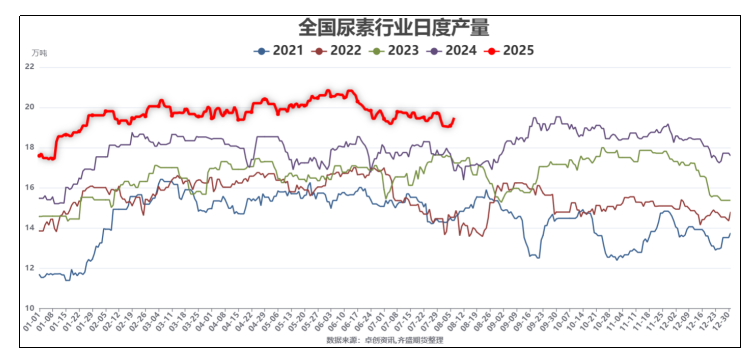
1. Report Industry Investment Rating No information provided in the content. 2. Core Viewpoints - In 2025, the high - end supply of urea suppressed its price increase, domestic demand determined the support level, and exports provided the driving force. The price showed a trend of rising first, then falling, and rising slightly at the end of the year. In 2026, due to new capacity, the supply side will still be under pressure. Exports are expected to continue to be released in the form of quotas. Agricultural demand may be advanced in the first half of the year, and the price is expected to be strong in the first half and decline in the second half, with an overall upward shift in the center of gravity [7]. - On the supply side, 5.87 million tons of new urea production capacity was put into operation in China in 2025, and 7.78 million tons are expected to be put into operation in 2026. Most of the new capacity is coal - based, and the coal - based production accounts for a high proportion. The total urea production from January to November 2025 was 65.057 million tons, a year - on - year increase of 7.82%. The coal price is expected to rise moderately in 2026, and attention should be paid to its impact on the cost support of urea [7]. - On the demand side, in terms of agricultural demand, the purchase of urea is expected to be advanced in 2026, and the total agricultural demand will maintain a year - on - year increase. The compound fertilizer factory has a high inventory, and raw material procurement is expected to be cautious. Other industrial demands related to real estate are expected to increase slightly. In terms of exports, the policy in 2026 is expected to be mainly relaxed, but in the first - half agricultural peak season, ensuring supply and stabilizing prices will be the main logic, and exports will be appropriately and limitedly liberalized [7]. 3. Summary by Directory Urea Market Review - In 2025, the urea market was affected by supply, domestic demand, and export news. The price showed a trend of rising first and then falling, with multiple pulse - like increases driven by export news. For example, in January, the market was weak due to insufficient domestic demand but rebounded due to export news; in February, the price rose due to the expectation of the spring plowing season; in May, the price declined due to the lower - than - expected export quota [12]. Urea Spot Price Trend - In 2025, the urea spot price showed a trend of rising first and then falling, and was lower than the previous year due to supply pressure. The Shandong spot price ranged from 1,550 yuan/ton to 1,900 yuan/ton. In 2026, if there is no significant change in export policy, the price is expected to continue to fluctuate at a low level [20]. Basis - The urea basis usually strengthens during the agricultural demand peak season and the reserve season and weakens during the off - season. In 2025, the annual fluctuation range was relatively small. Before June, the basis continued to strengthen, and then entered the agricultural off - season. The basis strengthened until the futures were at a premium, providing hedging opportunities for enterprises. During the winter storage period, the basis is expected to continue to strengthen, and attention should be paid to the entry opportunities of hedging goods [28]. Contango Structure - The contango structure of urea (near - term weak, long - term strong) is gradually flattening. Since the third quarter of 2025, the price of the 01 contract has continued to strengthen, and the 1 - 5 spread has weakened. With the arrival of the agricultural peak season in the coming year, the 5 - 9 spread is expected to gradually strengthen, and attention should be paid to positive spread arbitrage opportunities [33]. Urea Trading and Position - In 2025, the urea delivery volume increased significantly. From January to November, the delivery volume reached 25,700 lots, the highest in the same period in history. The addition of large - granular urea as an alternative delivery product deepened the service of futures to the real economy and facilitated the participation of upstream and downstream enterprises in delivery and futures business [39]. Supply Analysis Urea Production Capacity Investment - In 2025, 5.87 million tons of new urea production capacity was put into operation in China, and 7.78 million tons are expected to be put into operation in 2026. In the next five years, global new urea production capacity will mainly be concentrated in Latin America, Brazil, the United States, and India, with Australia adding 2 million tons [46]. Capacity Analysis - About 84% of the total production capacity has been in operation for less than 20 years. In recent years, most of the new production capacity uses the coal - water slurry process, and the fixed - bed and fluidized - bed processes are gradually being phased out. The anti - involution policy has promoted the optimization and technological upgrading of production capacity [54]. High - level Annual Production - From January to November 2025, the total urea production was 65.057 million tons, a year - on - year increase of 7.82%, and the capacity utilization rate was 84.64%, a year - on - year increase of 2.42%. The daily production was mostly around 190,000 - 200,000 tons. It is expected that the production capacity will resume in early 2026, increasing production [59]. Increasing Proportion of Coal - based Production - Seasonally, gas - based plants may reduce production in winter due to gas supply limitations, but the impact may be weakened by the increasing proportion of coal - based production. In 2025, the capacity utilization rate of gas - based plants was significantly lower than the previous year, while coal - based plants had more new investments and profits, with coal - based production accounting for about 76% [64][65]. Coal Price Trend - The production of coal - based urea is shifting from traditional high - quality anthracite to modern large - scale gasification using cheap lignite. The coal price in 2025 first decreased and then increased, and is expected to rise moderately in 2026 due to stricter policy regulation in the coking industry [72]. Natural Gas Price Trend - In 2025, the natural gas price fluctuated moderately and remained low and stable for two consecutive years due to sufficient supply and weak demand. The domestic natural gas production increased steadily, while the consumption growth rate slowed down [77]. Decent Profit of Coal - water Slurry Process - As of December 19, 2025, the profits of fixed - bed and gas - based urea production were negative, while the coal - water slurry process still had profits, but it was close to the cost line in November. The cost advantage of the coal - water slurry process will further expand the losses of fixed - bed and gas - based plants [81]. Unobvious Cost Support - Historically, the Shandong urea market price was initially benchmarked against the fixed - bed cost and later against the coal - water slurry cost. In 2025, the cost line support was weak, and the urea price mainly depended on fundamentals and export policies. With the expected increase in coal prices in 2026, attention should be paid to the cost support of urea [86]. Demand Analysis Overall Demand - Agricultural demand and compound fertilizer demand account for about 75% of the total urea demand [92]. Agricultural Demand - Urea agricultural demand is mainly concentrated in the first half of the year, with 4 - 5 months being the peak season. In 2025, due to the recovery of grain prices and low urea prices, the procurement of urea was advanced and dispersed. It is expected that the procurement will also be advanced in 2026. During the 14th Five - Year Plan period, the total agricultural demand will maintain a year - on - year increase due to the popularization of high - standard farmland and related technologies [97][99]. Compound Fertilizer Demand - In 2025, the production capacity of compound fertilizer plants continued to increase, and new capacity was characterized by technological upgrading and the expansion of leading enterprises. The production of compound fertilizers first decreased and then increased. In 2025, the cost of compound fertilizers was high, the price - difference with urea widened, and the demand for urea by compound fertilizer plants was advanced. It is expected that the demand will still be advanced in 2026 [106][121]. Real Estate - related Demand - In 2025, the real estate market was in a downturn, but the central government's economic work conference set the tone to stabilize the real estate market. It is expected that the real estate market will stop falling and stabilize in 2026 [129]. Melamine Demand - From January to November 2025, the melamine production decreased. Its demand for urea has obvious seasonal characteristics and is closely related to the real estate market. The export growth of melamine has slowed down, but China is still the world's largest producer and exporter [134]. Vehicle Urea Demand - With the advancement of emission standards, the demand for vehicle urea is increasing. Although the production and sales of diesel vehicles have declined, diesel trucks still dominate the market, and the demand for vehicle urea remains strong [139]. Thermal Power Denitrification Demand - With the replacement of new energy, the proportion of thermal power is gradually decreasing, and the demand for urea in thermal power denitrification has limited growth and is mainly stable [146]. Inventory - In 2025, the urea inventory was at a high level. Affected by the high - level supply and the advance of demand, the inventory decreased until April and then increased until December. With the support of winter storage and exports, the inventory began to decrease. It is expected that the inventory in 2026 will also start at a high level and show a seasonal "V" - shaped trend [151]. Export - In 2025, 4 batches of export quotas totaling about 4.6 million tons were issued, which repeatedly boosted the market but also caused price corrections after the release of positive news. It is expected that the export policy in 2026 will be mainly relaxed, and exports will be appropriately liberalized to solve the problem of oversupply during the non - agricultural peak season. The participation in Indian tenders has been low in recent years, and the export direction has shifted to Latin America and South America [155][157][158]. International Urea - In 2025, international urea prices were affected by gas restrictions in the Middle East and Indian tenders. There was a large price - difference between the domestic Shandong market price and the export price, and exports had large profits. The large - scale exports from China also put some pressure on international urea prices [163].
长江期货尿素周报:供求宽松,关注边际改善-20250908
Chang Jiang Qi Huo· 2025-09-08 02:53
Group 1: Report Overview - Report title: Yangtze River Futures Urea Weekly Report: Supply and Demand Loose, Pay Attention to Marginal Improvement [1] - Report date: September 8, 2025 [1] - Researcher: Zhang Ying, Practice No.: F03105021, Investment Consultation No.: Z0021335 [1] Group 2: Investment Rating - No investment rating information provided Group 3: Core View - Recently, the urea operating rate has decreased, and the daily output has dropped to 18 - 190,000 tons. Agricultural fertilizer demand is scattered, compound fertilizer finished product pick - up is poor, and the slow fertilizer preparation progress restrains the start - up. The continuous accumulation of urea enterprise inventory, the high port inventory, and the increase in the number of warehouse receipts reflect that the urea spot market has a loose supply - demand relationship. It is expected that the compound fertilizer demand will be postponed, waiting for the marginal improvement of supply and demand. Pay attention to the support at the phased price bottom, and focus on the support of 1650 - 1700 for the 01 contract [4] Group 4: Market Changes - Price: Affected by the downward adjustment of the urea spot quotation and poor sales, the support for the market expectation on the futures market weakened, and the urea price was strong first and then weak. On September 5, the closing price of the urea 2601 contract was 1,713 yuan/ton, a decrease of 33 yuan/ton from the previous week, a decline of 1.89%, and the lowest during the period was 1,706 yuan/ton. The daily average price of the urea spot in the Henan market was 1,699 yuan/ton, a decrease of 28 yuan/ton from the previous week, a decline of 1.62% [4][7] - Basis: On September 5, the main basis in the Henan market was - 14 yuan/ton, and the weekly basis operating range was (- 35) - (- 3) yuan/ton [4][10] - Spread: On September 5, the 9 - 1 spread was - 51 yuan/ton, and the weekly operating range was (- 73) - (- 50) yuan/ton [4][10] Group 5: Fundamental Changes Supply - China's urea operating load rate was 79.13%, a decrease of 2.6 percentage points from the previous week, among which the operating load rate of gas - head enterprises was 71.15%, a decrease of 0.65 percentage points from the previous week, and the daily average urea output was 182,700 tons. After the reduction or short - stop of some devices in Henan, Hebei and other places and then resumed production, and the smooth production after the commissioning of some devices in Shandong, Anhui, Xinjiang and other places, the overall operating rate decreased, and the urea supply decreased month - on - month [4][12] Cost - The trading in the anthracite market cooled down, and the price was mainly stable. As of September 4, the tax - included price of anthracite washed small lumps with S0.4 - 0.5 in Jincheng, Shanxi was 840 - 900 yuan/ton, and the tax - included price of anthracite washed lumps with S1 - 1.5 in Yangquan, Shanxi was 760 - 800 yuan/ton, both of which were flat compared with the closing price of the previous week [4][16] Demand - Agricultural demand: National agricultural demand was scattered at this stage. The average advance receipt of major urea production enterprises was 3.4 days, and the weekly production - sales rate of urea enterprises was 94.8%. Agricultural demand moderately followed up, the compound fertilizer operation was stable, and there was a bargain - hunting purchase of urea. The downstream operation of melamine and other products was generally stable, and the production and sales were stable [4][20] - Industrial demand: The capacity operation rate of compound fertilizer enterprises was 33.08%, a decrease of 6.14 percentage points from the previous week. The compound fertilizer inventory was 841,200 tons, a decrease of 26,000 tons from the previous week. During the domestic compound fertilizer sales stage, the operation of most fertilizer enterprises was relatively stable. Individual fertilizer enterprises had short - stop maintenance and would gradually resume production in the near future. It is expected that the compound fertilizer capacity operation rate may increase next week. The operating load rate of melamine enterprises was 55.11%, a decrease of 1.93 percentage points from the previous week, and the weekly output was 27,160 tons [4][24][27] Inventory - Urea enterprise inventory was 1.094 million tons, an increase of 91,000 tons from the previous week, continuing the inventory accumulation trend. Urea port inventory was 797,000 tons, an increase of 7,000 tons from the previous week, and the port inventory also remained at a high level. The number of registered urea warehouse receipts was 8,299, totaling 165,980 tons, an increase of 1,826 from the previous week, totaling 36,520 tons [4][31] Group 6: Key Points to Follow - Compound fertilizer start - up situation, urea device reduction and maintenance situation, export policy, and coal price fluctuations [4]
尿素:8月份震荡概率较大
Qi Huo Ri Bao· 2025-08-11 11:45
Group 1 - In July, urea prices experienced a spike followed by a decline due to macroeconomic factors, with expectations of maintaining volatility in August as fundamentals become crucial [1] - High supply remains the primary pressure on urea prices, with daily production exceeding 190,000 tons, marking a historical high compared to previous years [4] - As of August 7, urea enterprise inventory reached 783,000 tons, an increase of 26,000 tons from the previous week, indicating sustained high supply levels [4] Group 2 - Demand for compound fertilizers is expected to improve in August, becoming the main driver of demand as production ramps up for the autumn season, with compound fertilizer operating rates rising to approximately 34%, a 14 percentage point increase from previous lows [5] - Recent adjustments in export policies have allowed for partial exports of urea to India, with price floors set at $470/ton for small granules and $490/ton for large granules, potentially providing support to the market [6] - The raw material side remains relatively strong, with coal prices increasing from around 620 yuan/ton to 675 yuan/ton, a rise of 8.87%, which may lead to increased production costs for urea [7] - Overall, despite high supply acting as a key suppressive factor, support from raw materials, domestic demand, and exports may lead to a "top-down, bottom-up" volatile market for urea in August [7]