多物理场仿真

Search documents
——EDA行业系列报告202603期:系统级时代来临,芯和领衔国产多物理场仿真
Shenwan Hongyuan Securities· 2026-03-20 11:57
Investment Rating - The report maintains a positive outlook on the EDA industry, particularly focusing on the multi-physics simulation segment, which is expected to see significant growth due to the increasing complexity of semiconductor designs and the integration of EDA and CAE tools [1][2]. Core Insights - The EDA industry is entering a system-level era, with multi-physics simulation becoming a critical requirement as the semiconductor sector shifts towards advanced packaging and multi-die chip designs. This trend is driven by the need for enhanced performance and efficiency in AI chips, which are increasingly sensitive to physical disturbances [1][2][3]. - The report highlights that the market for EDA tools is projected to grow at a compound annual growth rate (CAGR) of 8.1% over the next five years, with the CAE sub-sector expected to grow at a much higher CAGR of 25.8% [1][2]. - Major acquisitions by leading EDA companies, such as Synopsys acquiring Ansys, Cadence's strategic mergers, and Siemens' acquisition of Altair, validate the trend towards system-level integration and the necessity for multi-physics simulation capabilities [1][2][3]. Summary by Sections 1. Multi-Physics Simulation: A Key Demand in the System-Level Era - Multi-physics simulation is essential for modeling complex systems where multiple physical fields interact, particularly in the semiconductor industry as designs become more intricate with advanced packaging technologies [8][12]. - The increasing complexity of chip designs necessitates early-stage simulations to predict potential issues, thereby reducing development costs and risks [8][12]. 2. Overseas Trends: Major Acquisitions Validate the "System-Level" Trend - Synopsys' acquisition of Ansys for $35 billion aims to enhance its multi-physics simulation capabilities, addressing the urgent need for system-level simulations in the semiconductor industry [54][55]. - Cadence is actively acquiring smaller firms to build a comprehensive multi-physics simulation portfolio, enhancing its capabilities across chip, packaging, and system levels [58][59]. 3. Domestic Trends: Chip and Semiconductor Positioning in System-Level EDA - The report emphasizes that domestic companies like Chip and Semiconductor are focusing on system-level EDA, filling gaps in the market for multi-physics simulation tools [1][2][3]. - The current landscape shows that domestic EDA companies primarily offer chip-level design tools, indicating a need for development in system-level multi-physics simulation capabilities [1][2].






EDA行业系列报告202603期:系统级时代来临,芯和领衔国产多物理场仿真
Shenwan Hongyuan Securities· 2026-03-20 10:42
Investment Rating - The report indicates a positive outlook for the EDA industry, particularly in the multi-physics simulation segment, which is expected to see significant growth due to the increasing complexity of semiconductor designs and the integration of EDA and CAE tools [1][2]. Core Insights - The EDA industry is transitioning into a system-level era, with multi-physics simulation becoming a critical requirement as semiconductor designs evolve towards advanced packaging and multi-die systems [1][2]. - The integration of EDA and CAE tools is a key trend, driven by the need for comprehensive simulation capabilities that address the complexities of modern chip designs, particularly in AI applications [1][2][3]. - The market for EDA tools is projected to grow significantly, with a CAGR of 8.1% over the next five years, and the CAE sub-segment expected to grow at a CAGR of 25.8% [1][2][3]. Summary by Sections 1. Multi-Physics Simulation: A Critical Demand in the System-Level Era - Multi-physics simulation is essential for modeling complex systems where multiple physical fields interact, particularly in the semiconductor industry as designs become more intricate [11][32]. - The shift towards multi-die systems in chip design is driven by the need for improved performance and efficiency, necessitating advanced simulation tools to predict and mitigate potential issues early in the design process [11][32]. 2. Overseas Trends: Mergers and Acquisitions Validate the "System-Level" Trend - Major EDA companies like Synopsys and Cadence are actively acquiring CAE capabilities to enhance their multi-physics simulation offerings, indicating a strong market trend towards integrated solutions [61][67]. - Synopsys' acquisition of Ansys for $35 billion exemplifies the industry's move towards comprehensive simulation platforms that cover the entire lifecycle of semiconductor design [61][63]. 3. Domestic Trends: Chip and Semiconductor Positioning in System-Level EDA - Domestic companies like Chip and Semiconductor are focusing on system-level EDA, filling gaps in the market for multi-physics simulation tools that cater to the entire design process from chip to system [1][2][3]. - The report highlights that while domestic EDA companies primarily focus on chip-level design tools, there is a growing need for capabilities that extend to system-level multi-physics simulation [1][2][3].

索辰科技:公司物理AI聚焦于多物理场仿真、物理规律驱动的智能体训练及行业级应用
Zheng Quan Ri Bao Wang· 2026-01-27 13:48
Core Viewpoint - The company focuses on physical AI, emphasizing multi-physical field simulation, physics-driven intelligent agent training, and industry-level applications, particularly in sectors like new energy batteries, embodied intelligence, and low-altitude economy [1] Group 1 - The company's physical AI is designed for virtual training applications [1] - The technology offers advantages such as autonomy, controllability, and safety customization [1]

行业聚焦:全球光学设计软件行业头部企业市场份额及排名情况(附厂商名单)
QYResearch· 2025-12-02 04:37
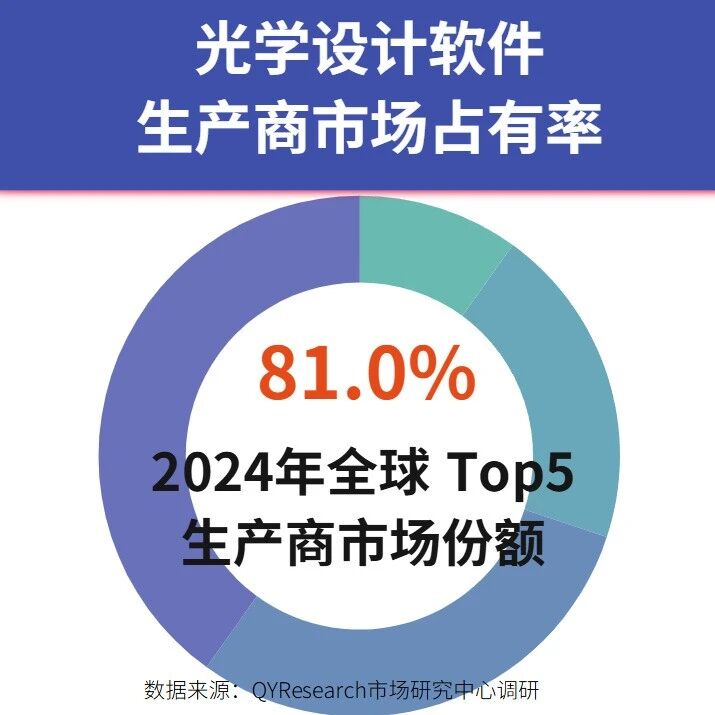
Core Insights - The global optical design software market is projected to reach $400 million by 2031, with a compound annual growth rate (CAGR) of 8.6% in the coming years [5]. - The market is characterized by a strong presence of leading manufacturers, with the top five companies holding approximately 81.0% of the market share in 2024 [9]. - The primary product type is locally deployed software, accounting for about 85.9% of the market, while optical instruments represent the main application area, capturing around 65.1% of the demand [12][14]. Market Trends - The optical design software industry is increasingly integrating with the optoelectronic sector, driven by the rapid growth in demand for high-performance optical systems in emerging fields such as 5G communication, autonomous driving, AR/VR, and biomedical imaging [17]. - Multi-physics simulation and system-level design are becoming mainstream, as future optical systems require integration of optical, thermal, structural, and electrical simulations [18]. - The adoption of intelligent and automated design optimization is accelerating, with AI technologies enabling features like automatic layout and parameter optimization, significantly reducing product development cycles [19]. - Cloud collaboration and ecosystem development are evolving, with a shift from local installations to cloud-based solutions that support multi-user collaboration and on-demand payment models [21]. Key Drivers - The demand for optical design software is expanding from traditional optical systems to comprehensive optoelectronic system designs, influenced by advancements in autonomous driving, AR/VR, and other high-tech applications [22]. - Multi-physics coupling and cross-platform collaboration are becoming standard, as applications in high-power lasers and aerospace require integrated design processes that assess the impact of various physical factors on imaging quality [23]. - The industry is increasingly leveraging intelligent optimization and automation to enhance efficiency in complex design scenarios, allowing engineers to focus on defining requirements and evaluating solutions [24]. - The transition to cloud-based deployment and the establishment of integrated service ecosystems are being driven by the need for localized support and collaboration across different regions [25]. Market Challenges - The optical design software market is characterized by high entry barriers and strong user loyalty, making it difficult for new entrants to compete with established players [26]. - There is a scarcity of skilled talent capable of utilizing optical design software effectively, which limits software utilization rates and affects renewal intentions [27]. - Localized demands coexist with competition from international giants, creating challenges for domestic software providers in meeting both global standards and local expectations [28]. - Issues related to software piracy and the need for ecosystem development are pressuring profit margins, as customers increasingly seek comprehensive solutions that combine software with databases and support services [29].

芯和代文亮博士:AI时代,要把EDA 这条“脖子”练粗
半导体行业观察· 2025-11-25 01:20
Core Viewpoint - The EDA industry is undergoing a methodological reconstruction due to the exponential increase in AI model scale and computing power requirements, transitioning from a "design tool" to the underlying operating system of AI computing systems [1][3]. Group 1: Challenges in EDA - The main challenge for domestic EDA in ensuring the autonomy of AI computing systems lies in the need to consider the entire system rather than just the chip, especially as Moore's Law becomes less applicable [3]. - The evolution of computing architecture from single chips to multi-chiplets and supernodes presents new challenges in maintaining flexibility, scalability, and high-bandwidth interconnects [4]. Group 2: Chiplet Architecture - The Chiplet design requires new verification and collaboration processes, with a two-phase approach: the first phase focuses on integrating computing and storage through a 2.5D structure, while the second phase involves hybrid bonding for 3D stacking [4]. - The integration of various components such as sensors, storage, and RF devices into a compact design necessitates multi-physical field collaborative analysis, which increases the complexity of simulation across different scales [4][6]. Group 3: System-Level Simulation - System-level simulation differs significantly from traditional EDA, as it must account for multi-physical field interactions and the potential for issues arising from high current and impedance fluctuations [5]. - Chiplet architecture offers advantages in system-level considerations, allowing for a more comprehensive approach to design and integration [5]. Group 4: AI Integration in EDA - The strategy of "EDA for AI" focuses on providing comprehensive solutions from chip design to system integration, addressing the challenges posed by AI's increasing computational demands [10]. - The "AI + EDA" strategy aims to integrate AI models into the design and simulation processes, significantly enhancing efficiency and enabling a shift from rule-driven to data-driven design approaches [12]. Group 5: Future Outlook - The future of EDA in the AI era is characterized by cross-scale, cross-physical, and cross-system engineering, with expectations for more domestic design tools to become practical and for system-level issues to be resolved during the simulation phase [14]. - The company is positioned as a key player in this transformation, leveraging advancements in Chiplet technology, supernodes, and AI factories to enhance the stability and power of AI computing infrastructure [14].