
存储架构

Search documents
英伟达,收尽天下之存储
新财富· 2026-03-09 08:16
Core Viewpoint - Nvidia is positioning itself to potentially become one of the largest storage companies globally by redefining storage systems for its partners, rather than just producing storage chips [2][3]. Group 1: AI and Storage Evolution - The AI race has shifted focus from sheer computational power to addressing the new bottleneck of memory capacity and bandwidth, particularly for handling large amounts of intermediate states in AI processing [5]. - Nvidia's new Rubin architecture introduces a "context memory storage platform" based on BlueField-4 DPU, which aims to revolutionize the storage industry by creating a new storage layer [7][10]. - The Vera Rubin NVL72 rack features four BlueField-4 DPUs managing a dedicated 150TB context memory pool, which serves as a "warm data" layer between GPU's HBM and traditional cold storage [7][10]. Group 2: Storage Architecture Changes - The new architecture allows for a significant increase in effective memory for each GPU, reaching up to 20TB, which is nearly a 200% increase compared to the previous Blackwell architecture [10]. - The three-tier storage system introduced by Nvidia includes HBM4 for hot data, DRAM for warm data, and the context memory storage platform (ICMS) for efficiently storing large KV caches [16][17]. - The ICMS platform reduces the cost of token generation for MoE models to one-tenth of previous costs and enhances inference performance by five times [20]. Group 3: Market Impact and Future Trends - The transformation of NAND flash from a cold storage solution to a critical component in real-time inference calculations will elevate its value and performance requirements [16]. - The demand for NAND due to the new architecture could lead to a significant increase in the overall NAND market, with Nvidia's deployment potentially adding over 115EB of NAND demand [21]. - The shift in storage dynamics is expected to drive a structural upgrade across the entire storage industry, making NAND storage a core hardware component for AI inference [26][27].


海力士+闪迪,存储芯片巨头力推 HBF 标准化
3 6 Ke· 2026-02-27 02:56
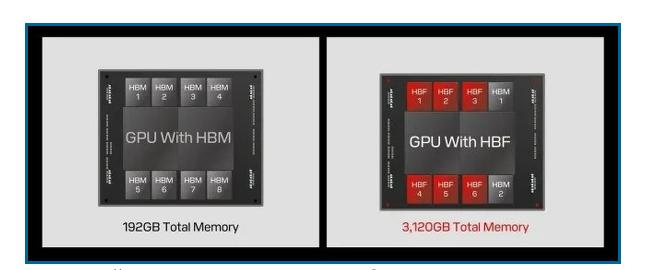
Core Viewpoint - The emergence of High Bandwidth Flash (HBF) technology is accelerating commercialization, aiming to fill the storage gap in AI inference, while existing technologies like HBM continue to evolve [1][2]. Group 1: HBF Technology Overview - HBF is not a new concept but is derived from the transition in the AI industry from training to large-scale inference, addressing the storage bottleneck in current architectures [2]. - HBF aims to provide a solution that combines high bandwidth, large capacity, and cost-effectiveness, bridging the gap between HBM's limited capacity and SSD's slower read/write speeds [2][3]. - HBF utilizes a restructured architecture and packaging optimization, incorporating 3D stacking technology from HBM and replacing storage media with NAND flash, achieving high-speed data transfer while retaining NAND's advantages [3]. Group 2: HBF and HBM Collaboration - HBF is designed to complement HBM rather than replace it, with HBM handling latency-sensitive tasks and HBF focusing on large-capacity sequential reads [4]. - The "H3 hybrid architecture" by SK Hynix demonstrates the synergy between HBM and HBF, showing significant performance improvements in various scenarios [4]. Group 3: Industry Response and Future Outlook - Major storage companies, including SK Hynix and SanDisk, are actively investing in HBF, with SanDisk being the pioneer in its commercialization [6]. - The establishment of a dedicated working group under the Open Compute Project (OCP) will facilitate the standardization of HBF technology, paving the way for its widespread adoption [6]. - HBF products are expected to be showcased by late 2026, with market demand projected to grow rapidly by 2030, driven by the expansion of AI inference applications [6]. Group 4: Challenges Ahead - Despite its promising outlook, HBF still faces inherent limitations related to NAND flash's slower write speeds, which could impact user experience in dynamic caching scenarios [7]. - Industry collaboration is necessary to address compatibility with existing GPU architectures, packaging complexity, and thermal management issues [7].
SK海力士联手闪迪,启动HBF标准化,容量碾压HBM 10倍!
Hua Er Jie Jian Wen· 2026-02-26 07:41
Core Insights - SK Hynix and SanDisk are collaborating to advance the global standardization of High Bandwidth Flash (HBF), positioned as a key solution to bridge the gap between HBM and SSD in the AI inference era [1] - The establishment of a dedicated working group under the Open Compute Project (OCP) framework marks a significant step in the competitive landscape of next-generation storage architecture [1][3] Group 1: HBF Technology Overview - HBF is designed to fill the storage hierarchy gap between ultra-fast HBM and high-capacity SSD, addressing the structural contradictions in existing storage architectures for AI services [2] - HBF offers approximately 10 times the storage capacity of HBM while maintaining high bandwidth, making it suitable for AI inference workloads [2] - The technology is expected to enhance the scalability of AI systems and potentially lower total cost of ownership (TCO) [2] Group 2: Industry Collaboration and Standardization - The collaboration between SK Hynix and SanDisk is based on their expertise in HBM and NAND design, packaging, and mass production [3] - The OCP serves as a widely recognized platform for advancing HBF standardization, transitioning from bilateral agreements to broader industry collaboration [3] - The goal is to launch HBF products by 2027, with the potential for HBF to become an industry standard that supports the growth of the AI ecosystem [3] Group 3: Market Outlook - Demand for HBF solutions is expected to accelerate around 2030, with long-term market potential projected to surpass that of HBM by approximately 2038 [4][5] - The commercialization cycle for HBF is anticipated to be shorter than that of HBM, driven by the growing AI workload and the shift from training to inference phases [4] - Companies that can provide both HBM and HBF solutions are likely to gain strategic advantages in the emerging market expected to see significant demand growth [5]