
存款保险制度

Search documents
21家系统重要性银行名单出炉!钱未存在这些银行里,有危险吗?
Sou Hu Cai Jing· 2026-02-14 09:50
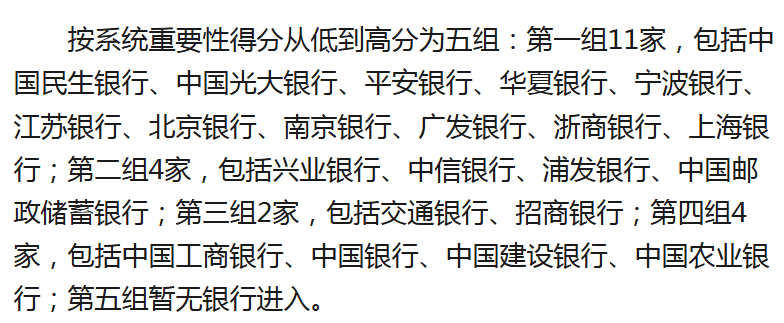
Core Viewpoint - The People's Bank of China has officially released the latest list of 21 systemically important banks, which excludes the central bank and three policy banks, highlighting the significance of commercial banks in this classification [1] Group 1: Systemically Important Banks - A total of 21 commercial banks have been classified into four tiers based on their importance, with the top tier consisting of the four major state-owned banks: Industrial and Commercial Bank of China, Agricultural Bank of China, Bank of China, and China Construction Bank [1] - The first tier includes 11 banks such as Minsheng Bank and Shanghai Bank, representing the lowest level of importance [1] - The second tier includes four banks: Industrial Bank, China CITIC Bank, Shanghai Pudong Development Bank, and Postal Savings Bank [1] - The third tier consists of China Communications Bank and China Merchants Bank, while the fifth tier currently has no banks included [1] Group 2: Market Implications - Systemically important banks account for less than 0.5% of the total 4,425 banking institutions in China, emphasizing their unique status and the potential impact on the financial system if any of them face operational risks [2] - Depositors can consider these 21 banks as a safe choice for their funds, as even the lowest tier banks benefit from implicit backing by the central bank, ensuring high security for depositors [2] Group 3: Non-Systemically Important Banks - The over 4,000 non-systemically important banks should not be viewed solely as high-risk; there is a significant size differentiation among them [4] - Some regional banks, like Shanghai Rural Commercial Bank and Chengdu Bank, have successfully listed and maintain a market value above 50 billion, indicating that not all non-systemically important banks are small or risky [5] Group 4: Deposit Insurance System - The deposit insurance system implemented in 2020 provides basic protection for depositors, ensuring that deposits up to 500,000 yuan will be fully compensated in the event of a bank failure [7] - For amounts exceeding 500,000 yuan, compensation will depend on the bankruptcy liquidation process, which may not guarantee full recovery [7] - Depositors are advised to diversify their risks by splitting large deposits across multiple accounts to stay within the insurance limit [9] Group 5: Recommendations for Depositors - To maximize safety, depositors should ensure they are dealing with legitimate banks and not non-bank financial institutions, and should confirm that their financial products are savings-related rather than investment products [9] - By following the principles of selecting the right institutions, recognizing appropriate products, and employing account splitting strategies, depositors can effectively safeguard their funds while optimizing returns [11]

法治科普|存款保险制度,存款人的“安全防护网”
Xin Lang Cai Jing· 2026-02-03 12:52
Core Viewpoint - The deposit insurance system serves as a crucial protective mechanism for ordinary depositors, establishing a safety net for deposit security in the financial market [1][6]. Group 1: Overview of Deposit Insurance System - The deposit insurance system, also known as the deposit guarantee system, protects depositors' interests, maintains bank credit, and stabilizes the financial order. It requires deposit-taking financial institutions to pay insurance premiums based on the amount of deposits they accept [3][8]. - In the event of a financial institution facing operational issues, the deposit insurance agency compensates depositors for insured deposits, thereby assuming the responsibility of paying statutory insurance [3][8]. - Over 110 countries and regions worldwide have established deposit insurance systems, highlighting its global significance [3][8]. Group 2: Regulatory Framework in China - China's deposit insurance system is mandatory and covers all legally established deposit-taking financial institutions, including commercial banks, rural cooperative banks, and credit cooperatives [3][8]. - Foreign banks' branches in China and domestic banks' overseas branches are generally excluded from deposit insurance unless otherwise arranged with other countries or regions [3][8]. Group 3: Value of Deposit Insurance System - The system enhances depositor protection by providing a clear legislative framework through the Deposit Insurance Regulations, which strengthens market constraints on financial institutions and stabilizes public confidence in the banking system [3][8]. - It is a key component of the financial safety net, complementing the central bank's role as the lender of last resort and enhancing the overall effectiveness of financial stability and regulatory oversight [3][8]. - The deposit insurance system supports the reform and development of small and private banks, facilitating their healthy growth and increasing financial support for small and micro enterprises [3][8]. Group 4: Risk Management Mechanism - China's deposit insurance system employs a risk minimization model, incorporating functions such as information collection, on-site verification, risk warning, early correction, and risk disposal [4][9]. - It implements differentiated risk premiums, encouraging prudent management among banks through a system of rewards and penalties based on their risk levels [4][9]. - The risk control mechanism effectively strengthens the safety net for public deposits and supports the stable operation of the financial system [4][9].

2月2日|金融小知识:存款保险制度,存款人的“安全防护网”
Xin Lang Cai Jing· 2026-02-02 10:51
Core Viewpoint - The deposit insurance system serves as a crucial protective mechanism for ordinary depositors, establishing a safety net for deposit security through institutional arrangements [1][5]. Group 1: Definition and Functionality - The deposit insurance system, also known as the deposit guarantee system, protects depositors' interests, maintains bank credit, and stabilizes the financial order. It requires deposit-taking financial institutions to pay insurance premiums based on the amount of deposits they accept [3][7]. - In the event of a financial institution facing operational issues, the deposit insurance agency compensates depositors for insured deposits, thereby assuming the responsibility of paying statutory insurance [3][7]. - Over 110 countries and regions worldwide have established deposit insurance systems, highlighting its global significance [3][7]. Group 2: Regulatory Framework - The deposit insurance system in China is mandatory and covers all legally established deposit-taking financial institutions, including commercial banks, rural cooperative banks, and credit cooperatives [3][7]. - Foreign banks' branches in China and domestic banks' overseas branches are generally excluded from deposit insurance, unless otherwise arranged with specific countries or regions [3][7]. Group 3: Importance and Value - The system enhances depositor protection by providing a clear legislative guarantee for public deposit safety, thereby reinforcing market constraints on financial institutions and stabilizing public confidence in the banking system [3][7]. - It is a key component of the financial safety net, complementing the central bank's role as the lender of last resort and enhancing the overall effectiveness of financial stability and regulatory efforts [3][7]. - The deposit insurance system supports the reform and development of small and private banks, facilitating their healthy growth and increasing financial support for small and micro enterprises [3][7]. Group 4: Risk Management Mechanism - China's deposit insurance system employs a risk minimization model, incorporating functions such as information collection, on-site verification, risk warning, early correction, and risk disposal [4][8]. - It implements differentiated risk-based premium rates, incentivizing prudent management among banks through a system of rewards and penalties based on their risk levels [4][8]. - The risk control mechanism effectively strengthens the safety net for public deposits and provides robust support for the stable operation of the financial system [4][9].

2家银行已经宣布倒闭,存款取不出来?建议储户记住这2点,放心存钱
Sou Hu Cai Jing· 2026-01-22 04:46
Core Viewpoint - The article discusses the establishment and effectiveness of China's deposit insurance system, which provides a safety net for depositors and addresses concerns about potential bank failures [1][12]. Group 1: Deposit Insurance System Overview - The deposit insurance system in China was officially established with the implementation of the "Deposit Insurance Regulations" on May 1, 2015, replacing the implicit insurance system that lacked clarity [3]. - The system guarantees full compensation for deposits up to 500,000 yuan per depositor in the same bank, covering 99.6% of depositors [3][4]. - As of June 2025, there are 3,554 insured institutions, including commercial banks, rural commercial banks, and credit cooperatives, indicating a broad coverage [3]. Group 2: Compensation Mechanism - In the event of a bank failure, the deposit insurance fund management must compensate depositors within seven working days [3]. - For deposits exceeding 500,000 yuan, compensation is based on the bank's liquidation assets, with historical cases showing that large depositors often receive a significant portion of their funds back [4]. Group 3: Exclusions from Coverage - Certain funds are not protected under the deposit insurance system, including bank-sold wealth management products, funds, and insurance products, which are considered investment products [5][7]. - Interbank deposits and deposits from bank executives are also excluded from the insurance coverage [7]. Group 4: Risk Management and Recommendations - The probability of bank failures is low due to stringent financial regulations and risk management practices in place [8]. - It is advised to diversify deposits across multiple banks to maximize insurance coverage and minimize risk exposure [9]. - Maintaining awareness of the financial health of banks and understanding the distinction between deposits and investment products is crucial for depositors [10][12].

从数字现金升级为数字存款货币 数字人民币存款利息如何计算(政策解读)
Ren Min Ri Bao· 2026-01-18 22:05
Core Viewpoint - The upgrade of the digital renminbi to version 2.0, effective from January 1, transforms it from digital cash to digital deposit currency, allowing users to earn interest on their wallet balances [1][2]. Group 1: User Impact - The most direct change for individual users is that the balance in their digital renminbi wallets can now earn interest, calculated at the prevailing savings rate for real-name wallets [2]. - Interest will be credited quarterly on specific dates, and users can check their interest amounts through the digital renminbi application [2]. - Only real-name wallets (categories one, two, and three) will earn interest, while category four wallets will not [3]. Group 2: Security and Advantages - Digital renminbi balances are covered by the deposit insurance system, providing the same level of security as traditional bank deposits [4]. - The digital renminbi incorporates advanced digital technology, allowing for secure transactions and the use of smart contracts [4]. - The dual-layer operational framework ensures that digital renminbi is integrated into the banking system without disrupting traditional banking operations [6]. Group 3: Operational Framework - The new digital renminbi framework aims to meet the evolving needs of the digital economy and enhance the management and service capabilities of the digital currency [5][6]. - The digital renminbi will be included in the banks' balance sheets, allowing banks to manage these assets effectively [6]. - The operational structure clarifies the responsibilities and rights of the institutions involved, promoting financial stability [6]. Group 4: Adoption and Usage - As of now, there are 230 million personal digital renminbi wallets opened, indicating significant user adoption [8]. - The digital renminbi is designed to function as a modern digital payment and circulation method, compatible with distributed ledger technology [8]. - By the end of 2025, the trial regions are expected to have processed transactions amounting to 19.5 trillion yuan, with a significant portion of cross-border payments conducted in digital renminbi [8].

3家银行已经倒闭了,存的钱取不出来?建议储户了解这2点,存款才放心
Sou Hu Cai Jing· 2026-01-13 06:07
Core Viewpoint - The article emphasizes the importance of understanding the deposit insurance system to alleviate concerns about bank failures and the safety of deposits [1][6][11]. Group 1: Deposit Insurance System - The deposit insurance system protects depositors by compensating them within a certain limit if a bank fails, ensuring that most ordinary depositors are covered [1][3][10]. - The insurance fund is managed by a dedicated institution, which guarantees that eligible depositors can recover their funds in case of a bank's issues [3][8][10]. - The existence of this system enhances the stability of the financial system by preventing panic withdrawals during bank crises [8][10]. Group 2: Key Considerations for Depositors - Depositors should be aware of the insurance coverage limit and consider diversifying their deposits across different banks to stay within the insured amount [3][4][11]. - It is crucial to choose reputable financial institutions, as not all entities are covered by the deposit insurance, particularly illegal or unregulated platforms [4][6][11]. - The article advises against being lured by high-interest rates from non-regulated financial products, as they often carry significant risks [4][11][12]. Group 3: Financial Environment and Regulation - The current financial regulatory environment is stricter, with enhanced risk control and transparency, reducing the likelihood of bank failures compared to the past [10][12]. - The deposit insurance fund is sustained by premiums paid by banks, ensuring that the burden does not fall on depositors [10][12]. - The accumulation of the deposit insurance fund indicates its effective operation and readiness to support depositors in extreme situations [10][12].

邮储银行郑州市分行多维度开展金融知识普及活动
Huan Qiu Wang· 2026-01-09 04:17
Core Viewpoint - Postal Savings Bank of China Zhengzhou Branch is actively promoting public awareness of the deposit insurance system to protect depositors' rights and interests through various outreach activities [1][2] Group 1: Promotional Activities - The bank is utilizing LED screens at branches to display key slogans and is broadcasting engaging educational videos about deposit insurance on television [1] - Staff members are proactively explaining the coverage and compensation limits of deposit insurance to customers during their visits [1] - The bank integrates deposit insurance knowledge into events like "Wealth Weekly Talks" and "Financial Salons," using interactive methods such as quizzes and case studies to enhance understanding in a relaxed environment [1] Group 2: Community Engagement - A promotional team is conducting outreach in rural areas, communities, schools, enterprises, and government agencies to ensure targeted coverage of key demographics [1] - The bank focuses on areas with a high concentration of elderly individuals, utilizing large print, local dialects, and audio materials to effectively communicate the deposit insurance message [1] Group 3: Online Promotion - The bank is exploring popular online methods for publicizing deposit insurance, including short videos, skits, and catchy phrases to clearly convey the information [1] - Various online channels are being used to disseminate deposit insurance knowledge, expanding the reach of the campaign beyond physical locations [1] Group 4: Future Plans - The bank plans to continue its deposit insurance promotion efforts and establish a regular education mechanism to enhance financial services and broaden outreach [2] - The goal is to ensure that deposit insurance knowledge reaches every household, contributing to local financial stability [2]

4家银行已宣布倒闭了,存款取不出来了?储户必须了解这2点,存款更放心
Sou Hu Cai Jing· 2026-01-06 07:47
Core Viewpoint - The safety of banks and the protection of depositors' funds are critical concerns, especially in light of recent issues faced by some banks. However, the situation is more complex than it appears, and there are mechanisms in place to protect depositors [1][10]. Group 1: Bank Risk and Regulatory Measures - The safety of deposits primarily depends on the risk profile of the bank and the protective measures established by the government [3]. - Financial regulatory agencies have stringent requirements for banks, including regular audits and risk assessments, to identify and address issues early [3]. - Even banks facing difficulties can survive through strategic investments, asset restructuring, and government intervention, as systemic risks can have widespread impacts [3][10]. Group 2: Deposit Insurance System - Since 2015, a deposit insurance system has been established, protecting depositors up to 500,000 yuan per bank [4]. - This insurance is automatically activated when deposits are made in participating banks, ensuring that depositors do not need to apply for coverage [6]. - The average household savings in China are below this threshold, meaning that over 90% of ordinary depositors are adequately protected [4]. Group 3: Information Transparency and Access - Many depositor concerns stem from information asymmetry; knowing where to find reliable information can alleviate fears [8]. - Regulatory bodies like the China Banking and Insurance Regulatory Commission regularly publish risk alerts and updates, providing transparency [8]. - Banks, especially publicly listed ones, are required to disclose financial reports, which serve as indicators of their health and stability [8]. Group 4: Financial Literacy and Management - Depositors who are unaware of their savings situation are more susceptible to panic during financial news [9]. - It is advisable for depositors to check their savings status and consider diversifying their deposits across multiple banks to maximize insurance coverage [5][9]. - Understanding the deposit insurance system and staying informed through official channels can empower depositors to manage their assets more effectively [12].
储户快要坐不住了?存款新政迎来4大变化,有存款的人该怎么办?
Sou Hu Cai Jing· 2025-12-20 17:52
Core Viewpoint - The banking environment is undergoing significant changes that affect how depositors view their savings and investment options, leading to a shift from traditional savings to more diversified financial products [1][12]. Group 1: Changes in Deposit Insurance and Banking Structure - The adjustment of the deposit insurance system indicates that while deposits are protected up to a certain limit, amounts exceeding this limit are at risk if a bank fails, prompting depositors to diversify their savings across multiple banks [2][4]. - The increase in the number of small and medium-sized banks dilutes the dominance of large banks, requiring depositors to be more discerning in their choices, as smaller banks may offer higher interest rates but come with increased risks [4][5]. Group 2: Interest Rate Trends and New Banking Products - Interest rates for fixed-term deposits are on a downward trend, with significant reductions observed in long-term deposits, reflecting a shift in banks' strategies to prioritize lending over attracting deposits [5][12]. - Banks are introducing a variety of new financial products, such as structured deposits and investment funds, to attract deposits, which often promise higher returns but also come with increased risks and complex terms [5][11]. Group 3: Strategies for Depositors - Depositors are encouraged to take a proactive approach to managing their funds, including assessing their financial situation, understanding their risk tolerance, and diversifying their investments across different banks and products [7][8][12]. - A gradual adjustment strategy is recommended, where depositors can start by allocating a small portion of their funds to new products to gauge their effectiveness before committing larger amounts [11][12].

【环球财经】土耳其2026年将提高银行存款国家保障上限至120万里拉
Xin Hua Cai Jing· 2025-12-16 09:13
Core Viewpoint - Turkey will increase the state guarantee limit for bank deposits from 950,000 lira to 1,200,000 lira starting in 2026, enhancing protection for depositors in case of bank insolvency [1] Group 1: Deposit Insurance Adjustment - The adjustment applies to both interest-bearing and non-interest-bearing accounts, including those operating under Islamic finance principles [1] - The increase in the guarantee limit means a larger proportion of individual account deposits will be protected during a bank's repayment crisis [1] - This adjustment is part of an annual routine revision based on inflation changes [1] Group 2: Current Banking Landscape - As of December 5, Turkey's banking system has a total deposit scale of 26.81 trillion lira, with local currency deposits amounting to 14.53 trillion lira [1] - Foreign currency deposits are approximately 249.4 billion USD, with resident foreign currency deposits totaling 212 billion USD [1]