
学习型社会建设

Search documents
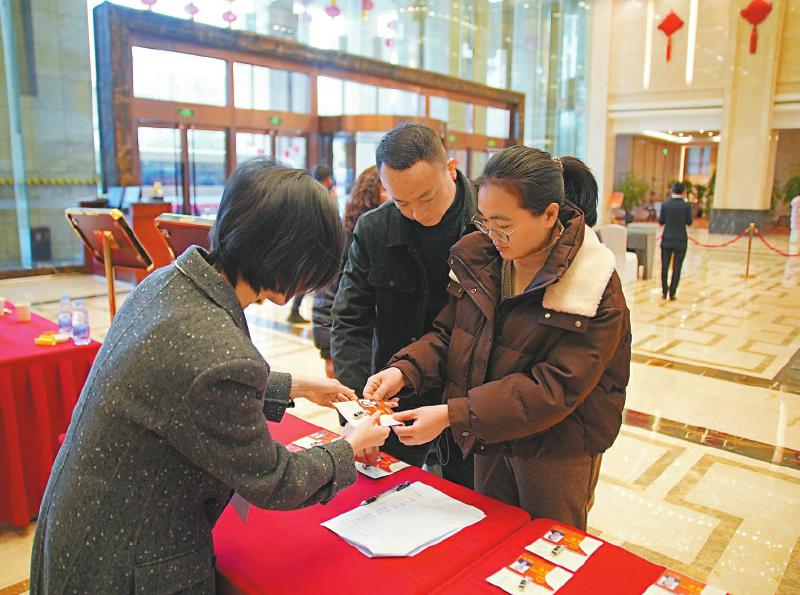
省人大代表政协委员基本报到完毕
Xin Lang Cai Jing· 2026-02-01 22:23
Group 1 - The provincial representatives have arrived at the venue for the 14th Provincial People's Congress, with all representatives reported by 10 PM on February 1 [2] - Representatives have conducted grassroots research to understand key issues and will transform these insights into proposals and suggestions for the meeting [3] - There is a strong focus on education, with representatives bringing forward suggestions such as establishing a systematic family education support system to benefit children's growth [3] Group 2 - The provincial committee members have also completed their registration by 10 PM on February 1, indicating readiness for the upcoming session [4] - Committee members are engaging in discussions about their proposals, emphasizing the importance of addressing issues like elderly education and community education to promote a learning society [4] - There is a collective commitment among committee members to represent the voices and concerns of the public, aiming to contribute effectively to the governance and development of the province [4]

学分银行扩大应用试点范围
Xin Lang Cai Jing· 2026-01-12 20:06
Core Points - The Beijing Municipal Education Commission has announced the "Interim Measures for Credit Recognition and Conversion of the Beijing Credit Bank," aiming to expand the application pilot scope of the credit bank and enhance the recognition, accumulation, and conversion of various learning outcomes, thereby supporting lifelong education and the construction of a learning society [1] Group 1 - The pilot will prioritize areas with a shortage of professionals or urgent recognition and conversion needs for learning outcomes [1] - The Beijing Credit Bank system has established over 2.03 million lifelong learning accounts for citizens, storing more than 6.34 million learning outcomes [1] - Pilot projects include elderly education, non-degree education training results stored in the credit bank, and course sharing and credit conversion between vocational colleges and higher education institutions [1] Group 2 - The newly announced measures apply mainly to credit recognition and conversion services for continuing education by credit bank service units, with non-degree education also being referenced [2] - Recognized learning outcomes will include three components: credit value, level, and category, with credit value based on the necessary social learning time [2] - The conversion of credits will generally not exceed 50% of the total credits required for graduation in the relevant major, and the same learning outcome cannot be converted multiple times [2]
更好满足老年群体精神文化需求 促进老年教育高质量发展
Ren Min Ri Bao· 2025-11-25 23:02
Core Viewpoint - The article emphasizes the importance of high-quality elderly education as a crucial support for ensuring a fulfilling, progressive, and enjoyable life for the elderly population in China, which is rapidly growing due to aging demographics [2][3]. Group 1: Importance of Elderly Education - Elderly education is essential for enhancing the quality of life for over 310 million elderly individuals in China, representing 22% of the total population by the end of 2024 [2]. - Promoting high-quality elderly education is vital for addressing the challenges of an aging population and transforming the demographic pressure into a human resource dividend [2][3]. - The development of elderly education is a key measure to ensure lifelong learning for all and to improve the modern education governance system [2][4]. Group 2: Policy and Institutional Framework - The article calls for a robust institutional framework to support the development of elderly education, including the establishment of specific regulations and responsibilities for various levels of government [4][5]. - It highlights the need for a comprehensive elderly education service system that covers urban and rural areas, ensuring accessibility and inclusivity [4][5]. Group 3: Collaborative Efforts and Resource Allocation - The article advocates for mobilizing social forces, including universities, vocational schools, and community organizations, to participate in elderly education [5][6]. - It suggests optimizing resource allocation to ensure that quality educational services reach grassroots levels, particularly in rural and remote areas [5][6]. Group 4: Educational Content and Methodology - The article stresses the importance of a balanced educational approach that includes moral, intellectual, and physical development, catering to the interests and learning patterns of the elderly [6][7]. - It proposes the establishment of a certification system for elderly learners to enhance their motivation and sense of achievement in lifelong learning [6][7]. Group 5: Integration with Social and Economic Development - The article encourages the integration of elderly education with the silver economy, promoting projects that combine health management and elderly services [7]. - It emphasizes the role of elderly education in fostering community engagement and volunteerism, allowing seniors to contribute to society while enhancing their own sense of purpose [7].
德州入选全国学习型城市网络城市
Qi Lu Wan Bao· 2025-08-14 21:35
Group 1 - The core viewpoint of the article highlights that Dezhou has been successfully included in the second batch of national learning city networks, marking a significant step in building a lifelong learning education system and advancing the construction of a learning society [1] - The national learning city network is an important initiative to implement the national strategy for building a learning society, aiming to promote universal and lifelong learning [1] - As of now, the number of cities in the national learning city network has increased to 126, with Shandong province having 8 cities selected, ranking among the top in the country [1] Group 2 - Dezhou plans to follow principles of "government coordination, complementary advantages, division of responsibilities, and collaborative promotion" to develop an implementation plan for building a learning city [2] - The city aims to refine work tasks and improve the promotion mechanism for building a learning city, leveraging digital empowerment to advance various initiatives [2] - This initiative is expected to inject new momentum into the city's civilization construction and high-quality development [2]
引新枝竞发 成蔚然之势
Huan Qiu Wang· 2025-06-30 00:55
Group 1: Core Perspectives - The construction of a strong education system requires systematic leaps and qualitative changes at both macro and micro levels [1] - Key issues must be addressed by gathering resources such as policies and funding to build a superior ecosystem [1] Group 2: Higher Education Technology Transfer - The Ministry of Education held a national meeting to promote the construction of regional technology transfer centers in universities [3] - Successful integration of technological and industrial innovation relies on strong universities, capable entrepreneurs, and financial support [3] - The first regional center in Jiangsu has demonstrated significant results in gathering various innovation elements and has set a precedent for future centers [3] Group 3: Educational Digitalization - The Ministry of Education emphasized the need for a new learning ecosystem that promotes lifelong learning through collaboration among schools, families, and society [4] - A successful learning society requires sufficient resource supply, convenient learning environments, and comprehensive incentive mechanisms [4] - The educational digitalization strategy is advancing through iterative processes, achieving significant progress in ecosystem integration [4] Group 4: Overall Education Reform - The acceleration of building a strong education system highlights the importance of organized integration and effective mechanism design [5] - There is a need to study non-educational factors that contribute to educational reform and to establish efficient systems and mechanisms [5]