宏观多资产策略

Search documents
马年开工!左手抗风险,右手抓超额
Xin Lang Cai Jing· 2026-02-24 11:06
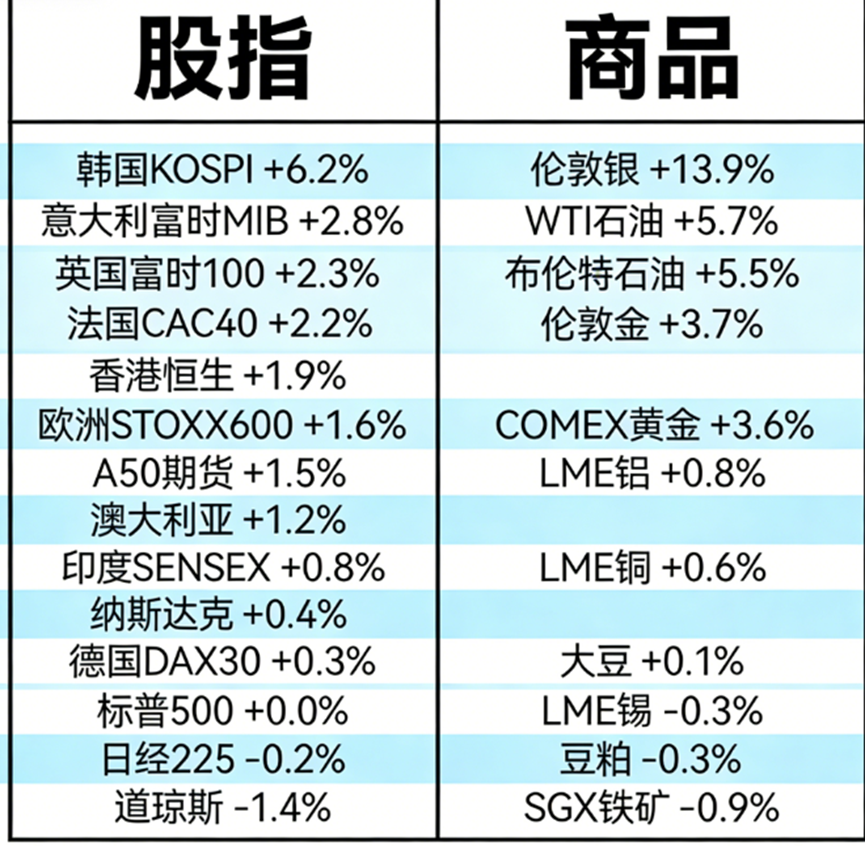
Global Market Performance - The U.S. Supreme Court ruled that the previous global tariffs imposed by the Trump administration were unconstitutional, leading to the cancellation of over $160 billion in tariffs, which could allow companies to claim refunds [1] - Following this, Trump announced a temporary 10% tariff on global goods, which was raised to 15% shortly after, set to take effect on February 24 [1] - The geopolitical tensions between the U.S. and Iran, along with the tariff fluctuations, contributed to a significant rise in gold prices, with international spot gold increasing nearly 6% over four days [1] Stock Market Performance - The South Korean KOSPI index surged by 6.2%, driven by strong performances in the semiconductor and AI sectors, with major companies like Samsung Electronics and SK Hynix reaching new highs [2] - European stock indices also saw gains, with France's CAC40 up 2.23%, the UK's FTSE 100 up 2.28%, and Germany's DAX up 0.31%, supported by economic recovery expectations and rising energy prices [2] - U.S. stock markets exhibited mixed results, with the Nasdaq up 0.36%, the S&P 500 nearly flat, and the Dow Jones down 1.4%, reflecting differing views on the U.S. economic recovery [2] Hong Kong Market Performance - The Hang Seng Index rose by 1.94%, aligning with the global stock market trends, while the Hang Seng Tech Index showed resilience with a slight increase of 0.47 [3] - The index experienced fluctuations during the holiday period, with a notable drop of 2.91% on February 20, followed by a rebound of 3.34% on February 23, driven by semiconductor and internet stocks [3] Commodity Market Performance - The commodity market emerged as the biggest winner during the holiday, particularly in precious metals and energy sectors, with silver prices soaring by 13.9% and gold prices increasing by 3.6% [4][14] - WTI crude oil rose by 5.57% and Brent crude by 5.5%, influenced by geopolitical tensions and OPEC+ maintaining production cuts, which raised concerns over energy supply [4][15] - Other commodities showed mixed performance, with LME aluminum up 0.8% and copper up 0.6%, while some commodities like LME tin and soybean meal experienced slight declines [5][15] Film Industry Performance - The 2026 Spring Festival box office totaled 5.752 billion yuan, marking a nearly 40% decline compared to the previous year, indicating a cooling trend in consumer sentiment [6][17] - The average daily box office fell below 1 billion yuan, reflecting a significant drop in performance during what is typically a peak season for the film industry [7][17] - The top film, "Fast Life 3," grossed 2.927 billion yuan, but overall performance was disappointing compared to previous years [8][18] Investment Insights - The investment landscape has shifted, emphasizing the importance of core assets and strategic allocation to navigate market cycles effectively [9][19] - Precious metals, particularly gold, are highlighted for their long-term investment value due to their safe-haven attributes and industrial demand [9][19] - The CTA strategy is gaining traction as a risk management tool, providing diversification and the ability to hedge against geopolitical and inflationary risks [10][20]

高手,是怎么玩转黄金的?
雪球· 2026-01-06 08:46
Core Viewpoint - Gold has emerged as the strongest asset of the year, with a price increase from below 2800 to over 4300, representing a year-to-date growth of over 50% [2][3]. Group 1: Gold's Role in the Market - Gold plays three roles in the market: as a commodity, currency, and investment [5]. - As a commodity, gold prices are driven by supply and demand dynamics, particularly influenced by central bank purchases and jewelry consumption [7]. - As a currency, gold prices typically move inversely to the US dollar index, meaning that a weaker dollar leads to higher gold prices [9][13]. - As an investment, gold's value is compared against other asset classes, and its opportunity cost is considered when evaluating potential returns from other investments [15][16][19]. Group 2: Investment Strategies in Gold - Private equity managers can leverage gold investments through three main strategies: subjective long strategies, macro multi-asset strategies, and CTA strategies [23]. - Subjective long strategies involve managers making investment decisions based on the current market value of gold, often focusing on its currency attributes during periods of weak dollar and low interest rates [25]. - Macro multi-asset strategies view gold as part of a broader asset allocation, using it to hedge against risks in other assets like stocks and bonds [33][37]. - CTA strategies focus on price movements without delving into fundamental analysis, using quantitative models to respond to market trends and relative strength among commodities [45][55]. Group 3: Conclusion on Gold Investment - Gold serves as both an offensive tool based on macroeconomic judgments and a stabilizing asset in a diversified portfolio, as well as a signal in quantitative models [57]. - The ability to identify diverse strategies and utilize flexible trading tools is crucial for successful gold investment [58].

明世伙伴基金:全天候收益捕手
Zhong Guo Ji Jin Bao· 2025-12-29 08:04
Core Viewpoint - The core viewpoint emphasizes the importance of a macro multi-asset strategy to navigate through market cycles, focusing on absolute returns and low volatility to meet client demands in the current low-interest and high-volatility environment [1][5]. Group 1: Investment Philosophy and Strategy - The investment philosophy is centered around "absolute returns and low volatility," with a macro perspective guiding asset allocation and selection processes [2][3]. - The strategy employs a dual-driven model of "Beta multi-asset allocation + Alpha return enhancement," focusing on selecting assets with strong macro logic and low correlation [3][6]. - The combination construction process involves systematic models for risk balance and active Alpha positioning based on macro environment assessments [3][4]. Group 2: Principles of Portfolio Construction - Portfolio construction adheres to three main principles: maintaining balanced risk exposure, ensuring high liquidity and transparency in underlying assets, and varying Alpha positioning based on product types [4][7]. - The strategy avoids credit bonds and individual stocks to ensure liquidity and minimize credit risk exposure [4][5]. Group 3: Market Context and Demand - The macro hedge strategy has gained traction in the domestic market, with increasing attention towards macro private equity funds due to their ability to provide stable returns amid market volatility [5][9]. - The current low-interest environment and the demand for low-volatility, stable products create a favorable backdrop for the growth of macro multi-asset strategies [9][10]. Group 4: Future Outlook and Market Potential - The domestic macro multi-asset strategy is viewed as being in a "blue ocean" phase, with potential market space reaching trillions, driven by increasing institutional interest and the need for stable investment products [8][9]. - The anticipated macro environment for 2026 is expected to be expansionary, with opportunities arising from U.S. monetary easing, AI industry growth, and a stable geopolitical landscape [11][12]. Group 5: Risk Management and Adaptation - The strategy emphasizes maintaining a balanced asset allocation while being prepared for unexpected macro events, highlighting the importance of tail risk management [13][14]. - Continuous evaluation of strategy execution and capacity limits is prioritized to ensure investor returns and satisfaction over mere scale expansion [7][10].
明世伙伴基金:全天候收益捕手
中国基金报· 2025-12-29 08:01
Core Viewpoint - The article emphasizes the importance of a macro multi-asset strategy to navigate through market cycles, focusing on absolute returns and low volatility to meet client demands in the current low-interest and high-volatility environment [2][10]. Group 1: Investment Philosophy and Strategy - The investment philosophy is centered around "absolute returns and low volatility," with a focus on risk-balanced macro multi-asset strategies to achieve stable long-term returns [4][6]. - The strategy is built on a dual-driven model of "Beta multi-asset allocation + Alpha return enhancement," which involves selecting assets with strong macro logic and low correlation, constructing a balanced portfolio, and adding active Alpha positions based on macro environment predictions [6][9]. - The combination construction process involves systematic models for risk balance and regular rebalancing, alongside a focus on macroeconomic indicators to express Alpha views [6][7]. Group 2: Market Context and Demand - The macro hedge strategy has gained traction in the domestic market, with increasing attention towards macro private equity funds, particularly in a low-interest environment where low-volatility products are scarce [8][12]. - The current economic cycle and low-interest rates create a strong demand for macro multi-asset strategies, which can fill the gap left by declining yields in traditional high-yield, low-volatility assets [13][12]. - The article notes that the domestic macro multi-asset strategy is still in a "blue ocean" phase, with potential market space reaching trillions, and the expectation of more large-scale macro private equity firms emerging [11][12]. Group 3: Future Outlook and Trends - The outlook for 2026 suggests a favorable macro environment for macro strategy products, driven by expected monetary and fiscal expansions in the U.S. and China, as well as ongoing developments in the AI industry [15][16]. - Key investment opportunities are anticipated in risk assets, including technology stocks and commodities, supported by global monetary expansion and the AI revolution [15][16]. - The strategy will maintain a balanced asset allocation while being prepared for tail risk management, emphasizing the need for flexibility in response to unexpected macro events [17].