
居民财富配置转型

Search documents
一文看懂2026年基金行业市场研究报告:行业马太效应进一步凸显
Xin Lang Cai Jing· 2026-02-09 10:21
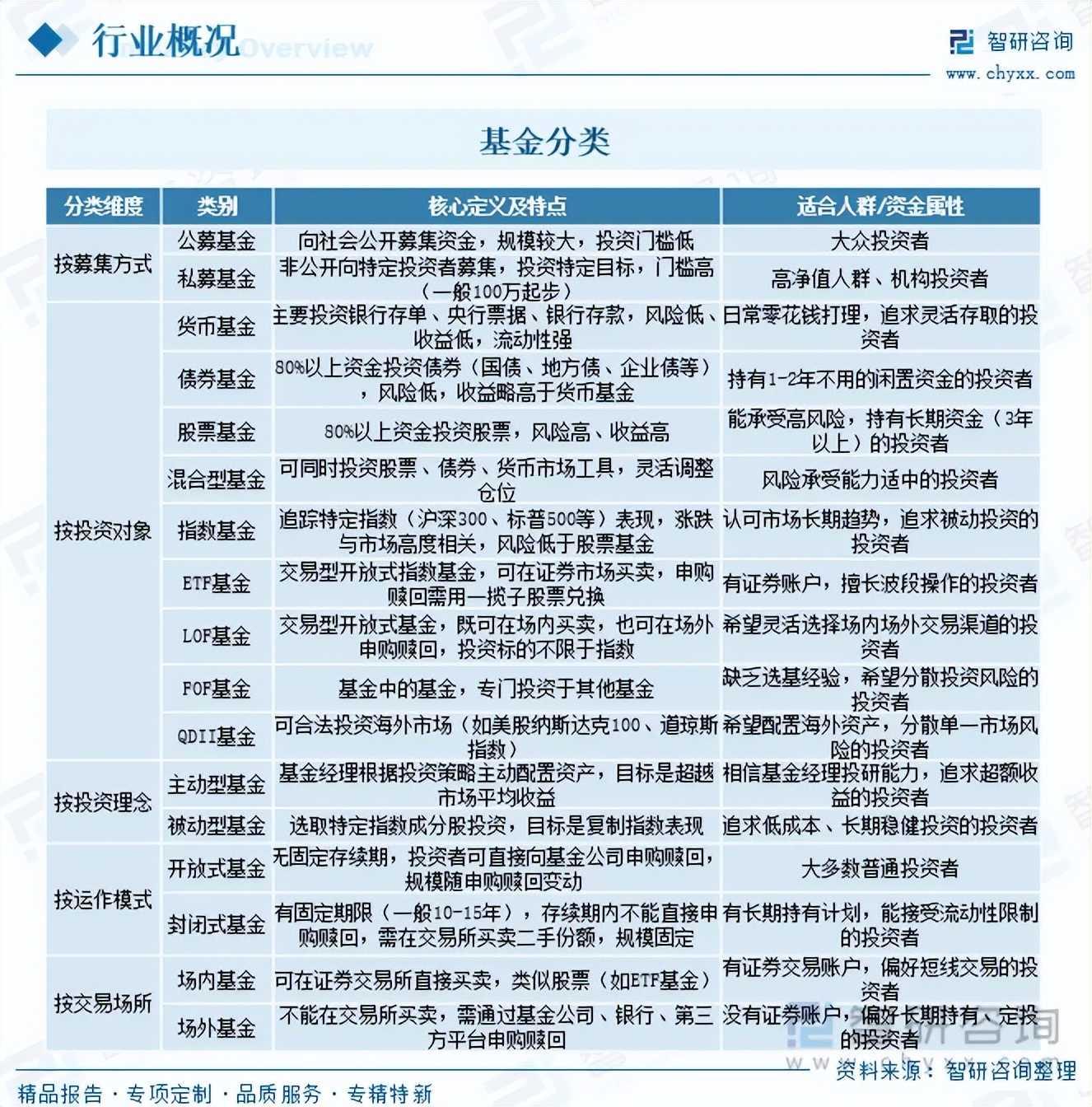
Core Insights - The real estate industry is transitioning to a stable development phase, leading to a shift in public investment needs from mere preservation to diversified value growth [1][15] - There is a significant adjustment in national asset allocation, with funds moving from traditional savings and real estate to standardized equity and fixed-income fund products [1][15] - The fund industry in China is expected to see substantial growth, with a projected total of 151,286 funds by October 2025, including 13,381 public funds and 137,905 private funds, with a total scale of 590,112.3 billion yuan [1][15] Overview of the Fund Industry - Funds, or securities investment funds, pool capital from multiple investors to create an independent asset managed by professional fund managers, allowing for diversified investment and risk sharing [2][16] - The benefits of funds include lower investment thresholds for ordinary investors, risk diversification, and professional management, although they still carry inherent market risks [2][16] Fund Classification - Funds can be categorized based on various criteria, including: - **By fundraising method**: Public funds (open to the public) and private funds (targeted at specific investors) [3][17] - **By investment object**: Money market funds, bond funds, stock funds, mixed funds, index funds, ETF funds, LOF funds, FOF funds, and QDII funds [3][17] - **By investment philosophy**: Active funds (managed to outperform the market) and passive funds (aiming to replicate market indices) [3][17] - **By operation mode**: Open-end funds (allowing continuous buying and selling) and closed-end funds (fixed size, traded on exchanges) [3][17] - **By trading venue**: On-exchange funds (traded like stocks) and off-exchange funds (purchased through fund companies or banks) [3][17] Development History - The development of China's fund industry has evolved through five key phases: pilot exploration, regulatory initiation, rapid expansion, transformation and adjustment, and high-quality development [6][20] - Recent trends indicate a shift towards professionalization, diversification, and internationalization, with innovative products like public REITs and ESG-themed funds emerging [6][20] Market Policies - The Chinese government emphasizes the importance of the fund industry for the stability of the capital market and the support of the real economy, implementing various policies to encourage and regulate its development [8][22] - Key policies include initiatives for green finance, support for technology enterprises, and measures to enhance financial services for housing rental markets [8][22] Current Market Status - The fund industry is experiencing a migration of capital from traditional savings and real estate to standardized equity and fixed-income products, indicating a broadening of investment strategies among the public [1][15] - The multi-layered fund product system in China is now capable of meeting diverse wealth management needs, with significant growth potential in the coming years [1][15]

公募基金去年四季度加码非银金融,保险、券商股获青睐
Huan Qiu Wang· 2026-02-01 03:00
Core Viewpoint - The non-bank financial sector has become a significant focus for fund allocation, with public funds increasing their positions in this area, particularly in insurance and brokerage stocks, which are now the fourth largest area of increase in holdings [1][3]. Group 1: Non-Bank Financial Sector - Public funds have increased their allocation to non-bank financials (insurance, brokerages) by over 1 percentage point, making it the fourth largest area of fund increase, following non-ferrous metals, communications, and basic chemicals [1]. - The insurance sector has shown remarkable performance, with leading companies like China Ping An and China Pacific Insurance receiving significant over-allocations due to improved balance sheets and recovery in new business value [3]. - The brokerage sector is experiencing a trend of concentration among leading firms, with public funds increasing their holdings in major brokerages like CITIC Securities and Huatai Securities, while smaller firms see limited increases [3]. Group 2: Investment Trends and Market Outlook - The current increase in non-bank financials is primarily driven by value-oriented funds, contrasting with growth-driven sectors like non-ferrous metals and communications [3]. - The insurance index has risen by 23.42% in the fourth quarter of 2025, significantly outperforming bank and brokerage stocks, highlighting the sector's stability and growth potential [3]. - The outlook for the non-bank financial sector remains focused on "performance-driven" strategies, with attention on new policy developments and market activity levels, suggesting that this sector may become a key allocation area for medium to long-term funds in a low-interest-rate environment [4].




居民财富配置转型:解锁消费增长与产业创新路径
经济观察报· 2025-12-26 12:23
Core Viewpoint - The article emphasizes the need for a shift in household wealth allocation towards risk financial assets to enhance property income and achieve wealth preservation and appreciation, which is essential for boosting consumer spending and driving technological and industrial innovation supported by the capital market [1][2]. Group 1: Consumer Spending and Property Income - The decline in consumer spending growth is linked to the decrease in property income growth, with retail sales growth falling to 3% in September 2025, indicating ongoing pressure on consumption [5][6]. - From 2021 to 2024, urban residents' property income growth dropped from 10.2% to 2.2%, further declining to 1.7% in the first three quarters of 2025 [5][6]. - The significant drop in wealth, with stock market losses around 10 trillion yuan and real estate value declines of 50-60 trillion yuan, has exerted downward pressure on consumption [6]. Group 2: Wealth Structure and Financial Assets - In 2025, property income accounted for 8.1% of total household income in China, lower than the U.S. (20%) but higher than Japan (3-4%), Germany (5-7%), and the UK (6-8%) [8]. - The structure of household wealth is heavily dominated by real estate, which constitutes about 60% of total assets, significantly higher than in the U.S. (25%) and Japan (36%) [8]. - The low proportion of risk financial assets (17%) compared to low-risk assets (83%) indicates a need for a shift in investment strategies to enhance property income [12][15]. Group 3: Challenges in Financial Asset Allocation - The preference for low-risk assets is influenced by historical trends of rising property prices and the perception of real estate as a safer investment compared to stocks [17][18]. - The long-term returns of A-share companies have not matched China's rapid economic growth, leading to lower investor confidence in stock investments [18]. - High market volatility has significantly reduced the returns for retail investors, highlighting the need for a more stable investment environment [19]. Group 4: Strategies for Improvement - To improve household wealth allocation, it is essential to enhance the long-term profitability of listed companies and shift their focus towards shareholder returns [21][22]. - Expanding investment options for residents in risk financial assets through pension reforms and encouraging participation in stock markets can help diversify asset allocation [23][24]. - Stabilizing the real estate market is crucial to prevent further declines in property values, which could hinder the shift towards risk financial assets [26].

居民财富配置转型:解锁消费增长与产业创新路径
Jing Ji Guan Cha Wang· 2025-11-14 16:27
Group 1 - The core viewpoint of the article emphasizes the need to increase household consumption and promote technological and industrial innovation, which requires support from the capital market and a shift in household wealth allocation towards risk financial assets [2][3][16] Group 2 - The decline in household consumption growth is linked to the decrease in property income growth, with retail sales growth falling to 3% in September 2025, indicating ongoing pressure on consumption [3] - From 2021 to 2024, urban residents' property income growth dropped from 10.2% to 2.2%, further declining to 1.7% in the first three quarters of 2025 [3] - The overall decline in household wealth, driven by a 33% drop in the CSI 300 index and a 13.5% decrease in housing prices, has exerted downward pressure on consumption [3][8] Group 3 - The structure of household wealth is heavily skewed towards real estate, with property accounting for approximately 60% of total household assets, significantly higher than in the US and other developed countries [6][12] - The proportion of financial assets held in low-risk investments exceeds 80%, limiting the potential for generating property income [9][11] Group 4 - The article suggests that the current asset allocation structure poses challenges for household wealth and consumption, particularly as property values decline and the demand for real estate decreases [8][24] - It highlights the need for a shift towards risk financial assets to stabilize and increase property income growth, thereby promoting household consumption [16][24] Group 5 - Recommendations for improving the situation include enhancing the profitability of listed companies, increasing household investment in risk financial assets, reducing market volatility, and stabilizing the real estate market [16][20][22] - The article stresses that a transition in household asset allocation will require a concerted effort and may take 10 to 20 years to achieve [24]
