
市市通高铁

Search documents
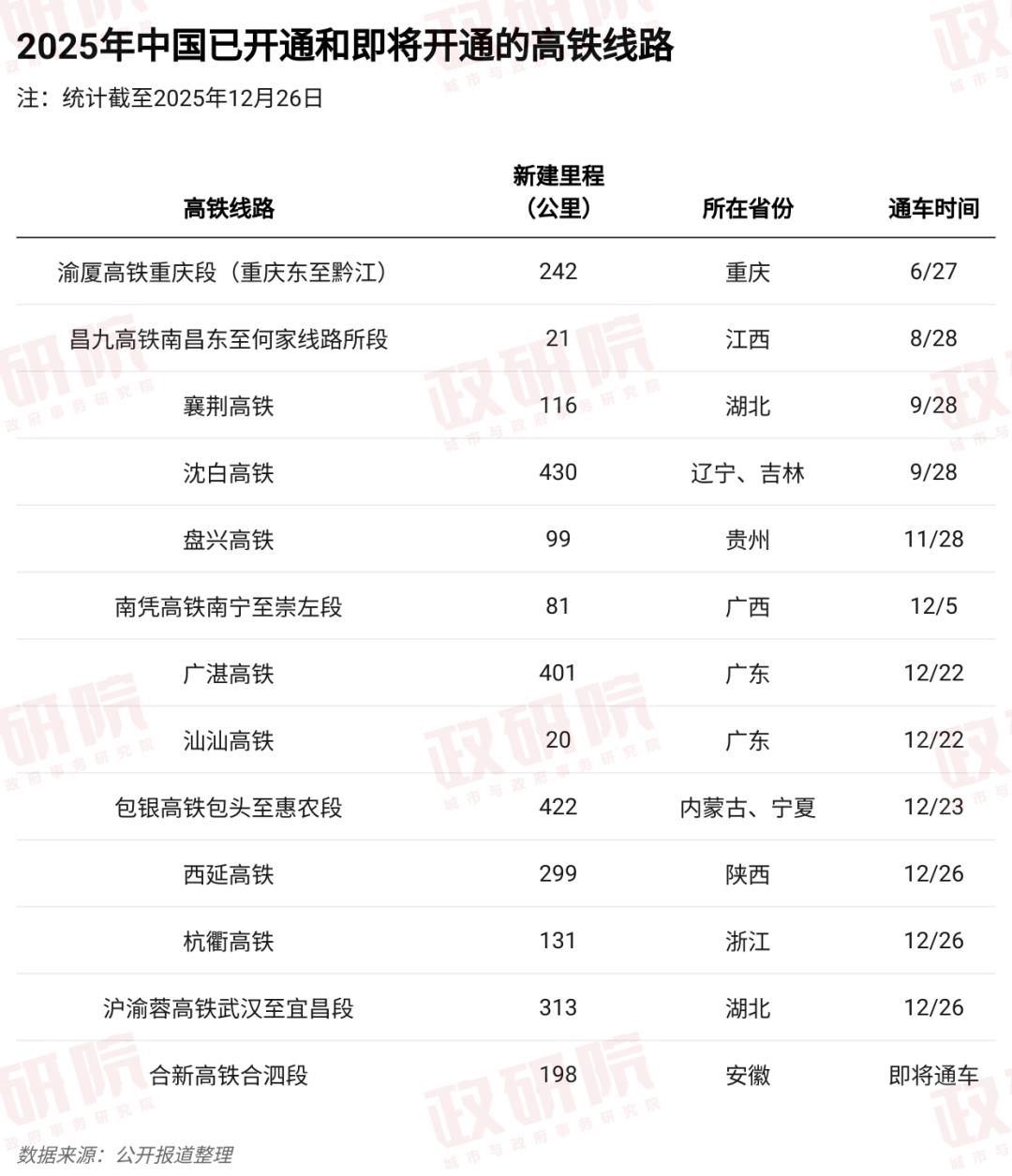
2025高铁开通5万公里 广东里程再居全国榜首
3 6 Ke· 2025-12-29 02:21
Core Viewpoint - The recent opening of multiple high-speed rail lines in China marks a significant expansion of the national high-speed rail network, enhancing connectivity and economic integration across various regions [1][4][6]. Group 1: High-Speed Rail Openings - As of December 26, 2025, a total of 12 new high-speed rail lines have been opened, increasing the total operational mileage to over 50,000 kilometers, with an addition of approximately 2,575 kilometers this year [1][2]. - Notable new lines include the Guangzhang High-Speed Rail and the Shanshan High-Speed Rail in Guangdong, the Baoyin High-Speed Rail in Inner Mongolia, and several others across various provinces [1][2][4]. Group 2: Economic Impact - The new high-speed rail lines are expected to reshape regional economic structures by improving transportation efficiency and facilitating the movement of people and goods [2][4][6]. - The Baoyin High-Speed Rail, for instance, significantly reduces travel time between Baotou and Yinchuan from 6 hours to under 3 hours, enhancing connectivity in the northwest [4][5]. Group 3: Regional Connectivity - The opening of the Xiyuan High-Speed Rail connects cities like Yan'an and Tongchuan to Xi'an, creating a one-hour economic circle [5][7]. - The Guangzhang and Shanshan High-Speed Rail lines integrate major cities in Guangdong into the Guangdong-Hong Kong-Macao Greater Bay Area's two-hour transportation circle [6][7]. Group 4: Future Developments - The "14th Five-Year Plan" continues to emphasize railway construction, with plans for new lines and improvements to existing networks, aiming for a more refined and efficient high-speed rail system [10][11]. - The focus will shift towards optimizing existing routes and enhancing urban connectivity rather than solely expanding the network [11][12]. Group 5: Financial Considerations - The financial burden of high-speed rail projects is significant, with total liabilities reaching 6.2 trillion yuan by the end of 2024, leading to a need for more sustainable development strategies [11][12]. - The emphasis will be on ensuring that new projects align with economic viability and population capacity to avoid long-term operational losses [12][13].

贵州“市市通高铁”,到底有多重要?
3 6 Ke· 2025-12-04 02:52
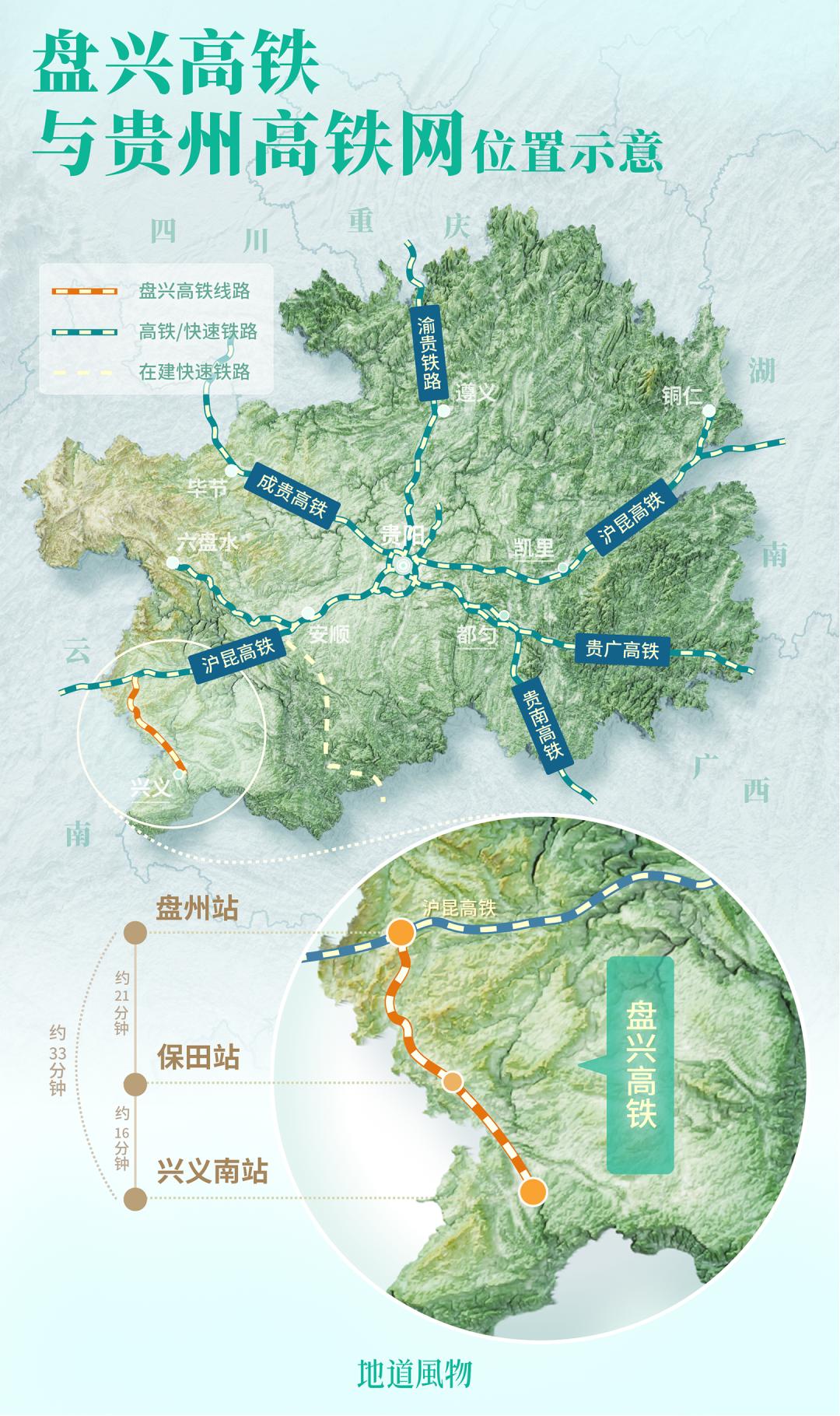
Core Insights - The opening of the Panxing High-Speed Railway marks a significant infrastructure achievement in Guizhou, connecting Liupanshui and Qianxinan, reducing travel time from over four hours to under two hours between Guiyang and Xingyi [1][4] - The railway features a bridge-tunnel ratio of nearly 91%, making it a remarkable engineering feat and establishing Guizhou as the first province in Southwest China to achieve high-speed rail coverage for all city-level centers [1][5] - The railway enhances economic connectivity in the region, creating a "golden tourism belt" that integrates cultural and tourism resources across Guizhou's western counties [1][6] Infrastructure Development - The Panxing High-Speed Railway is a culmination of Guizhou's efforts over the past two decades to improve transportation, overcoming geographical challenges with over 2,800 tunnels and 30,000 bridges [4][5] - The railway includes 46 bridges and 38 tunnels along its 99-kilometer route, with advanced technologies ensuring safety and efficiency during construction [5][6] - Guizhou's total highway mileage exceeds 9,000 kilometers, and high-speed rail coverage is approximately 1,900 kilometers, positioning it among the top in Western China [5] Economic Impact - The railway connects Qianxinan to the national railway network, facilitating tighter integration with major economic regions such as the Yangtze River Delta and the Guangdong-Hong Kong-Macau Greater Bay Area [6][9] - The Panxing High-Speed Railway is expected to extend to Baise in Guangxi, enhancing Guizhou's access to maritime routes and transforming it into a crucial hub in the new western land-sea corridor [9][20] - The railway's opening is anticipated to stimulate tourism and economic growth in the region, making it easier for visitors from major cities to explore Guizhou's natural and cultural attractions [22][23] Cultural and Historical Significance - The areas served by the Panxing High-Speed Railway, particularly Panxian and Xingyi, have historically been important nodes in transportation networks, dating back to ancient trade routes [10][12] - The railway not only facilitates modern travel but also revives historical connections, enhancing cultural exchanges between Guizhou and neighboring regions [10][12] - The design of the railway stations reflects local cultural symbols, integrating the natural landscape into the travel experience [15][19]
逆袭!这个高原山地省率先“县县通高速”,又将“市市通高铁”
Di Yi Cai Jing· 2025-11-27 10:30
Core Points - Guizhou is set to become the second province in Western China to achieve "high-speed rail connectivity between all cities" after Guangxi, with the opening of the Panxun High-speed Railway on November 28 [1][2] - The Panxun High-speed Railway, spanning 99 kilometers with a design speed of 250 km/h, will significantly enhance travel convenience and promote tourism and economic development in the region [1][2] - By the end of 2024, all cities in Guizhou will be connected to the high-speed rail network, marking a major milestone in the province's transportation infrastructure [2] Infrastructure Development - Guizhou has invested nearly 400 billion yuan during the 12th Five-Year Plan to become the first province in Western China to achieve "county-level expressway connectivity" [3] - The province's total expressway mileage is expected to exceed 9,500 kilometers by the end of this year, ranking fifth in the country [3] - The 14th Five-Year Plan aims for a comprehensive transportation investment of 90 billion yuan, with the goal of completing 500 kilometers of expressways and achieving over 1,900 kilometers of high-speed rail [3] Economic Impact - The opening of the Panxun High-speed Railway is anticipated to drive the development of tourism resources along the route and contribute to high-quality regional economic growth [1][2] - The establishment of a multi-modal transportation network in Guizhou is expected to enhance the flow of people and goods, improving overall connectivity and accessibility [3]
贵州即将实现“市市通高铁” 盘兴高铁进入运行试验阶段
Yang Shi Xin Wen· 2025-10-11 14:08
Group 1 - The Panzheng-Xingyi High-Speed Railway has officially entered the trial operation phase as of October 11, with the first test train departing from Panzhou Station [1] - Once completed, the railway will enable high-speed rail connectivity between all cities in Guizhou Province, significantly enhancing regional transportation [1] - The travel time from Guiyang to Xingyi will be reduced to 2 hours, creating a high-speed rail traffic circle within 1 to 2 hours to eight central cities in the province [1] Group 2 - The development of the Panzheng-Xingyi High-Speed Railway is expected to play a crucial role in improving the regional railway network layout [1] - The project is anticipated to promote local economic development by facilitating better transportation links [1]
“市市通高铁”的竞赛,该降温了
Hu Xiu· 2025-09-23 06:39
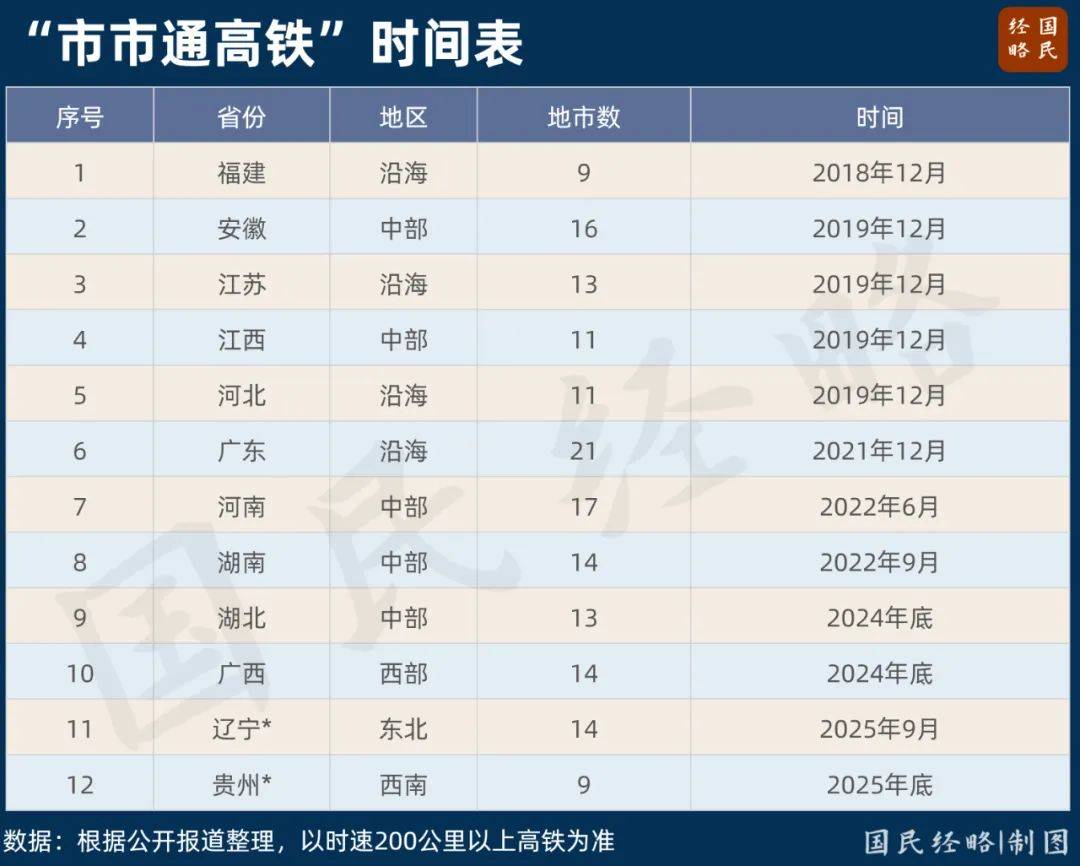
Core Viewpoint - The expansion of high-speed rail (HSR) networks in China is accelerating, with new provinces achieving "city-to-city high-speed rail" connectivity, enhancing regional economic integration and competitiveness [3][4][10]. Group 1: High-Speed Rail Expansion - The Guizhou Panxun to Xingyi high-speed railway has entered the critical acceptance phase, while the Shenyang to Baihe section of the Shenyang-Jia high-speed railway has begun trial operations [2]. - With the opening of the Panxun high-speed railway, Guizhou will achieve full high-speed rail connectivity, while Liaoning will also join the ranks of provinces with "city-to-city high-speed rail" [3][4]. - Currently, there are 10 provinces with "city-to-city high-speed rail," and this number will increase to 12 with the inclusion of Guizhou and Liaoning [4]. Group 2: Economic Impact and Challenges - High-speed rail is viewed as a symbol of modernization and an economic accelerator, reshaping China's economic geography [5][7]. - The competition for high-speed rail routes and stations is intensifying, driven by the desire for economic growth and regional dominance [8]. - High-speed rail networks are crucial for connecting cities and facilitating investment, as seen in the case of Chengdu, which experienced a population increase of nearly 6 million from 2010 to 2020 due to improved rail connectivity [12]. Group 3: Financial and Operational Challenges - The construction of high-speed rail is capital-intensive, with costs often reaching hundreds of billions or even trillions, leading to significant debt reliance on bank loans and bond issuance [19]. - As of the end of 2024, the total debt of the China National Railway Group is projected to exceed 6.2 trillion yuan [19]. - Many high-speed rail lines, especially in central and western regions, are operating at a loss, which places additional financial burdens on local governments [20][21]. Group 4: Strategic Considerations for Future Development - The value of high-speed rail extends beyond economic calculations, providing significant social benefits and improving transportation efficiency for remote areas [32]. - Future high-speed rail construction should prioritize scientific planning and cost-benefit analysis to avoid blind investments [35][36]. - Policies are being implemented to control the construction of parallel high-speed rail lines and ensure that new projects meet specific demand criteria [36][37].
今年首个“市市通高铁”的省份来了
Hu Xiu· 2025-09-11 00:37
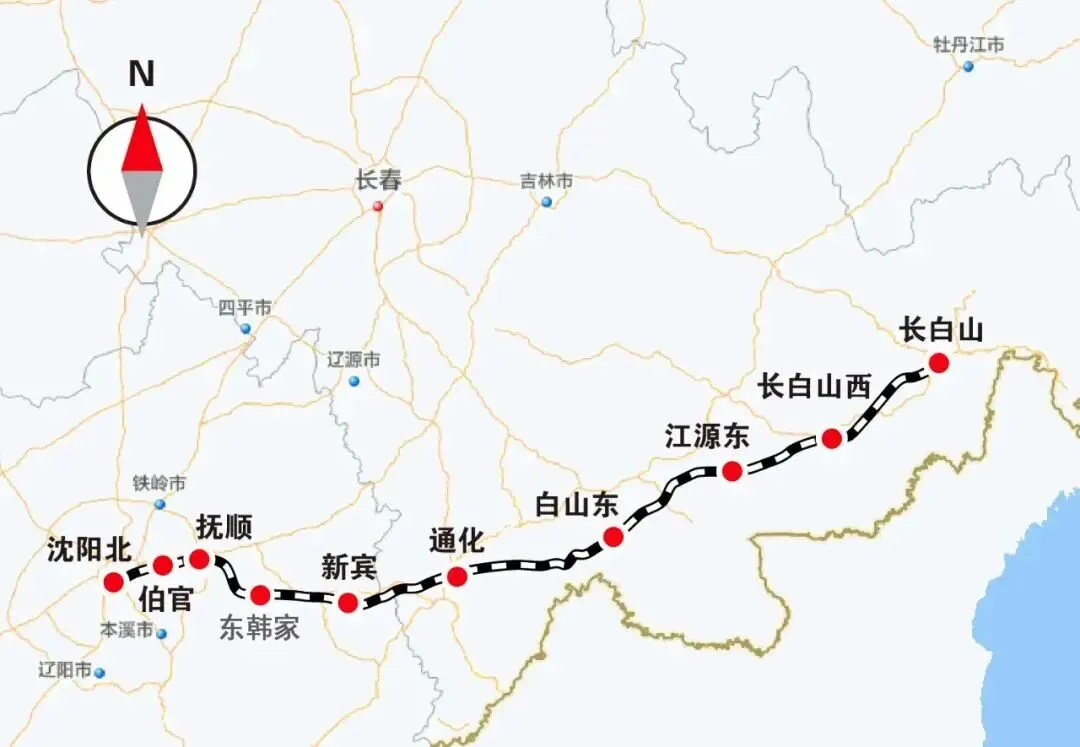
Core Viewpoint - The opening of the Shenyang-Baihe High-Speed Railway (沈白高铁) marks the first province in Northeast China to achieve "city-to-city high-speed rail" connectivity, enhancing regional transportation and economic integration [1][3][14]. Summary by Sections High-Speed Railway Development - The Shenyang-Baihe High-Speed Railway, approximately 430 kilometers long with a design speed of 350 km/h, connects several cities in Liaoning and Jilin provinces, including Shenyang, Fushun, Tonghua, and Baishan [2][22]. - With the completion of this railway, Liaoning will become the 11th province in China to achieve "city-to-city high-speed rail" connectivity, while Tonghua and Baishan will be the first cities in Jilin to join the national high-speed rail network [3][14]. Economic Impact - The Shenyang-Baihe High-Speed Railway is expected to transport around 11 million tourists annually, significantly boosting the local economy, particularly in the hospitality and service sectors [22]. - The railway will facilitate the integration of various industries along its route, including heavy industry in Harbin, automotive in Changchun, and high-tech in Dalian, promoting regional economic collaboration [19][20]. Challenges and Historical Context - Historically, Northeast China was a leader in railway development, but the region has lagged in high-speed rail construction compared to other provinces [5][10]. - The slow progress in high-speed rail development in Northeast China is attributed to challenging geological conditions, economic feasibility concerns, and the region's geographical position at the periphery of the national railway network [12][13]. Future Developments - The completion of the Shenyang-Baihe High-Speed Railway is part of a broader initiative to enhance high-speed rail connectivity in Northeast China, with additional projects like the Mudanjiang-Dunhua Railway and Qiqihar-Tongliao Railway in the pipeline [25][29]. - Jilin province aims to achieve "city-to-city high-speed rail" connectivity by prioritizing the construction of key lines and improving existing infrastructure to enhance regional transportation networks [30][33].
东北“破零”,谁是下一个?
Mei Ri Jing Ji Xin Wen· 2025-09-10 16:03
Core Viewpoint - The opening of the Shenyang-Baihe High-Speed Railway (沈白高铁) marks the first province in Northeast China to achieve "city-to-city high-speed rail" connectivity, enhancing regional transportation and economic integration [1][8]. Group 1: High-Speed Rail Development in Northeast China - The Shenyang-Baihe High-Speed Railway spans approximately 430 kilometers with a design speed of 350 km/h, connecting five cities in Liaoning and Jilin provinces [1][8]. - With the completion of the Shenyang-Baihe High-Speed Railway, Liaoning will become the 11th province in China to achieve "city-to-city high-speed rail" connectivity, while Jilin will see its first cities integrated into the national high-speed rail network [1][6]. - The railway is expected to significantly reduce travel times, with the shortest journey from Beijing to Changbai Mountain taking approximately 4 hours and 33 minutes, and from Shenyang to Changbai Mountain taking about 1 hour and 53 minutes [8][12]. Group 2: Economic Implications - The Shenyang-Baihe High-Speed Railway is anticipated to transport around 11 million tourists annually, boosting local economies, particularly in the hospitality and service sectors [12][13]. - The railway will facilitate the integration of various industries along the route, including heavy industry in Harbin, automotive in Changchun, and high-tech in Dalian, promoting regional economic collaboration [11][12]. - The opening of the railway is seen as a "economic revitalization line," with significant potential for enhancing investment attraction from Beijing and facilitating industrial transfers [12][13]. Group 3: Challenges and Future Developments - Northeast China's high-speed rail development has faced challenges due to unique geological conditions, such as high bridge-tunnel ratios and extreme winter weather, which complicate construction [7][11]. - The region's economic viability for high-speed rail projects is under scrutiny, as local governments face debt pressures, impacting the feasibility of large-scale infrastructure projects [7][11]. - Future projects, such as the Mudanjiang-Dunhua Railway and the Qiqihar-Tongliao Railway, are in the planning stages, indicating a renewed focus on expanding the high-speed rail network in Northeast China [14][16].
贵州盘兴高铁进入联调联试阶段
Zhong Guo Xin Wen Wang· 2025-09-07 00:46
Core Viewpoint - The Guizhou Panxing High-Speed Railway has entered the critical stage of joint debugging and testing, marking a significant step towards its scheduled opening [1][3]. Group 1: Project Overview - The Panxing High-Speed Railway, with a design speed of 250 km/h, spans approximately 98 kilometers, featuring 46 bridges and 38 tunnels, which together account for 90.66% of the total line [5]. - The railway connects key locations, including Pan County, Xiangshui Town, and the city of Xingyi, ultimately linking to the Wanfenglin Airport with two stations: Baotian and Xingyi South, along with the reconstruction of Pan County Station [5][7]. Group 2: Economic and Regional Impact - Upon completion, the railway will enable a two-hour travel time from Guiyang to Xingyi, creating a high-speed transportation network that connects Guiyang to eight central cities in the province within one to two hours, significantly enhancing regional connectivity and economic development [7]. Group 3: Safety and Regulations - The railway authorities have implemented a closed management system during the testing phase, warning the public against unauthorized access to the railway line and emphasizing the importance of safety during high-speed operations [7].
市市通高铁,下一个是贵州
Hu Xiu· 2025-08-15 05:44
Core Points - Guizhou is set to become the second province in the western region and the twelfth nationwide to achieve "city-to-city high-speed rail" connectivity, following the completion of the Panxing high-speed rail line [2][4] - The province has made significant strides in infrastructure development, particularly in high-speed rail and highways, contributing to its rapid GDP growth [8][10] - Guizhou's high-speed rail network connects major regions, enhancing its position as a transportation hub in Southwest China [12][18] Infrastructure Development - The Panxing high-speed rail line has begun static acceptance testing, marking a significant milestone for Guizhou as it completes its high-speed rail network [1] - Guizhou has over 900 kilometers of highways and 2000 kilometers of high-speed rail, ranking fifth and first in the western region, respectively [11] - The province's high-speed rail construction is characterized by a high proportion of bridges and tunnels due to its mountainous terrain, with the upcoming Panxing line having a bridge-tunnel ratio of 90.66% [32][28] Economic Impact - The large-scale infrastructure investments have been a key driver of Guizhou's GDP growth, which has consistently ranked first in the country from 2010 to 2020 [16][14] - High-speed rail significantly enhances tourism in Guizhou, reducing travel times dramatically and boosting visitor numbers [22][23] - The financial backing for high-speed rail projects comes from a mix of central government funding, local contributions, and bank loans, with local funding becoming more prominent in recent projects [40][39] Future Prospects - By 2025, Guizhou and Liaoning are expected to complete their high-speed rail networks, joining 12 other provinces in achieving this goal [45] - Other provinces in the western region, such as Sichuan and Shaanxi, are still working towards similar connectivity, with timelines extending to 2028 [52][50] - The pace of high-speed rail construction is slowing down due to fiscal constraints and the saturation of high-speed rail access in major population centers [57][58]
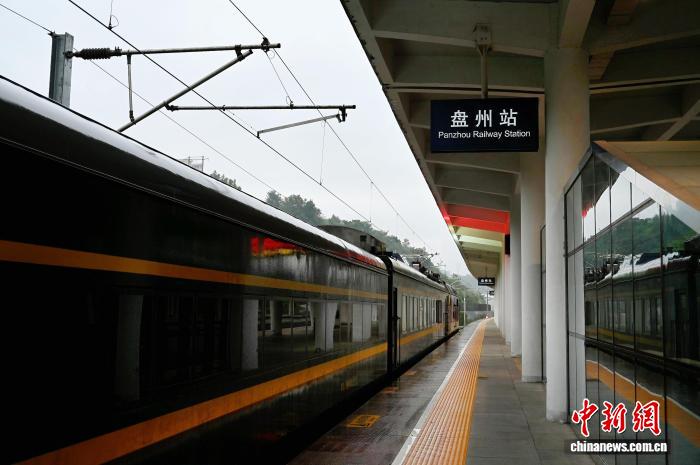
盘兴高铁进入静态验收阶段,贵州离实现“市市通高铁”又近一步
Xin Jing Bao· 2025-08-08 05:49
Core Viewpoint - The Panxun High-speed Railway (referred to as "Panxun High-speed Railway") has officially entered the static acceptance phase, indicating that the main construction of the project has been largely completed [1] Group 1: Project Status - Static acceptance involves a comprehensive inspection of the newly constructed high-speed railway line's main, supporting, and auxiliary works, as well as facilities for fire safety, environmental protection, security, and hygiene, to confirm compliance with design and quality standards [1] - The static acceptance work commenced in early August and is scheduled for completion by the end of August [1] Group 2: Future Operations - Following the completion of static acceptance, dynamic acceptance (including joint debugging and testing), preliminary acceptance, and safety assessments will be conducted before the initial operation [1] Group 3: Economic and Regional Impact - The Panxun High-speed Railway is the final project for Guizhou Province to achieve the goal of "high-speed rail access to every city," enabling a travel time of 2 hours from Guiyang to Xingyi [1] - The railway will create a high-speed rail transportation circle of 1 to 2 hours connecting Guiyang to eight central cities (prefectures) within Guizhou Province, which is significant for improving the regional railway network layout, promoting local economic development, and enhancing inter-regional connectivity [1]