
平台规则监管

Search documents
微信:限制元宝违规链接在微信内直接打开!元宝回应
Zhong Guo Zheng Quan Bao· 2026-02-04 04:03
Group 1 - The core announcement from WeChat addresses the crackdown on third-party inducement sharing behaviors, particularly during the Spring Festival marketing period [1][2] - WeChat received user complaints regarding the "Yuanbao" marketing activities, which involved inducing users to frequently share links in WeChat groups through tasks and red envelopes, disrupting platform order and user experience [1][2] - WeChat has taken action by limiting the ability to directly open the violating links associated with Yuanbao, with these measures effective immediately [2][3] Group 2 - Yuanbao responded on Weibo, stating that it is urgently optimizing and adjusting its sharing mechanism to enhance the user experience for red envelope grabbing [3]


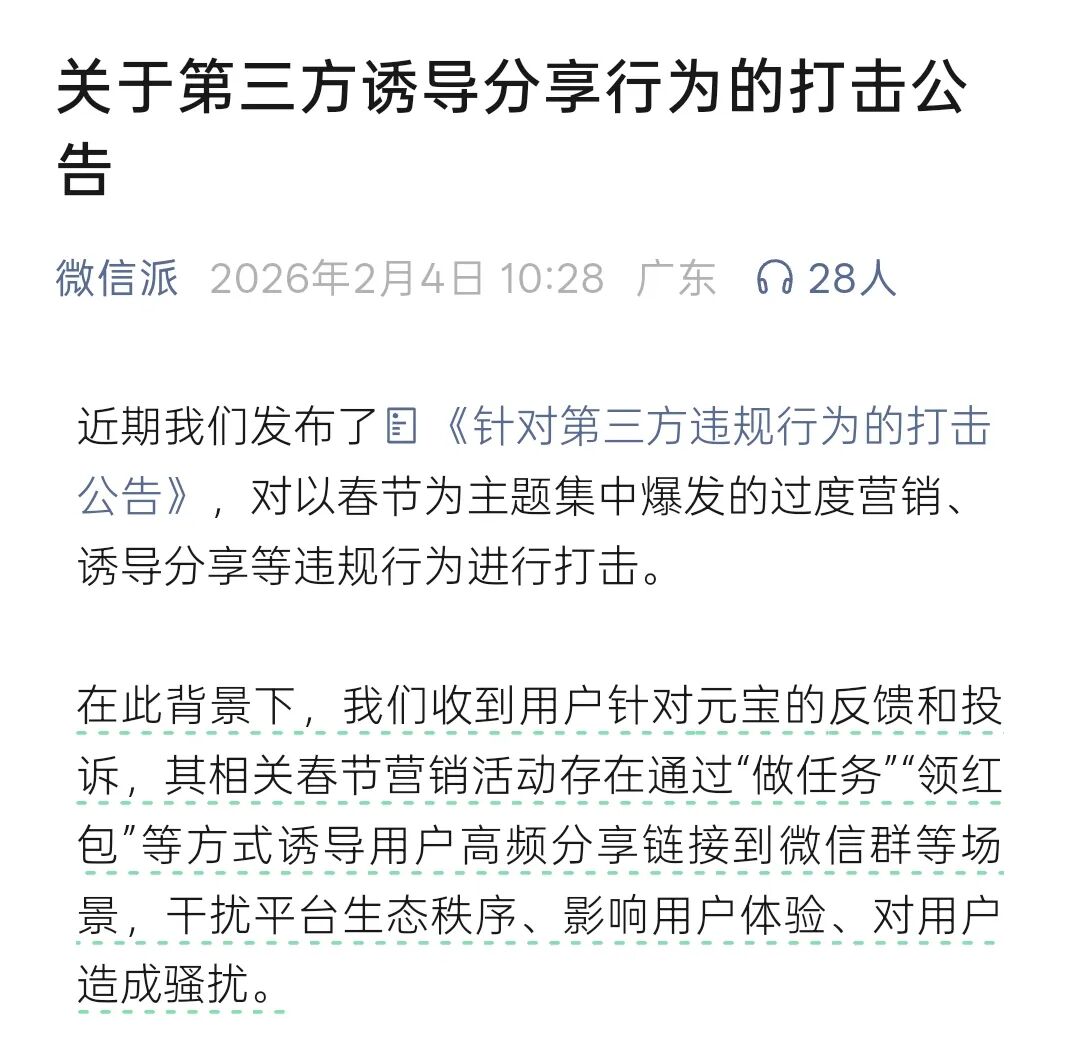
微信将限制微信内元宝违规链接 元宝回应:已第一时间优化活动设计
智通财经网· 2026-02-04 03:07
Core Viewpoint - The announcement from WeChat's official account "WeChat派" addresses the crackdown on third-party inducement sharing behaviors, particularly during the Spring Festival, highlighting issues of excessive marketing and user harassment [1] Group 1: Announcement Details - The announcement indicates that user feedback and complaints regarding "元宝" (Yuanbao) have been received, pointing out that their Spring Festival marketing activities involved inducing users to share links frequently through methods like "completing tasks" and "receiving red envelopes" [1] - The platform's ecosystem order and user experience were reportedly disrupted due to these practices, leading to the decision to restrict the direct opening of Yuanbao's links within WeChat [1] - The measures taken to address these violations are effective immediately [1] Group 2: Company Response - Yuanbao responded in the comments section of the announcement, expressing understanding and respect for the platform's rules, and stated that they have optimized their activity design to ensure compliance [1] - The company thanked users for their supervision and support [1]
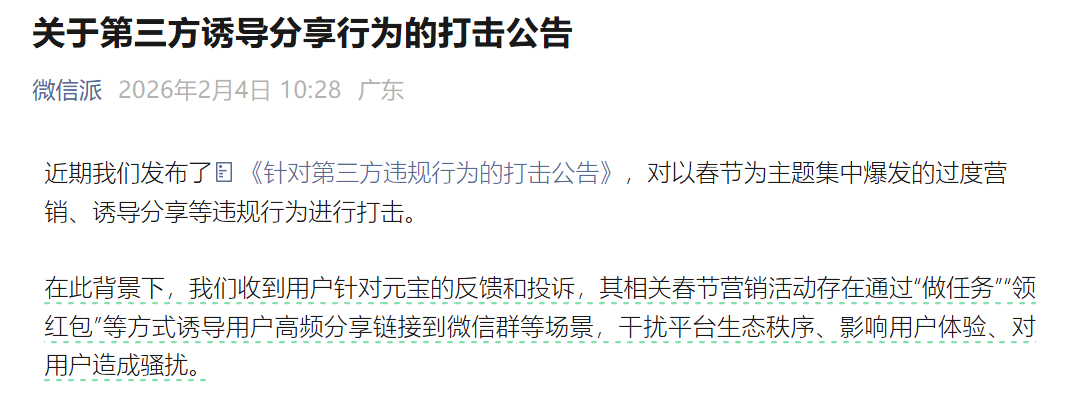
微信限制元宝直接打开
Xin Lang Cai Jing· 2026-02-04 03:04
Group 1 - The core viewpoint of the article is that WeChat has taken action against third-party marketing practices that induce excessive sharing and disrupt user experience during the Spring Festival [1] - WeChat's announcement highlights the crackdown on over-marketing and inducement behaviors related to the Spring Festival, which have led to user complaints about the "Yuanbao" marketing activities [1] - The platform has restricted the direct opening of "Yuanbao" links within WeChat to maintain ecosystem order and protect user experience [1] Group 2 - The measures implemented by WeChat are effective immediately and will be monitored based on user feedback and platform rules [1] - The company emphasizes its commitment to safeguarding user experience amidst the ongoing Spring Festival marketing activities [1]
监管新规 三大变化专治平台任性
Xin Lang Cai Jing· 2026-02-01 21:21
Core Viewpoint - The implementation of the "Regulations on the Supervision and Management of Online Trading Platform Rules" aims to address consumer concerns regarding reduced membership rights and unclear platform rules, establishing clear guidelines for platform operations [1][2]. Group 1: Transparency and Rule Modification - The regulations enhance the transparency of platform rule formulation and modification, requiring platforms to prominently display rules on their homepage and allow for user and merchant feedback before any changes are made [1]. - Platforms must adopt reasonable suggestions from users and merchants; failure to disclose rules or implement changes without proper notice may lead to regulatory penalties [1]. Group 2: Membership Rights Protection - The regulations prohibit platforms from unilaterally modifying rules during the membership service period, preventing additional charges or reductions in member rights without proper notification [1]. - Consumers must be clearly informed of any changes related to membership rights before purchasing services [1]. Group 3: Fair Pricing Practices - The regulations ban "big data price discrimination," ensuring that platforms cannot set different prices for the same goods or services under similar transaction conditions without consumer awareness [2]. - Platforms are required to provide evidence of fair pricing mechanisms if consumers claim price discrimination; failure to do so may result in negative consequences for the platform [2].
完善平台规则和直播电商监管
Xin Lang Cai Jing· 2026-01-07 22:25
Core Viewpoint - The new regulations introduced by the State Administration for Market Regulation and the National Internet Information Office aim to enhance the supervision of online trading platforms and live e-commerce, focusing on platform responsibilities and consumer protection. Group 1: Regulation of Live E-commerce - The "Live E-commerce Supervision Management Measures" strengthen regulatory tools by including traffic control and AI-generated content, such as digital human anchors, to prevent the misuse of technology for spreading false information [1] - Live e-commerce platforms are required to take immediate action against violations reported by regulatory authorities, including warnings, limiting functions, and account closures [2] - The measures also mandate that AI-generated images and videos used in live e-commerce must be clearly labeled and continuously disclosed to consumers [2] Group 2: Protection of Platform Operators and Consumers - The "Network Trading Platform Rules Supervision Management Measures" focus on protecting the rights of all parties involved, prohibiting unreasonable restrictions on platform operators and unfair fees [3] - Specific illegal practices such as "only refunds," "forced choices," and "big data killing familiarity" are explicitly detailed to ensure fair treatment of consumers and operators [3] - The regulations enhance the transparency and public accessibility of platform rules, requiring platforms to clearly display rules and provide reasons for negative actions taken against operators [4] Group 3: Responsibilities of Platforms - Platforms are designated as key players in the live e-commerce ecosystem, with responsibilities outlined in various laws and regulations [4] - The regulations require platforms to continuously publicize their rules, ensuring clarity and ease of understanding for both operators and consumers [4] - Platforms must inform consumers of any changes to membership services and provide channels for appeals regarding penalties or damages [4]
市场监管总局:禁止平台利用不合理规则限制经营者自主经营
Xin Hua Cai Jing· 2026-01-07 09:11
Core Viewpoint - The State Administration for Market Regulation (SAMR) has introduced the "Regulations on the Supervision and Management of Online Trading Platforms" to enhance transparency and fairness in platform governance, addressing issues such as arbitrary rule-making and abuse of rules [1][2]. Group 1: Platform Responsibilities - The regulations focus on enhancing procedural transparency, requiring platforms to publicly disclose rule-making processes, solicit public opinions, and establish transitional periods for significant changes [1]. - The regulations emphasize fair execution of rules, mandating the establishment of complaint rights and dispute resolution mechanisms to prevent arbitrary enforcement and rule abuse [2]. - The regulations specifically prohibit platforms from imposing unreasonable restrictions on merchants, charging unjust fees, and diminishing member rights, thereby protecting the autonomy of platform operators and consumer rights [2]. Group 2: Social Governance and Oversight - The regulations encourage a multi-party governance mechanism, promoting the publication of compliance reports by platforms, expert evaluations by regulatory bodies, and assessments by third-party organizations to foster a collaborative oversight environment [2].
两部门:平台不得强制经营者以低于成本的价格销售商品、承担退款不退货等售后责任等;不得大数据“杀熟”、不得利用平台规则减免自身责任
Mei Ri Jing Ji Xin Wen· 2026-01-07 04:17
Core Viewpoint - The newly released "Regulations on the Supervision and Management of Rules for Online Trading Platforms" aims to standardize the formulation, modification, and execution of platform rules, maintain order in online transactions, and protect the legitimate rights and interests of all parties involved in online trading [1]. Group 1: Responsibilities of Online Trading Platforms - The regulations emphasize the responsibilities of online trading platforms in formulating, modifying, and executing platform rules, including obligations for information disclosure, public consultation, and establishing complaint channels [2]. - Specific requirements are outlined for ensuring information, network, and data security, as well as protecting the rights of platform operators and consumers [2]. - Platforms are prohibited from imposing unreasonable restrictions on operators' business activities or consumers' rights through platform rules [2]. Group 2: Enforcement and Regulatory Mechanisms - The regulations call for enhanced collaboration between market supervision and cybersecurity departments, establishing mechanisms for information sharing and joint assessments [3]. - Platforms are encouraged to publish compliance reports and engage in self-assessments or third-party evaluations to ensure adherence to the regulations [3]. Group 3: Transparency and Fairness in Rule Formulation - Online trading platforms must prominently display platform rules on their websites and applications, ensuring easy access for operators and consumers [9]. - The content of platform rules should be clear and understandable, with significant terms highlighted to protect the rights of users [10]. - Platforms are required to solicit public opinions on rule changes and must document and respond to feedback appropriately [11][12]. Group 4: Consumer and Operator Rights Protection - The regulations prohibit platforms from unreasonably limiting the rights of consumers or imposing excessive fees and penalties on operators [21][28]. - Platforms must ensure that any changes to rules do not adversely affect consumers' rights, particularly regarding membership services [21][32]. - Operators and consumers must be informed of their rights and have access to effective dispute resolution mechanisms [15][21]. Group 5: Legal Responsibilities and Penalties - Non-compliance with the regulations can result in penalties, including fines ranging from 10,000 to 100,000 yuan for various violations [27][41]. - The regulations outline specific behaviors that could lead to administrative penalties, emphasizing the importance of adherence to the established rules [39][40]. Group 6: Implementation Timeline - The regulations will come into effect on February 1, 2026, providing a timeline for platforms to adjust their practices accordingly [33].
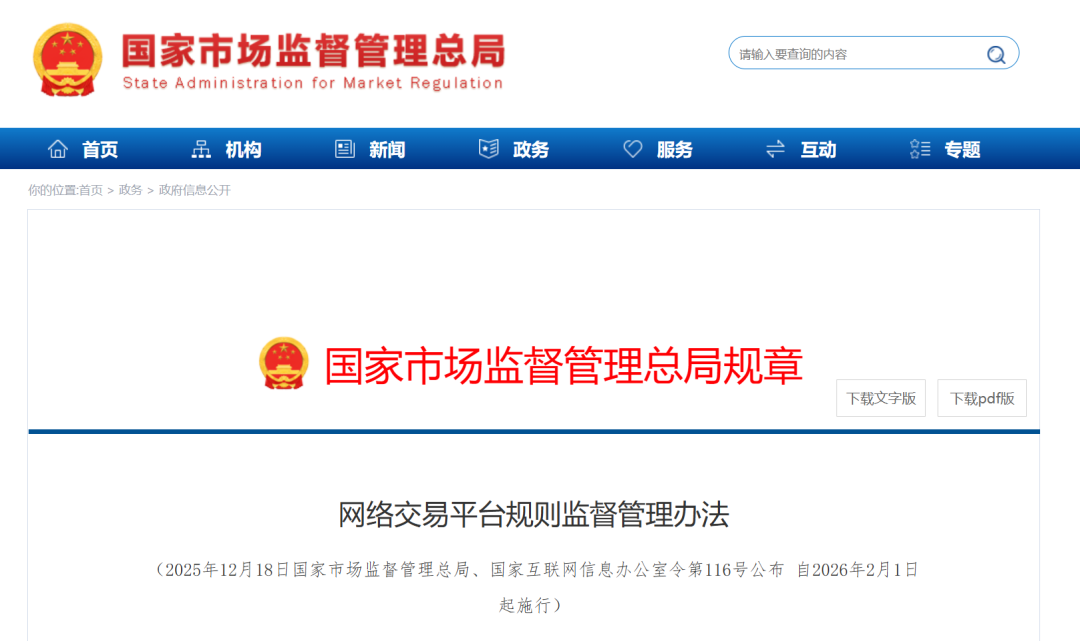
两部门:网络交易平台经营者不得强制或者变相强制平台内经营者按照其定价规则 以低于成本的价格销售商品或者提供服务
智通财经网· 2026-01-07 02:44
Core Viewpoint - The newly released regulations by the State Administration for Market Regulation and the National Internet Information Office aim to standardize the rules governing online trading platforms, ensuring fair practices and protecting the rights of all parties involved in online transactions [1][3]. Group 1: General Principles - The regulations are designed to regulate the formulation, modification, and execution of platform rules, maintaining order in online transactions and protecting the legal rights of all parties involved [3][4]. - Online trading platform operators must adhere to principles of openness, fairness, and justice in their rule-making processes [4][5]. Group 2: Platform Rules and Responsibilities - Platform rules include service agreements, management rules for operators, transaction and dispute resolution rules, personal information protection rules, and intellectual property protection rules [4][5]. - Operators are required to manage the entry and exit of platform participants and ensure compliance with quality assurance, consumer rights protection, and data security [4][5]. Group 3: Restrictions on Operators - Operators are prohibited from imposing unreasonable restrictions on the independent business activities of platform operators, such as forcing them to bear refund responsibilities or participate in promotional activities [1][13]. - Operators cannot compel platform participants to sell goods or services below cost, which disrupts market competition [1][13]. Group 4: Consumer Rights Protection - The regulations prevent operators from excluding or limiting consumer rights, such as the right to choose products or services and the right to seek compensation [15][30]. - Operators must not set different prices for the same goods or services under the same trading conditions without consumer knowledge [15][31]. Group 5: Supervision and Compliance - Market supervision and internet information departments are tasked with overseeing the formulation, modification, and execution of platform rules, ensuring compliance with the regulations [17][33]. - Operators are encouraged to publish annual compliance reports regarding their platform rules and to engage in self-assessment [17][36].