网络交易

Search documents
【关注】节后复工三举措推动网络市场监管
Sou Hu Cai Jing· 2026-02-26 09:58
Core Viewpoint - The article emphasizes the importance of regulating online market transactions and ensuring consumer safety as businesses resume operations after the Spring Festival holiday [1] Group 1: Regulatory Actions - The market supervision authority in Zhuoerqi is conducting a special regulatory action focused on online market transactions to safeguard online consumer safety [1] - The authority is utilizing a network transaction data monitoring platform to inspect websites, online stores, and apps, particularly monitoring hot-selling products and services such as food, pharmaceuticals, cosmetics, health products, and beauty services [2] - Strict regulations are being enforced against merchants who fail to display required business licenses and certificates, as well as against misleading advertisements, especially those using medical terminology outside of approved contexts [2] Group 2: Legal Compliance - The implementation of the "Live E-commerce Supervision Management Measures" and "Network Transaction Platform Rules Supervision Management Measures" starting February 1 is highlighted, urging businesses to comply with various laws including the E-commerce Law and Consumer Rights Protection Law [2] - Businesses are encouraged to establish a robust network management system, appoint responsible personnel, and ensure timely identification and resolution of issues [2] Group 3: Consumer Protection - The regulatory focus includes addressing consumer complaints related to live-streaming sales, "ghost delivery" services, unlicensed operations, and exaggerated claims in advertisements [2] - The core principle of the regulatory approach is to discover and address issues as they arise, aiming to purify the online market environment [2]
市场监管总局晒2025年成绩单:公平竞争市场环境持续优化
Jin Rong Shi Bao· 2026-02-06 01:04
Group 1: Market Regulation and Business Environment - In 2025, the number of newly established business entities reached 25.745 million, with active enterprises increasing by 9.8% year-on-year, raising their share of total enterprises by 4.7 percentage points [1] - The market regulation system received 26.46 million complaints, recovering economic losses of 4.35 billion yuan for consumers, and recalled 8.236 million consumer goods [1] - The market regulation authority aims to enhance comprehensive market supervision capabilities to support economic growth and high-quality development [1] Group 2: Governance of Unreasonable Charges - In 2025, 5,918 cases of illegal charges by government departments and other entities were investigated, resulting in fines of 347 million yuan and refunds of 1.35 billion yuan to businesses [2] - The market regulation authority is implementing a long-term strategy to address unreasonable charges, including revising guidelines for commercial bank fees and monitoring over 5,200 enterprises for pricing issues [2] - Continuous efforts will be made to alleviate the burden on businesses and ensure a conducive development environment [2] Group 3: Platform Economy Regulation - The market regulation authority has made significant progress in regulating the platform economy, focusing on issues like unreasonable fees and transparency in rules [3] - Measures include rectifying practices such as "only refunds" and "mandatory shipping insurance," and issuing compliance guidelines for platform operations [3][4] - Future efforts will focus on enhancing regulatory frameworks and ensuring platforms fulfill their responsibilities [4][5] Group 4: Consumer Goods Standards Upgrade - The market regulation authority plans to promote the upgrading of consumer goods standards to meet new consumer demands for safety, quality, and sustainability [6] - Initiatives will include updating standards in traditional industries and enhancing service standards across various sectors [6] - There will be an emphasis on developing mandatory standards related to safety to strengthen consumer protection [6]
经营主体合规指引③丨@各网络交易经营者,春节请注意!
Sou Hu Cai Jing· 2026-02-05 09:27
Core Viewpoint - The article emphasizes the need for strict regulations and compliance in the Hainan tourism consumption market, particularly in the context of online transactions, to prevent illegal activities and protect consumer rights as the 2026 Spring Festival approaches [1]. Group 1: Platform Responsibility - Platforms must implement real identity verification and conduct qualification audits for operators, especially those dealing with duty-free goods, cross-border e-commerce, prepaid consumption, and off-campus training [3]. - Internal management should be strengthened with established rules and a regular inspection mechanism to monitor product information, transaction behavior, and promotional content [3]. Group 2: Anti-Smuggling Measures - Platforms are prohibited from engaging in "proxy purchasing" smuggling and must not provide sales channels for unqualified operators [4]. - There should be a focus on monitoring transactions of Hainan duty-free goods and a ban on advertising illegal activities related to "proxy purchasing" [4]. Group 3: Pricing and Promotion Regulations - Compliance with pricing laws is mandatory, including clear pricing and prohibition of hidden fees [5]. - Promotional activities must be genuine and transparent, avoiding false discounts or misleading pricing strategies [5]. Group 4: Live E-commerce Management - Live e-commerce must comply with regulations, avoiding the sale of prohibited items and ensuring truthful promotional content [6][7]. Group 5: Consumer Rights Protection - Strict adherence to consumer protection laws is required, including a seven-day no-reason return policy and clear refund conditions for special goods and services [8]. - A mechanism for resolving consumer disputes should be established, encouraging mediation and cooperation with regulatory bodies [8]. Group 6: Advertising Content Oversight - An advertising review system must be established to ensure compliance with advertising laws, particularly in sensitive sectors like food, medicine, and education [9]. - Prohibited advertisements must be promptly removed, and violations reported to regulatory authorities [9]. Group 7: Social Responsibility - Platforms should promote integrity and legal compliance among operators, encouraging green and rational consumption [10]. - An emergency response mechanism should be in place to address potential issues during the Spring Festival, such as product quality problems and price fluctuations [10].


关于加强金融消费者权益保护,今日起施行!
Zheng Quan Ri Bao Wang· 2026-02-01 11:25
Group 1: Banking Regulations - The "Administrative Measures for Custody Business of Commercial Banks" will take effect on February 1, 2026, aiming to promote the standardized development of custody business and enhance risk management in commercial banks [2] - The measures consist of five chapters and 49 articles, outlining the basic principles and requirements for commercial banks to conduct custody business, including the establishment of governance structures and management systems [2] Group 2: Consumer Protection - The "Measures for the Appropriateness Management of Financial Institution Products" will also be effective from February 1, 2026, focusing on enhancing consumer protection in financial products [3] - The measures require financial institutions to classify investment products by risk levels and manage them dynamically, with special protections for ordinary investors [3] Group 3: Cash Payment Regulations - The "Regulations on Cash Payment and Services" will be implemented on February 1, 2026, to uphold the legal status of the Renminbi and prevent refusal of cash payments [4] - The regulations mandate that businesses must respect consumers' rights to choose legal payment methods and cannot refuse cash payments without legal justification [4] Group 4: E-commerce Regulations - The "Supervision and Management Measures for Network Trading Platform Rules" will come into effect on February 1, 2026, aimed at regulating the formulation and execution of platform rules to maintain order in online transactions [5] - The measures prohibit unreasonable restrictions on operators' activities and ensure consumer rights are protected against unfair practices [5] Group 5: Live E-commerce Management - The "Supervision and Management Measures for Live E-commerce" will be effective from February 1, 2026, focusing on the responsibilities of various stakeholders in the live e-commerce ecosystem [6] - The measures prohibit false advertising and the sale of illegal goods, and require compliance with legal standards for AI-generated content used in live commerce [6]
金融机构禁止误导性销售产品
Xin Lang Cai Jing· 2026-02-01 06:55
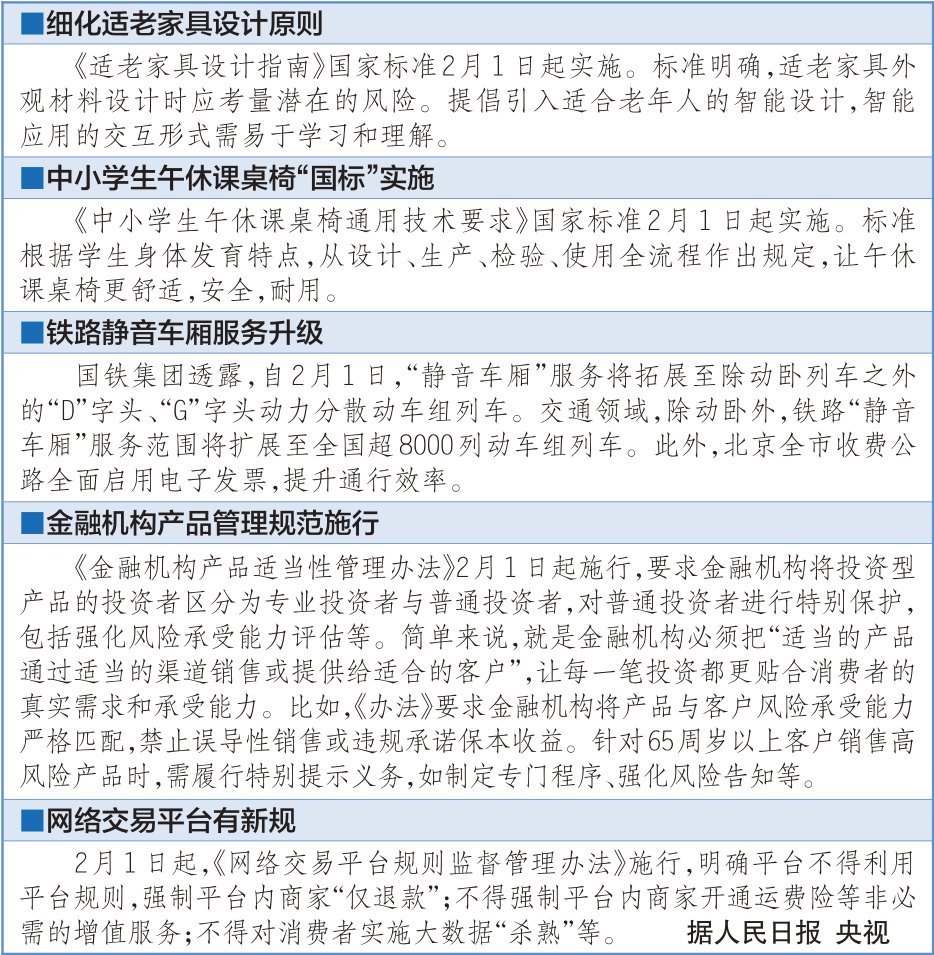
Group 1 - New regulations aimed at consumer protection and market fairness will be implemented starting February, covering various sectors including elderly care, online consumption, investment safety, and public services [1] Group 2 - The national standard for elderly furniture design, effective from February 1, emphasizes risk consideration in materials and promotes smart designs that are easy for seniors to learn and understand [2] Group 3 - The national standard for student nap desks and chairs will also take effect on February 1, focusing on comfort, safety, and durability based on students' physical development characteristics [3] Group 4 - The "silent carriage" service on trains will expand to over 8,000 train sets nationwide, excluding sleeper trains, starting February 1, enhancing travel comfort [4] Group 5 - The "Financial Institutions Product Appropriateness Management Measures" will be implemented on February 1, requiring financial institutions to differentiate between professional and ordinary investors, with special protections for the latter [5] Group 6 - New rules for online trading platforms will take effect on February 1, prohibiting platforms from forcing merchants to offer unnecessary services and preventing practices like "big data price discrimination" against consumers [6]
网络平台迎来更精细化管理
Jing Ji Ri Bao· 2026-01-14 00:04
Core Viewpoint - The rapid development of platform economy in China has led to significant roles played by large online trading platforms, creating a dual market connecting numerous operators and consumers, while also facing governance challenges [1] Group 1: Regulatory Developments - The State Administration for Market Regulation and the National Internet Information Office have jointly issued the "Regulations on the Supervision and Management of Online Trading Platforms" and the "Supervision and Management Measures for Live E-commerce," aiming to establish behavioral boundaries and clarify responsibilities in the online market [2] - The two regulations focus on prominent issues to protect the rights and interests of all parties involved, addressing problems such as data manipulation and false marketing [3] Group 2: Implementation and Impact - The regulations create a clear responsibility system across the entire transaction chain, which is expected to reduce illegal activities from the source and enhance consumer rights [4] - The "Live E-commerce Supervision Management Measures" specify the responsibilities of various stakeholders, including platform operators and live marketing personnel, to ensure compliance and protect consumer rights [4] - The implementation of these regulations is anticipated to provide clear management guidelines for platforms, enhancing compliance awareness among operators and better protecting consumer rights [5]
市场监管总局、国家网信办联合印发两部《办法》——网络平台迎来更精细化管理
Jing Ji Ri Bao· 2026-01-13 22:08
Core Viewpoint - The rapid development of platform economy in China has led to significant roles played by large online trading platforms, creating a dual market connecting numerous operators and consumers, while also facing complex governance challenges [1] Group 1: Regulatory Developments - The State Administration for Market Regulation and the National Internet Information Office have jointly issued the "Regulations on Supervision and Management of Online Trading Platforms" and the "Regulations on Supervision of Live E-commerce," aiming to establish behavioral boundaries and clarify responsibilities in the online market [2] - The two regulations focus on prominent issues to protect the rights of all parties involved, addressing problems like data manipulation and false marketing [3] Group 2: Legal Framework and Responsibilities - The "Regulations on Supervision and Management of Online Trading Platforms" explicitly prohibit unreasonable restrictions on operators' autonomy, unreasonable fees, and practices that undermine consumer rights, such as data manipulation [3] - The "Regulations on Supervision of Live E-commerce" clarify the legal responsibilities of multiple parties, including platforms and live stream operators, and set boundaries against false advertising and commercial defamation [3] - A key highlight of the new regulations is the establishment of a clear responsibility system across the entire transaction chain, aiming to reduce illegal activities from the source [4] Group 3: Industry Impact and Future Directions - The implementation of these regulations is expected to enhance the compliance awareness of operators and better protect consumer rights, fostering a fair and transparent market environment [5] - The new regulations will provide clear management guidelines for platforms, promoting better management of live stream operators and related service institutions, thereby strengthening the foundation for healthy industry development [5]
新规划定红线
Xin Lang Cai Jing· 2026-01-11 22:25
Core Viewpoint - The recent joint release of the "Regulations on the Supervision and Management of Online Trading Platforms" and the "Supervision Management Measures for Live E-commerce" by the State Administration for Market Regulation and the National Internet Information Office aims to establish clear industry guidelines and responsibilities for various stakeholders in the live e-commerce sector, ensuring consumer rights and market order [2] Group 1: Regulatory Measures - New flow control measures will include artificial intelligence-generated content, such as digital human anchors, under regulatory oversight [2] - The regulations further specify rules against practices like "refund only," "choose one of two," and "big data discrimination" [2] - The focus is on four main entities: platform operators, live room operators, live marketing personnel, and service agencies for live marketing [2] Group 2: Market Impact - The regulations are designed to enhance the operational responsibilities of stakeholders, thereby improving the regulatory framework [2] - Ensuring the protection of rights for both operators and consumers is crucial for fostering a vibrant online consumption environment [2] - The measures aim to instill confidence in consumers, encouraging them to engage more actively in online shopping [2]

提升网络交易平台产品和服务质量
Xin Lang Cai Jing· 2026-01-10 19:31
Core Viewpoint - The recent guidelines issued by the State Administration for Market Regulation aim to enhance the quality of products and services on online trading platforms, addressing issues such as product authenticity, service standardization, and consumer rights protection, thereby promoting sustainable development of the platform economy [1][2]. Group 1: New Measures and Their Impact - The guidelines establish a quality closed-loop system that connects the supply side, operation side, regulatory side, and consumer side, facilitating a shift from "scale expansion" to "quality enhancement" in the platform economy [1]. - The guidelines emphasize the importance of product innovation and standardized services on the supply side, while reinforcing the responsibilities of platforms and operators on the operation side [1][4]. - Regulatory innovations are introduced to enhance efficiency and ensure that violations are effectively addressed, while consumer protection services are optimized to improve shopping confidence [1][3]. Group 2: Key Features of the Guidelines - The guidelines highlight three main characteristics: the use of technology to enhance consumer experience and regulatory precision, a focus on emerging business models like live commerce with specific selection mechanisms and training requirements, and a collaborative governance approach involving multiple stakeholders [2]. - The guidelines encourage platforms to leverage technology for quality monitoring and consumer experience optimization, utilizing big data and artificial intelligence [2][4]. - A collaborative governance model is promoted, involving government oversight, platform accountability, corporate self-regulation, and social supervision [2]. Group 3: Addressing Consumer Concerns - The guidelines propose measures to ensure product authenticity, such as combating counterfeit goods and implementing quality safety verification systems, allowing consumers to purchase with confidence [3][5]. - Improvements in online service standards and after-sales support are emphasized, including the establishment of direct hotlines for elderly consumers [3]. - Mechanisms for rapid issue resolution, such as "preliminary reconciliation" and "one-click evidence submission," are introduced to facilitate consumer rights protection [3]. Group 4: Development and Governance Strategies - The guidelines advocate for activating supply and enhancing quality by supporting platforms in adopting new manufacturing models that align production with consumer demand [4]. - The introduction of a "product digital passport" initiative aims to create a traceability system for quality assurance, allowing consumers to verify product authenticity [4]. - The guidelines call for stringent entry and listing audits for platform enterprises, utilizing digital and AI technologies for daily management and ensuring that credit regulatory data informs platform operations [4][5]. Group 5: Specific Requirements for Stakeholders - For platform operators, the guidelines stress the establishment of comprehensive quality control systems from supplier management to quality traceability and recall processes [5]. - In the context of live commerce, the guidelines recommend the creation of a "quality-first" selection mechanism and enhanced training for hosts, along with a "blacklist" system to ensure high-quality content and products [5].
两部新规提出哪些新举措?
Xin Lang Cai Jing· 2026-01-10 19:31
Core Viewpoint - The new regulations introduced by the State Administration for Market Regulation and the National Internet Information Office aim to enhance the supervision of online trading platforms and live e-commerce, focusing on protecting the rights of operators and consumers while ensuring platform accountability [2][4]. Group 1: Regulation of Live E-commerce - The "Live E-commerce Supervision Management Measures" include flow control and the regulation of AI-generated content, such as digital human hosts, to prevent the misuse of technology for spreading false information [2][3]. - Live e-commerce platforms are required to take immediate action against violations by operators and marketers, including warnings, limiting functionalities, and account closures [3]. - The measures also encompass private domain live streaming, mandating other online service providers to fulfill their responsibilities as platform operators [3]. Group 2: Online Trading Platform Rules - The "Online Trading Platform Rules Supervision Management Measures" address issues like "only refunds," "penalties," and "membership downgrades," prohibiting unreasonable restrictions on operators and ensuring fair treatment of consumers [4]. - Specific illegal practices such as "forced low-price sales" and "data-driven price discrimination" are further detailed in the new regulations [4]. - The measures enhance consumer protection by clarifying the limitations on operators' liability and ensuring transparency in platform rules [5]. Group 3: Transparency and Accountability - The regulations emphasize the importance of transparency in platform rules, requiring platforms to publicly disclose rules clearly and prominently [5]. - Platforms must inform operators and consumers about any negative management measures taken, including the rationale and avenues for appeal [5]. - The responsibilities of live e-commerce platform operators are detailed, covering aspects like qualification verification, information reporting, and consumer rights protection [5].