情感交互

Search documents
一年两代三款机器人!西南首个→全球首个,这家机器人企业厉害了!
DT新材料· 2026-02-04 16:05
Core Viewpoint - The article highlights the rapid development and market potential of the emotional interaction humanoid robot "AIQ" by Sichuan Embodied Humanoid Robot Technology Co., Ltd. (EIR), which has received nearly a thousand order inquiries since its debut, indicating strong demand in various sectors [2][4]. Company Overview - Sichuan Embodied Humanoid Robot Technology Co., Ltd. was established in September 2024 and launched its first commercial humanoid robot, "Tianxing 1," in December of the same year. The company has since developed multiple iterations, including "Tianxing 2," and the latest "AIQ," showcasing significant advancements in humanoid robotics within a short timeframe [4][6]. - The company anticipates annual revenue to exceed 100 million yuan by 2026, reflecting its growth trajectory and market confidence [4]. Product Development - The "Tianxing 2" robot features 55 degrees of freedom, enabling highly realistic movements and significant improvements in performance, perception, and spatial intelligence compared to its predecessor [6]. - The development of the "Tianxing" series demonstrates EIR's transition from general control to emotional intelligence in humanoid robots, marking a critical leap from laboratory validation to engineering implementation [6]. Industry Context - The global nylon market is projected to surpass $47 billion, with ongoing innovations in high-performance and functional nylon polymers driving new applications in sectors such as electric vehicles, electronics, and humanoid robotics [13]. - The upcoming "2026 Advanced Nylon Industry Innovation and Application Development Conference" aims to address challenges and strategies in nylon technology innovation and application development, focusing on emerging industries like humanoid robots [13][7]. Event Details - The conference will take place on March 19-20, 2026, in Guangzhou, featuring discussions on nylon's role in various applications, including humanoid robots, and will gather industry leaders and experts for knowledge sharing and collaboration [7][15]. - The event will include specialized activities such as a terminal supply-demand exchange meeting and a visit to Xiaopeng Motors, enhancing networking opportunities within the industry [18][17].


人形机器人的下一个万亿市场:叫“情绪经济”
机器人大讲堂· 2026-01-14 04:03
Core Viewpoint - The article discusses the emergence of "Ai Qiao," the world's first emotional interaction humanoid robot, which aims to serve as an emotional companion rather than a labor replacement, highlighting a shift in focus within the humanoid robotics industry [1][4][20]. Group 1: Industry Context - The humanoid robotics industry is at a crossroads, with many companies focusing on labor replacement and industrial applications, while "Ai Qiao" chooses to address emotional needs [5][26]. - The industry is experiencing a technical "involution," where companies compete on physical capabilities rather than addressing real human needs, leading to a disconnect between technology and everyday life [6][12]. - The global AI companionship market is projected to grow significantly, from $30 million currently to between $70 billion and $150 billion by 2030, indicating a strong demand for emotional support solutions [12]. Group 2: Ai Qiao's Unique Approach - "Ai Qiao" is designed to recognize at least 14 human emotions with an accuracy of over 85%, utilizing a unique ELA model that focuses on emotional interaction rather than physical task execution [9][17]. - The robot features advanced hardware with 59 degrees of freedom in facial expressions and 32 degrees in its body, allowing for nuanced emotional responses and interactions [11][19]. - The design philosophy emphasizes emotional resonance over mere functionality, aiming to create a robot that can genuinely respond to human emotions and needs [20][26]. Group 3: Application Scenarios - "Ai Qiao" targets several high-emotional-value sectors, including cultural tourism, elder care, service environments, and family settings, positioning itself as a companion rather than a tool [20][23]. - In cultural tourism, it serves as an interactive storyteller, enhancing visitor experiences by providing local insights in a relatable manner [20]. - In elder care, it addresses the shortage of caregivers by offering continuous emotional support without requiring users to wear devices, thus preserving their privacy [23]. Group 4: Future Outlook - The development of "Ai Qiao" represents a long-term commitment to refining emotional interaction capabilities through continuous testing and feedback in real-world applications [33]. - The company aims to build trust with users by demonstrating the robot's effectiveness in complex environments, thereby validating its emotional interaction approach [24][25]. - The ultimate goal is to create a robot that enhances human life by providing companionship and emotional support, rather than merely replacing human labor [30][34].

AI玩具的风,吹动投资人
3 6 Ke· 2025-12-18 02:23
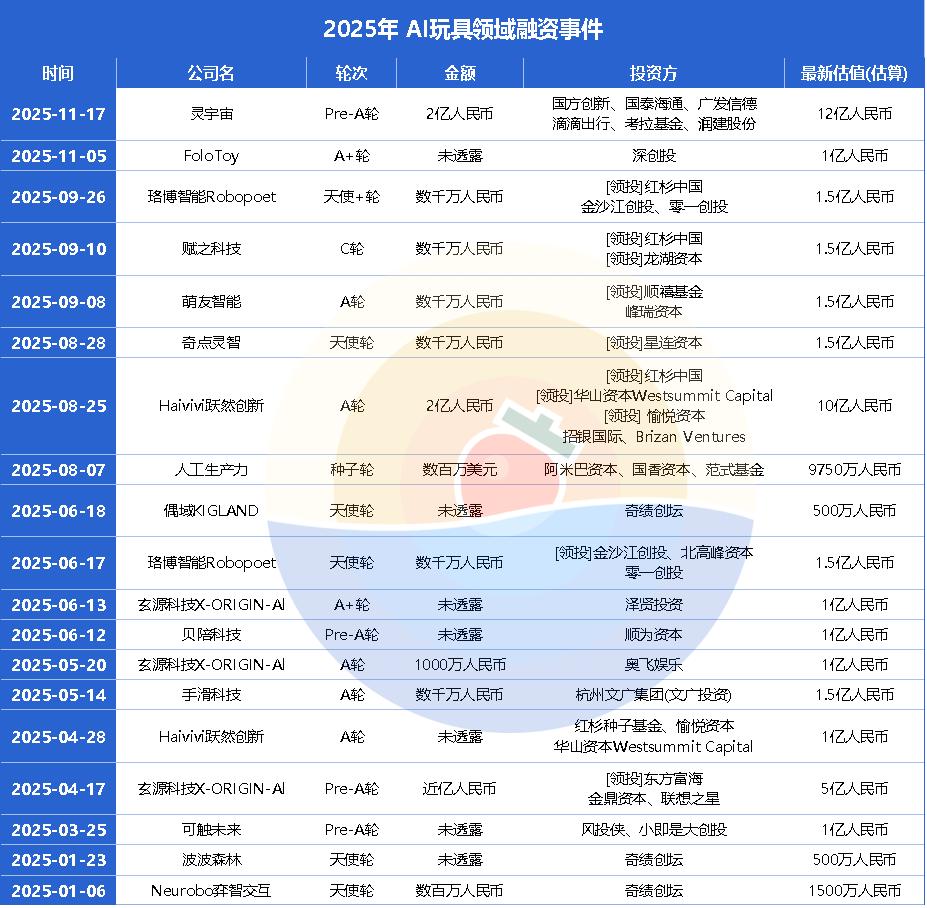
Core Insights - The AI toy sector is experiencing a surge in investment interest, driven by the commercialization of AI technology and the emergence of new companies in the market [1][2] - The global AI toy market is projected to reach nearly $20 billion by 2024, with a compound annual growth rate of approximately 14%-16%, potentially exceeding $35.11 billion by 2030 and $60 billion by 2034 [1] - Investment activity in the AI toy sector has significantly increased, with 19 financing events reported in 2025, up from 14 in 2024 and just 3 in 2023 [2] Investment Trends - The financing scale for AI toy companies has started at around tens of millions of RMB, with several companies founded in 2023-2024 already achieving valuations exceeding 1 billion RMB [2] - Major investment firms such as Sequoia China, GSR Ventures, and Didi Chuxing are actively participating in funding rounds, indicating strong institutional interest [2][13] - Notable financing events include Lingyu Universe's 200 million RMB Pre-A round and Haivivi's 200 million RMB A round, both achieving valuations over 1 billion RMB [4][7] Company Developments - Lingyu Universe, founded in 2023, has rapidly completed three rounds of financing within six months, achieving a valuation of 1.2 billion RMB [4] - Haivivi, originally focused on children's hardware, pivoted to AI toys in response to market changes and has successfully launched products like BubblePal, selling over 300,000 units [5][6] - Other companies in the sector, such as Robopoet and Bepei Technology, have also secured significant funding, contributing to the overall growth of the AI toy market [8] Market Dynamics - The AI toy market is characterized by a diverse range of products and a growing number of startups, with over 100 investment institutions involved [9][13] - The competitive landscape includes both established players and new entrants, with a focus on emotional interaction and user engagement as key selling points [11][18] - The decline in technology costs and the robust supply chain in regions like the Pearl River Delta are facilitating the rapid commercialization of AI toys [17] User Experience and Challenges - High return rates for some AI toys, reported at 20%-40%, highlight challenges in user experience and product differentiation [15] - Concerns about product quality and the prevalence of "pseudo-AI" products have been raised, indicating a need for genuine innovation in the sector [15] - The emotional value provided by AI toys is seen as a significant driver of demand, particularly in urban environments where companionship is increasingly sought after [18]
人形机器人在情感陪伴场景更易落地
Zhong Guo Zheng Quan Bao· 2025-12-07 20:22
Core Insights - Humanoid robots are seen as a key carrier of the Fourth Industrial Revolution and are expected to become an important factor in future productivity [1] - The humanoid robot industry is entering a critical mass production phase, with emotional interaction being a key to commercial viability [1][2] Industry Development - The year 2025 is projected to be the year of mass production for humanoid robots, with current technology having passed a basic threshold, although multiple bottlenecks remain [1] - Challenges include precision in operation, with current upper limb operation accuracy having centimeter-level discrepancies, and limitations in core components due to power semiconductor and material technology [1] - Full-sized humanoid robots are not yet ready for industrial production lines due to high precision requirements, with a forecast of three to five years needed for technological breakthroughs [1] Market Potential - There is a growing contradiction between the demand for companionship among family members and the insufficient time spent together, leading consumers to be willing to pay for quality emotional companion robots [2] - This niche market is expected to reach a scale of hundreds of billions, with the potential for over a million units to be promoted, providing a clear direction for commercialization [2] Differentiation Strategy - Companies must break free from traditional industrial application dependencies and seek new opportunities through differentiated competition [2] - Technological innovation is identified as the core driving force for company development, with Sichuan Embodied Technology developing the first "Emotion-Language-Action" large model (ELA) in China to support emotional interaction [2] - The company has launched two full-sized humanoid robot platforms, "Tianxing 1" and "Tianxing 2," along with the "Ling Tong" series of quadruped robots, covering various sectors such as industrial inspection, emergency rescue, cultural tourism services, and educational companionship [2] Product Innovation - Sichuan Embodied Technology leverages the industrial and cultural advantages of Chengdu to create unique product innovations [3] - The company aims to build a brand, ecosystem, and product IP by focusing on smart terminal products, integrating local cultural elements into product design through collaborations with industries like animation and gaming [3] - The goal is to make robots not just functional tools but also carriers of emotion and culture [3]

智能驾驶&座舱行业展望
2025-10-14 14:44
Industry and Company Analysis Summary Industry Overview - The smart driving and cockpit industry is experiencing significant collaboration among domestic OEMs, including BYD, Geely, Chery, FAW, Dongfeng, Changan, BAIC, SAIC, and GAC, with China Automotive Intelligent Technology (Tianjin) Co., Ltd. for research and user experience evaluation of intelligent connected vehicles [1][3] - The evaluation system for smart driving performance is based on N-CAP and CICAP standards, combined with consumer subjective evaluations, providing objective and scientific improvement suggestions for automakers [1] Key Companies and Their Performance - **Huawei**: Leading in L3 level autonomous driving with an aggressive strategy. Their ADS system has version differences, with high-end models like the Aito M8/M9 using ADS 4.0, while the M7 uses a downgraded version. Full features require additional payment, but the downgraded version is sufficient for low traffic cities and highways [1][8] - **Xpeng Motors**: Shows slightly lower stability compared to Huawei but performs well in certain scenarios [6] - **Li Auto**: Has a conservative but stable strategy, closely matching Huawei and Xpeng in overall performance [7] - **NIO and Xiaomi**: Positioned in the third tier, with NIO showing limited progress and Xiaomi needing algorithm optimization for better urban performance [7] Technological Developments - **Qualcomm 8,397 Chip**: Expected to be adopted by Li Auto and Xiaomi in 2026, with some traditional manufacturers potentially following suit due to issues with NVIDIA's Sora development [4][15] - **L2 Mandatory Standards**: Implementation is expected to increase compliance costs for automakers by 15%-20%, particularly affecting Xiaomi due to recent accident scenarios [4][17] User Experience Evaluation - The user experience evaluation for smart driving includes fixed-route tests in urban and highway environments, assessing various scenarios such as tunnels and complex intersections. The results are based on both professional evaluations and actual user feedback, ensuring a comprehensive analysis [5][10] Smart Cockpit Interaction - The evaluation of smart cockpit human-machine interaction focuses on usability, safety, creativity, and emotional engagement. New force car companies like NIO, Xpeng, and Li Auto excel in this area, while traditional manufacturers like BYD and Geely are catching up [12][13] - Huawei's HarmonyOS cockpit system is competitive but lacks customization features, leading to product homogenization [13] Future Trends - The future of smart cockpits will focus on five dimensions: visual, auditory, tactile, physiological monitoring, and optoelectronic applications. Key developments include DMS and OMS becoming mandatory standards, enhanced auditory quality, and more natural human-machine dialogue [19] - Touch interaction technology will rely on advancements in holographic technology, which could enable more complex gesture controls [20] Emerging Technologies Impacting Supply Chain - Technologies such as HUD and AR HUD, electronic rearview mirror systems, and smart seating are expected to significantly impact the automotive supply chain. These innovations will drive demand for related components and systems [22][25] Conclusion - The smart driving and cockpit industry is rapidly evolving, with significant advancements in technology and user experience evaluation. Key players like Huawei, Xpeng, and Li Auto are leading the charge, while regulatory changes are reshaping compliance costs and testing requirements. The future will see a focus on enhanced interaction and emerging technologies that will further transform the automotive landscape [1][4][19]


情绪价值,天价账单,首形科技卖「情感」能成吗?
Tai Mei Ti A P P· 2025-10-14 02:27
Core Viewpoint - The article discusses the rapid advancements and significant investments in Shouxing Technology, a company specializing in emotional robots, highlighting the shift in investor focus from efficiency to emotional value in the robotics industry [3][6][20]. Group 1: Investment and Financing - Shouxing Technology completed three rounds of financing between June and September 2025, with significant investments from major players like Ant Group, indicating strong market confidence in its technology [4][6]. - The funds raised are primarily aimed at iterating the emotional base model and applying it across various scenarios, showcasing a clear strategic direction [4][6]. Group 2: Emotional Value vs. Efficiency - The company represents a shift in the robotics industry, where emotional robots are seen as creating new market spaces, contrasting with traditional efficiency-focused robots [7][20]. - Investors are increasingly valuing emotional robots for their potential to establish human-robot emotional connections, which is viewed as a critical element for the next generation of human-machine interaction [6][7]. Group 3: Technological Advancements - Shouxing Technology's emotional base model integrates multimodal information, allowing robots to recognize and predict human emotions, thus overcoming the "uncanny valley" effect [8][10]. - The company has developed a bionic facial system driven by 26 micro-motors, enhancing the robot's ability to interact naturally with humans [10]. Group 4: Commercialization Challenges - Despite a reported gross margin of 61.99%, this figure is based on small-batch custom production, raising concerns about the company's long-term profitability as it scales [12][16]. - The company faces significant challenges in defining a sustainable business model, particularly in the consumer market, where emotional value is difficult to quantify [18][20]. Group 5: Market Dynamics and Competition - The emotional robot market is under pressure from virtual alternatives that offer similar emotional support at a lower cost, challenging the pricing strategy of physical robots [18][19]. - Historical examples of failed high-end tech products serve as cautionary tales for Shouxing Technology, emphasizing the need for a balance between artistic value and functional performance [15][19]. Group 6: Future Outlook - The financing success of Shouxing Technology reflects a broader market reassessment of the value of emotional robots, but the company must prove its technology can deliver sustainable returns to maintain investor confidence [20].
当AI学会去爱:在游戏中重塑亲密关系 | 张志会 Jaz | TEDxSongze Ave
TEDx Talks· 2025-10-10 14:24
Company Focus - CYBERPINKY, a "female emotional service" company, was founded and incubated by ANTLER and NVIDIA [1] - CYBERPINKY is pioneering a new upgrade in female emotion and virtual companionship through the "Ruyi Qing Tan" series, integrating large models, multi-modal interaction, IP creation, and gamified innovative narratives [1] - The company is exploring the boundaries and possibilities of AI in human emotional connection within the "female x technology" sector [1] Technological Innovation - The company is developing an "emotional engine" by combining AI technology with Otome games to understand and respond to women's delicate emotions [1] - The company is exploring how AI can deeply understand, respond to, and carry women's emotions, making technology a catalyst for real emotional connections [1] - The company is integrating cutting-edge AI with innovative storytelling to create unique emotional interaction and virtual companionship experiences for women [1] Founder's Background - Zhang Zhihui, the founder, has over ten years of innovation experience spanning entertainment and technology, with previous roles at the National Centre for the Performing Arts, Disney (US & Shanghai) [1] - Zhang Zhihui holds a Bachelor's degree in Automation from the Communication University of China, a Master's degree in Service Management from Cornell University, and an MBA from Peking University [1] - In 2022, Zhang Zhihui co-founded AI computer vision company Susulin Technology, which won several AI entrepreneurship and innovation awards and represented China's AI enterprise ecosystem at the 2024 NVIDIA GTC Global Conference [1]