房地产下行

Search documents
PPI“失去十五年”之谜︱重阳荐文
重阳投资· 2026-01-26 07:32
Core Viewpoint - The Producer Price Index (PPI) in China has shown zero growth over the past 15 years, despite a significant GDP increase of 250% during the same period, indicating a persistent weakness in PPI and underlying demand issues [1][5]. Group 1: PPI Trends and Historical Context - The PPI has been in a declining trend since October 2021, with a year-on-year decrease of 1.9% reported for December 2025, marking 39 consecutive months of decline [1][5]. - Historical data shows that from March 2012 to August 2016, PPI experienced negative growth for 54 months, and from July 2019 to January 2021, there were 18 months of negative growth [1][5]. - The PPI index, set at 100 in December 2010, remained at 100 by December 2025, indicating no overall price increase in 15 years [1][5]. Group 2: Factors Influencing PPI - The PPI's long-term decline is attributed to an oversupply in production capacity, particularly after China's entry into the WTO, which led to a significant drop in export dependence [12][13]. - The fluctuation in PPI is primarily influenced by the prices of production materials, which have shown a cumulative increase of zero over the past 15 years, while living material prices have increased by 4.4% [8][11]. - The prices of living materials peaked at 108.4% in November 2022 before declining, likely due to the end of pandemic-related restrictions [9]. Group 3: Demand and Supply Dynamics - The weak demand in the downstream market, particularly after the real estate sector peaked in 2021, has hindered the transmission of price increases from upstream to downstream sectors [41][42]. - The relationship between real estate investment and PPI is evident, with a significant drop in real estate investment correlating with the decline in PPI [36][38]. - The overall demand for consumer goods has been on a downward trend, with industrial value-added growth outpacing terminal demand growth since 2020, indicating a supply surplus [31][33]. Group 4: Recommendations for Economic Adjustment - To promote a moderate recovery in price levels, it is essential to adjust the supply-demand relationship, particularly by expanding effective demand [42]. - The focus should be on increasing the income of middle and low-income groups to stimulate consumption, while stabilizing the real estate market to alleviate oversupply issues [52]. - The government should optimize fiscal spending structures to enhance direct transfers to residents, thereby increasing disposable income and consumption [52].

明明是要提振消费,怎么成了鼓励贷款了?
Sou Hu Cai Jing· 2025-12-14 13:00
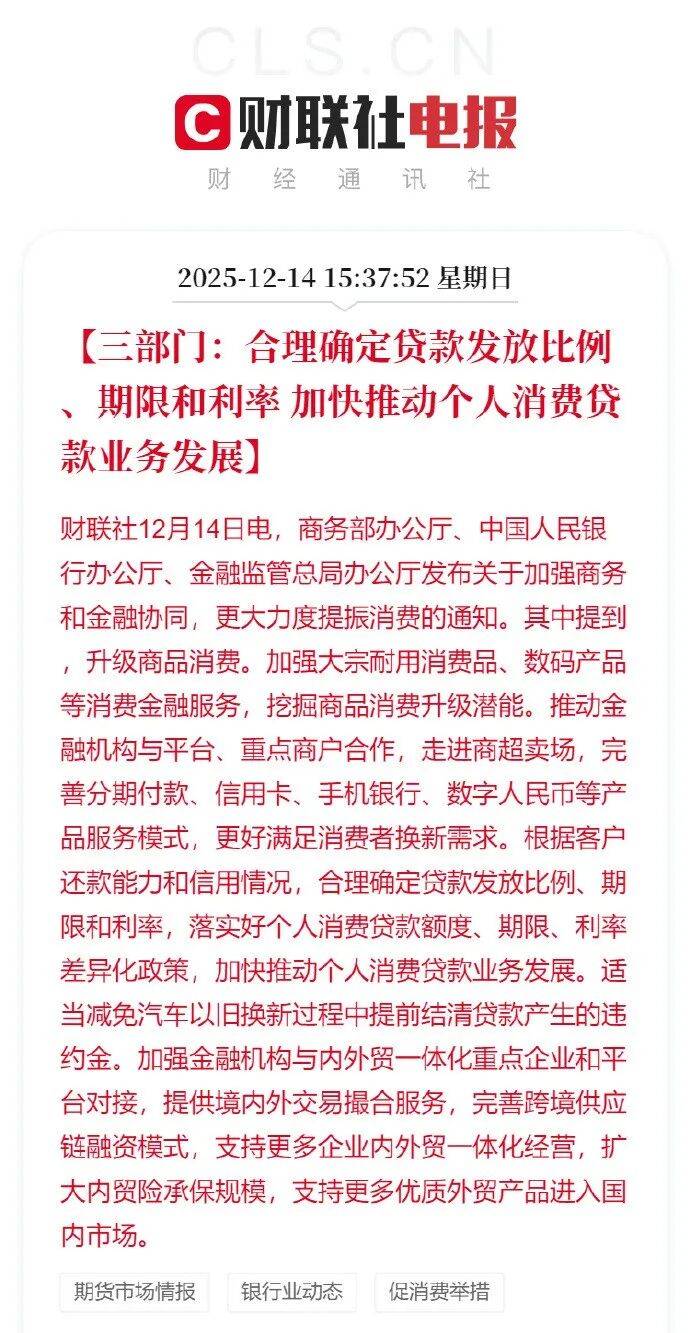
Group 1 - The recent announcement from the Ministry of Commerce, the Central Bank, and the Financial Regulatory Authority focuses on boosting consumer spending by facilitating personal consumption loans [4] - The strategy appears to aim at fundamentally changing the growth model rather than merely stimulating consumption, as indicated by the continuation and potential expansion of national subsidies [4] - Despite the nominal growth of per capita disposable income and consumption expenditure both at 5.3% in 2024, the growth rate of net property income at 2.2% lags behind wage income growth of 5.8%, indicating a reliance on wage income rather than asset appreciation [4][5] Group 2 - The decline in real estate has directly reduced household income, leading to a perception of reduced wealth and consequently tighter spending [5] - The overall household debt level decreased slightly from 63.5% to 63.2% between Q2 and Q3 of 2024, but this is significantly higher than the 20% level a decade ago, indicating a rapid increase in debt primarily driven by housing [6] - The trend of proactive deleveraging is evident, with more individuals opting for early mortgage repayments than taking out new loans, reflecting a cautious approach to financial management [6] Group 3 - Consumer confidence index remains below the neutral line of 100, indicating persistent pessimism among consumers, with a recorded value of 89.4 in October 2025 [7][8] - The decline in real estate prices has led to a reduction in household wealth, affecting consumer spending and employment across related industries [8] - The fundamental issue is identified as insufficient total demand and lack of consumer confidence, rather than inadequate credit supply [10] Group 4 - The approach of increasing credit supply to stimulate consumption is seen as a supply-side solution to a demand-side problem, which may not yield sustainable results [10] - The strategy may lead to a short-term boost in consumption data but risks exacerbating long-term debt burdens and potentially creating new bad debts if economic conditions do not improve [11][12]
数据有点异常!房地产一些风险要注意了
Sou Hu Cai Jing· 2025-11-05 05:08
Economic Outlook - The economic growth momentum has weakened since Q3 2025, with GDP growth expected to decline to approximately 4.8% in Q3 and 4.5% in Q4, although the annual growth target of around 5% is still achievable due to strong performance in the first half of the year [1][7] - The report indicates that the main reasons for the weakening domestic demand include the reduction in the effectiveness of the trade-in subsidy policy and a significant decline in restaurant consumption, which aligns with previous analyses [3][5] Consumer Spending - From January to August, the total retail sales of consumer goods grew by 4.6% year-on-year, a decrease of 0.4 percentage points compared to the first half of the year [5] - The decline in retail sales growth is primarily attributed to the diminishing impact of the trade-in subsidy policy, with sales growth for home appliances and communication equipment dropping significantly [5] - Service consumption has outperformed goods consumption, contributing positively to overall consumption growth, with service retail sales increasing by 5.1% compared to 4.8% for goods [5][3] Real Estate Market - The real estate market has accelerated its downturn since Q3, with pressures on both supply and demand sides becoming more pronounced [6] - Demand has decreased due to a continuous decline in residents' willingness to purchase homes, while supply is increasing with a residential inventory of 400 million square meters, reflecting a year-on-year increase of 5.4% [6][8] Housing Supply Issues - The average housing supply interruption rate across the country has risen to 3.7%, up from 1.6% in 2022, with some third and fourth-tier cities exceeding 5% [8] - This represents a 130% increase in mortgage interruption rates over three years, highlighting significant challenges in the housing market [8] Future Economic Predictions - The report provides forecasts for various economic indicators for Q3 and Q4 of 2025, suggesting a cautious outlook for the macroeconomic environment if no new stimulus policies are introduced [10][7]


在房产高峰期上车的人,现在怎么样了?后悔了吗?
Sou Hu Cai Jing· 2025-10-21 17:16
Core Insights - The real estate market has been in decline for two to three years, impacting individuals who purchased properties between 2020 and 2022 [1] Group 1: Individual Experiences - A leader in the company bought a three-bedroom apartment in Longgang for 4 million yuan in 2021, while also owning a two-bedroom apartment in Shenzhen, resulting in a loss of over 800,000 yuan due to market decline [2] - The leader's wife lost her job, increasing financial pressure on him, but he managed to sell the two-bedroom apartment at a loss of 600,000 yuan, ultimately balancing out the gains and losses from both properties [3][4][5] - A friend purchased a four-bedroom apartment in Huizhou for 1.5 million yuan, expecting appreciation, but the property value has halved, leaving it unsellable and un-rentable [6][7] - Another friend, who owned a restaurant, faced severe financial difficulties after buying a property during a peak period, leading to unpaid mortgage and eventual divorce [9][10][11] Group 2: Broader Implications - Some individuals have managed to cope with the downturn due to stable incomes, while others faced layoffs and struggled to sell their properties at reasonable prices [12] - The narrative highlights the importance of adaptability in the job market, as illustrated by a case of an individual with a high salary who has been unemployed for two years, emphasizing the need for flexibility in job acceptance [13]