房地产市场小阳春

Search documents
3月楼市销售数据及市场趋势解读
2026-04-01 09:59
Summary of Real Estate Market Conference Call Industry Overview - The conference call discusses the real estate market in March 2026, focusing on the performance of the Top 100 real estate companies and the overall market trends [1][2][3][4][5][6][7][8][9][10][11][12]. Key Points Market Performance - In March 2026, the Top 100 real estate companies saw a month-on-month increase in operational amounts by approximately 118%, although year-on-year, there was a decline of 15.1% [1][2]. - The cumulative operational amount for the first quarter of 2026 decreased by 23.8% year-on-year [2]. - The sales performance of the top three companies showed a smaller decline of 6.2% year-on-year, while companies ranked 50 to 100 experienced a decline of only 5.5% [2]. New Housing Market - The new housing market showed signs of weak recovery with a month-on-month increase in transaction area of 89% in March, but a year-on-year decrease of 32% [3]. - The supply of new homes in 50 key cities decreased significantly, with a year-on-year drop of nearly 60%, leading to constrained transaction volumes [3][4]. - The first quarter's cumulative supply saw a year-on-year decline of 42% [3]. Second-Hand Housing Market - The second-hand housing market outperformed the new housing market, with a month-on-month increase of 117% in transaction area and a year-on-year increase of 6% in March [8]. - The overall first quarter saw a 4% year-on-year increase in second-hand housing transactions [8]. - In major cities, second-hand housing transactions accounted for 60% to 70% of total transactions, indicating a shift in buyer preference towards more affordable options [8]. City-Level Analysis - The performance of different city tiers showed significant differentiation. Third and fourth-tier cities experienced a smaller year-on-year decline of 9%, while first-tier cities faced declines exceeding 30% [4]. - Major cities like Beijing, Shanghai, and Shenzhen saw significant drops in transaction volumes, while Guangzhou remained relatively stable [4]. Land Market Trends - The land market showed an increase in transaction scale and amount, with a month-on-month increase of 21% and a year-on-year increase of 2% as of March 25, 2026 [9]. - However, the overall enthusiasm for land auctions has declined, with companies focusing on high-quality land in core cities [9]. Policy Direction - Future policies are expected to focus on "controlling growth, reducing inventory, and optimizing supply," moving away from strong stimulus measures [11][12]. - Specific measures may include reforms to the housing provident fund system and targeted subsidies for first-time buyers and families with multiple children [11][12]. Market Sentiment - Despite weak macro data, there are signs of improved market sentiment, with increased foot traffic in sales offices in cities like Guangzhou and Changsha [6][7]. - The market is expected to stabilize and gradually recover, particularly in the second-hand housing sector, as inventory levels decrease and viewing activity increases [9]. Investment Strategies - Leading real estate companies are focusing their investments on high-quality land in core cities, while also exploring urban renewal projects [12]. - The cautious investment attitude reflects the ongoing market stabilization phase and the competitive landscape in core urban areas [12]. Additional Insights - The differentiation in market performance is not only evident between city tiers but also within projects in the same city, highlighting a significant structural divide [5][6]. - The overall market is expected to continue its bottoming process, with the second quarter of 2026 being a critical observation period for confirming market stability [9].



2026年1-2月中国房企业绩分析报告
克而瑞地产研究· 2026-02-28 14:00
Core Insights - The second-hand housing market in key cities has seen a slight year-on-year increase in cumulative sales, with a total transaction area of approximately 1,509 million square meters, reflecting a 2% increase compared to the previous year [14][28] - In February 2026, typical real estate companies achieved a sales operation amount of 123.42 billion yuan, with a cumulative sales operation amount of 288.87 billion yuan for the first two months [15][17] Group 1: Sales Performance - In February 2026, typical real estate companies recorded a single-month sales operation amount of 123.42 billion yuan, with a year-on-year increase in sales for 29 companies [21][22] - The top-performing companies included several small and medium-sized private enterprises, with nine companies experiencing sales growth exceeding 100% [21][22] - Notably, China State Construction's sales increased by 114.5%, largely due to the success of its high-end project in Shanghai [22][23] Group 2: Policy Environment - Central authorities have emphasized the need for continued monetary and credit support to stabilize the real estate market, with local governments implementing various supportive policies [25][26] - Shanghai's recent policy changes, including relaxed purchase restrictions and optimized housing fund policies, are expected to positively influence market expectations [27] Group 3: Market Trends - The new housing market in February 2026 saw a total transaction area of approximately 6.75 million square meters, with a notable decline in first and second-tier cities but a slight increase in third and fourth-tier cities [28] - The land market remains at a seasonal low, but there has been a noticeable increase in land auction activity, with a total transaction area of 2.157 million square meters and a transaction amount of 72.4 billion yuan [29] - The upcoming "small spring" in March is anticipated to see a rebound in transaction volumes across new homes, second-hand homes, and land markets due to pent-up demand and easing of restrictions [30]




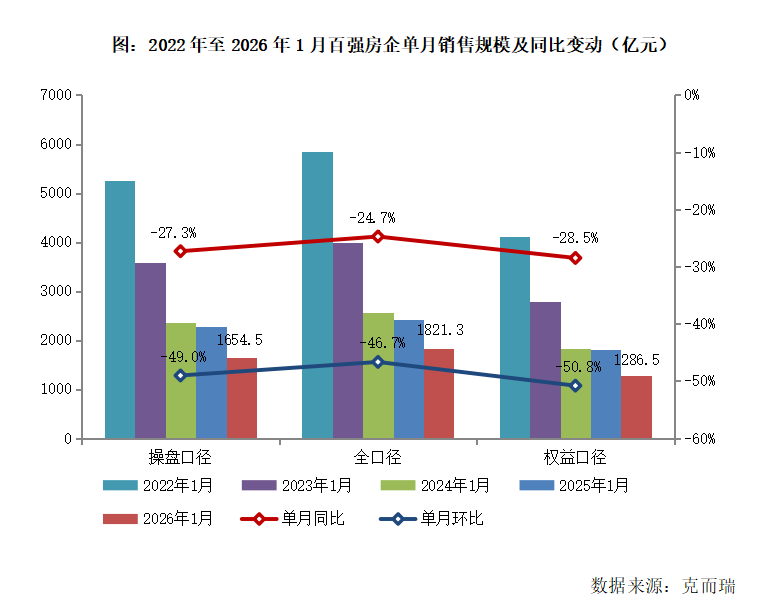
克而瑞地产研究:1月新房市场整体进入淡季 百强房企单月业绩1654.5亿元
智通财经网· 2026-02-11 13:19
Core Viewpoint - The real estate market in China is experiencing a seasonal slowdown in January 2026, but there are signs of recovery in the second-hand housing market in key cities, which may stabilize market expectations and lead to a potential "small spring" after the Spring Festival, especially with supportive policies in place [1][12]. Group 1: Sales Performance - The top 100 real estate companies achieved a total sales amount of 165.45 billion yuan in January 2026 [2][8]. - 32 companies among the top 100 reported year-on-year sales growth, with 10 companies experiencing growth rates exceeding 100% [8][10]. - Notably, companies like Junyi Holdings and Bangtai Group saw significant increases in sales, with Junyi Holdings reporting a staggering growth of 757.4% [10]. Group 2: Market Dynamics - The new housing market showed weak performance with a transaction area of approximately 8.1 million square meters, while the second-hand housing market saw a 16% month-on-month increase and a 33% year-on-year increase in transaction area [12]. - The central government has introduced various supportive policies focusing on urban renewal, financing optimization, and tax incentives to stimulate the real estate market [12][13]. Group 3: New Entrants and Rankings - In January 2026, seven new companies entered the top 100 list, with CITIC City Opening making a notable entry into the top 30 [5][6]. - The sales performance of new entrants indicates that some small and medium-sized private enterprises are managing to maintain stable operations and achieve growth despite market challenges [5][8].

内房股早盘普涨 上海推进二手房收储 一线城市二手房成交回暖
Zhi Tong Cai Jing· 2026-02-04 02:25
Group 1 - The core viewpoint of the article highlights a significant increase in the stock prices of Chinese real estate companies, driven by supportive government measures for the housing market [1] - China Construction Bank is backing the first batch of second-hand housing acquisitions in Shanghai for affordable rental housing projects, focusing on older small-sized second-hand homes in specific districts [1] - According to CICC, the listing volume of second-hand homes in Shanghai has started to decline since Q3 2025, leading to a continuous decrease in the listing turnover cycle [1] Group 2 - In January, Beijing's second-hand housing transaction volume exceeded 15,000 units, maintaining stability above 14,000 units for three consecutive months [1] - Shanghai's second-hand housing transactions have also surpassed 22,000 units for three consecutive months, while Shenzhen recorded 6,802 units, marking a nearly 10-month high [1] - Guangzhou's second-hand residential net signing reached 8,881 units, indicating strong market resilience, with industry experts noting an early emergence of a "small spring" in the real estate market [1]
港股异动 | 内房股早盘普涨 上海推进二手房收储 一线城市二手房成交回暖
智通财经网· 2026-02-04 02:19
Group 1 - The real estate stocks in China experienced a significant increase in early trading, with notable gains from companies such as Yuexiu Property (+4.01%), China Overseas Land & Investment (+4%), and China Resources Land (+3.89%) [1] - China Construction Bank is supporting the first batch of second-hand housing acquisitions in Shanghai for affordable rental housing projects, focusing on older small-sized second-hand homes in specific districts [1] - According to CICC, the listing volume of second-hand homes in Shanghai has been declining since Q3 2025, indicating a positive response to supply pressures in the housing market [1] Group 2 - In January, Beijing's second-hand housing transaction volume exceeded 15,000 units, remaining stable above 14,000 units for three consecutive months, while Shanghai's transactions surpassed 22,000 units [2] - Shenzhen recorded 6,802 second-hand homes sold, marking a nearly 10-month high, and Guangzhou saw 8,881 units, indicating strong market resilience [2] - Industry experts suggest that a "small spring" in the real estate market is emerging, with the second-hand market showing early signs of recovery, making post-Spring Festival listing changes a key observation point for supply-demand dynamics [2]

淡季不淡,一线城市二手房成交集体回暖
Di Yi Cai Jing· 2026-02-03 08:28
Core Insights - The second-hand housing market in first-tier cities is showing signs of independent recovery, with significant increases in transaction volumes despite the traditional off-season [1] - The market is experiencing a "small spring" ahead of the usual peak season, indicating a potential bottoming out of prices and a shift in market sentiment [1] Beijing Market - In January, Beijing's second-hand housing transaction volume reached 15,082 units, maintaining above 14,000 units for three consecutive months [5] - The market's recovery began after the introduction of new supportive policies on December 24, 2025, which included easing purchase requirements for non-local buyers and supporting families with multiple children [5] - The demand for second-hand school district homes has surged, with prices in some areas increasing by approximately 100,000 to 150,000 yuan [5] Shanghai Market - Shanghai's second-hand housing transactions also saw a rise, with January figures reaching 22,834 units, marking a five-year high [8] - The listing volume in Shanghai has decreased for nine consecutive months, dropping from around 120,000 units in April 2025 to 89,000 units in January 2026, a decline of 26% [9] - The shift in landlord mentality, with many opting to hold onto properties rather than engage in price competition, has contributed to the declining listing volume [9] Guangzhou and Shenzhen Markets - Guangzhou's second-hand housing market recorded 8,881 transactions in January, showing resilience with a slight month-on-month increase [10] - In Shenzhen, the transaction volume reached 6,802 units, a 2.9% increase month-on-month and a 45.5% increase year-on-year, marking a ten-month high [10] - The average price in Shenzhen remained stable at 50,801 yuan per square meter, with a notable increase in transactions for high-quality properties [10] Market Sentiment and Future Outlook - The overall sentiment in the first-tier cities remains positive, with a significant portion of respondents in a survey indicating expectations of stable or increasing prices [11] - The market is expected to continue its recovery, driven by strong demand and favorable policies, with predictions of good transaction volumes in the upcoming months [12] - However, the market still faces challenges, including the need for further reductions in transaction costs and improvements in consumer confidence [12]
2026年3月小阳春稳了,下半年市场看政策力度
Xin Lang Cai Jing· 2026-01-27 08:31
Core Viewpoint - The real estate market is showing signs of recovery in early 2026, supported by policies and market sentiment, with a strong likelihood of a "small spring" in March, although the sustainability of this recovery depends on future policy measures [1][10] Group 1: Market Indicators - As of early March, new home transaction area in 30 cities increased by 1% year-on-year, while second-hand home transaction area surged by 39% in 16 cities, exceeding market expectations [3] - The new home subscription index has been rising since the Spring Festival, approaching the relative high point of October 2024, indicating a potential increase in March transactions [3] - The daily viewing index for second-hand homes in early March was 12% higher than the peak in October 2024, driving up transaction activity [3] Group 2: Policy Support - Systematic support from the central government is crucial for the realization of the "small spring," including tax rebates on personal income for home purchases extended to the end of 2027, saving buyers thousands on a 3 million home [4] - The optimization of capital gains tax for homes sold within two years has reduced the tax rate from 5% to 3%, significantly lowering the transaction threshold for second-hand homes [4] - Mortgage rates have reached historical lows, with some cities offering first-time home loan rates as low as 3.05%, reducing monthly payments by approximately 1200 yuan for a 1 million loan over 30 years [4] Group 3: Supply-Side Risk Management - The normalization of the real estate financing "white list" system has alleviated funding pressures for over 8000 projects, with loans exceeding 2 trillion yuan [6] - The promotion of existing home sales trials has mitigated risks of unfinished projects, ensuring funds are used specifically for their intended purposes [6] - High-quality residential properties are commanding a premium, with prices per square meter in compliant buildings in Beijing and Hangzhou exceeding ordinary units by 800-1500 yuan, highlighting the importance of quality in driving demand [6] Group 4: Market Structural Differentiation - Despite the potential for a "small spring," significant structural differentiation in the market persists, with first-tier and strong second-tier cities expected to stabilize first, while many third and fourth-tier cities face population outflows and high inventory [7] - The transaction volume for homes under 90 square meters in first-tier cities increased by 12%, while larger units over 120 square meters require price reductions of over 20% to sell [7] - The shift from "location is everything" to "quality is king" reflects changing consumer preferences in the market [7] Group 5: Consumer Confidence and Future Policy Needs - Weak consumer confidence remains a major barrier to sustained market recovery, with only 2% of surveyed individuals planning to buy a home in the next 12 months, and 67% of respondents in first-tier cities expecting price declines [9] - There is a strong expectation for policies supporting home purchase subsidies, monetary arrangements, and loan support, indicating a direction for future policy efforts [9] - The key variables for market direction in the second half of the year will be the strength and precision of policy measures aimed at stimulating demand and addressing risks [9]