房地产政策调控

Search documents
重庆:实施多子女家庭购房补贴,优化住房公积金贷款政策
Xin Lang Cai Jing· 2026-02-09 10:00
Group 1 - The core viewpoint of the article is the introduction of financial incentives to stabilize the real estate market in Chongqing, China, through subsidies for families with two or three children purchasing new homes [1] Group 2 - The Chongqing Municipal Housing and Urban-Rural Development Committee, along with relevant departments, issued a notice on February 9 to enhance policy integration effects in the real estate market [1] - Families with two children will receive a subsidy of 20,000 yuan, while families with three children will receive 30,000 yuan when purchasing new homes in the central urban area [1] - The subsidy is limited to one-time assistance per family and is applicable only for homes that have completed online signing and contract filing [1] - To support improved housing demand, families using housing provident fund loans for new home purchases will have the recognized number of housing units reduced by one if they already own a home in the district where the new purchase is located [1]
房地产行业深度报告:房地产行业:销售延续调整,“控增量、去库存”下投资承压
金融街证券· 2026-01-29 10:25
Investment Rating - The report maintains an "Outperform" rating for the real estate industry, indicating a positive outlook compared to the broader market [3]. Core Insights - The report highlights that the sales of new homes in China are expected to decline, but the rate of decline is slowing down. In 2025, the total sales of commercial housing are projected to be 8.39 trillion, a year-on-year decrease of 12.6%, while the sales area is expected to be 881 million square meters, down 8.7% year-on-year [4][9]. - The report emphasizes the ongoing inventory reduction efforts, with the area of existing home sales increasing to 316 million square meters, accounting for 35.91% of total sales area, which is a 5.07% increase from 2024 [15][19]. - The report notes that the second-hand housing market is experiencing an upward trend in transaction volume, which is partially diverting demand from new homes. The prices of second-hand homes are under pressure, which may impact new home sales [30][28]. Summary by Sections New Homes - The sales scale of new homes is expected to decline in 2025, but the decline rate is narrowing. The total sales amount is projected at 8.39 trillion, with a year-on-year decrease of 12.6%, and the sales area at 881 million square meters, down 8.7% year-on-year [4][9]. - The report indicates that the sales area decline is less severe than the sales amount decline, suggesting a trend of "price for volume" [9][10]. Second-Hand Homes - The report states that the transaction area of second-hand homes is on the rise, with a total sales area of 201 million square meters in 2025, showing a slight year-on-year decrease of 0.2% [28][26]. - The prices of second-hand homes are under pressure, with a year-on-year decline of 7% in first-tier cities, which may affect new home sales due to increased competition [30][31]. Land Market - The report notes a reduction in the total area of land sold in 300 cities, with a total planning area of 624 million square meters, down 13.27% year-on-year. However, the average land price has increased compared to 2024 [39][41]. - State-owned enterprises are leading in land acquisition, with major players like China Overseas Land, China Merchants Shekou, and Poly Developments being the top three in land acquisition amounts [41][42]. Investment Trends - The report highlights a continued decline in real estate development investment, with a cumulative year-on-year decrease of 13.9% in December. The report indicates that the market is still under pressure, with no clear signs of recovery [45][48]. - New construction and completion areas are also experiencing a decline, with new construction down 20.4% year-on-year, reflecting a cautious approach from developers in response to market conditions [48][50]. Hong Kong Real Estate Market - The report discusses the easing of housing policies in Hong Kong, which has reduced transaction costs and attracted new demand. The influx of talent has also increased rental demand, contributing to a gradual recovery in rental prices [52][56]. - The report notes that the mortgage rates in Hong Kong have decreased, falling below rental yields, which has improved the attractiveness of property investments [58][59]. Investment Recommendations - The report suggests focusing on developers with sufficient new value in core areas, such as Country Garden, Greentown China, and China Resources Land. It also recommends paying attention to real estate ETFs like Huabao CSI 800 Real Estate ETF and Southern CSI All-Share Real Estate ETF [60][62].
2026年3月小阳春稳了,下半年市场看政策力度
Xin Lang Cai Jing· 2026-01-27 08:31
Core Viewpoint - The real estate market is showing signs of recovery in early 2026, supported by policies and market sentiment, with a strong likelihood of a "small spring" in March, although the sustainability of this recovery depends on future policy measures [1][10] Group 1: Market Indicators - As of early March, new home transaction area in 30 cities increased by 1% year-on-year, while second-hand home transaction area surged by 39% in 16 cities, exceeding market expectations [3] - The new home subscription index has been rising since the Spring Festival, approaching the relative high point of October 2024, indicating a potential increase in March transactions [3] - The daily viewing index for second-hand homes in early March was 12% higher than the peak in October 2024, driving up transaction activity [3] Group 2: Policy Support - Systematic support from the central government is crucial for the realization of the "small spring," including tax rebates on personal income for home purchases extended to the end of 2027, saving buyers thousands on a 3 million home [4] - The optimization of capital gains tax for homes sold within two years has reduced the tax rate from 5% to 3%, significantly lowering the transaction threshold for second-hand homes [4] - Mortgage rates have reached historical lows, with some cities offering first-time home loan rates as low as 3.05%, reducing monthly payments by approximately 1200 yuan for a 1 million loan over 30 years [4] Group 3: Supply-Side Risk Management - The normalization of the real estate financing "white list" system has alleviated funding pressures for over 8000 projects, with loans exceeding 2 trillion yuan [6] - The promotion of existing home sales trials has mitigated risks of unfinished projects, ensuring funds are used specifically for their intended purposes [6] - High-quality residential properties are commanding a premium, with prices per square meter in compliant buildings in Beijing and Hangzhou exceeding ordinary units by 800-1500 yuan, highlighting the importance of quality in driving demand [6] Group 4: Market Structural Differentiation - Despite the potential for a "small spring," significant structural differentiation in the market persists, with first-tier and strong second-tier cities expected to stabilize first, while many third and fourth-tier cities face population outflows and high inventory [7] - The transaction volume for homes under 90 square meters in first-tier cities increased by 12%, while larger units over 120 square meters require price reductions of over 20% to sell [7] - The shift from "location is everything" to "quality is king" reflects changing consumer preferences in the market [7] Group 5: Consumer Confidence and Future Policy Needs - Weak consumer confidence remains a major barrier to sustained market recovery, with only 2% of surveyed individuals planning to buy a home in the next 12 months, and 67% of respondents in first-tier cities expecting price declines [9] - There is a strong expectation for policies supporting home purchase subsidies, monetary arrangements, and loan support, indicating a direction for future policy efforts [9] - The key variables for market direction in the second half of the year will be the strength and precision of policy measures aimed at stimulating demand and addressing risks [9]


地产情绪升温,关注政策催化
GOLDEN SUN SECURITIES· 2026-01-25 11:19
Investment Rating - The report maintains a "Buy" rating for key stocks in the construction materials sector, including Yao Pi Glass, Yinlong Co., Puyang Co., San Ke Tree, and Bei Xin Materials, while recommending "Hold" for Wei Xing New Materials [7]. Core Insights - The construction materials sector saw a significant increase of 7.50% from January 19 to January 23, 2026, outperforming the Shanghai and Shenzhen 300 index by 8.17% [12]. - The Ministry of Housing and Urban-Rural Development emphasized urban renewal, focusing on the renovation of old urban communities, complete community construction, and the transformation of small public spaces [1]. - The report highlights a decrease in local government bond issuance, indicating a potential easing of fiscal pressure and a chance for municipal engineering projects to accelerate [1]. - The glass industry is approaching a supply-demand balance, with a focus on the photovoltaic glass sector amid production cuts to alleviate supply tensions [1]. - The cement industry is experiencing a demand downturn, with prices fluctuating around the breakeven point, while supply-side improvements are anticipated [1]. Summary by Sections Cement Industry Tracking - As of January 23, 2026, the national cement price index was 345.33 CNY/ton, down 0.5% week-on-week, with a significant drop in cement output and supply [18]. - The capacity utilization rate for cement clinker kilns was 42.42%, reflecting a 1.72 percentage point increase from the previous week [18]. - The report notes a complex market situation influenced by weather, funding constraints, and environmental regulations, leading to a projected weakening in demand as the Spring Festival approaches [18]. Glass Industry Tracking - The average price of float glass as of January 22, 2026, was 1138.82 CNY/ton, with a slight increase of 0.05% week-on-week [35]. - Inventory levels for float glass showed a decrease of 9 million weight boxes compared to the previous week, but a year-on-year increase of 1188 million weight boxes [35]. - The report anticipates stable pricing in the short term, with potential policy changes affecting supply dynamics [35]. Fiberglass Industry Tracking - The market for fiberglass remains stable, with no significant changes in production capacity or pricing observed [6]. - Demand for high-end electronic yarns is expected to remain strong, while ordinary products may see moderate price increases [6]. Consumer Building Materials - The consumer building materials sector is experiencing a weak recovery, with rising prices for upstream raw materials such as aluminum and natural gas [6]. - The report emphasizes the potential for long-term market share growth in consumer building materials due to ongoing renovation demand [1]. Carbon Fiber Industry Tracking - The carbon fiber market is stable, with production rates and costs remaining consistent, although profit margins are under pressure [6]. - Import and export data indicate a net import of carbon fiber products, with significant price differentials between imports and exports [6].


房地产市场一线观察:存量与增量并重 区位分化扩大
Xin Hua Wang· 2026-01-23 22:53
Core Insights - The real estate market is experiencing structural changes with a focus on both existing and new properties, as well as a widening differentiation among regions [1][2][4] - Recent policies aimed at stabilizing the market, such as tax refunds for housing exchanges and lower mortgage rates, have led to increased activity in certain cities, particularly in the second-hand housing market [1][2] Group 1: Policy Impact - Recent policy adjustments in cities like Beijing, Shenzhen, and Chengdu have lowered purchasing thresholds and improved transaction efficiency, benefiting first-time buyers and those looking to upgrade their homes [1][2] - The introduction of tax reduction policies has increased interest in properties that are less than two years old, leading to a notable rise in transactions [1] Group 2: Market Trends - By 2025, the proportion of second-hand housing transactions is expected to rise to 44.6% of total housing transactions, indicating a growing significance of the second-hand market [2] - Major cities such as Beijing, Shanghai, and Guangzhou are seeing over 60% of their residential transaction volumes come from second-hand properties, highlighting a shift in market dynamics [2] Group 3: Regional Differentiation - There is a clear differentiation in sales performance among various districts and projects within the same city, with high-quality new developments achieving over 70% sales rates, while older properties struggle [3] - Core cities are witnessing a strong demand for premium land parcels, reflecting a preference for quality over quantity in real estate development [3] Group 4: Supply and Demand Dynamics - As of the end of 2025, the total area of unsold commercial housing is projected to decrease to 76,632 million square meters, indicating effective supply-side measures [4] - The collaboration between supply-side controls and demand-side stimulus is expected to lead to a more balanced and optimized real estate market [4] Group 5: Long-term Outlook - Despite a decline in overall sales volume, there remains a long-term demand for housing driven by changing population dynamics and the need for diversified housing solutions [5] - The real estate market is transitioning towards a model that better aligns housing supply with population movement and industrial development, aiming to meet the diverse needs of different demographic groups [5]
民生直通车丨存量与增量并重 区位分化进一步扩大——房地产市场一线观察
Xin Hua Wang· 2026-01-23 14:27
Core Insights - The real estate market is experiencing structural changes with a focus on both existing and new properties, as well as a widening differentiation among regions [1][2][4] - Recent policies aimed at stabilizing the real estate market include tax refunds for housing exchanges and adjustments to housing purchase conditions for non-local families [1][3] - The second-hand housing market is projected to account for 44.6% of total housing transactions by 2025, indicating a significant shift towards existing properties [2] Policy Impact - Recent policy adjustments in cities like Beijing, Shenzhen, and Chengdu have lowered purchase thresholds and improved transaction efficiency, leading to increased market activity [1][3] - The introduction of tax reduction policies has positively influenced buyer sentiment, particularly for properties less than two years old, resulting in increased sales [1] Market Trends - The second-hand housing market is expected to grow, with major cities showing a significant proportion of transactions in this segment, exceeding 60% in cities like Beijing and Shanghai [2] - There is a notable disparity in sales performance among different projects within the same region, with high-quality new developments achieving over 70% sales rates, while older properties struggle [3] Supply and Demand Dynamics - The total area of unsold commercial housing is projected to decrease, reflecting effective supply-side controls and demand-side stimulus measures [4] - The real estate market is transitioning towards a model that balances both new and existing properties, with a focus on high-quality development and meeting diverse housing needs [5]
所有人注意!2026年中国房地产,彻底明牌
Sou Hu Cai Jing· 2026-01-22 15:46
Core Insights - The 2026 real estate policy is characterized by a systematic and forward-looking framework, moving away from fragmented regulations and emphasizing a clear direction for stabilizing expectations and shortening cycles [1] - Demand-side policies are focused on reducing burdens and establishing long-term mechanisms, including tax rebates and historically low mortgage rates, which effectively lower the costs for homebuyers [4] - Supply-side policies have shifted from controlling new supply to optimizing existing stock and preventing risks, supporting quality developers and revitalizing idle assets [5][9] Demand-Side Policies - Continuous implementation of tax rebates for housing exchanges and extended tax incentives until the end of 2027, alongside mortgage rates dropping to historical lows, significantly reduces costs for residents [4] - Local initiatives, such as promotional activities in Hunan and subsidies for housing exchanges in Zhuhai, are tailored to meet both first-time and upgrading homebuyer needs [5] - Early market feedback indicates a recovery in confidence, with user engagement on platforms like Anjuke showing increases of 8.6% and 7.1% year-on-year [5] Supply-Side Policies - The focus has shifted to supporting quality housing projects and revitalizing existing properties, alleviating financial pressures on developers [9] - The introduction of a financing "white list" mechanism aims to support quality developers and urban renewal projects, enhancing the overall market stability [5] - The dual-sided regulation approach breaks away from the previous reliance on demand stimulation, providing a policy foundation for market stabilization [5] Market Dynamics - The 2026 real estate market exhibits characteristics of both bottoming out and structural differentiation, with total declines slowing and structural differences becoming the core market issue [8] - Key indicators such as real estate investment and sales have dropped significantly from 2021 peaks, indicating a gradual rebalancing of supply and demand [8] - Price adjustments show that second-hand housing prices in major cities have fallen by nearly 40% from their peak, with 80% of cities now entering a reasonable price range [8] Industry Transformation - The real estate industry's underlying logic is being fundamentally restructured, moving away from high-leverage and high-turnover models, with risk clearance and model transformation as core tasks [9] - As of October 2025, 21 distressed developers have completed debt restructuring, with a total debt reduction of 1.2 trillion yuan, although risks remain evident [9] - The industry is transitioning towards high-quality development, with a focus on refined operations and a shift from scale expansion to quality improvement [9] Conclusion - The clear direction of the 2026 real estate market aligns with industry development rules and policy goals, marking a return to the residential nature of real estate from a financial perspective [10] - For homebuyers, the combination of policy benefits and price adjustments presents a rare opportunity, particularly in core cities where quality assets remain a preferred choice for value retention [10] - Developers must adapt to policy directions by enhancing product quality and operational capabilities to thrive in a differentiated market [10] - Local governments need to reduce reliance on land finance and establish mechanisms for the coordinated development of real estate and the real economy to achieve sustainable growth [10]
首付比例降至30% 降首付新政推动商办市场去库存
Bei Jing Shang Bao· 2026-01-18 23:19
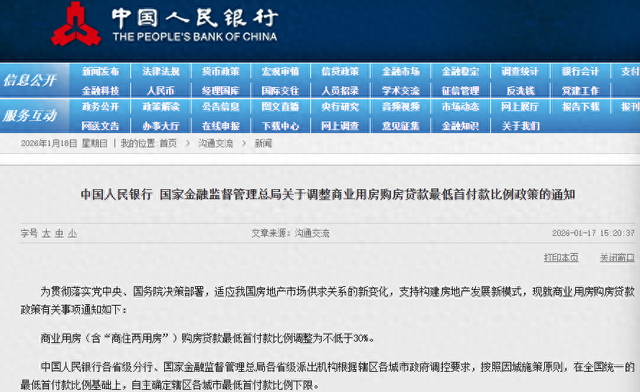
Core Viewpoint - The People's Bank of China and the National Financial Regulatory Administration have announced a reduction in the minimum down payment ratio for commercial property loans to 30%, down from the previous 50% or higher, aiming to stimulate demand in the commercial real estate market [1][2]. Group 1: Policy Impact - The reduction in the down payment ratio is expected to significantly lower the initial financial burden on buyers, particularly benefiting small businesses and startups [2][3]. - This policy adjustment is seen as a coordinated effort with residential market policies, addressing structural issues in commercial real estate [2][3]. - The new policy is anticipated to enhance transaction activity, accelerate inventory reduction for real estate companies, and improve cash flow [3][4]. Group 2: Market Conditions - As of November 2025, the total unsold commercial housing area is 750 million square meters, with office space accounting for 52.34 million square meters, indicating a persistent inventory issue [2]. - Commercial properties constitute approximately 20%-30% of the inventory held by real estate companies, with slow turnover being a significant challenge for cash recovery [3][4]. - The demand for commercial space is expected to increase as the consumer economy recovers and the service sector continues to rebound [3][4]. Group 3: Regional Variations - The implementation of the 30% down payment ratio may vary by region, with local governments having the authority to adjust the minimum based on specific market conditions [5][6]. - Some cities have already introduced various support measures to address high inventory levels, including subsidies for purchasing commercial properties [5]. - Analysts suggest that cities with high inventory should adhere to the 30% minimum, while core areas in first-tier cities may maintain a higher ratio to balance inventory reduction and risk management [6].
利好落地!降首付新政推动商办市场去库存,各地执行有差异
Bei Jing Shang Bao· 2026-01-18 08:59
Core Viewpoint - The People's Bank of China and the National Financial Regulatory Administration have announced a reduction in the minimum down payment ratio for commercial property loans to 30%, aimed at stimulating demand in the commercial real estate market [1][3]. Group 1: Policy Impact - The adjustment of the down payment ratio from over 50% to 30% significantly lowers the initial financial burden on buyers, particularly benefiting small and medium-sized enterprises and startups [3][4]. - This policy is expected to enhance transaction activity and accelerate the inventory reduction of commercial properties, which have been lagging behind the residential market [3][4]. - The new policy aligns with other recent measures, such as personal tax refunds and housing quality improvements, signaling a continued effort to stabilize the real estate market and prevent structural risks [4][5]. Group 2: Market Dynamics - Commercial properties account for approximately 20%-30% of real estate inventory, and their slow turnover has been a bottleneck for companies' cash flow [4]. - The reduction in down payment requirements is anticipated to stimulate demand in active commercial markets, particularly in first- and second-tier cities, thereby speeding up inventory clearance [5]. - The fundamental recovery of the commercial property market will depend on sustained growth in consumption and the service sector, as well as stability in the employment market and corporate expansion willingness [5][6]. Group 3: Regional Implementation - The 30% down payment is a minimum requirement, with regional variations possible based on local government policies, allowing for tailored approaches to inventory management and risk prevention [5][6]. - In cities with high inventory and slow turnover, the minimum down payment may be strictly enforced at 30%, while core areas in first-tier cities may maintain higher ratios of 40%-50% to balance inventory reduction and risk management [5][6].
商业用房贷款迎重磅利好,首付比例降至30%
Xin Lang Cai Jing· 2026-01-18 01:56
Core Viewpoint - The People's Bank of China and the National Financial Regulatory Administration have announced a significant policy change, reducing the minimum down payment ratio for commercial property loans from 50% to 30%, aimed at supporting the real estate market and alleviating inventory pressure [1][3]. Group 1: Policy Changes - The new policy allows local financial institutions to set their own minimum down payment ratios based on local market conditions, providing greater flexibility and autonomy in implementing credit policies [3]. - The reduction in the down payment requirement is expected to lower the initial financial burden for buyers, thereby increasing their purchasing willingness and enhancing their payment capacity [3][4]. Group 2: Market Impact - The adjustment is anticipated to boost the activity in the commercial property market, addressing high inventory levels and long turnover periods in certain cities [4]. - Analysts suggest that this policy, along with other measures like tax rebates and housing quality improvements, signals a sustained effort to stabilize the real estate market and prevent risks [4]. - The change reflects a targeted approach to regulation, recognizing the distinct characteristics and demands of the commercial real estate sector compared to the residential market [4].