
技术择时

Search documents
技术择时信号20260116:A股技术指标仍维持乐观,仍看好小盘胜率
CMS· 2026-01-17 11:41
Quantitative Models and Construction Methods - **Model Name**: DTW Timing Model **Model Construction Idea**: Based on similarity analysis, the model evaluates the similarity between current index trends and historical trends to predict future market movements[22][24] **Model Construction Process**: 1. Identify historical market segments with high similarity to the current market using DTW (Dynamic Time Warping) distance instead of Euclidean distance to avoid sequence mismatches[24][26] 2. Calculate the weighted average future returns and standard deviation of the selected historical segments (weights are the inverse of the DTW distance)[22] 3. Generate trading signals based on the average future returns and standard deviation thresholds[22] **Formula**: $ Weighted\ Average\ Return = \frac{\sum_{i=1}^{n} \frac{Return_i}{DTW\ Distance_i}}{\sum_{i=1}^{n} \frac{1}{DTW\ Distance_i}} $ $ Weighted\ Standard\ Deviation = \sqrt{\frac{\sum_{i=1}^{n} \frac{(Return_i - Weighted\ Average\ Return)^2}{DTW\ Distance_i}}{\sum_{i=1}^{n} \frac{1}{DTW\ Distance_i}}} $ **Evaluation**: The DTW algorithm improves timing accuracy by addressing sequence mismatches, and the model performs well under normal market conditions but struggles with sudden macroeconomic changes[9][24][26] - **Model Name**: Foreign Capital Timing Model **Model Construction Idea**: Extract timing signals from price movements of foreign-listed assets related to A-shares[32][33] **Model Construction Process**: 1. Use FTSE China A50 futures (Singapore market) to construct premium/discount and price divergence indicators[32] 2. Use Southern A50 ETF (Hong Kong market) to construct price divergence indicators[32] 3. Combine signals from both assets to form the final foreign capital timing signal[32] **Evaluation**: The model effectively captures foreign capital dynamics and provides stable timing signals, with high annualized returns and favorable risk metrics[15][32] --- Model Backtesting Results - **DTW Timing Model**: - Absolute return since November 2022: 34.75%[9] - Maximum drawdown: 21.36%[4] - 2024 sample performance: 15 signal switches, stable excess returns[12][14] - **Foreign Capital Timing Model**: - Annualized return (2014-2024): 18.96% (long-short), 14.19% (long-only)[15] - Maximum drawdown: 25.69% (long-short), 17.27% (long-only)[15] - Win rate: ~55%, profit-loss ratio > 2.5[15] - 2024 sample performance: Absolute return 31.33%, maximum drawdown 8.23%[18] --- Quantitative Factors and Construction Methods - **Factor Name**: DTW Similarity Factor **Factor Construction Idea**: Measure the similarity between current and historical market trends using DTW distance[22][24] **Factor Construction Process**: 1. Apply DTW distance to compare time-series data of market indices[24] 2. Select historical segments with high similarity for prediction[22] 3. Calculate weighted future returns and standard deviation based on DTW distance[22] **Formula**: $ DTW\ Distance = \min\{ \sum_{i=1}^{n} |x_i - y_j| + \text{Boundary\ Constraints} \} $ **Evaluation**: DTW-based factors outperform traditional Euclidean distance methods in time-series analysis, providing more accurate predictions[24][26] - **Factor Name**: Foreign Capital Premium/Divergence Factor **Factor Construction Idea**: Extract timing signals from foreign-listed assets related to A-shares[32][33] **Factor Construction Process**: 1. Calculate premium/discount and divergence metrics for FTSE China A50 futures and Southern A50 ETF[32] 2. Combine metrics to form composite timing signals[32] **Evaluation**: The factor effectively captures foreign capital dynamics and provides robust timing signals[32][33] --- Factor Backtesting Results - **DTW Similarity Factor**: - Predictive accuracy improves with DTW distance, outperforming traditional methods in time-series analysis[24][26] - **Foreign Capital Premium/Divergence Factor**: - High annualized returns and favorable risk metrics, with consistent performance across different market conditions[15][32]
技术择时信号20260109:A股仍维持乐观信号,看好小盘收益弹性
CMS· 2026-01-11 08:17
Quantitative Models and Construction Methods 1. Model Name: DTW Timing Model - **Model Construction Idea**: The DTW timing model is based on a similarity approach, analyzing the similarity between current index trends and historical trends. It selects historical segments with high similarity as references and calculates the weighted average future returns and standard deviations of these segments to generate trading signals [20][22]. - **Model Construction Process**: 1. Use the DTW (Dynamic Time Warping) distance algorithm instead of Euclidean distance to measure similarity, as DTW is better suited for time series problems by addressing sequence misalignment issues [22]. 2. Calculate the weighted average future returns and standard deviations of selected historical segments, where weights are the inverse of the DTW distance [20]. 3. Generate trading signals based on the average future returns and standard deviations [20]. 4. To address the "pathological matching" issue in traditional DTW algorithms, improved DTW algorithms with boundary constraints (e.g., Sakoe-Chiba and Itakura Parallelogram) are applied [24][26][28]. - **Model Evaluation**: The DTW timing model demonstrates stable excess returns in general market conditions but may underperform during periods of sudden macroeconomic policy changes [9]. 2. Model Name: Foreign Capital Timing Model - **Model Construction Idea**: This model leverages information embedded in the price movements of two offshore assets related to A-shares: FTSE China A50 Index Futures (Singapore market) and the Southbound A50 ETF (Hong Kong market) [30]. - **Model Construction Process**: 1. Construct two indicators using FTSE China A50 Index Futures: basis and price divergence [30]. 2. Construct a price divergence indicator using the Southbound A50 ETF [30]. 3. Combine the timing signals from the two assets to form the foreign capital timing signal [30]. - **Model Evaluation**: The model achieves strong performance, with annualized returns of 18.96% (long-short strategy) and 14.19% (long-only strategy) over the full sample period (2014-2024). It also exhibits a high win rate (close to 55%) and a profit-loss ratio exceeding 2.5 [13]. --- Model Backtesting Results 1. DTW Timing Model - **Absolute Return**: 35.52% since November 2022 [9] - **Excess Return (relative to CSI 300)**: 8.60% [9] - **Maximum Drawdown**: 21.32% [9] 2. Foreign Capital Timing Model - **Annualized Return (Long-Short Strategy)**: 18.96% (2014-2024) [13] - **Annualized Return (Long-Only Strategy)**: 14.19% (2014-2024) [13] - **Maximum Drawdown**: 25.69% (Long-Short), 17.27% (Long-Only) [13] - **Win Rate**: Close to 55% [13] - **Profit-Loss Ratio**: Exceeds 2.5 [13] - **Absolute Return (2024)**: 31.33% (Long-Only Strategy) [17] - **Maximum Drawdown (2024)**: 8.23% [17] --- Quantitative Factors and Construction Methods 1. Factor Name: DTW Distance - **Factor Construction Idea**: DTW distance is used as a similarity measure for time series, addressing sequence misalignment issues that arise with traditional Euclidean distance [22]. - **Factor Construction Process**: 1. Compute the DTW distance between the current index trend and historical trends [22]. 2. Use the inverse of the DTW distance as weights to calculate the weighted average future returns and standard deviations of historical segments [20]. 3. Generate trading signals based on these weighted averages [20]. - **Factor Evaluation**: DTW distance is more effective for time series problems compared to Euclidean distance, as it resolves sequence misalignment and improves model performance [22]. 2. Factor Name: Basis and Price Divergence (Foreign Capital Timing Model) - **Factor Construction Idea**: These factors are derived from offshore assets to capture information about A-share market trends [30]. - **Factor Construction Process**: 1. Calculate the basis and price divergence indicators using FTSE China A50 Index Futures [30]. 2. Calculate the price divergence indicator using the Southbound A50 ETF [30]. 3. Combine these indicators to form the foreign capital timing signal [30]. - **Factor Evaluation**: These factors effectively capture offshore market signals and contribute to the strong performance of the foreign capital timing model [13]. --- Factor Backtesting Results 1. DTW Distance - **Absolute Return**: 35.52% since November 2022 [9] - **Excess Return (relative to CSI 300)**: 8.60% [9] - **Maximum Drawdown**: 21.32% [9] 2. Basis and Price Divergence - **Annualized Return (Long-Short Strategy)**: 18.96% (2014-2024) [13] - **Annualized Return (Long-Only Strategy)**: 14.19% (2014-2024) [13] - **Maximum Drawdown**: 25.69% (Long-Short), 17.27% (Long-Only) [13] - **Win Rate**: Close to 55% [13] - **Profit-Loss Ratio**: Exceeds 2.5 [13] - **Absolute Return (2024)**: 31.33% (Long-Only Strategy) [17] - **Maximum Drawdown (2024)**: 8.23% [17]
技术择时信号:市场震荡看多,结构上维持看好小盘
CMS· 2025-08-09 14:14
Quantitative Models and Construction Methods DTW Timing Model - **Model Name**: DTW Timing Model - **Model Construction Idea**: The model is based on the principle of similarity and the DTW algorithm, focusing on price and volume timing[1][5][14] - **Model Construction Process**: - The model examines the similarity between current index trends and historical trends, selecting several historical segments with high similarity as references[25] - It calculates the weighted average future price change and weighted standard deviation of the selected historical segments (weights are the inverse of the distance)[25] - Based on the average future price change and standard deviation, trading signals are generated[25] - The model uses the DTW distance algorithm instead of the Euclidean distance for similarity measurement, as DTW distance can better handle time series mismatches[27] - Improved DTW algorithms such as Sakoe-Chiba and Itakura Parallelogram are introduced to overcome the "over-bending" issue in traditional DTW algorithms[29][30][35] - **Model Evaluation**: The model has shown stable excess returns in general market conditions, although it faced some drawdowns during periods of sudden macroeconomic policy changes[16] Foreign Capital Timing Model - **Model Name**: Foreign Capital Timing Model - **Model Construction Idea**: The model is based on the divergence between foreign and domestic related assets[1][14] - **Model Construction Process**: - The model uses two foreign-listed assets related to A-shares: FTSE China A50 Index Futures (Singapore market) and Southern A50 ETF (Hong Kong market)[34] - It constructs two indicators from FTSE China A50 Index Futures: premium and price divergence, forming the FTSE China A50 Index Futures timing signal[34] - It constructs a price divergence indicator from Southern A50 ETF, forming the Southern A50 ETF timing signal[34] - The timing signals from both assets are combined to form the foreign capital timing signal[34] - **Model Evaluation**: The model has shown good performance with high annualized returns and low maximum drawdowns[20][23] Model Backtest Results DTW Timing Model - **Absolute Return**: 25.79% since November 2022[5][16] - **Excess Return**: 16.83% relative to CSI 300[5][16] - **Maximum Drawdown**: 21.32%[5][16] - **Absolute Return (2024)**: 23.98% on CSI 300[18] - **Excess Return (2024)**: 2.76%[18] - **Maximum Drawdown (2024)**: 21.36%[18] - **Win Rate (2024)**: 53.85%[18] - **Profit-Loss Ratio (2024)**: 2.93[18] Foreign Capital Timing Model - **Absolute Return (2024)**: 29.11% for long strategy[5][23] - **Maximum Drawdown (2024)**: 8.32% for long strategy[5][23] - **Annualized Return (2014-2024)**: 18.96% for long-short strategy, 14.19% for long strategy[20] - **Maximum Drawdown (2014-2024)**: 25.69% for long-short strategy, 17.27% for long strategy[20] - **Daily Win Rate (2014-2024)**: Nearly 55%[20] - **Profit-Loss Ratio (2014-2024)**: Both exceed 2.5[20]

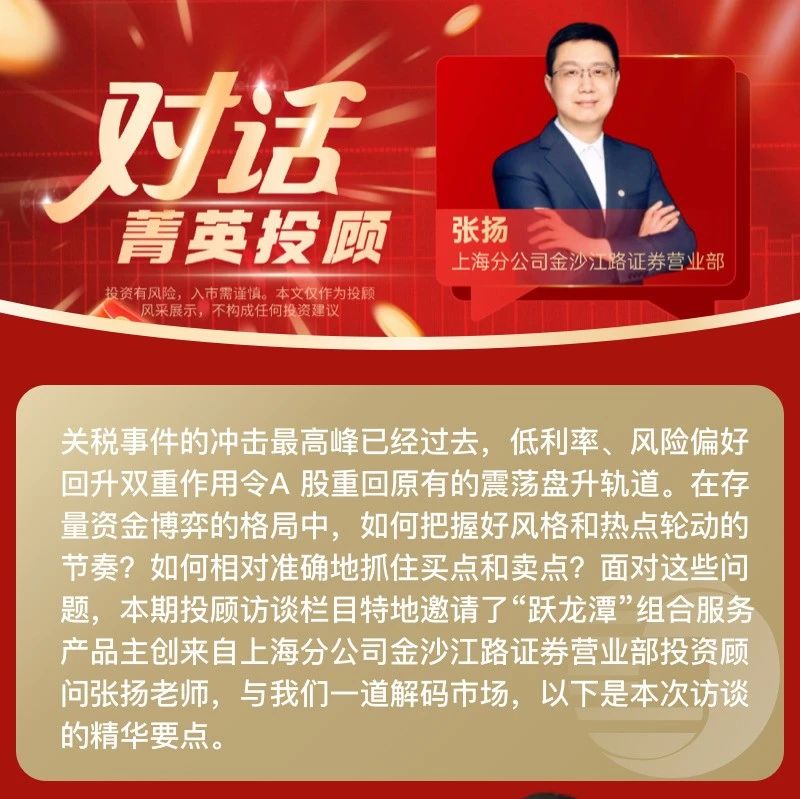
对话菁英投顾---“跃龙潭”主创张扬
申万宏源证券上海北京西路营业部· 2025-07-11 01:59
Core Viewpoint - The article discusses the recovery of A-shares due to the end of tariff shocks and the return of low interest rates and risk appetite, emphasizing the importance of timing and style rotation in investment strategies [2]. Investment Philosophy - The investment philosophy centers on "value stock selection, technical timing, and prioritizing capital safety," focusing on steady investments and capturing opportunities during market corrections [5]. - The advisor emphasizes the importance of timing in investments, advocating for a right-side trading approach that allows for better investor experience [6]. Valuation and Safety Margin - Valuation assessment combines both art and science, relying on financial data and industry trends while also considering market conditions [7]. - Key indicators for judging valuation include historical comparisons, industry benchmarks, and dynamic PE ratios, with a cautious approach to maintaining a safety margin [8]. Stock Selection Strategy - The advisor prefers a bottom-up stock selection strategy, focusing on individual company fundamentals rather than macroeconomic trends [9]. - A good company is defined by reasonable valuation, consistent profit growth exceeding 20%, significant competitive advantages, and strong cash flow [10]. Financial Statement Analysis - Financial statements are crucial for assessing a company's operational status and identifying potential risks, requiring a thorough understanding of historical data [11][12].

技术择时信号:整体维持震荡,结构转为看好小盘
CMS· 2025-04-12 12:54
- The DTW timing model is based on the principle of similarity and the DTW (Dynamic Time Warping) algorithm, which is a volume-price timing model[1][4][14] - The foreign capital timing model is constructed based on the divergence between foreign and domestic related assets, using four indicators reflecting foreign capital movements to generate timing signals for the A-share market[1][4][14] - The DTW timing model has shown an absolute return of 17.39% and an excess return of 17.83% relative to the CSI 300 since November 2022, with a maximum drawdown of 21.32% and a weekly win rate of over 60%[4][16] - The foreign capital timing model's long strategy has achieved an absolute return of 28.83% since 2024, with a maximum drawdown of 8.32%[4][23] - The DTW timing model uses the DTW distance algorithm instead of the Euclidean distance to measure similarity, as the DTW distance can better handle the misalignment of time series[29][30] - The DTW timing model has been improved by incorporating boundary constraints proposed by Sakoe-Chiba and Itakura to address the "pathological matching" problem of the traditional DTW algorithm[31][32][37] - The foreign capital timing strategy is based on two overseas listed assets related to A-shares: FTSE China A50 Index Futures (Singapore market) and Southern A50ETF (Hong Kong market), constructing timing signals through price divergence and premium/discount indicators[36][12] - The DTW timing model's performance in 2024 includes an absolute return of 15.68%, an excess return of 4.93%, a maximum drawdown of 21.36%, a trading win rate of 63.64%, and a profit-loss ratio of 2.64[18][19][20] - The foreign capital timing model's performance from December 30, 2014, to December 31, 2024, shows an annualized return of 18.96% (long-short) and 14.19% (long-only), with maximum drawdowns of 25.69% and 17.27%, respectively, and a daily win rate of nearly 55%[20][22][24]
技术择时信号:整体维持看多,结构继续看好红利和小盘风格
CMS· 2025-03-15 07:10
Quantitative Models and Construction Methods 1. Model Name: DTW Timing Model - **Model Construction Idea**: Based on the principle of similarity and the Dynamic Time Warping (DTW) algorithm, this model identifies timing signals by comparing current market trends with historical patterns[4][25] - **Model Construction Process**: - The model calculates the similarity between the current index trend and historical market trends using the DTW distance metric, which is more flexible than Euclidean distance for time-series data[27] - Historical segments with high similarity are selected as references - The weighted average future returns and standard deviations of these historical segments are calculated (weights are the inverse of the DTW distance) - Trading signals are generated based on the average future returns and standard deviations[25] - Improved DTW algorithms, such as those with Sakoe-Chiba and Itakura boundary constraints, are used to address issues like "over-warping" in traditional DTW[29] - **Model Evaluation**: The DTW algorithm is particularly suitable for time-series problems and outperforms other methods due to its flexibility in handling temporal misalignments[27] 2. Model Name: Foreign Capital Timing Model - **Model Construction Idea**: This model leverages the price movements of offshore assets related to A-shares to generate timing signals for the A-share market[32] - **Model Construction Process**: - Two offshore assets are used: FTSE China A50 Index Futures (Singapore market) and Southern A50 ETF (Hong Kong market) - For FTSE China A50 Index Futures, two indicators are constructed: basis and price deviation - For Southern A50 ETF, a price deviation indicator is constructed - Timing signals from these two assets are combined to form the overall foreign capital timing signal[32] --- Model Backtesting Results 1. DTW Timing Model - **Out-of-Sample Performance (Since November 2022)**: - Absolute return: 25.38% - Excess return over CSI 300: 19.02% - Maximum drawdown: 20.07% - Weekly win rate: Over 60% - Weekly win rate in 2024: Over 70%[4][16] - **Performance in 2024 (CSI 300)**: - Absolute return: 23.58% - Excess return: 5.27% - Maximum drawdown: 14.88% - Trading win rate: 63.64% - Profit-loss ratio: 2.64[16] 2. Foreign Capital Timing Model - **Full-Sample Performance (2014-2024)**: - Annualized return: 18.96% (long-short), 14.19% (long-only) - Maximum drawdown: 25.69% (long-short), 17.27% (long-only) - Daily win rate: Nearly 55% - Profit-loss ratio: Above 2.5[18] - **Out-of-Sample Performance in 2024**: - Long-only strategy: - Absolute return: 28.05% - Maximum drawdown: 8.32% - Long-short strategy: - Absolute return: 21.66% - Maximum drawdown: 13.14%[21]