改善

Search documents
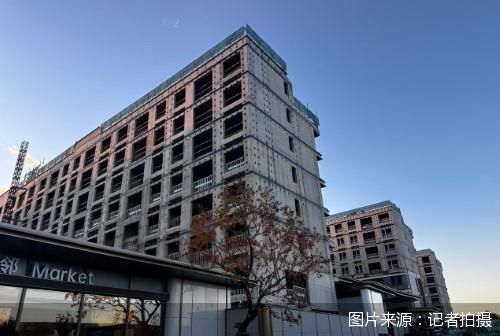
区域楼市观察丨东小口断供五年终“补仓”,北京昌平“10盘联动”再添置业新选择
Bei Jing Shang Bao· 2025-11-12 07:35
Core Insights - The newly supplied land in the Dongxiaokou area of Changping marks the first addition in five years, indicating a shift in the local real estate landscape [1][3] - The successful land auction reflects a broader trend of increasing new housing supply in the Changping district, which is expected to enhance the overall living quality in the area [1][4] Land Supply and Market Dynamics - The Dongxiaokou Zhen He Village plot is strategically located between the Fifth and Sixth Ring Roads, near the intersection of Haidian, Chaoyang, and Changping districts, and close to the under-construction subway line 13B [3] - The last land supply in this area occurred in 2020, with previous sales averaging around 58,000 yuan per square meter, while recent transactions have stabilized around 55,000 yuan per square meter [3][4] - The Changping district has successfully auctioned five plots by November 2025, matching the total land supply for the entire previous year, with a total transaction value of 10.454 billion yuan [4] New Housing Market Characteristics - Currently, there are nine active projects in Changping, with prices ranging from approximately 39,000 yuan to 61,300 yuan per square meter, indicating a diverse market catering to various buyer needs [4][5] - New housing projects are increasingly located near major commercial centers and subway lines, leading to a significant price gap between new and second-hand homes [5][6] - The average price of new homes in the Changping Beiqijia area is around 53,900 yuan per square meter, while second-hand homes in the same area range from 18,000 to 28,000 yuan per square meter [5] Product Offerings and Consumer Preferences - The primary unit sizes for new homes in the Changping area are concentrated between 75 and 130 square meters, with a focus on three-bedroom designs to meet both first-time buyers and those seeking upgrades [8][9] - Some developers are introducing larger units to differentiate their offerings, although these larger units represent a small percentage of total inventory [9] - The trend towards higher quality housing is evident, with new projects featuring high space utilization rates and enhanced community amenities, such as fitness centers and social spaces [11][12] Quality and Value Enhancement - The introduction of "good housing" projects in Changping signifies a quality upgrade in the new housing market, with improved design and higher standards of living [11][12] - The average usable area ratio for new homes has increased to over 90%, compared to around 75% for second-hand homes, enhancing the value proposition for buyers [11][12] - The ongoing supply of quality land is expected to drive further improvements in housing quality and create a cluster effect for high-quality developments in the region [12]

专题回顾 | 从北上深杭二手成交结构、房价变化看市场回稳进程
克而瑞地产研究· 2025-05-09 09:42
Core Viewpoint - The second-hand housing market in Beijing, Shanghai, Shenzhen, and Hangzhou is showing signs of recovery in Q1 2025, with transaction volume increasing by 17% year-on-year, indicating a stabilization in prices and market expectations [1][5][10]. Group 1: Transaction Volume and Market Trends - In Q1 2025, the total transaction area for both new and second-hand homes reached 82.04 million square meters, marking a 17% year-on-year increase, which is at the median level over the past six years [5]. - The year-on-year growth rate for second-hand homes outpaced that of new homes in most cities, with Shanghai, Shenzhen, and Hangzhou seeing around 50% increases in second-hand transactions [6][8]. - The "recognizing house but not loan" policy has led to a 40% week-on-week increase in viewings for second-hand homes in key cities, indicating a quicker recovery in new home purchases [10]. Group 2: Listing Volume and Market Dynamics - The growth rate of new listings for second-hand homes in Beijing, Shanghai, Shenzhen, and Hangzhou has slowed, with a year-on-year increase of 16% and 55% in Beijing and Shanghai, respectively, while Shenzhen and Hangzhou saw declines of 11% and 19% [12][14]. - The proportion of listings for luxury homes priced over 10 million yuan has increased in Beijing, Shanghai, and Hangzhou, while Shenzhen has seen a decline in high-end listings [15][20]. Group 3: Demand Segmentation and Price Trends - The concentration of transactions for affordable housing has decreased, while the demand for high-end and luxury properties has increased, particularly in the 140 square meters and above segment [23][27]. - Over half of the second-hand housing units in major cities have seen price increases, with more than 50% of neighborhoods in Shanghai and Hangzhou reporting rising prices [33][35]. - The bargaining space for second-hand homes in Beijing and Shanghai has narrowed over the past year, with current negotiation margins remaining below 20% in major cities [44]. Group 4: Market Confidence and Future Outlook - The second-hand housing market is transitioning from a phase of "price reduction for volume" to "volume increase with stable prices," indicating a more active supply and demand dynamic [42][43]. - The recovery in market confidence is reflected in the rising prices of high-end properties, while the prices of affordable housing are stabilizing, suggesting a potential upward trend in the near future [44][45].
专题 | 从北上深杭二手成交结构、房价变化看市场回稳进程
克而瑞地产研究· 2025-05-04 01:29
Core Viewpoint - The second-hand housing market in Beijing, Shanghai, Shenzhen, and Hangzhou is showing signs of recovery in Q1 2025, with transaction volume increasing by 17% year-on-year, indicating a stabilization in prices and market expectations [1][5][10]. Group 1: Transaction Trends - In Q1 2025, the total transaction area for both new and second-hand homes reached 82.04 million square meters, marking a 17% year-on-year increase, which is at the median level of the past six years [5]. - The year-on-year growth rate for second-hand homes outpaced that of new homes in most cities, with Shanghai, Shenzhen, and Hangzhou seeing around 50% increases in second-hand transactions [6][8]. - The transaction volume for new homes in Shenzhen surged by 83% year-on-year, attributed to a low base from the previous year [6]. Group 2: Listing Trends - The growth rate of new listings for second-hand homes in Beijing, Shanghai, Shenzhen, and Hangzhou has slowed, with a year-on-year increase of 16% and 55% in Beijing and Shanghai, respectively, while Shenzhen and Hangzhou saw declines of 11% and 19% [12][14]. - The proportion of listings for luxury homes priced over 10 million yuan has increased in Beijing, Shanghai, and Hangzhou, while Shenzhen experienced a decline in high-end listings [15][20]. Group 3: Buyer Demand - The proportion of transactions for affordable housing remains above 50%, but the concentration has decreased, with higher demand for improved and luxury properties [23]. - The transaction share for properties priced between 5 million and 30 million yuan has increased, indicating a shift in buyer preferences towards higher-value homes [23][31]. Group 4: Price Trends - Over 50% of second-hand housing communities in Shanghai, Shenzhen, and Hangzhou have seen price increases, with Beijing reaching 46% [33]. - The bargaining space for second-hand homes in major cities has narrowed, with Shanghai, Shenzhen, and Hangzhou all having less than 20% negotiation space [35][44]. - High-end properties are leading the price increases, with a significant portion of affordable housing also showing signs of price stabilization [44][45]. Group 5: Market Dynamics - The second-hand housing market is transitioning from a "price-for-volume" strategy to a "volume-increase-price-stability" model, indicating a more active supply and demand dynamic [42]. - The concentration of transactions is shifting towards core urban areas, with notable increases in transaction volumes in key districts of Beijing, Shanghai, Shenzhen, and Hangzhou [43].