
政府入股企业

Search documents
华尔街日报:不确定经济政策能否赢中选,特朗普质疑“有好消息股市反而跌,特别好消息股市就会崩盘”,这都是美联储的错!
美股IPO· 2025-12-15 07:15
Core Viewpoint - The article discusses President Trump's acknowledgment of uncertainty regarding the effectiveness of his economic policies before the upcoming midterm elections, attributing market reactions to the Federal Reserve's hawkish stance and emphasizing the need for low interest rates and tariffs to stimulate the economy [1][3][5]. Group 1: Economic Policy and Midterm Elections - Trump expressed uncertainty about whether his economic policies will help the Republican Party win the midterm elections, admitting that the full effects of economic activities may not be seen until the second quarter of next year [3][4]. - Despite boasting about creating a strong economy, Trump noted that many Americans are not feeling the benefits of economic growth due to slow job growth and rising prices of everyday goods and services [3][7]. Group 2: Federal Reserve Criticism - Trump criticized the Federal Reserve for creating a "good news is bad news" market phenomenon, where positive economic data leads to market declines due to fears of interest rate hikes [5][6]. - He stated a strong desire for a 1% interest rate target, contrasting sharply with the current Federal Reserve stance, indicating potential conflicts between the White House and the Fed if economic data remains strong [5][6]. Group 3: Tariff Policy and Government Intervention - Trump reiterated his reliance on tariffs, claiming they have brought wealth to the U.S. and provided leverage in international negotiations, although his tariff policies face legal challenges [6]. - He defended government intervention in the economy, confirming plans for the government to invest in defense and critical industries, suggesting a shift towards more active industrial policy [6]. Group 4: Inflation Challenges - Inflation remains a core challenge for Trump, who blames it on previous administrations while asserting that he has lowered prices; however, prices for essential goods have risen significantly during his term [7].

美政府考虑入股军工企业
Di Yi Cai Jing· 2025-08-28 00:55
Group 1 - The U.S. government is considering acquiring equity in defense contractor Lockheed Martin, following its recent investment in Intel [1][2] - U.S. Commerce Secretary Gina Raimondo highlighted that 97% of Lockheed Martin's revenue comes from the U.S. government, indicating a close relationship between the company and the government [1] - In 2024, Lockheed Martin reported that 73% of its net sales would come from the U.S. government, with 65% specifically from the Department of Defense [1] Group 2 - Intel announced a deal with the U.S. government for an $8.9 billion investment, acquiring 9.9% of the company's common stock [2] - The funding for Intel's investment comes from previously allocated subsidies under the CHIPS and Science Act, totaling $5.7 billion, along with an additional $3.2 billion from government-funded projects [2] - Following the transaction, the U.S. government will become a major shareholder in Intel, with President Trump expressing interest in similar future investments [2]


财报公布,英伟达盘后大跌
Zhong Guo Zheng Quan Bao· 2025-08-27 23:21
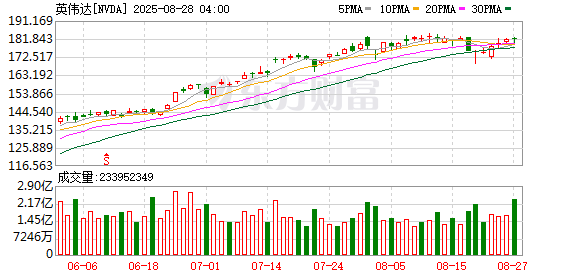
Market Overview - On August 27, U.S. stock indices experienced slight gains, with the Dow Jones Industrial Average, Nasdaq, and S&P 500 rising by 0.32%, 0.21%, and 0.24% respectively [1] - Major technology stocks showed mixed performance, with the Wind U.S. Tech Giants Index increasing by 0.15%, Microsoft up by 0.94%, and Nvidia down by 0.09% [3][4] Nvidia Financial Performance - Nvidia reported Q2 revenue of $46.7 billion for the fiscal year 2026, up from $30.04 billion year-over-year, exceeding market expectations of $46.058 billion [5] - Data center revenue reached $41.1 billion, compared to $26.272 billion in the same quarter last year, slightly below the expected $41.3 billion [5] - Net profit for the quarter was $26.422 billion, up from $16.599 billion year-over-year, surpassing the forecast of $23.465 billion [5] - Nvidia's gross margin for Q2 was 72.4%, and it projected Q3 revenue of $54 billion, with a variance of 2%, above analyst expectations of $53.46 billion [5] - Following the earnings announcement, Nvidia's stock initially dropped over 5% in after-hours trading, closing down 3.04% [5] Commodity Market - Gold prices saw a slight increase, with COMEX gold futures rising by 0.55% [9] - International oil prices also rose, with ICE Brent crude increasing by 0.75% and NYMEX WTI crude up by 0.96% [9][10] - High supply pressure remains in the global oil market, with Goldman Sachs predicting an oversupply of 1.8 million barrels per day from Q4 2025 to Q4 2026, leading to an expected increase in global oil inventories by nearly 800 million barrels by the end of 2026 [10] Government Investment in Defense Sector - The U.S. government is considering acquiring stakes in defense contractors, specifically mentioning Lockheed Martin, following a recent investment in Intel [12] - Lockheed Martin's annual report indicates that 73% of its net sales come from the U.S. government, with 65% from the Department of Defense [12]

美政府考虑入股军工企业 特别点名洛克希德·马丁公司
Yang Shi Xin Wen· 2025-08-27 23:02
Core Viewpoint - The U.S. government, following its investment in Intel, is now considering acquiring stakes in major defense contractors, specifically Lockheed Martin [1] Group 1: Government Interest - U.S. Commerce Secretary Ross revealed that the Trump administration is interested in acquiring equity in defense companies [1] - Discussions regarding defense-related investments are reportedly intense, with a particular focus on Lockheed Martin [1]
特朗普政府考虑入股军工企业
Bei Jing Ri Bao Ke Hu Duan· 2025-08-27 22:25
Core Viewpoint - The U.S. government, under the Trump administration, is considering acquiring equity in defense contractors, specifically targeting Lockheed Martin, following a recent investment in Intel [1] Group 1: Government Interest in Defense Sector - U.S. Commerce Secretary Ross revealed that the government is interested in purchasing shares of defense contractors, with Lockheed Martin being specifically mentioned [1] - Lockheed Martin generates 97% of its revenue from the U.S. government, indicating a close relationship between the company and the government [1] - The discussion around funding for military procurement is ongoing, with further deliberations needed among defense officials [1] Group 2: Recent Investment in Intel - The U.S. government recently announced an investment of $8.9 billion in Intel, acquiring 9.9% of the company's shares [1] - The funding for this investment comes from $5.7 billion in subsidies granted to Intel under the CHIPS and Science Act, along with an additional $3.2 billion from government-funded projects [1] - Following this transaction, the U.S. government will become a major shareholder in Intel, with President Trump expressing a desire for more similar investments in the future [1]
美财长贝森特:考虑在其他行业收购股权,英伟达不在考虑范围内
Feng Huang Wang· 2025-08-27 22:16
Group 1 - The U.S. government, represented by Treasury Secretary Scott Basset, confirmed the potential for equity acquisitions in other industries following the recent deal with Intel, but Nvidia is not under consideration [1] - The transaction with Intel is said to have created $11 billion in value for the U.S., with expectations for further appreciation [1] - Basset emphasized the need for self-sufficiency in critical industries, citing the vulnerabilities exposed in the supply chain during the COVID-19 pandemic [1] Group 2 - Republican Congressman Don Bacon expressed opposition to government acquiring equity in companies [2] - Senator Todd Young, a key proponent of the CHIPS and Science Act, indicated that the intent of the legislation was not for government ownership but to enhance economic and national security [2] - Senator Bernie Sanders supported the idea of converting subsidies into equity, arguing that it is unfair for taxpayers to provide billions in subsidies without receiving a stake in profitable companies like Intel [2]
美国政府入股英特尔10%,要东山再起?能挑战台积电霸主地位吗?
Hu Xiu· 2025-08-27 10:02
Core Insights - The U.S. government has invested $8.9 billion to acquire a 10% stake in Intel, becoming the largest shareholder, but it only received common stock without voting rights, resembling a clever form of subsidy [1] Group 1 - The investment positions the U.S. government as a significant player in Intel's ownership structure [1] - The lack of voting rights indicates a strategic approach to support the company without direct control [1] - This move reflects broader governmental strategies to bolster domestic semiconductor manufacturing [1]
美股异动丨英特尔涨近5%,特朗普政府欲入股
Ge Long Hui· 2025-08-15 13:57
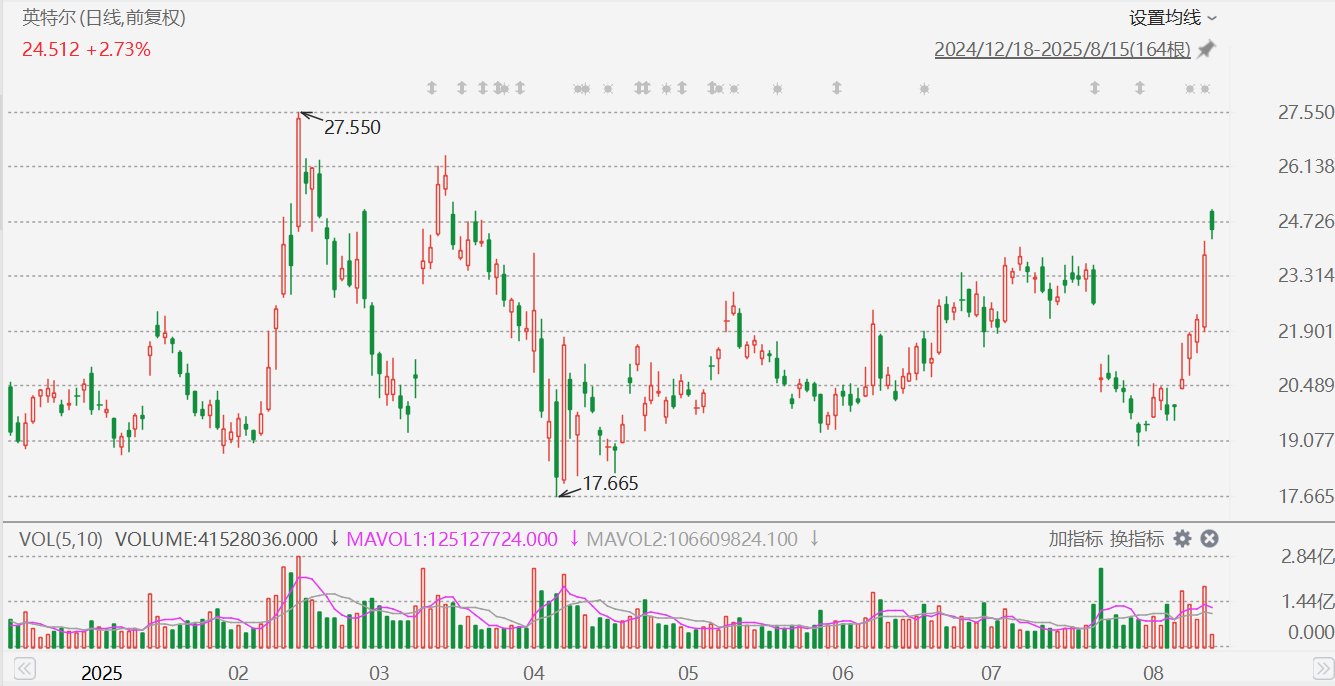
Core Viewpoint - Intel (INTC.US) shares rose by 4.82% to $25.01, reaching a new high since March 19, amid reports of negotiations between the Trump administration and Intel for potential government investment to support domestic manufacturing [1] Group 1: Government Involvement - The Trump administration is in talks with Intel to potentially acquire a stake in the struggling chip manufacturer [1] - This investment aims to assist Intel in expanding its manufacturing capabilities in the United States, particularly in Ohio [1] Group 2: Manufacturing Plans - Intel has committed to transforming its Ohio facility into the largest chip manufacturing plant in the world, although this promise has faced multiple delays [1] - The discussions stem from a recent meeting between Trump and Intel's CEO, focusing on government equity participation [1] Group 3: Uncertainty of the Deal - Details of the potential investment are still being organized, and the scale of the government's stake remains unclear [1]
美媒称美国政府有意入股英特尔
Xin Hua She· 2025-08-15 10:25
Group 1 - The White House is in talks with Intel regarding a potential investment in the struggling chip company, which could aid in the planning of a chip manufacturing facility in Ohio [1] - If an agreement is reached, it may help Intel in its goal to establish the world's largest chip manufacturing center, although the project has faced multiple delays [1] - Following the news, Intel's stock price rose by 8.9% on the 14th, closing at $23.86 per share, increasing its market capitalization to $104.4 billion [1] Group 2 - Intel announced further layoffs and has halted plans for projects in Germany and Poland [2] - The potential investment from the U.S. government may be driven by President Trump's desire for Intel to create more jobs in the U.S. [2] - The involvement of the U.S. government in key industries has been noted, as seen in the recent acquisition of U.S. Steel by Japan's Nippon Steel, where the government obtained a "golden share" to exercise veto rights on important corporate matters [2]
美股异动丨英特尔盘前涨超4%,特朗普政府正讨论入股
Ge Long Hui A P P· 2025-08-15 10:15
Core Viewpoint - The U.S. government is negotiating with Intel to acquire a stake in the struggling chip manufacturer to support its domestic manufacturing expansion [1] Group 1: Company Developments - Intel's stock rose over 4% to $24.92 following news of the negotiations with the Trump administration [1] - The potential investment aims to bolster Intel's plans for a major manufacturing facility in Ohio, which the company has committed to making the largest chip manufacturing plant in the world, despite previous delays [1] Group 2: Government Involvement - The discussions were initiated after a meeting between Trump and Intel's CEO, focusing on the U.S. government purchasing shares in the company [1] - Details of the potential deal are still being organized, and the scale of the government's stake remains uncertain [1]