散户资金

Search documents
A股连阳,谁在发力?
Hua Er Jie Jian Wen· 2026-01-13 08:43
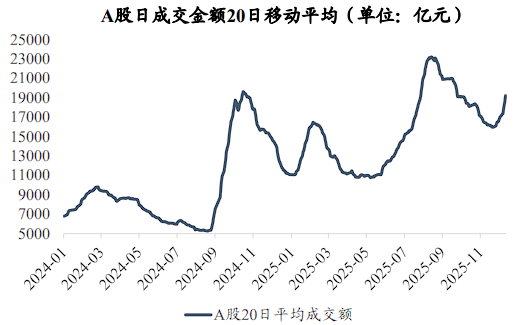
Core Viewpoint - The A-share market is experiencing a strong upward trend driven by leveraged funds and retail investors, with significant contributions from speculative and foreign capital, leading to a notable increase in market risk appetite [1][3]. Group 1: Market Performance - During the first week of January 2026, the A-share market saw a substantial increase, with the Wind All A Index rising by 5.1% and the average daily trading volume surging over 700 billion yuan to 2.85 trillion yuan [1]. - The financing balance reached a historical high of 2.61 trillion yuan, accounting for 2.53% of the total A-share market capitalization, placing it in the 96th percentile historically since 2021 [3][10]. Group 2: Investor Sentiment - Retail investor sentiment has significantly improved, with net inflows of 155.7 billion yuan, marking the second-highest level in the past year [3][15]. - The activity of speculative funds has also increased, with an average daily trading volume of 31.4 billion yuan on the Long Hu List, reaching a six-month peak [3][17]. Group 3: Foreign Investment - Foreign capital has shown a renewed interest, with the average daily trading volume of the Stock Connect increasing by 98.6 billion yuan to 327.2 billion yuan, representing an increase of 0.73 percentage points in trading volume share [3][19]. - Passive foreign capital has turned into a slight net inflow of 6.7 million dollars, indicating a stronger attraction towards technology sectors [3][23]. Group 4: Macro Liquidity - The central bank's significant net withdrawal of 166 billion yuan has not tightened market liquidity, as interbank market interest rates have declined, maintaining a loose monetary environment [6][8]. - The RMB exchange rate appreciated to 6.98 against the US dollar, with the 2-year and 10-year China-US interest rate differentials narrowing [9]. Group 5: ETF Market Dynamics - The ETF market has shown structural divergence, with a slight net outflow of 390 million yuan from stock ETFs, while industry-themed ETFs attracted a net inflow of 13.6 billion yuan [25][26]. - Broad-based ETFs faced significant net outflows, particularly from the CSI A500-related ETFs, which saw a redemption of 13.1 billion yuan [25].

资金行为研究双周报(2025/12/01-2025/12/12):杠杆资金多头力量抬升-20251213
ZHONGTAI SECURITIES· 2025-12-13 13:12
Market Fund Flow Overview - Institutional funds have shown a net outflow from major indices, while retail funds have stabilized after a brief outflow, indicating a shift towards net inflow [3][10] - The net inflow rate difference between retail and institutional funds for the ChiNext index fell into negative territory from December 4 to 8, suggesting stronger institutional support for the index during this period [3][10] Market Capitalization and Valuation Style - Institutional funds are accelerating their outflow from high valuation indices and the CSI 300, reflecting a profit-taking tendency, while retail funds continue to flow into high valuation and large-cap styles [3][22] - The net inflow rate difference between retail and institutional funds has narrowed significantly after December 11, indicating a potential increase in institutional support for small-cap stocks [3][22] Major Industry Style - Both institutional and retail funds have consistently flowed into the consumer sector, while there is a divergence in the technology and cyclical manufacturing sectors [4][27] - Institutional outflows from the technology sector have increased again after a brief slowdown, while outflows from the cyclical sector have shown a converging trend [4][27] Primary Industry Fund Flow - In the upstream resources sector, there is a strong consensus on non-ferrous metals and basic chemicals, with institutional outflows from non-ferrous metals no longer significantly increasing [5][40] - The midstream materials and manufacturing sector has seen high trading activity in electrical equipment, while the downstream essential consumption sector has seen increased institutional investment in agriculture, forestry, animal husbandry, and fishery [5][40] Leverage Fund Situation - The margin trading balance remains high at approximately 2.51 trillion yuan, with the average collateral ratio slightly fluctuating [5][77] - The trading activity of margin financing has stabilized, with the trading volume accounting for 9.89% of total market transactions, indicating sustained market risk appetite [5][79] - The net buying amount of margin trading in the electronics sector has significantly increased, indicating a shift from bearish to bullish sentiment [5][84]
花旗:什么支撑市场走高?看这3个因素就够了
Jin Rong Jie· 2025-05-22 07:34
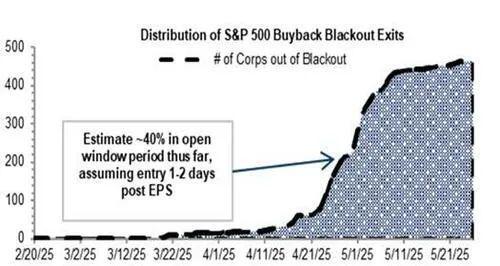
Core Viewpoint - The recent rise in the U.S. stock market is primarily driven by three forces: programmatic trading from CTAs (Commodity Trading Advisors), continuous corporate buybacks, and aggressive retail investor buying [1][3]. Group 1: Retail Investor Activity - Retail investors have shown remarkable buying strength, with net purchases reaching $4.1 billion, marking the highest level ever recorded for that time period [1]. - Retail trading volume accounted for approximately 36%, setting a new historical record, with total net purchases for the day amounting to $5.4 billion [1][3]. Group 2: Corporate Buybacks - The end of the stock buyback blackout period has contributed to the ongoing market rally, as companies are now able to repurchase their shares [2]. - Although the year-to-date buyback authorization has reached a historical high, actual execution of these buybacks has not yet matched the authorized amounts, typically executing around 80-90% of the authorized volume [10]. Group 3: CTA Activity - CTAs remain consistent buyers regardless of market conditions, with significant inflows during sideways and rising markets, and limited selling during downturns [8][10]. - In the upcoming months, CTAs are expected to sell only during significant market declines, specifically at a 2.5 standard deviation drop [10]. - Current market activity indicates that long-term institutions are slightly net selling, while hedge funds are maintaining a neutral stance with minor adjustments in macro positions [3].